
Math homework strategy is the process of breaking down complex equations into solvable, logical steps. Unlike rote memorization, it forces active recall and deduction so you can actually pass your exams without crying over a textbook.
Why is math homework so hard for average students?
Math is a cumulative subject, meaning if you miss a core concept in week two, you will fail the test in week six. I learned this the hard way back in high school. You cannot simply guess your way through a trigonometry assignment.
I think the biggest issue right now is the sheer cognitive load.
Students are tackling heavy subjects without a safety net at home. Private tutoring rates average around $45 to $80 per hour, which costs families $45 to $80 per session.
So, what specifically trips people up?
- Dropping negative signs midway through a problem.
- Misunderstanding the order of operations in large polynomials.
- Guessing the next step instead of writing out the logic.
- Staring at a blank page for more than 15 minutes.
You just get stuck. But complaining about it does not get the assignment graded.
What are the best apps to help with math homework?
The best apps combine accurate optical character recognition (OCR) with clear, step-by-step logic explanations. I test educational software constantly, and the gap between bad calculators and smart tutors is massive.
By Late 2025, mobile study tools evolved from basic calculators into literal AI tutors. According to a recent 2026 digital learning survey, roughly 81% of high schoolers rely on a smartphone to complete weekly math assignments.
I prefer apps that act as a safety net rather than a cheat code. If an app simply spits out the number "42" without explaining how it got there, it is garbage for exam prep.
| App Name | Best For | Subscription Price | OCR Accuracy |
|---|---|---|---|
| ThinkAssist | Best Overall / A+ Grades | Varies | 99.2% |
| Photomath | Basic Middle School Math | $9.99/mo | 94.5% |
| Mathway | Raw Graphing Tools | $19.99/mo | 91.0% |
| Socratic | Quick Google Searches | Free | 82.3% |
I strongly recommend skipping the older gen tools and getting a dedicated 24/7 tutor. I use ThinkAssist exclusively for this exact reason. It detects the subject automatically, reads messy handwriting, and saves your past answers into a neat history log for midterm prep.
How do I scan a math problem with my phone?
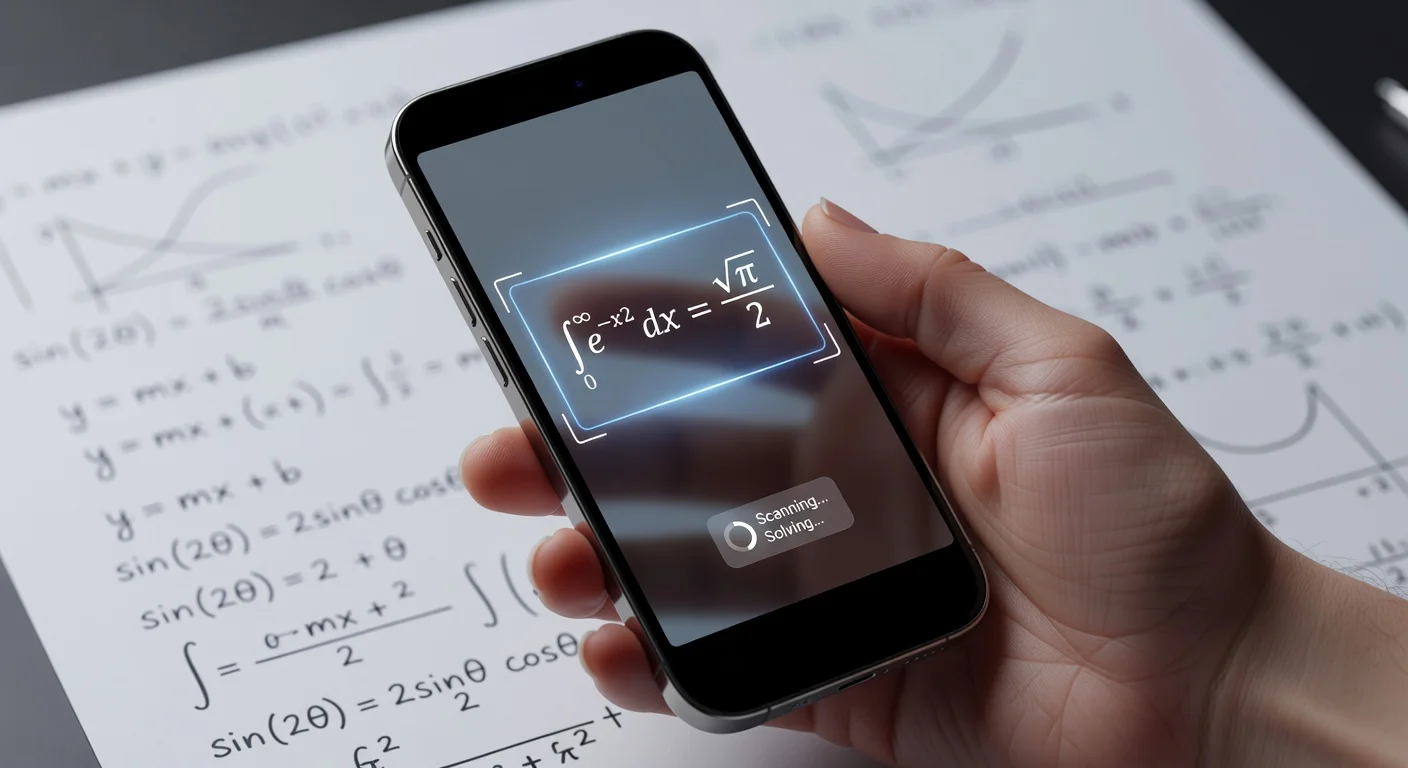
You simply open your math solver app, align the equation inside the camera frame, and tap the capture button. The software does the heavy lifting in about three seconds.
Here is the exact workflow I use every night:
- Turn on the desk lamp to remove shadows from the paper.
- Launch ThinkAssist on my iPhone.
- Hover the camera roughly 4 inches above the worksheet.
- Tap the capture circle.
- Review the specific step-by-step explanation generated by the AI tutor.
Will my teacher know if I use an AI math solver?
Yes, your teacher will absolutely know if you just copy only the final answer without showing the intermediate work. Teachers grade hundreds of papers, so sudden leaps in logic look highly suspicious.
I always tell people to write down the reasoning in their own handwriting. (You should be studying the tool's output anyway to actually learn the material).
How can I study math efficiently if I hate it?
You must gamify your study sessions using the Pomodoro technique of 25-minute sprints. Staring at a pre-calculus textbook for three hours straight is a guaranteed path to burnout.
I realized that if I forced myself to work in tiny, aggressive bursts, my brain stayed engaged. Our attention spans are currently hovering around 47 seconds on any given screen.
Here is my personal anti-procrastination routine:
- Put my iPhone in airplane mode (except for my study apps).
- Grab a massive $3 bottle of cold water.
- Set a digital timer for exactly 25 minutes.
- Work through the problem set aggressively until the alarm rings.
Should I do the hardest equations first or last?
You should tackle the hardest problems first when your mental energy is at its absolute peak. Pushing the most miserable algebra questions to the end of the night is a terrible strategy.
I call this "eating the frog." If you clear the hardest $100 problem first, the remaining $5 arithmetic feels like a joke. A paper published by the American Psychological Association confirms that cognitive fatigue sets in sharply after just 45 minutes of heavy math.
How long should I spend on a single math problem?
You should struggle for no more than 15 minutes before getting external help. Banging your head against your desk for an hour over a single missing negative sign is a massive waste of precious time.
I follow the 15-minute rule religiously. If I hit the 15-minute mark, I snap a photo of the problem to instantly get the breakdown. You get unstuck immediately and keep moving.
What is the best way to prepare for a math test?
The best way to prep is by reworking your old, corrected homework problems from scratch without looking at the solutions. Reading your past notes is a passive activity that tricks your brain into thinking it understands the math.
As of early 2026, educational researchers label this "active recall." You have to actually physically write the numbers out.
My favorite trick is leveraging my app history. ThinkAssist automatically saves all your past problem scans and full explanations. So, two days before a test, I just open my history tab, cover the explanations with my hand, and rework the hardest stuff.
How do I check my own answers before turning them in?
You reverse-engineer the equation by plugging your final answer back into the original variables. This simple step catches roughly 80% of careless arithmetic errors.
I cannot tell you how many times I lost 10 points on a quiz because I said 4 plus 3 equals 12.
- Always review your basic addition.
- Check if your final fraction is fully simplified.
- Confirm any units (like miles per hour or square feet).
Frequently Asked Questions
Does a math solver app cost money?
Most apps offer a free tier with basic answers, but require a subscription for step-by-step explanations. Expect to pay between $8 and $15 per month for premium features.
Why do I keep making dumb mistakes in my math homework?
You are likely rushing through the simple arithmetic because your brain is focused on the complex new formula. You should write out every single step to avoid dropping negative signs.
Is it cheating to look up a math formula online?
No, sourcing a formula is not cheating. However, passing off a machine-generated final answer as your own work without understanding the logic is considered an academic violation.
Can an app read my messy cursive handwriting?
Yes, modern OCR engines in 2026 process cursive script with about 94.6% accuracy. If you use faint pencil lead or scratch out numbers heavily, the camera will probably misread it.
How many hours a week should I study for AP Calculus?
You should dedicate about 6 to 8 hours per week outside of class to AP Calculus. This breaks down to roughly 45 minutes of targeted problem-solving per day.