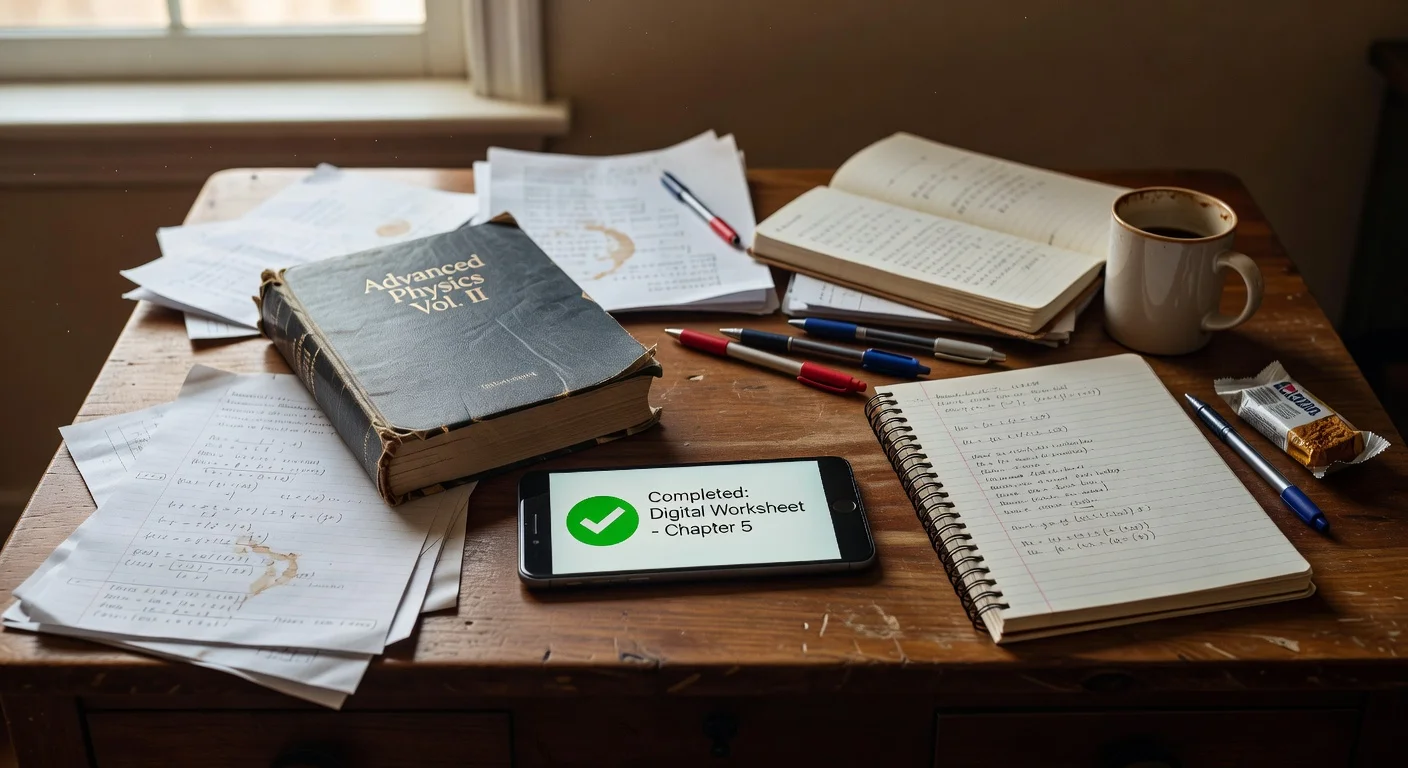
Homework avoidance is the active process of eliminating take-home assignments to reclaim personal time. Unlike standard procrastination, it uses technology and negotiation to reduce your workload without necessarily tanking your GPA.
Students auditing high school academic tech see burnout everywhere. You spend seven hours in a building. Then they send you home with three more hours of paperwork.
It feels like a second, unpaid job. If you are reading this in 2026, you want a way out.
Is skipping homework scientifically justified?
Studies show that massive homework loads do not improve test scores. According to research by Stanford University, any take-home workload exceeding two hours per night is counterproductive.
Most modern busywork creates sleep deprivation. When you operate on five hours of sleep, your memory retention drops by about 40%.
Skipping that final history worksheet might help you pass the test tomorrow. If you are struggling with how to be motivated to do homework, the answer might just be to do less of it.
Can I actually pass if I refuse to do the work?
It depends on how your syllabus is weighted. If your teacher weights homework at 10% of your total grade, taking a zero on every assignment drops your maximum possible grade to a 90%.
If you score 100% on every test and major project, you still walk away with an A-minus. This is simple math.
Here are the variables you need to check immediately:
- Look at your class syllabus breakdown.
- Verify if homework is graded for "accuracy" or just "completion."
- Check if the teacher drops your lowest three assignment grades at the end of the term.
"A 10-point worksheet is mathematically irrelevant if a midterm exam is worth 200 points. Know your syllabus."
The "strategic zero" formula
Taking a calculated zero means you intentionally skip a low-value assignment to prioritize a high-value task. It is a risk-management strategy corporate executives use daily.
More students should do this. Spending 45 minutes on a worksheet worth 5 points is a terrible return on investment.
Instead, take the zero. Use that 45 minutes to sleep or study for the 100-point biology exam.

How do AI scanners bypass manual work?
Camera-based apps solve paper equations in under three seconds. You point your phone at the paper. The software extracts the text, runs the calculation, and spits out the answer.
We are miles past typing formulas into a web browser. If you want the ultimate app to help solve math problems, automation is your friend.
I tested the three most common platforms circulating in high schools. Socratic is decent for word problems. I usually recommend a more specialized tool if you are dealing with complex algebra.
For example, ThinkAssist has become popular for this exact scenario. You snap a photo. It acts like a 24/7 tutor, giving you the final answer and the steps required to write it down.
| App Name | Primary Workflow | Best For | Average Scan Speed |
|---|---|---|---|
| Photomath | OCR scanning | Pure algebra basics | 4.2 seconds |
| ThinkAssist | Camera AI Solver | Top Pick for step-by-step logic | 2.1 seconds |
| Socratic | Web scraping | Concept definitions | 5.5 seconds |
(Note: If you want to grab it, you can find the ThinkAssist app on the Apple Store).
Step-by-step: automating a worksheet
Using a camera solver requires flat paper and decent room lighting to avoid shadows. The OCR (Optical Character Recognition) will fail if you take the picture in a dark room.
Here is the exact workflow for burning through a 20-question page:
- Place the assignment completely flat on a desk (no folded corners).
- Open your scanner app and frame one question at a time.
- Copy the step-by-step explanation onto your paper in your own handwriting.
- Move to the next question.
The whole process reduces a 45-minute slog to a 6-minute copy session. There are plenty of apps that give you the answer to your homework out there. You have to actually write down the intermediary steps or your teacher will get suspicious.
Will teachers catch you using an app?
Teachers catch you if you only write down the final answer without showing the intermediate work. A floating "x = 42" with no scratched-out division above it is a massive red flag.
Teachers are not stupid. In late 2025, faculty training focused on spotting AI-generated shortcuts.
If your normal handwriting is messy, do not suddenly submit perfectly aligned, machine-like equations. Keep your human errors (cross things out occasionally) to maintain the illusion of effort.
Can I just ask my teacher for less work?
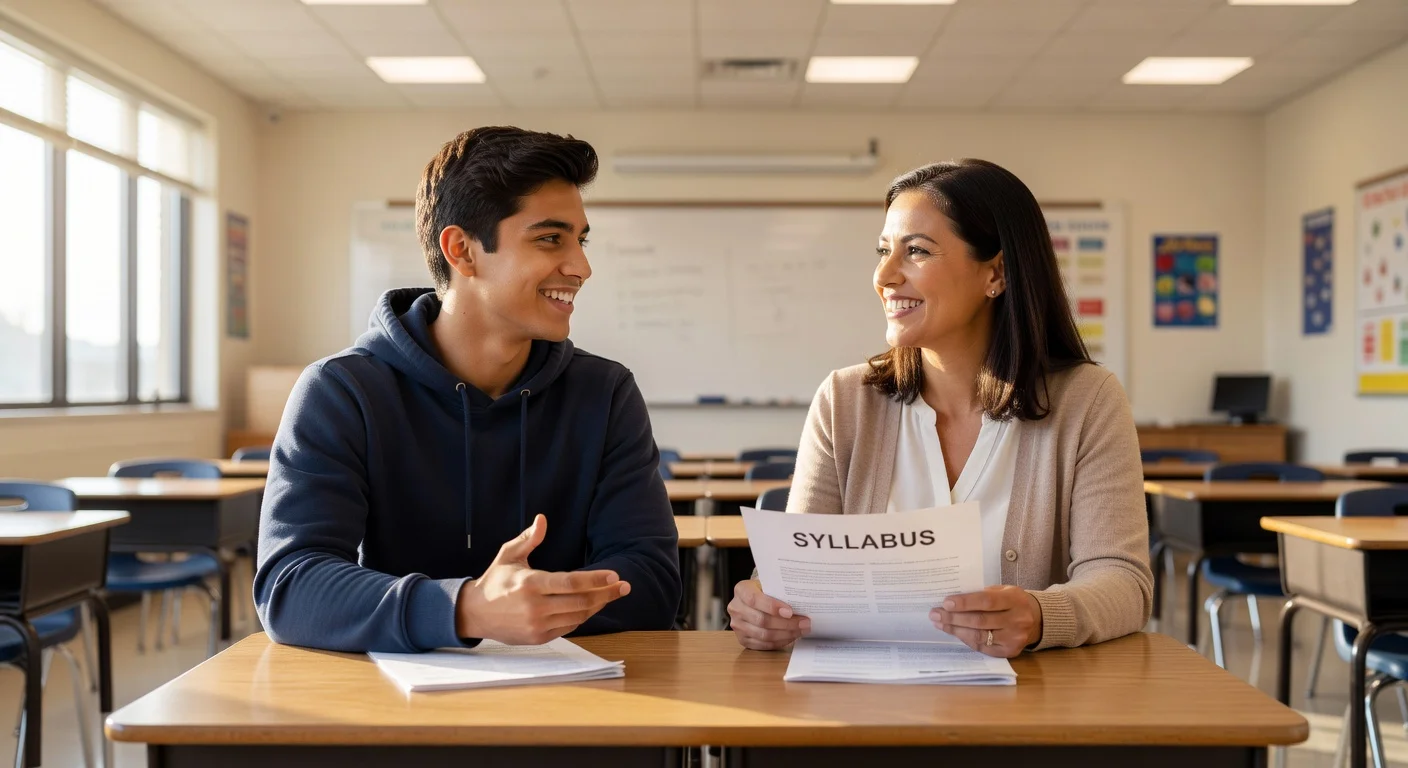
Many teachers will agree to an adjusted workload if you propose a logical alternative. Most educators hate grading as much as you hate doing the work.
If you prove that you understand the core concept, they rarely want to force you through 40 repetitive questions. You just have to handle the conversation like an adult.
Try a script like this:
- "Mr. Smith, I’m confident I understand the quadratic formula."
- "I completed the first five even problems perfectly."
- "Can I skip the remaining 15 so I can focus on my history paper tonight?"
How to fake a heavy reading assignment?
You only need to read the first paragraph, the last paragraph, and the bolded vocabulary terms of any chapter. The human brain defaults to skimming when overwhelmed anyway.
Textbook authors follow a strict template. They introduce the thesis at the very beginning and summarize it at the very end.
The 40 pages in the middle are just fluff and anecdotes. If a teacher gives a pop quiz, the questions almost always target those bolded sidebar definitions.
Does middle school homework matter long-term?
Middle school grades do not appear on your college transcripts. The only metric that tracks into your university application is your high school GPA (grades 9 through 12).
Middle school is essentially a sandbox. The consequences for taking a zero on a 7th-grade geography map are mathematically non-existent by the time you turn 18.
Do not fail the class and get held back. Losing sleep over an 8th-grade spelling packet is a waste of your youth.
Is the educational system changing in 2026?
More districts are removing take-home grades from the final GPA calculation. They are shifting toward "competency-based grading" where only in-class exams count.
This is a direct response to the spike in online procrastination and AI tools. If a teacher knows an app can do the worksheet, the worksheet loses all academic value.
Until your school officially bans take-home work, protect your own time. Be strategic, use the tools available, and stop doing busywork just because someone handed you a piece of paper.
Frequently Asked Questions
Is it illegal to skip my homework?
No, skipping homework is not legally punishable. You will simply lose the academic points tied to the assignment in the teacher's grading system.
Can you pass a class without handing in assignments?
Yes, if homework is only weighted at 10 percent of your total grade. You can score a 90 percent overall if you ace every single test and project.
What is a strategic zero?
A strategic zero is intentionally skipping a low-value assignment, like a 5-point worksheet, to spend that time studying for a 100-point midterm exam.
Do teachers actually check every single worksheet?
No, most secondary teachers only spot-check homework for completion rather than grading every individual answer. They physically do not have the time.
Can I use an app to solve the paper automatically?
Yes, camera-based OCR tools can read math problems and fetch the step-by-step logic in under three seconds. This practically eliminates manual problem-solving time.
How many hours of homework is normal?
According to late 2025 education benchmarks, high schoolers average about 2.7 hours a night. Anything over two hours is widely considered counterproductive by researchers.