
Math riddles are word puzzles that require mathematical operations, spatial reasoning, or pattern recognition to reach a non-obvious solution. Unlike standard textbook equations, these riddles test your ability to convert linguistic statements into logical constraints. To solve them, you usually need to look past distracting surface details, identify the core algebraic or probabilistic relationship, and avoid common cognitive biases like the base-rate fallacy.
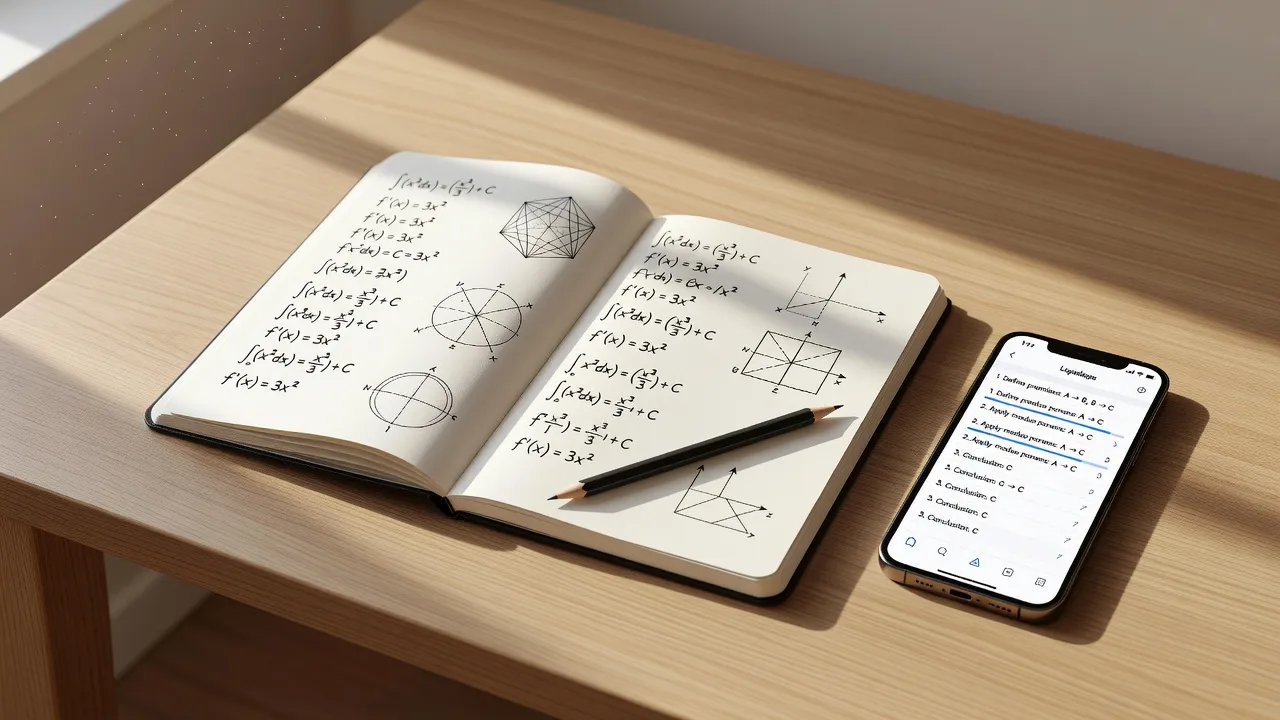
What are the top math riddles to sharpen your logic?
The best math riddles blend simple, everyday language with surprising mathematical counter-intuitions. They do not require a degree in calculus, but they force you to re-examine basic assumptions about numbers, probability, and spatial logic.
As of August 2026, educational approaches have shifted away from simple mental math drills toward lateral logic puzzles. When you run into a word puzzle with complex constraints that feels impossible to map out on paper, an ai homework helper app like ThinkAssist lets you scan handwritten diagrams or word problems to get an immediate, step-by-step breakdown of the underlying logic.
Below is a curated list of the seven best math riddles, ranging from classic financial paradoxes to formal constraint-satisfaction problems.
1. The Missing Dollar Riddle
The Missing Dollar Riddle is a famous verbal misdirection puzzle that tricks your brain into adding an expense to a debt. It illustrates how simple linguistic framing can obscure basic balance-sheet accounting.
The Riddle
Three guests check into a hotel room that costs $30. They split the bill equally, paying $10 each. Later, the hotel clerk realizes the room rate was actually $25. He gives $5 in single dollar bills to the bellhop to return to the guests. The bellhop decides to cheat the guests slightly: he keeps $2 for himself as a tip and gives $1 back to each of the three guests.
Now, each guest has paid $9 (totaling $27). The bellhop kept $2. That equals $29. Where did the extra dollar go?
Why It Made the List
I love this riddle because it demonstrates how easy it is to perform incorrect financial addition when presented with an authoritative narrative. It exposes our vulnerability to bad framing.
The Trade-Off & Solution
- The Trap: The riddle tricks you into adding the bellhop's $2 to the guests' $27.
- The Mathematical Reality: The bellhop's $2 is already included in the $27 spent by the guests ($25 for the room + $2 kept by the bellhop). To balance the books, you subtract the $2 tip from the $27 to get the $25 room price, or add the $3 refund to the $27 spent to match the original $30.
2. The Two Ropes and a Lighter
The Two Ropes Riddle is a non-linear time-measurement problem that relies on burn rates rather than fixed lengths. It forces you to manipulate physical properties instead of counting seconds.
The Riddle
You have two ropes and a lighter. Each rope takes exactly 60 minutes to burn completely from end to end. However, neither rope burns at a uniform rate (for example, half the rope might burn in 1 minute while the rest takes 59 minutes). How can you measure exactly 45 minutes using only these ropes and the lighter?

Why It Made the List
This riddle forces you to abandon standard measuring assumptions. Because length does not correspond linearly to time, standard ruler-style division fails completely.
The Trade-Off & Solution
- The Trap: Trying to measure or cut the ropes physically based on length.
- The Mathematical Reality: Light Rope A at both ends simultaneously, and light Rope B at one end. Because Rope A is burning from both ends, it will consume itself in exactly 30 minutes. The instant Rope A completely burns out, 30 minutes have elapsed, and Rope B has 30 minutes of burn time remaining. At that exact moment, light the other end of Rope B. It will burn out in 15 minutes. 30 + 15 = 45 minutes.
3. The Monty Hall Problem
The Monty Hall Problem is a probability puzzle based on conditional decision-making that counter-intuitively proves changing your choice doubles your odds of winning. It remains one of the most famously disputed simple probability questions in history.
The Riddle
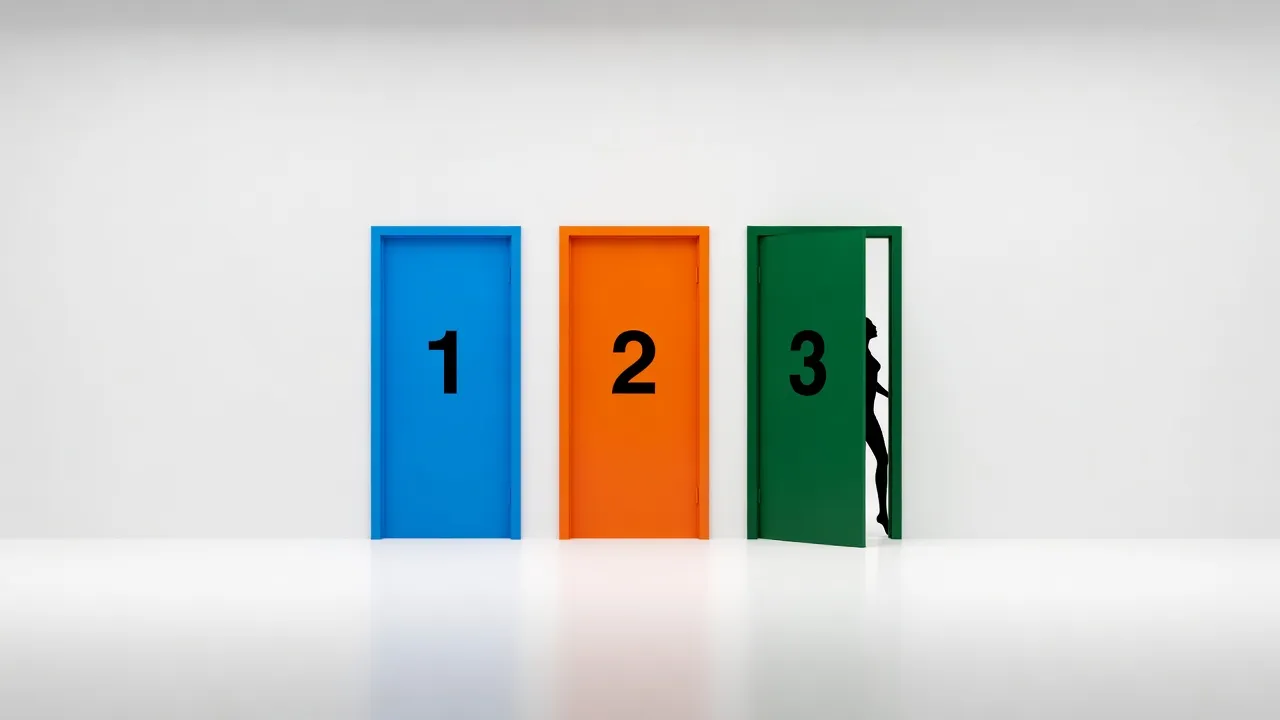
You are on a game show with three closed doors. Behind one door is a luxury car; behind the other two are goats. You pick Door 1. The host, who knows what is behind every door, opens Door 3 to reveal a goat. He then asks you: "Do you want to switch to Door 2?" Should you switch, or stay with Door 1?
Why It Made the List
Even doctorate mathematicians famously argued against the correct answer when parade columnist Marilyn vos Savant published it. The problem is documented in detail by the Mathematical Association of America, showing how strongly human intuition resists Bayesian probability updating.
The Trade-Off & Solution
- The Trap: Assuming that because two doors remain, the probability is 50/50.
- The Mathematical Reality: You should always switch. When you first picked Door 1, you had a 1/3 chance of being right and a 2/3 chance that the car was behind one of the other doors. The host opening a losing door does not alter your initial 1/3 odds. By offering a switch, he concentrates the full 2/3 probability of the remaining unchosen set onto Door 2.
4. The 3-Jug Water Pouring Puzzle
The 3-Jug Water Pouring Puzzle is a spatial state-space search problem requiring you to measure a precise volume without external tools. It tests your ability to plan multiple algorithmic steps ahead.
The Riddle
You have three unmarked jugs with capacities of 8 gallons, 5 gallons, and 3 gallons. The 8-gallon jug is filled completely with water, while the 5-gallon and 3-gallon jugs are empty. How can you divide the water into two equal parts (4 gallons each) using only these three jugs?
Why It Made the List
It is a classic example of diophantine operations framed as a hands-on physical task. Computer science courses frequently use it to teach breadth-first graph traversal algorithms.
The Trade-Off & Solution
- The Trap: Attempting to guess measurements visually instead of relying on discrete full-to-capacity transfers.
- The Mathematical Reality: You must execute a sequence of pouring operations that maximize jug capacities:
- Pour 8g jug into 5g jug (Balances: 3g, 5g, 0g).
- Pour 5g jug into 3g jug (Balances: 3g, 2g, 3g).
- Pour 3g jug back into 8g jug (Balances: 6g, 2g, 0g).
- Pour 2g from 5g jug into 3g jug (Balances: 6g, 0g, 2g).
- Pour 8g jug into 5g jug (Balances: 1g, 5g, 2g).
- Pour 5g jug into 3g jug until full (needs 1g) (Balances: 1g, 4g, 3g).
- Pour 3g jug back into 8g jug (Balances: 4g, 4g, 0g).
5. The Heavy Coin Among 12 Coins
The 12 Coins Riddle is an information theory puzzle where you must isolate an outlier coin using a balance scale in minimal steps. It forces you to extract maximum information from every outcome, including equality.
The Riddle
You have 12 identical-looking coins. Eleven weigh exactly the same, but one is counterfeit and has a different weight (you do not know if it is heavier or lighter). You have a traditional balance scale. How can you find the fake coin and determine whether it is heavy or light in just 3 weighings?
Why It Made the List
It is one of the toughest balance scale problems because the unknown variable is binary (heavy OR light), expanding the search space significantly.
The Trade-Off & Solution
- The Trap: Dividing the coins into two equal groups of six. That wastes information because a balanced scale tells you nothing useful about which subset holds the outlier.
- The Mathematical Reality: You must divide the coins into three groups of four (A, B, C).
- Weighing 1: Compare Group A against Group B. If they balance, the fake is in Group C. If they do not balance, you know Group C is genuine and you have isolated the discrepancy to A or B.
- By continuing to eliminate possibilities using known-good coins as reference weights, you split the remaining state space down to 1 coin in exactly three weighings.
6. Cheryl’s Birthday Riddle
Cheryl's Birthday is a logic riddle based on self-referential mathematical deduction and mutual knowledge elimination. It made international headlines when it appeared on a Singapore Math Olympiad exam.
The Riddle
Albert and Bernard meet Cheryl and want to know her birthday. Cheryl gives them a list of 10 possible dates:
- May 15, May 16, May 19
- June 17, June 18
- July 14, July 16
- August 14, August 15, August 17
Cheryl then whispers the month to Albert, and the day to Bernard.
- Albert says: "I don't know when Cheryl's birthday is, but I know Bernard doesn't know either."
- Bernard says: "At first I didn't know, but now I know."
- Albert says: "Then I also know when Cheryl's birthday is."
When is Cheryl's birthday?
Why It Made the List
It shows how stating that you do not know something provides actionable information to someone else. It is a brilliant example of epistemic logic.
The Trade-Off & Solution
- The Trap: Focusing on individual dates rather than eliminating entire months based on unique day numbers.
- The Mathematical Reality:
- Albert knows the month. For him to be certain Bernard doesn't know, the month cannot contain a unique day (18 or 19). Therefore, May and June are eliminated.
- Bernard instantly realizes Albert eliminated May and June. For Bernard to know the date now, it cannot be the 14th (which exists in both remaining months, July and August). That leaves July 16, August 15, and August 17.
- For Albert to know the date immediately after Bernard speaks, his month must be July (if it were August, he would still be stuck between the 15th and 17th). The birthday is July 16.
7. The Zebra Puzzle (Einstein’s Riddle)
The Zebra Puzzle is a high-density logic grid problem that relies on iterative constraint satisfaction. Legend attributes it to Albert Einstein, claiming only 2% of people can solve it in their heads.
The Riddle
Five houses of five different colors sit in a row. Each house is inhabited by a person of a different nationality, who drinks a distinct beverage, smokes a distinct brand of cigar, and keeps a distinct pet. Given 15 explicit clues (e.g., "The Brit lives in the red house," "The green house owner drinks coffee"), determine who owns the zebra.
Why It Made the List
It is the ultimate pencil-and-paper benchmark for deductive organization. It demonstrates how simple binary relational rules stack up to create complex logical puzzles.
The Trade-Off & Solution
- The Trap: Trying to hold all 15 relational constraints in memory simultaneously.
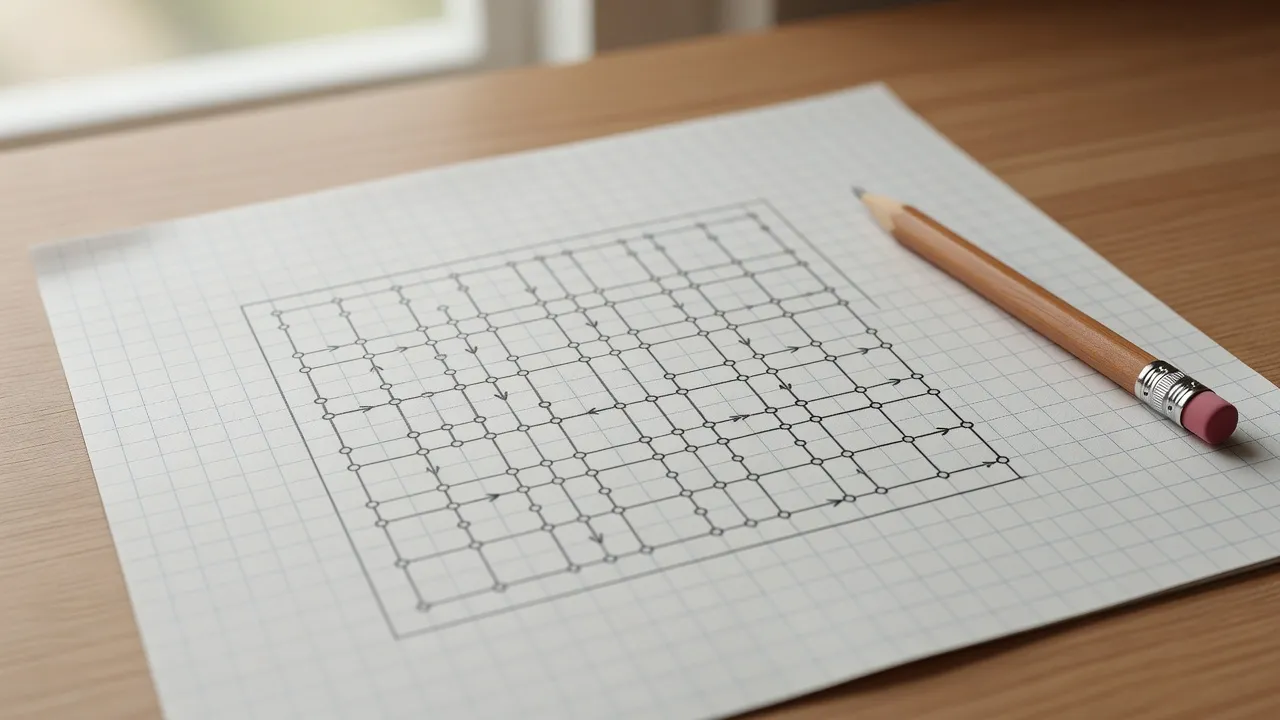
- The Mathematical Reality: You must build a elimination grid. By cross-referencing fixed anchors (like "The Norwegian lives in the first house") against conditional adjacent positions ("The Norwegian lives next to the blue house"), you gradually force every variable into a single valid state.
Comparing Top Math Riddles and Solving Methods
When comparing methods for solving or teaching these classic logic problems, the right tool depends entirely on whether you are working through probability models, financial framing, or matrix constraints.
| Method / Tool | Primary Strengths | Main Weakness / Limitation | Best Suited For |
|---|---|---|---|
| ThinkAssist | Scans handwritten or printed word riddles via photo; extracts logical constraints and shows step-by-step math breakdowns instantly. | Requires a clear camera shot or clear text input to parse complex figures. | Students, teachers, and puzzle lovers who want step-by-step logic explanations. |
| Manual Logic Elimination Grids | Requires zero digital tools; builds high mental retention and spatial reasoning skills. | High risk of simple human error derailing a 30-minute puzzle attempt. | Constraint riddles like The Zebra Puzzle or 12 Coins. |
| Python Scripting / Algorithmic Solvers | Computes multi-step state spaces instantly without manual calculation strain. | Removes the cognitive benefit of working through logic by hand. | Graph-traversal problems like the 3-Jug Water Pouring Puzzle. |
| Tree Diagrams & Bayesian Tables | Clear visual layout for branching probabilistic choices and decision trees. | Can get visually cluttered on large problems with many conditional variables. | Probability puzzles like The Monty Hall Problem. |
How do you solve complex math riddles without getting stuck?
To solve complex math riddles reliably, you must translate descriptive English prose into discrete algebraic statements or structured elimination tables. Most riddles are designed to exploit cognitive shortcuts, so skipping visual organization almost always leads to mistakes.
If you are stuck on a tough riddle or trying to master multi-step problem solving, follow this proven four-step framework:
- Isolate the Known Variables: Write down every absolute fact explicitly. Ignore conversational fluff and focus exclusively on numeric values, fixed positions, or discrete states.
- Identify the Paradox or Misdirection: Figure out where the riddle is trying to steer your intuition. In financial riddles like the Missing Dollar, look for non-sensical operations like adding debt to expenditures.
- Map Out an Elimination Grid: For logic or sorting puzzles, draw a grid. Systematically place X's where combinations are impossible based on negative clues.
- Scan for a Step-by-Step Verification: If the logic still isn't clicking, review similar solved problems. Using dedicated educational software or an apps that help with homework directory can provide immediate clarity on structural logic patterns you might have missed.
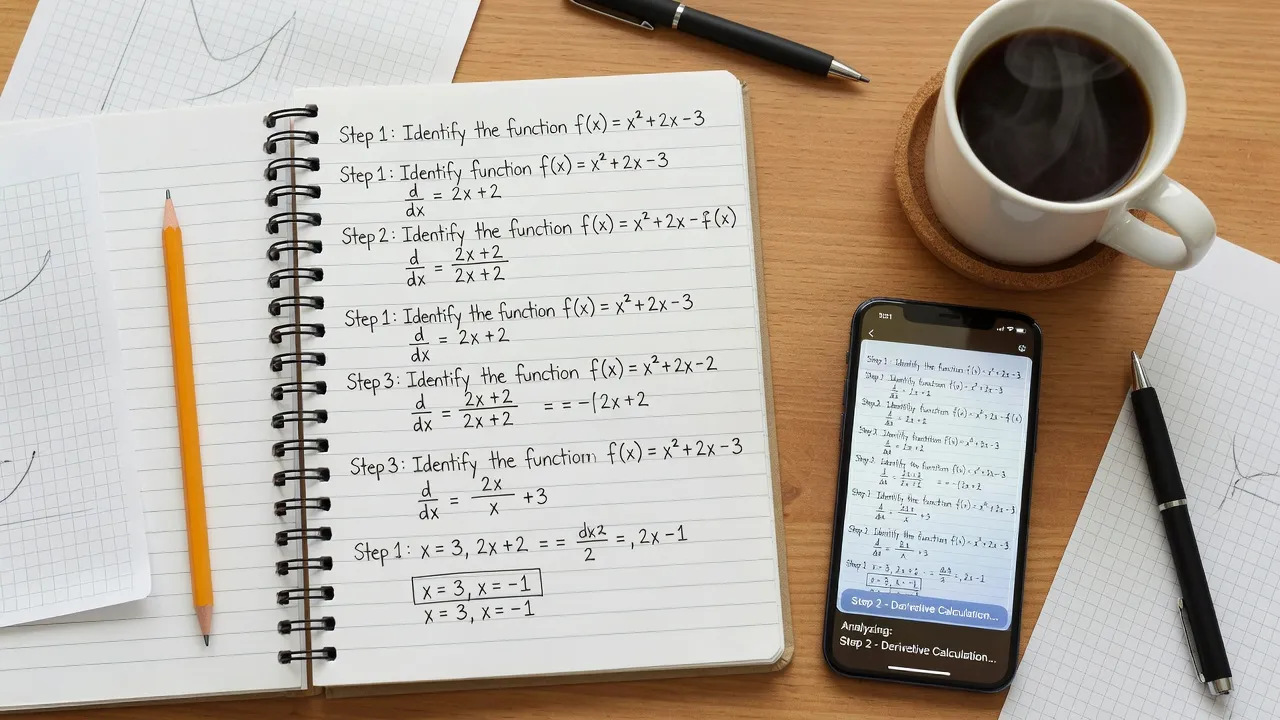
If you struggle to spot where your logic broke down, snapping a quick photo using a dedicated tool like the ThinkAssist iOS App breaks down the equation or word problem into individual steps. This helps you figure out how do i solve this math problem by seeing the logical flow clearly instead of guessing at the answer.
Why have math riddles changed so dramatically by 2026?
By 2026, math riddles have shifted from simple lateral-thinking parlor tricks to foundational exercises for algorithmic logic and computational thinking. Modern educational standards prioritize teaching students how to construct clear logical steps over rote arithmetic.
Here is what has changed in how educators and puzzle enthusiasts treat math riddles today:
- AI-Powered Interactive Parsing: Rather than relying on simple answer keys printed upside down at the back of a book, readers now use AI solvers to receive dynamic hints. Software can guide you through the logic step-by-step without spoiling the final answer.
- Emphasis on Formal Logic in School Curricula: Puzzles like Cheryl's Birthday are no longer just for math Olympiads. Standardized tests increasingly feature epistemic logic questions to measure reasoning abilities that standard algebra tests miss.
- Integration of Spatial and Visual OCR: Modern learning apps process handwritten logic diagrams, turning a sketched balance scale or a jug-pouring flowchart into a step-by-step verification model instantly.
Frequently Asked Questions
What is the difference between a math riddle and a standard math problem?
A standard math problem gives you explicit numbers and asks for a direct calculation using a known formula. A math riddle frames the problem with linguistic ambiguity or counter-intuitive scenarios, requiring you to uncover the hidden mathematical relationships before performing any operations.
Why are probability math riddles like Monty Hall so confusing?
Probability riddles trigger strong cognitive biases because human intuition defaults to assuming equal odds among remaining choices. People tend to ignore conditional background information, such as an informed host removing an incorrect option, which alters the underlying probabilities.
Can math riddles help improve overall problem-solving skills?
Yes, math riddles strengthen working memory, pattern recognition, and lateral thinking. They teach you to systematically break down complex statements, isolate core constraints, and resist immediate, intuitive assumptions that are often wrong.
What is the best strategy for solving word-based math riddles?
The best approach is to strip away descriptive narrative details and translate the clue text directly into formal mathematical equations or logical elimination grids. Focus on identifying what information is fixed versus what variables are changing.
Are math riddles useful for job interviews?
Many technical, financial, and software engineering firms use math and logic riddles during technical interviews. They test how systematically you analyze unfamiliar problems, handle constraints under pressure, and articulate your step-by-step thought process.
How do AI apps help you understand math riddles?
AI apps like ThinkAssist use Optical Character Recognition (OCR) to read printed or handwritten word problems. They break the riddle down into discrete logical constraints and explain the underlying steps required to reach the solution.
What age group benefits most from math riddles?
Math riddles benefit learners of all ages, from elementary students developing basic numerical intuition to adults maintaining cognitive agility. Adjusting the difficulty—from simple arithmetic word tricks to complex constraint logic—makes them useful at any learning stage.