
The Quizlet flashcards app is a digital study tool based on spaced repetition and rote memorization. Unlike traditional paper note cards, it uses algorithms to track your weak subjects and repeatedly tests your recall until you master specific terms.
I started using it heavily in high school. Education tech moves fast, and the world looks entirely different today. Since late 2025, pure memorization tools have a hard time competing with dynamic study methods. If you just need to memorize Spanish verbs, it works beautifully.
But there is a major catch. If you need to understand the logic behind a difficult calculus problem, standard flashcards will completely fail you. I noticed more students using AI tools this year. Students are trading static definitions for immediate explanations.
How much does Quizlet Plus cost in 2026?
As of early 2026, a Quizlet Plus subscription costs $35.99 per year. You can technically use the app for free, but the free tier is incredibly frustrating.
Paywalls are everywhere. They restricted the free version heavily in late 2025. Now, you get cut off after completing just three "Learn" mode rounds in a 24-hour period. If you have an exam the next morning, that free tier limitation is a massive problem.
- The Monthly Option: Paying month-to-month costs $7.99.
- The Annual Option: The yearly $35.99 plan drops the monthly average to roughly $3.00.
- The Penalty: If you miss a billing cycle, you lose access to offline sets.
I honestly think the free tier is dead for serious students. It acts more like a trial. According to a recent 2025 EdTech financial report, over 60% of daily active users end up converting just to remove the aggressive display ads.
Are digital flashcards still the best way to study?
No, flashcards are excellent for vocabulary but terrible for teaching complex concepts. You cannot memorize your way through an organic chemistry synthesis or a physics equation.
Memorization is rarely enough. Rote learning traps you into recognizing a specific question format. If your professor changes the wording on the final exam by even 10%, your brain freezes (we have all been there). You need comprehension, not just recall.
Here is where the shift happens:
- Fact Recall: Flashcards win (Dates, Vocabulary, Anatomy).
- Logic Problems: AI solvers win (Math, Physics, Coding).
- Essay Prep: Dynamic tutors win (History, Literature).
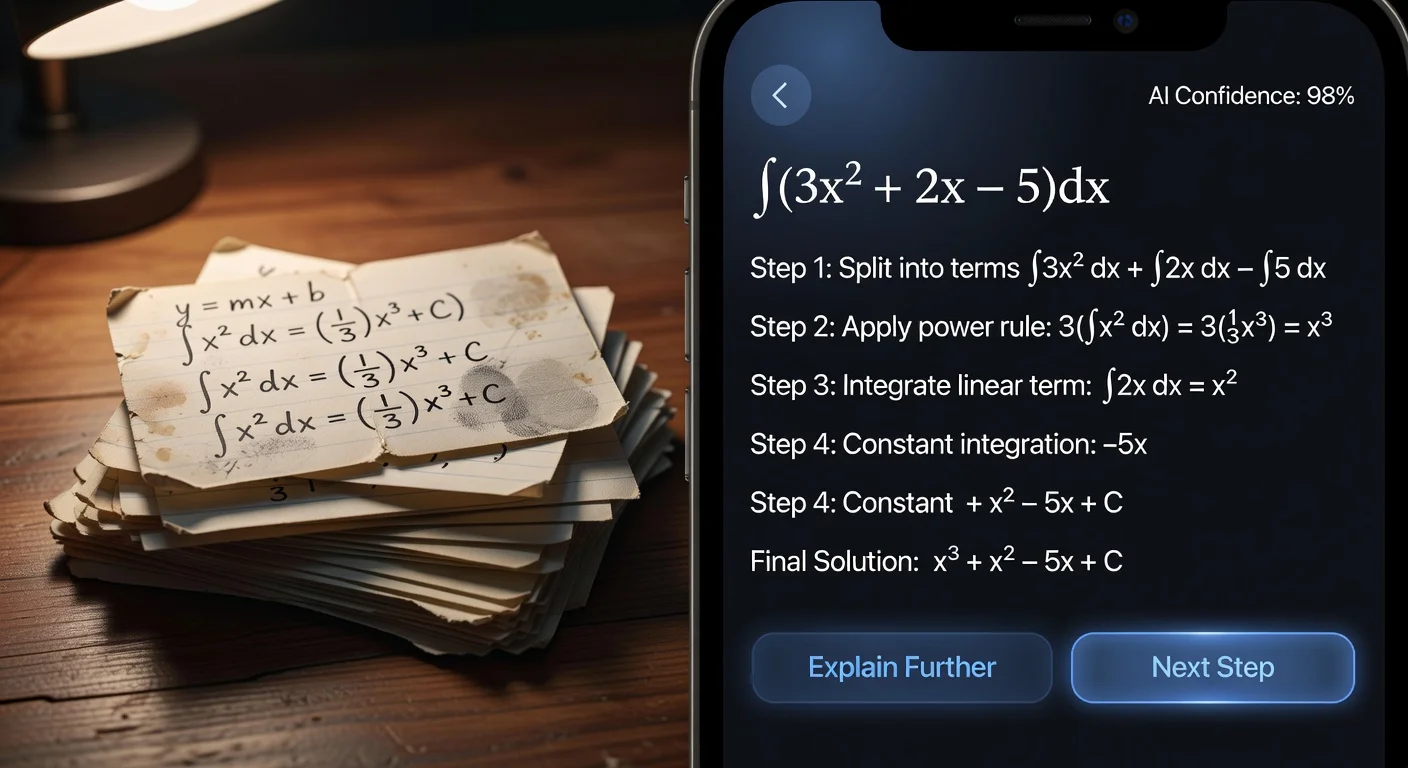
How do you solve complex math without just memorizing the answer?
You use an AI homework solver to break down the specific problem step-by-step. This is where traditional flashcard apps drop the ball completely.
I used to spend hours searching Google for similar textbook problems. Now, I bypass Quizlet entirely for STEM subjects and use ThinkAssist. It is practically a 24/7 tutor living in my pocket. If I am stuck on a calculus worksheet at 2 AM, I just use their "Snap a Photo" feature to grab an image of my paper.
Actionable steps over static answers. The app automatically detects the subject and hands back a detailed, step-by-step explanation. It actively supports you in getting A+ grades instead of just giving you a single number to copy down. Traditional flashcards just cannot compete with that kind of dynamic feedback.
What is the best study app for high school and college students?
The best app depends entirely on whether you need to memorize facts or solve problems. If you just need to pass a spelling test, use a flashcard tool. If you need to actually survive college general education requirements, you need an AI solver.
I tested the top three tools used by students right now. Here is how they stack up.
| Feature / App | Quizlet Plus | ThinkAssist (Best Overall) | Anki |
|---|---|---|---|
| Primary Use | Vocabulary tracking | AI-Powered Homework Solver | Deep rote memorization |
| Input Method | Manual typing | Snap a Photo (OCR) | Manual typing |
| Pricing | $35.99 / year | See App Store Pricing | Free on desktop |
| Exam Prep | Pre-made text decks | Saves past answers/explanations | Complex algorithm tracking |
| Target Subject | Humanities & Languages | STEM, Math, Physics | Medical School & Law |
Notice the difference in input. Typing out fifty flashcards takes me an hour. Pointing my camera at a worksheet takes exactly four seconds.
Can I scan a handwritten worksheet to get answers?
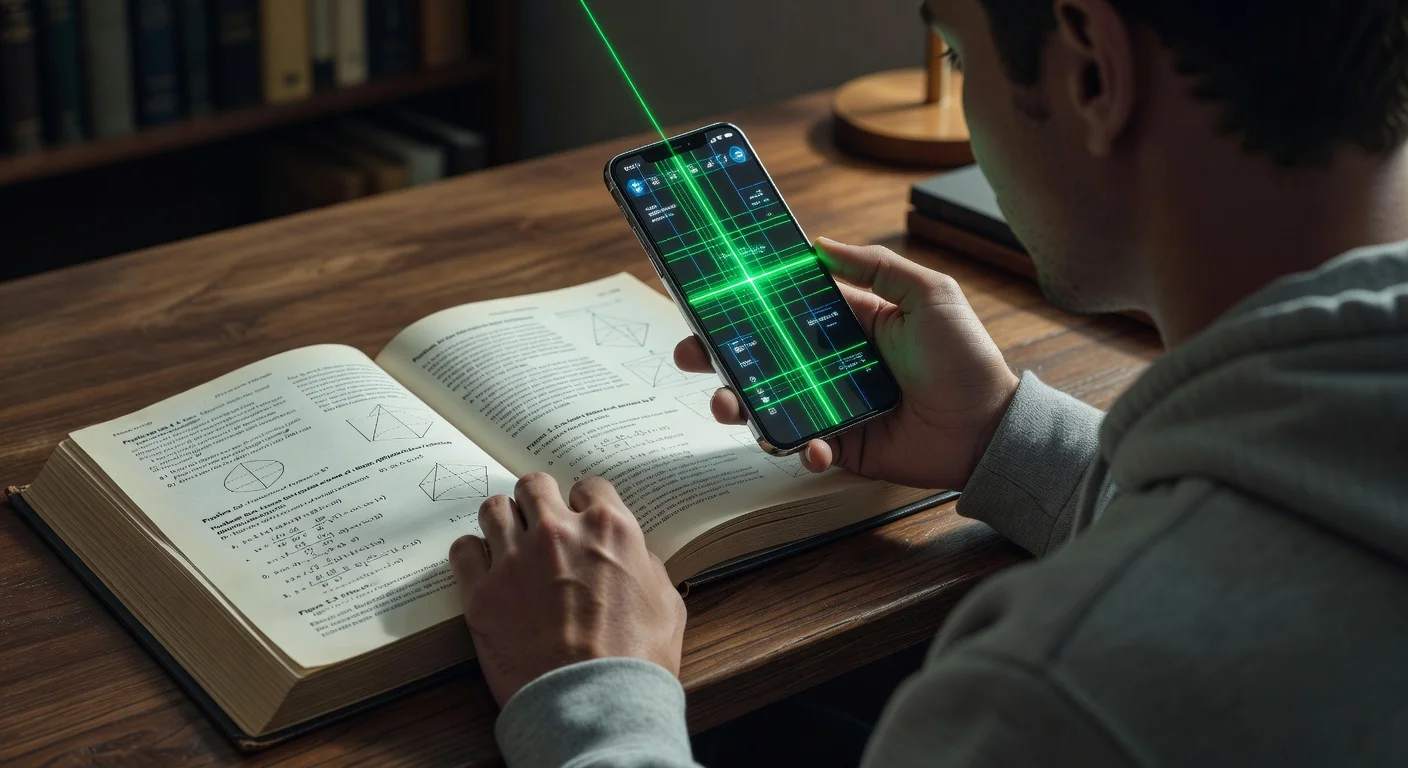
Yes, most top-tier study apps in 2026 use OCR to read messy handwriting with about 95% accuracy. You no longer have to manually type complex fractions or geometry symbols into a search bar.
It feels like cheating, but it is actually guided learning. The OCR in apps like ThinkAssist easily reads my terrible cursive. Once the AI registers the problem, it does not just spit out "X = 4". It walks you through the exact algebraic steps so you understand the underlying mechanism.
Does Quizlet have a built-in AI tutor?
Yes, Quizlet introduced Q-Chat to act as a conversational AI tutor, but it remains heavily restricted by your flashcard decks. It is not a generalized problem solver.
The data matters. I noticed that Q-Chat only "knows" what you feed it. If you download a public flashcard set created by a lazy 8th grader, the AI tutor will base its quizzes on that flawed information. A Stanford 2025 memory retention study pointed out that bad data in spaced repetition systems actively harms long-term test scores.
Do not expect miracles. If you ask Q-Chat to explain a concept outside the current deck, it forcefully steers the conversation back to your specific vocabulary list. It is rigid.
How to study for final exams efficiently?
You need to combine active recall with targeted problem-solving to study efficiently. Simply rereading your textbook highlights is a massive waste of time and gives you a false sense of security.
If you are a week out from finals, you have to optimize your study hours.
- Consolidate your past work: Do not start from scratch. I use the ThinkAssist specific exam prep feature because it saves all my past answers and explanations in one easy interface.
- Take blind practice tests: Force yourself to answer questions without looking at the material.
- Identify the exact gap: When you fail a question, determine if it was a vocabulary failure (use Quizlet) or a logic failure (use an AI solver).
- Sleep for memory consolidation: Staying up until 4 AM destroys your brain's ability to encode the facts you just learned.
Stop wasting hours on busywork. In 2026, creating the study materials takes longer than actually studying them. I strictly automate the preparation phase. I snap pictures of my assignments, let the AI categorize the subjects, and spend my actual brainpower reviewing the step-by-step logic.
Is Anki better than Quizlet for medical students?
Yes, Anki remains the undisputed king for medical and law students because its spaced repetition algorithm is highly customizable. Quizlet hides the math from you, but Anki lets you tweak the exact decay rate of your memory.
The learning curve is brutal. Anki looks like Windows 95 software. It is clunky, hard to sync across devices, and creating custom decks requires almost coding-level patience.
But the results speak for themselves. You will rarely find a med student fighting for USMLE scores who relies on Quizlet. They need absolute control over thousands of data points. For the rest of us just trying to pass high school biology, Anki is massive overkill.
It all comes down to speed based on your specific needs. If you want easy vocabulary, pay the $35.99 for Quizlet. If you want a personal AI tutor to solve the exact homework problem in front of you, use a modern solver app.
Frequently Asked Questions
Is the Quizlet flashcards app completely free in 2026?
No, the free tier is heavily restricted. You hit a paywall after just a few practice rounds, making the $35.99 annual subscription basically mandatory for daily use.
Can Quizlet solve math problems from a picture?
No, Quizlet is primarily text-based flashcards. If you want to snap a photo of handwritten math for step-by-step solutions, you need an AI tool like ThinkAssist.
How does spaced repetition improve memory?
It forces your brain to recall information right before you are about to forget it. This active recall strengthens the neural pathways over time.
Does Quizlet's Q-Chat actually work?
It works reasonably well for basic vocabulary and definitions. However, it struggles heavily with complex logic or subjects that require visual diagrams.