
To solve math inequality word problems, you translate real-world constraints into algebraic symbols ($\le, \ge, <, >$), construct an inequality, and solve for the variable while adjusting for negative operations. Following a structured five-step method eliminates confusion surrounding key phrases like "at least" or "no more than" in under five minutes per problem. This guide breaks down the step-by-step translation process and points you to top practice resources updated for 2026.
If you struggle to break down complex text during late-night study sessions, AI tools can streamline the learning process. Using ThinkAssist allows you to snap a photo of any problem and receive instant step-by-step explanations, making it easier to learn how to solve word problems in math on your own timeline.
Solving Math Inequality Word Problems at a Glance
The table below outlines the five main steps needed to convert real-world conditions into solved inequalities.
| Step | Action | Estimated Time | Core Skill |
|---|---|---|---|
| Step 1 | Define the variable | 1 Minute | Assigning a symbol to the target value |
| Step 2 | Map key signal phrases | 1 Minute | Decoding phrases like "at most" and "exceeds" |
| Step 3 | Write the inequality | 1 Minute | Constructing the algebraic expression |
| Step 4 | Isolate the variable | 1-2 Minutes | Applying inverse operations and sign-flip rules |
| Step 5 | Interpret the solution | 1 Minute | Verifying real-world context and bounds |
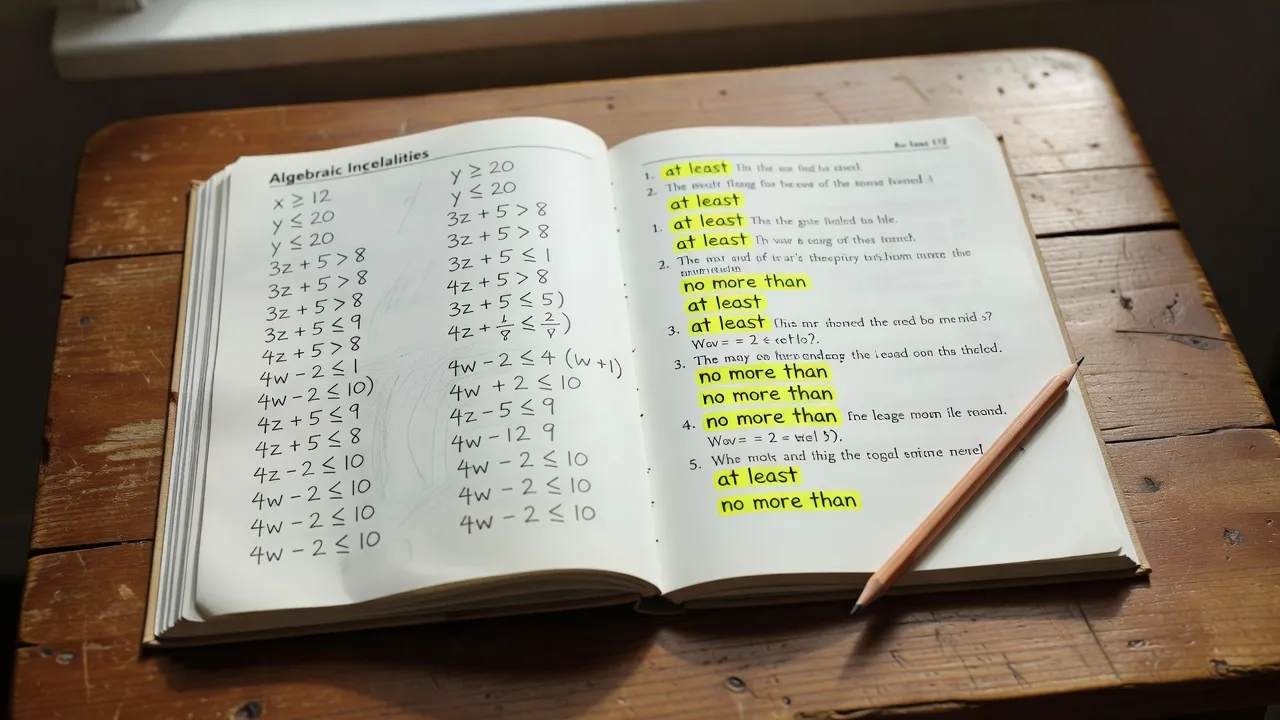
Step 1: Identify the unknown quantity and set a variable
To start any inequality word problem, identify the missing number the prompt asks you to find and assign it a clear letter variable. Read the last sentence of the word problem first, as it almost always defines the target value.
For example, if a problem asks for the minimum number of cupcakes you need to sell to earn $100, let $c$ represent the number of cupcakes. Writing down "Let $c$ = number of cupcakes" keeps your target clear before you touch any numbers.
Failing to define the variable early leads to setting up equations with mismatched units, such as adding dollars directly to item counts.
Step 2: Translate signal phrases into inequality symbols
Translating key English phrases into the correct math inequality symbol is the most important part of setting up your equation. Word problems use distinct language patterns to set boundary conditions rather than exact equality.
Phrases like "at least" or "no less than" mean the value can equal the limit or go higher, which corresponds to the greater-than-or-equal-to symbol ($\ge$). Conversely, phrases like "at most" or "no more than" indicate a maximum threshold, requiring the less-than-or-equal-to symbol ($\le$).
| Phrase in Word Problem | Mathematical Meaning | Inequality Symbol | Example Statement |
|---|---|---|---|
| "At least", "No less than", "Minimum of" | Greater than or equal to | $\ge$ | Must be at least 18 years old ($a \ge 18$) |
| "At most", "No more than", "Maximum of" | Less than or equal to | $\le$ | Elevator capacity is at most 2,000 lbs ($w \le 2000$) |
| "More than", "Exceeds", "Greater than" | Strictly greater than | $>$ | Score exceeded 90 points ($s > 90$) |
| "Less than", "Under", "Fewer than" | Strictly less than | $<$ | Under 12 years old ($a < 12$) |
Mastering these signal phrases takes practice across multiple problem types. You can test your recall using custom study sets or a digital hw help app to practice converting text into mathematical notation.
Step 3: Construct the linear or multi-step inequality
Building the inequality requires combining your variable, given constants, and the translated comparison symbol into a single algebraic statement. Group your starting quantities, recurring operational rates, and maximum or minimum boundaries on their respective sides of the symbol.
Consider this problem: A phone plan charges $30 per month plus $0.05 per text message, and you want to keep your bill at no more than $50. Your fixed cost is 30, your variable rate is $0.05t$, and your ceiling is 50.
Combining these elements yields the expression $30 + 0.05t \le 50$. Notice that "no more than" dictates the $\le$ sign because the total cost cannot exceed 50.
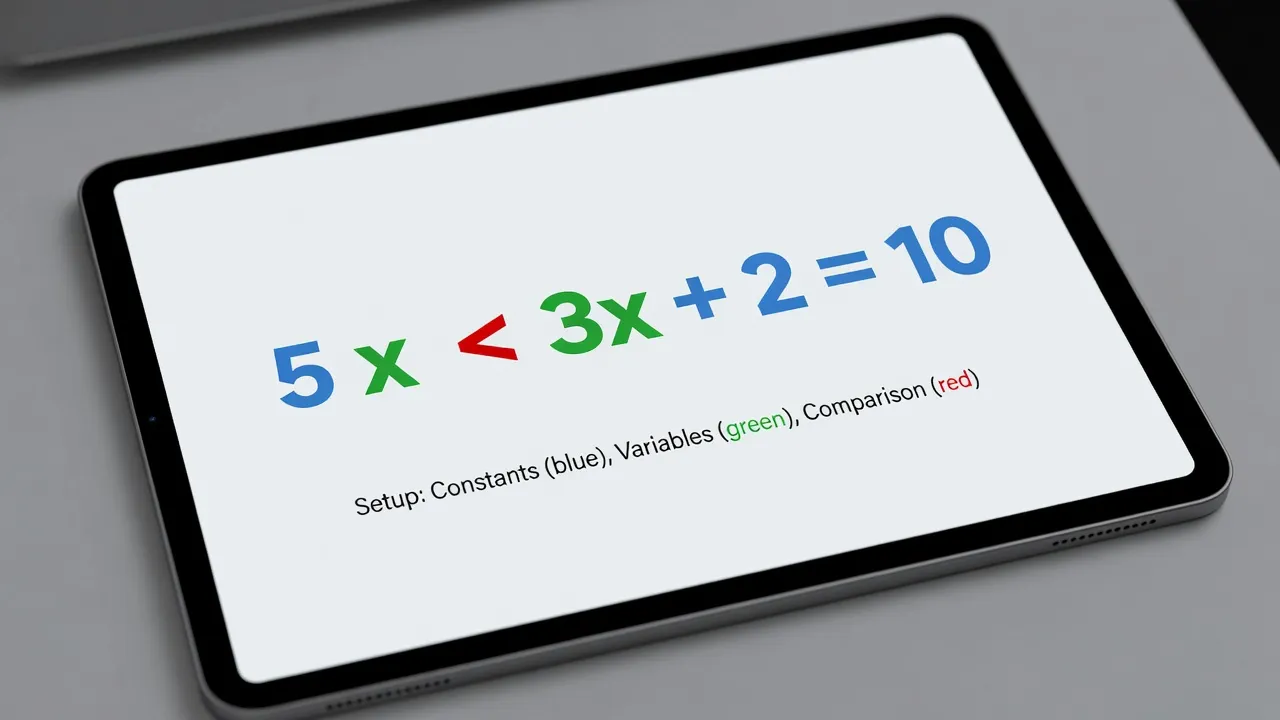
Step 4: Solve the inequality using inverse operations
Isolate the variable on one side of the symbol by applying standard algebraic inverse operations, making sure to flip the inequality sign whenever you multiply or divide by a negative number. You treat inequalities almost identical to standard equations, with one critical rule exception.
To solve $30 + 0.05t \le 50$, start by subtracting 30 from both sides to get $0.05t \le 20$. Next, divide both sides by 0.05, which yields $t \le 400$.
- Start with the inequality: 30 + 0.05t ≤ 50
- Subtract 30 from both sides: 0.05t ≤ 20
- Divide both sides by 0.05: t ≤ 400
If you ever divide or multiply by a negative coefficient, such as solving $-2x < 10$, you must reverse the direction of the symbol to keep the math true ($x > -5$).
If you get stuck verifying whether a sign flip applies to your problem, taking a photo of your written steps with the ThinkAssist iOS App provides immediate line-by-line feedback.
Step 5: Interpret and check the solution set
Verify your final answer by picking a reasonable test value from your solution set and plugging it back into the original word problem text. Inequality solutions represent a whole range of possibilities rather than a single fixed answer.
In the phone bill example, the mathematical solution is $t \le 400$. In real-world context, this means you can send anywhere from 0 up to 400 text messages while staying within your $50 budget limit.
Test the boundary by plugging in 400 messages: $30 + 0.05(400) = 50$, which matches your budget limit. Then test an invalid number like 401: $30 + 0.05(401) = 50.05$, which violates the "no more than $50" condition and confirms your boundary line is correct.
Are there Math-Aids worksheets for inequality word problems with 'at least'/'no more than'?
Yes, Math-Aids offers customizable worksheets specifically designed for math inequalities word problems containing phrases like 'at least' and 'no more than'. Their dynamic PDF generator lets you pick the exact topic, variable style, and difficulty range you need.
You can select single-variable or two-step inequality configurations on the Math-Aids website without paying any subscription fees. The main drawback is that the generated sheets rely heavily on static templates, which can feel repetitive after a few practice sets.
For students who want extra practice beyond standard printed sheets, pairing a downloadable two step equations worksheet with interactive digital tools ensures you get both variable repetitions and immediate answer checking.

Are there Purplemath worksheets or practice problems for inequality word problems?
Yes, Purplemath provides free step-by-step written tutorials and embedded practice problems covering single-variable and compound inequality word problems. The site focuses on practical strategies for dissecting complex phrasing into logical mathematical statements.
Rather than providing endless printable drill sheets, Purplemath excels at explaining why specific words turn into specific inequality symbols. Their tutorials show complete written solutions for classic scenarios like grade averages, speed limits, and profit thresholds.
The platform is completely free to read, though the site layout includes ad placements between step-by-step solution breakdowns.
Are there Khan Academy practice problems for inequality word problems?
Yes, Khan Academy features dedicated interactive practice modules and video lessons for linear inequality word problems. Their platform automatically checks your inputs, offers real-time hints, and tracks your mastery across grade levels.
As of August 2026, Khan Academy remains 100% free for students and teachers. You can access targeted practice sets specifically titled "Linear inequality word problems" within their Algebra 1 course.
Their system gives immediate visual feedback when you select the wrong inequality symbol, making it ideal for self-directed review.
Khan Academy Workflow:
- Watch Video Lesson
- Attempt 4-Question Drill
- Review Step-by-Step Hints
Are there Art of Problem Solving practice problems for inequality word problems?
Yes, Art of Problem Solving (AoPS) offers advanced inequality word problems through its Alcumus adaptive practice engine and contest preparation textbooks. These problems are significantly more challenging than standard high school algebra questions.
The questions hosted on Art of Problem Solving target competition math contexts like AMC 8 and MATHCOUNTS. While basic access to Alcumus is free, their online structured courses and primary textbooks require a paid purchase.
If you are aiming for top-tier scores or math competitions, AoPS provides challenging word problems that force you to combine multi-step inequalities with logic proofs.
Are there mathisfun.com practice problems for inequality word problems with 'at least'/'no more than'?
Yes, mathisfun.com includes clear explanations and self-checking interactive quiz questions that feature 'at least' and 'no more than' word problems. Their practice sections present word problems with simple visual diagrams and step-by-step solution toggles.
The site at Math is Fun is free to access and uses straightforward language aimed at middle school and introductory algebra students. Each problem set lets you check your work instantly and reveals the full worked solution if you get stuck.
While the site design is plain, its clear breakdown of inequalities makes it an effective refresher for basic symbol translation.
Common traps to avoid in inequality word problems
Even when you know the five steps, small calculation traps can ruin an otherwise correct setup. Spotting these common mistakes early saves significant time on homework and exams.
- Forgetting to flip the symbol: When multiplying or dividing both sides by a negative coefficient, you must flip the inequality direction (e.g., $-3x \le 12$ becomes $x \ge -4$).
- Misinterpreting inclusive boundaries: Words like "more than" strictly mean $>$, whereas "at least" means $\ge$. Pay close attention to whether the boundary value is included.
- Ignoring negative practical constraints: When calculating real-world objects like tickets or hours worked, your solution set cannot practically go below zero ($x \ge 0$).
- Swapping variable sides without reversing the sign: Writing $5 > x$ is mathematically identical to $x < 5$, but students often misread $5 > x$ as "x is greater than 5."
When practicing late at night, double-checking your logic against an automated solver helps reinforce correct habits. ThinkAssist provides automatic subject detection and instant step-by-step explanations, allowing you to catch sign-reversal errors before turning in assignments.
Frequently Asked Questions
What is the difference between "at least" and "more than" in math word problems?
"At least" means the quantity can be equal to or greater than the given number, represented by the greater-than-or-equal-to symbol ($\ge$). "More than" means the quantity must be strictly greater than the number, represented by the greater-than symbol ($>$), excluding the boundary value itself.
How do you know when to flip the inequality sign in a word problem?
You flip the inequality sign whenever you multiply or divide both sides of the inequality by a negative number during the algebraic isolation step. Adding or subtracting negative values does not change the direction of the inequality sign.
What does "no more than" mean in an inequality?
"No more than" sets an upper limit on a value, meaning the quantity can be less than or equal to the specified number. It is represented mathematically by the less-than-or-equal-to symbol ($\le$).
Can an inequality word problem have a negative answer?
In pure algebra, yes, an inequality solution set can contain negative numbers. However, in real-world word problems involving physical items like time, money, or distance, answers are typically restricted to non-negative values ($x \ge 0$).
Are there free online apps that help solve inequality word problems step-by-step?
Yes, tools like ThinkAssist let you photograph written math inequality problems to receive instant, step-by-step breakdowns. Platforms like Khan Academy also offer free interactive practice exercises with built-in hint systems.
What is a compound inequality word problem?
A compound inequality word problem involves two distinct conditions joined by the words "and" or "or." An "and" problem requires the solution to satisfy both boundaries simultaneously (such as $10 \le x \le 20$), while an "or" problem requires satisfying at least one condition.