
To solve word problems in math, read the text twice to isolate the final question, assign variables to unknown quantities, translate the word phrases into an equation, solve the math statement, and verify that your numerical answer makes practical sense. This 5-step framework transforms confusing math paragraphs into simple equations in 3 to 5 minutes per problem. Applying a consistent translation method helps students avoid common translation traps across basic arithmetic, middle-school algebra, and high-school calculus word problems.
Solving word math problems remains one of the trickiest skills in STEM education because it forces your brain to switch between reading comprehension and numerical logic. As of August 2026, modern math standards emphasize problem-solving frameworks over rote memorization, meaning exams test how well you structure a problem rather than just whether you can multiply numbers.
The standard roadmap below breaks down what you need for each phase of a word problem.
| Step | Objective | Realistic Time | Required Tools |
|---|---|---|---|
| 1. Target Extraction | Identify the final question and label knowns vs. unknowns. | 30-60 seconds | Highlighter or scratch paper |
| 2. Variable Mapping | Assign letters (like $x$ or $y$) to missing values and list given numbers. | 30-45 seconds | Pencil and paper |
| 3. Equation Setup | Translate operational keywords into arithmetic operators ($+$, $-$, $\times$, $\div$). | 60-90 seconds | Translation reference sheet |
| 4. Computation | Work through algebraic steps or use an AI tool to calculate the answer. | 60-120 seconds | Calculator or ThinkAssist |
| 5. Context Check | Verify units and test if the answer satisfies original real-world conditions. | 30-60 seconds | Mental check |
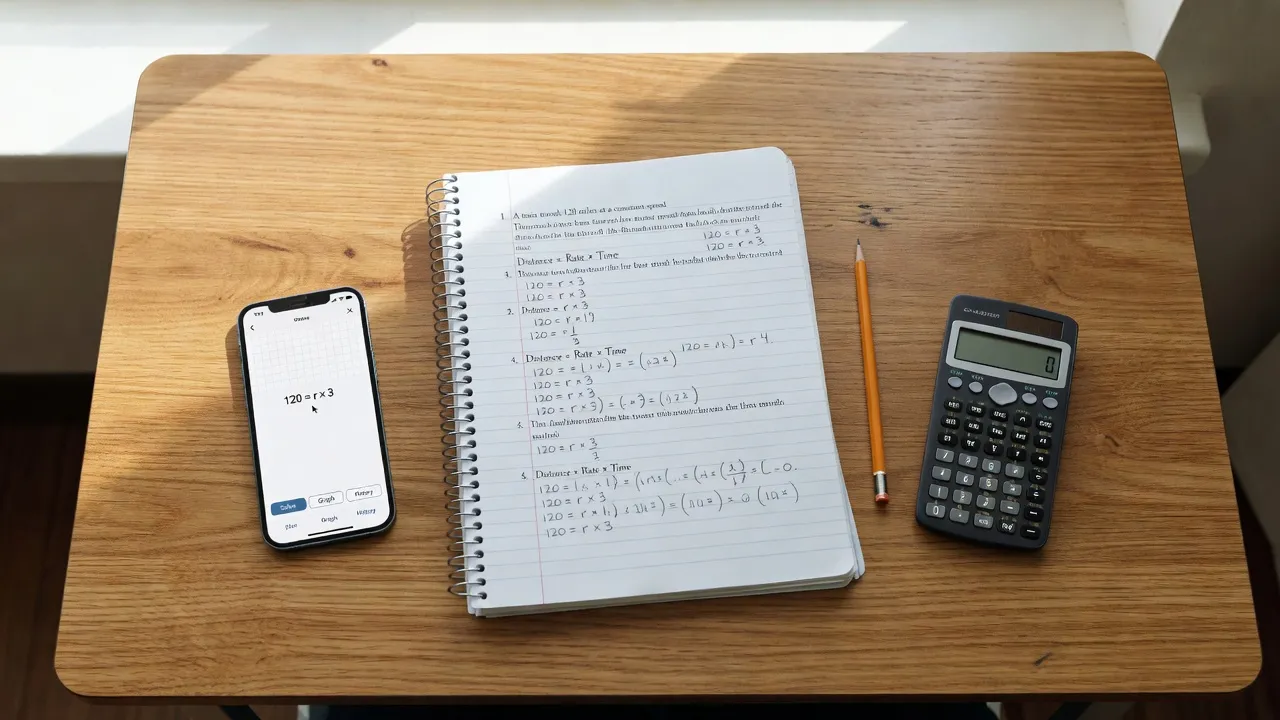
Step 1: Read the problem actively to isolate the core question
To isolate the core question in a math word problem, read the entire text twice and highlight the sentence ending with a question mark. The biggest mistake students make is grabbing the numbers right away and performing random arithmetic before understanding what the problem asks them to calculate.
During your first pass, read the text like a story without focusing on the figures. During your second pass, zero in on the final sentence. According to math instruction guidelines from the National Council of Teachers of Mathematics, students who restate the target question in their own words before doing math double their chances of setting up the right equation.
What operational keywords signal specific math steps?
Operational keywords are specific English words that signal addition, subtraction, multiplication, division, or equality. Memorizing these linguistic triggers allows you to convert English sentences into mathematical operations quickly.
- Addition triggers: "Sum," "total," "altogether," "increased by," "combined," "in addition to."
- Subtraction triggers: "Difference," "fewer than," "decreased by," "less than," "remains."
- Multiplication triggers: "Product," "times," "of" (especially with fractions or percentages), "per," "at this rate."
- Division triggers: "Ratio," "quotient," "split equally," "per unit," "out of."
- Equals triggers: "Is," "was," "yields," "amounts to," "gives."
Be careful with phrases like "less than." For example, "5 less than $x$" translates to $x - 5$, not $5 - x$. Order matters in subtraction and division.
Step 2: Extract variables and map out given data
Extract variables by writing down every number given in the text alongside a letter that stands for the unknown quantity. Organizing the raw facts in a column on scratch paper removes conversational distractions from the story problem.
For example, if a problem states, "Elena bought 3 notebooks and a $5 pen for a total of $20," you convert that text into three distinct data points:
- Notebook count = 3
- Pen price = $5
- Total cost = $20
- Unknown ($x$) = Price of one notebook
If you get stuck trying to map complex math scenarios, using a digital homework tool can clarify how to label variables. If you ask yourself how do I solve this math problem, snapping a photo with an app like ThinkAssist automatically detects the subject and extracts the primary data points for you.

Step 3: Translate verbal phrases into algebraic equations
To translate verbal phrases into equations, replace the defined operational keywords with math symbols and connect the known values to your variable. This builds the actual mathematical structure you need to solve.
Let's look at the notebook example from Step 2. "Elena bought 3 notebooks ($x$) and a $5 pen for a total ($=$) of $20."
- "3 notebooks" becomes $3x$.
- "and a $5 pen" becomes $+ 5$.
- "total of $20" becomes $= 20$.
Putting it together gives the linear equation: $3x + 5 = 20$.
If your assignment involves systems of linear equations or quadratic models, practice breaking down the relationship into two distinct steps. For multi-step practice, working through a structured two step equations worksheet helps build muscle memory for these word-to-symbol conversions.
Word Sentence:  "Three times a number increased by five equals twenty"
                     │    │       │         │       │      │      │
Math Symbols:        3  · x       +         5       =     20
                     └────────────┬─────────┘       └──────┘
Equation:                      3x + 5              =  20
Step 4: Solve the equation using standard math rules
Solve the equation by using inverse operations to isolate the unknown variable on one side of the equals sign. Balance the equation by performing the exact same arithmetic action on both sides until your variable stands alone.
Using our equation $3x + 5 = 20$:
- Subtract 5 from both sides to eliminate the constant: $3x = 15$.
- Divide both sides by 3 to eliminate the coefficient: $x = 5$.
    3x + 5 = 20
        - 5   - 5   (Subtract 5 from both sides)
   ─────────────
        3x = 15
        ──   ──     (Divide both sides by 3)
         3    3
         x = 5
How do AI solvers assist when you get stuck on complex calculations?
AI math solvers analyze written text using Optical Character Recognition (OCR) to convert word problems into step-by-step mathematical proofs. As of 2026, educational AI apps do not just give you the final answer; they walk you through the logical progression so you can learn the setup method.
If you hit a wall while solving word math problems at night, an ai homework helper app like ThinkAssist functions as a 24/7 personal tutor. You snap a picture of the textbook page, and the app breaks the text down into clear, understandable steps. This gives you instant assistance on assignments without waiting for classroom hours.
Step 5: Check your solution against the original real-world context
To check your solution, plug your numerical answer back into the original story text to see if the sentence remains logically and physically true. Do not just check your equation—check the wording of the problem itself.
In our notebook example, if $x = 5$, test the original story: "3 notebooks at $5 each ($15) plus a $5 pen equals $20." The numbers match the problem statement.
Checking real-world logic also helps you catch impossible outputs. According to the Wikipedia page on Word Problems, logical sanity checks prevent errors like offering negative time measurements or fractional human beings in rate and population questions.
- Is the sign correct? Distance, age, and physical items cannot be negative.
- Are the units correct? If the question asks for time in minutes, but your formula yielded hours, convert the units before turning in your work.
- Is the scale realistic? A word problem calculating a person's walking speed should not produce an answer of 300 miles per hour.
How to approach multi-step word math problems
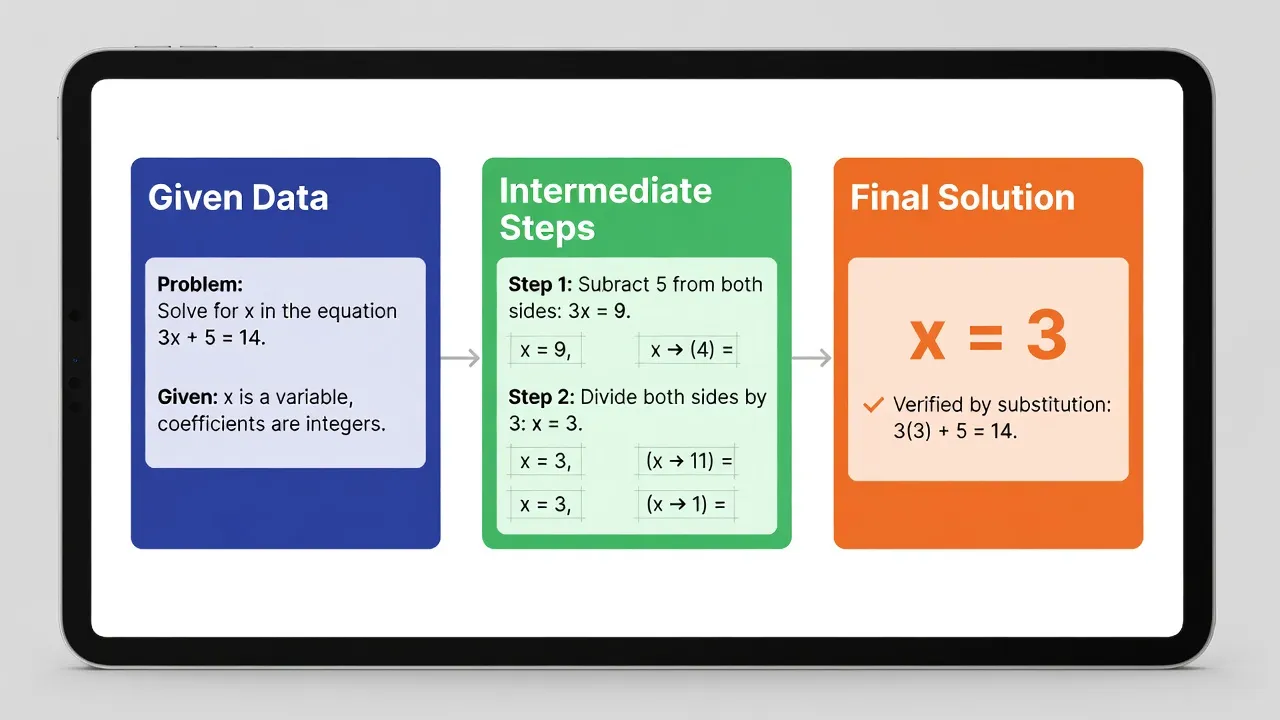
To solve multi-step word math problems, break the narrative down into sequential sub-problems and solve each part one at a time. Multi-step problems contain hidden intermediate steps that you must calculate before you can answer the final question.
Consider this rate problem: "a bakery makes 120 cupcakes every morning. They sell 75% of them by noon at $3 each, and sell the remaining cupcakes in the afternoon at a 50% discount. How much total revenue does the bakery make?"
To tackle this without feeling overwhelmed, break the work down into three smaller sub-problems:
- Calculate morning sales volume: $75%$ of $120 = 0.75 \times 120 = 90$ cupcakes.
- Calculate morning revenue: $90 \times $3 = $270$.
- Calculate afternoon sales volume and discount price:
- Remaining cupcakes = $120 - 90 = 30$ cupcakes.
- Discounted price = $$3 \times 0.50 = $1.50$.
- Afternoon revenue = $30 \times $1.50 = $45$.
- Sum total revenue: $$270 + $45 = $315$.
By treating each sentence as its own mini-equation, you remove the stress of trying to manage the entire math problem all at once.
What changed in math word problems in 2026?
Math word problems in 2026 emphasize real-world data literacy, multi-variable constraints, and open-ended scenario modeling rather than simple trick-keyword templates. Standardized testing curricula updated their guidelines to make word problems test true critical thinking instead of simple pattern matching.
Historically, students relied on basic keyword shortcuts (like assuming "and" always meant addition). However, curriculum updates documented by online learning platforms like Khan Academy show that modern test problems deliberately use keywords in complex ways to discourage memorization shortcuts.
Here is what has changed in recent math assignments:
- Irrelevant Data Ingestion: Problems now intentionally include extra numbers that are not needed for the calculation, forcing students to read critically.
- Contextual Unit Conversions: Problems frequently mix measurement units within the same sentence (e.g., combining meters per second with miles per hour).
- AI-Assisted Verification: Modern classrooms encourage students to use AI solvers to check their steps and identify translation mistakes independently.
Frequently Asked Questions
Why are math word problems so difficult to understand?
Math word problems require both reading comprehension and numerical reasoning at the same time. Students often struggle because they try to calculate numbers immediately without first translating the verbal scenario into a clear mathematical equation.
What is the most common mistake when solving word math problems?
The most common mistake is misinterpreting order-sensitive operational phrases, such as confusing "5 less than a number" ($x - 5$) with "5 minus a number" ($5 - x$). Another frequent error is forgetting to convert units before finishing the problem.
How can I tell if a word problem requires addition or multiplication?
Addition represents combining distinct amounts together, while multiplication represents combining equal groups repeatedly. Look for phrases like "per," "each," or "at a rate of" to signal multiplication.
Can AI apps solve handwritten word math problems?
Yes, modern AI homework solver apps use optical character recognition to read and process handwritten text from notebook pages. Apps like ThinkAssist scan the handwriting, interpret the problem statement, and generate step-by-step solutions.
How do I identify extra or unnecessary information in a math word problem?
Identify unnecessary information by first highlighting the exact target question at the end of the problem. Any number or statement that does not directly influence that final target calculation can be crossed out before you begin writing your equation.
How long should it take to solve a high school algebra word problem?
A standard single-variable or two-step algebra word problem typically takes 3 to 5 minutes to solve manually. Complex multi-step scenarios or mixture problems may require 5 to 8 minutes to read, model, and calculate properly.
What should I do if my calculated word problem answer doesn't make sense?
If your answer yields an impossible result—such as negative distances, fractional people, or unrealistic speeds—go back to Step 3 and re-verify your equation translation. Check your positive and negative signs and make sure you applied inverse operations correctly.