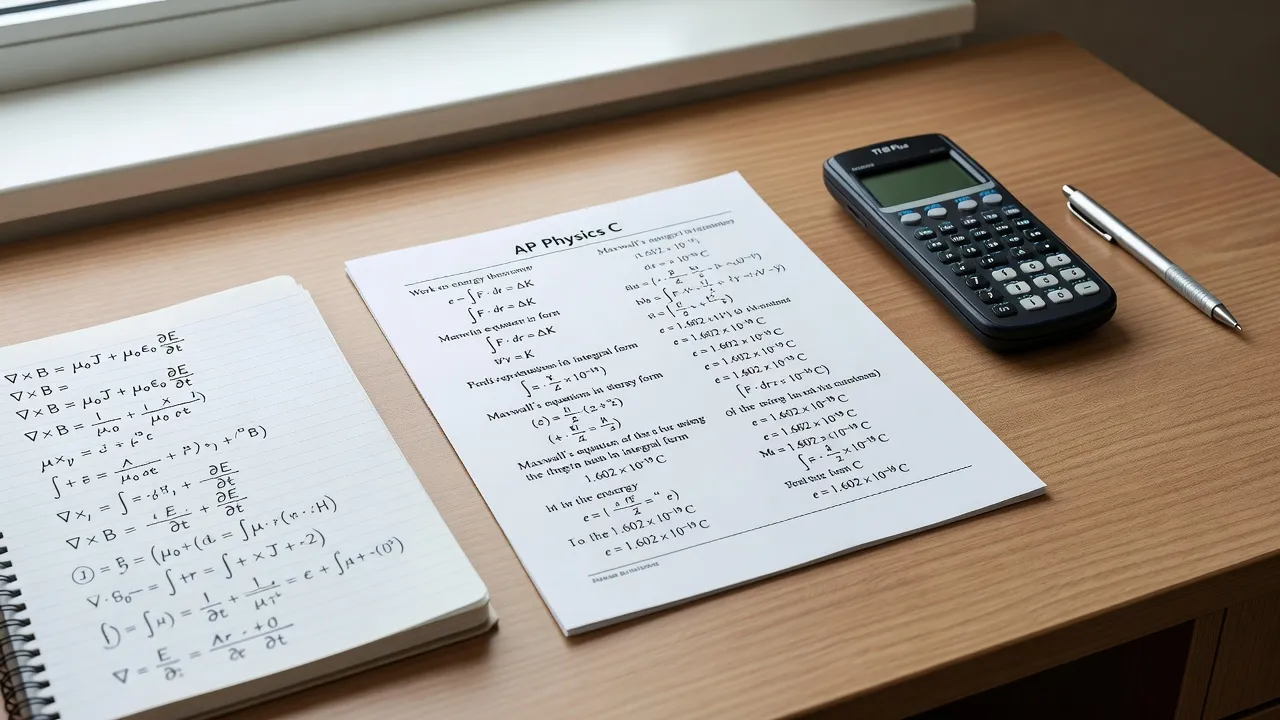
The AP Physics C equation sheet is an official formula reference provided by the College Board during both the AP Physics C: Mechanics and AP Physics C: Electricity and Magnetism exams. It contains fundamental constants, trigonometric identities, common conversion factors, and foundational physics equations across calculus-based mechanics and electromagnetism. However, relying on it blindly will cost you points because it intentionally omits calculus derivations, specific geometric moments of inertia, and boundary conditions.
As of August 2026, the College Board continues to structure the AP Physics C curriculum around calculus-based problem solving. This means the equation sheet acts as a structural frame rather than a complete answer key. If you do not know how to convert standard algebraic expressions into differential equations, having the reference sheet on your desk will not help you on exam day.
Using a supplemental study app like ThinkAssist during your homework sessions can help you bridge the gap between static formula lists and dynamic calculus derivations. By breaking complex multi-step physics problems into clear conceptual stages, ThinkAssist helps you learn which steps require integration or differentiation rather than simple variable substitution.
What is on the AP Physics C equation sheet?
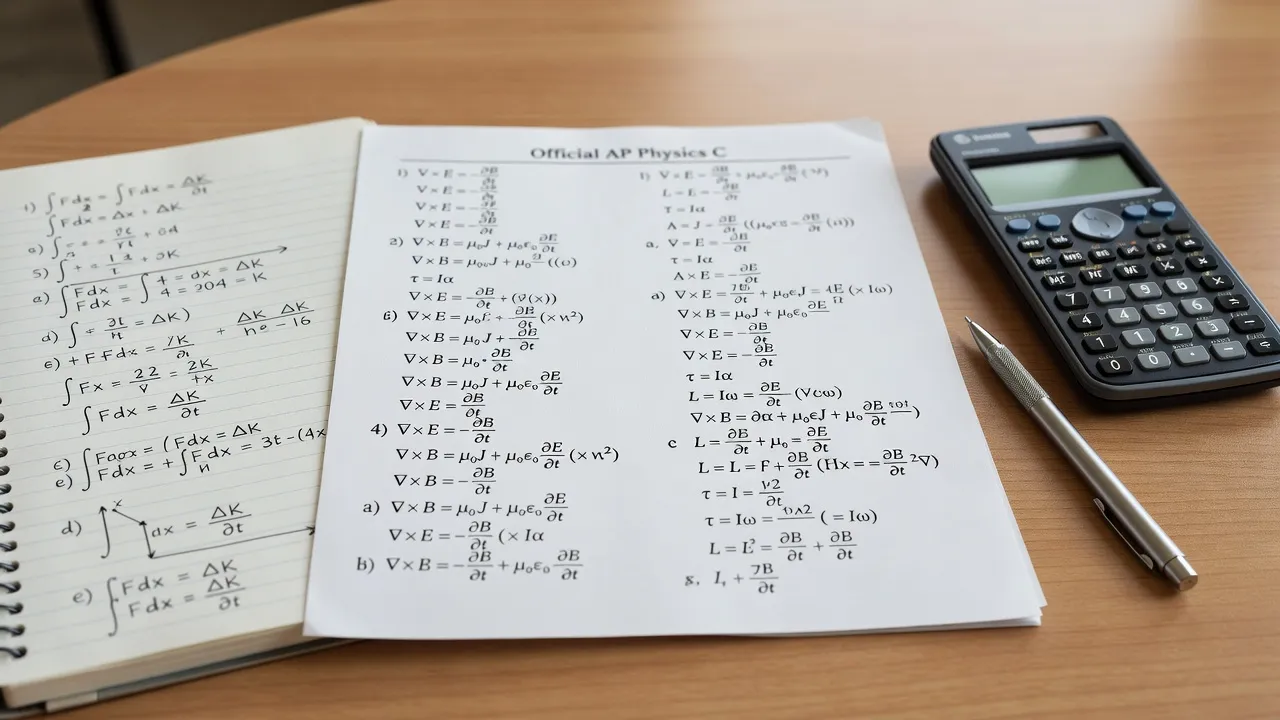
The AP Physics C equation sheet contains five main reference sections: physical constants and conversion factors, unit symbols, common mathematical prefixes, trigonometric functions, and core equations for Mechanics and Electricity & Magnetism. The reference guide is designed to eliminate the need to memorize raw numbers like Coulomb's constant or the universal gravitational constant.
The official document spans four pages and is divided cleanly so students can reference fundamental concepts quickly:
- Constants and Conversion Factors: Values such as proton mass ($m_p \approx 1.67 \times 10^{-27}\text{ kg}$), speed of light ($c \approx 3.00 \times 10^8\text{ m/s}$), vacuum permittivity ($\epsilon_0 \approx 8.85 \times 10^{-12}\text{ C}^2/\text{N}\cdot\text{m}^2$), and standard acceleration due to gravity ($g = 9.8\text{ m/s}^2$).
- Prefixes and Unit Symbols: Standard SI prefixes ranging from giga ($10^9$) to pico ($10^{-12}$), alongside standard units for electric flux, magnetic field strength, and mechanical energy.
- Geometric and Trigonometric Formulas: Area and volume expressions for spheres, cylinders, and rectangles, plus basic right-triangle definitions for sine, cosine, and tangent.
- Core Physics Equations: Algebraic formulas for kinematics, Newton's laws, work and energy, linear momentum, rotational motion, simple harmonic motion, gravitation, electrostatics, capacitors, circuits, magnetic fields, and electromagnetism.
You can download the full, current reference tables directly from the official College Board AP Central repository.
What key formulas are missing from the Physics C equation sheet?
The AP Physics C equation sheet intentionally omits intermediate calculus steps, specific moments of inertia, vector cross-product rules, and circuit response equations. The College Board expects students to derive specialized equations using calculus rather than memorizing exhaustive lists of situational formulas.
If you only study what is printed on the sheet, you will run into hard limits during free-response questions (FRQs). Here are the primary concepts left off the official sheet:
1. Specific Moments of Inertia
The equation sheet lists the general definition for moment of inertia ($I = \sum m_i r_i^2 = \int r^2 dm$), but it only provides a few common geometric shapes. You will not find formulas for a thin spherical shell, a non-uniform rod with variable density ($\lambda(x)$), or an off-axis rotating disk. You are expected to evaluate $I = \int r^2 dm$ using direct calculus integration.
2. Differential Forms of Motion
While basic derivative relationships like $v = \frac{dx}{dt}$ and $a = \frac{dv}{dt}$ are listed, the sheet leaves out variable-force equations. If force depends on time ($F(t)$), velocity ($F(v)$), or position ($F(x)$), you must set up and solve a differential equation. For instance, drag force problems ($F_{drag} = -bv$) require integrating $\int \frac{dv}{v}$ to derive exponential velocity decay, which is nowhere on the sheet.
3. Maxwell-Ampere and Electromagnetic Induction Details
The sheet presents Gauss's Law ($\Phi_E = \oint \vec{E} \cdot d\vec{A} = \frac{Q_{encl}}{\epsilon_0}$) and Ampere's Law ($\oint \vec{B} \cdot d\vec{l} = \mu_0 I$), but leaves out specific symmetrical evaluations. You must know how to set up Gaussian surfaces (spheres, cylinders, pillboxes) and Amperian loops without step-by-step guidance.
4. RC, RL, and LC Circuit Time Constants
The formula sheet provides the relationship for capacitive reactance and basic energy storage, but omits the explicit time-dependent charging and discharging equations:
$$I(t) = I_0 e^{-t/\tau}$$
$$Q(t) = Q_{max}\left(1 - e^{-t/RC}\right)$$
Understanding how differential equations produce these exponential curves is a core requirement of the course.
AP Physics C reference sheet breakdown: Provided vs. required knowledge
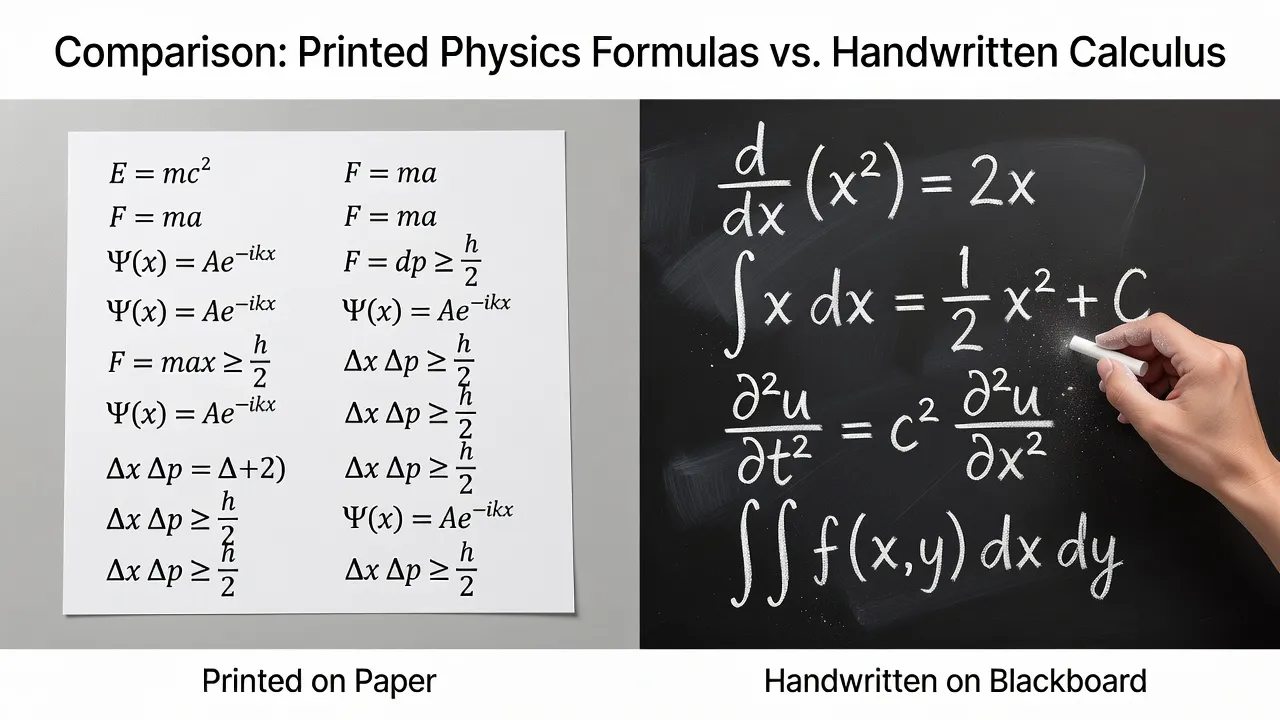
The table below outlines what the AP Physics C equation sheet gives you versus the mathematical logic you must bring to the exam yourself:
| Physics Topic | Equations Provided on Sheet | Missing Concepts You Must Derive or Know |
|---|---|---|
| Kinematics & Dynamics | $v_x = v_{x0} + a_x t$ $x = x_0 + v_{x0}t + \frac{1}{2}a_x t^2$ | Position from variable acceleration: $x(t) = x_0 + \int v(t) dt$. Terminal velocity derivations via differential equations. |
| Rotational Motion | $\omega = \omega_0 + \alpha t$ $\tau = r F \sin\theta$ $I = \int r^2 dm$ | Moment of inertia of non-uniform rods using $\lambda(x) dx$. Parallel Axis Theorem ($I = I_{cm} + MD^2$). |
| Work & Energy | $K = \frac{1}{2}m v^2$ $\Delta U = -W = -\int \vec{F} \cdot d\vec{r}$ | Finding conservative forces from potential energy functions using gradients ($F_x = -\frac{dU}{dx}$). |
| Simple Harmonic Motion | $T = 2\pi\sqrt{\frac{m}{k}}$ $T = 2\pi\sqrt{\frac{L}{g}}$ | Physical pendulum period ($T = 2\pi\sqrt{\frac{I}{mgD}}$). Differential form of SHM: $\frac{d^2x}{dt^2} + \omega^2 x = 0$. |
| Electrostatics | $\vec{F}_E = \frac{1}{4\pi\epsilon_0}\frac{q_1 q_2}{r^2}\hat{r}$ $V = \frac{1}{4\pi\epsilon_0}\sum \frac{q_i}{r_i}$ | Electric field from continuous charge distributions using $\vec{E} = \frac{1}{4\pi\epsilon_0}\int \frac{dq}{r^2}\hat{r}$. Electric field from potential gradient ($\vec{E} = -\nabla V$). |
| Circuits (DC & Calculus) | $R_s = \sum R_i$ $C_p = \sum C_i$ $\mathcal{E} = -L\frac{dI}{dt}$ | Time-dependent charge/current equations for charging/discharging RC and RL circuits. LC circuit oscillation frequency ($\omega = \frac{1}{\sqrt{LC}}$). |
| Magnetism & Induction | $\vec{F}_B = q\vec{v}\times\vec{B}$ $\oint \vec{B}\cdot d\vec{l} = \mu_0 I$ | Biot-Savart Law application for finite line segments or circular loops. Displacement current term in Ampere-Maxwell Law. |
When tackling difficult practice sets or homework assignments involving these derived expressions, checking your step-by-step logic matters just as much as getting the right final number. Using an ai homework helper app like ThinkAssist allows you to scan a problem and immediately see how calculus integrals link back to the simplified formulas on your equation sheet.
How is the AP Physics C equation sheet structured for Mechanics vs. E&M?
The College Board splits the Physics C equation sheet into two distinct topical sections: Mechanics equations on page two, and Electricity & Magnetism equations on page three. While both sections share the same constants and mathematical reference pages, they cover separate course modules that are often tested in different exam blocks.
Mechanics Equation Section
The Mechanics section focuses entirely on classical Newtonian mechanics. Equations are organized into sub-groups:
- Linear Motion and Newton's Laws: Net force equations ($\sum \vec{F} = m\vec{a} = \frac{d\vec{p}}{dt}$), impulse-momentum theorem ($\vec{J} = \int \vec{F} dt = \Delta \vec{p}$), and friction force limits ($F_f \le \mu F_N$).
- Work, Energy, and Power: Work integral ($W = \int \vec{F} \cdot d\vec{r}$), kinetic energy, spring potential energy ($U_s = \frac{1}{2}k x^2$), and instantaneous power ($P = \vec{F} \cdot \vec{v} = \frac{dE}{dt}$).
- Rotation and Universal Gravitation: Rotational kinematics, angular momentum ($\vec{L} = \vec{r} \times \vec{p} = I\vec{\omega}$), rotational kinetic energy ($K_{rot} = \frac{1}{2}I\omega^2$), Newton's law of universal gravitation ($\vec{F}_g = -G\frac{m_1 m_2}{r^2}\hat{r}$), and gravitational potential energy ($U_g = -G\frac{m_1 m_2}{r}$).
Detailed physics resources like MIT OpenCourseWare's Classical Mechanics detail how these rotational and linear equations parallel each other line-by-line.
Electricity and Magnetism Equation Section
The E&M section shifts focus to electromagnetic field theory, charge dynamics, and electric circuits:
- Electrostatics and Capacitance: Coulomb's Law, electric potential definition ($V = -\int \vec{E} \cdot d\vec{r}$), potential due to point charges, and parallel-plate capacitance ($C = \epsilon_0 \frac{A}{d}$).
- Current, Resistance, and Circuits: Ohm's Law ($V = IR$), electrical resistance ($R = \frac{\rho l}{A}$), electric power ($P = IV$), and equivalent resistance/capacitance formulas for series and parallel networks.
- Magnetostatics and Induction: Magnetic force on moving charges and current-carrying wires ($\vec{F}_M = I\int d\vec{l} \times \vec{B}$), Biot-Savart Law, Magnetic Flux ($\Phi_B = \int \vec{B} \cdot d\vec{A}$), and Faraday's Law of Induction ($\mathcal{E} = -\frac{d\Phi_B}{dt}$).
How should you use the equation sheet during study sessions?
You should use the AP Physics C equation sheet as a secondary verification tool during study sessions, rather than relying on it to guide your problem-solving strategy. If you pause to search the equation sheet every time you start a problem, you will run out of time on exam day.
Here is a practical workflow to train yourself for maximum efficiency:
- Annotate your practice sheet early in the school year: Print out a clean copy of the official sheet. Whenever you learn a new calculus derivation in class, write the derivation steps right next to the corresponding base formula on your study copy.
- Identify core variables fast: Ensure you recognize every symbol instantly. For example, do not confuse $\mathcal{E}$ (electromotive force / EMF) with $E$ (electric field magnitude) or $\vec{E}$ (electric field vector).
- Practice converting integrals to algebraic forms: Train yourself to look at integral signs like $W = \int \vec{F} \cdot d\vec{r}$ and immediately ask: "Is the force constant?" If force is constant, you collapse the integral to $W = F d \cos\theta$. If force varies with position, you set up integration limits.
- Use step-by-step problem solvers when stuck: If you do not know how a solutions manual derived a formula from the reference sheet, use a photo solver app to see the missing steps. Taking a picture with ThinkAssist provides the intermediate calculus steps so you can see exactly how base formulas transform into final answers.
How calculus requirements change how you read the equation sheet
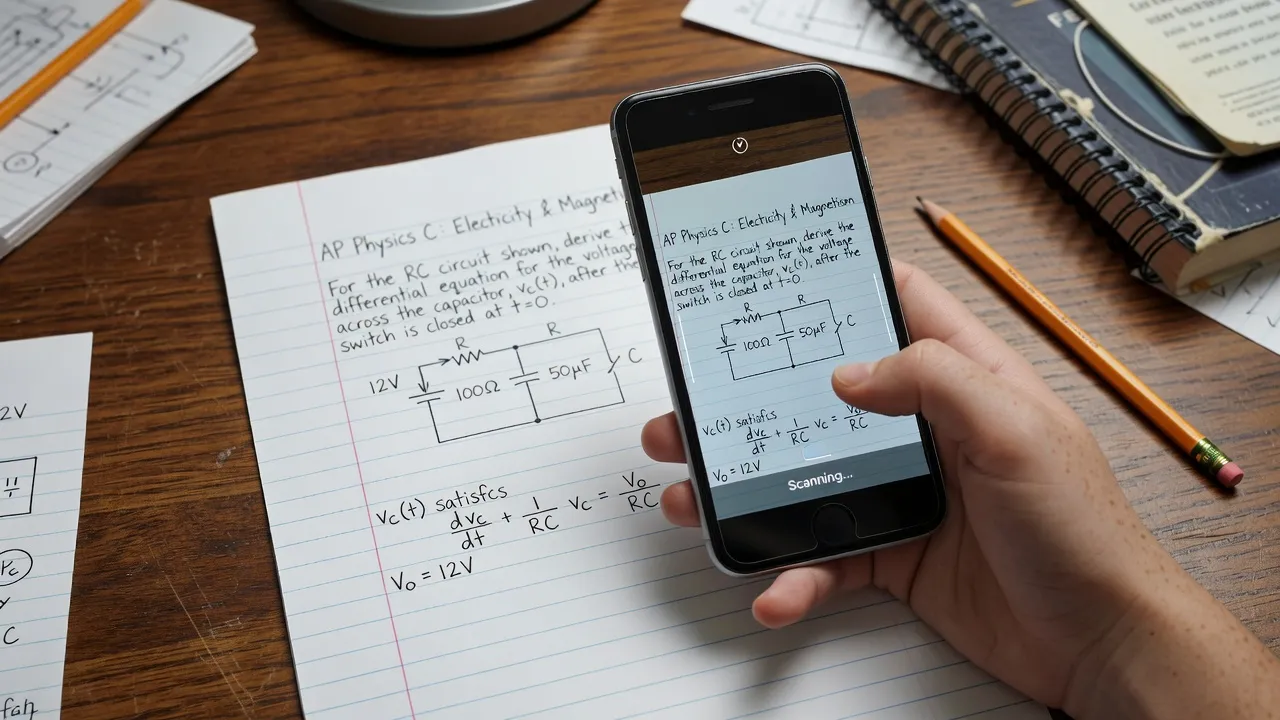
The presence of calculus means that many formulas on the AP Physics C equation sheet represent general differential or integral definitions rather than simple plug-and-chug equations. In AP Physics 1 (algebra-based), formulas give you direct answers. In AP Physics C, formulas give you relationship rules that you must evaluate using calculus.
Understanding how to translate these expressions is critical for both the multiple-choice and free-response sections.
1. Derivatives Represent Rates of Change
Whenever you see a fraction with a $d$ in the numerator and denominator, the equation sheet is telling you to take a derivative:
- $v = \frac{dx}{dt}$: Velocity is the first time derivative of position.
- $a = \frac{dv}{dt} = \frac{d^2x}{dt^2}$: Acceleration is the time derivative of velocity or the second derivative of position.
- $I = \frac{dq}{dt}$: Electric current is the rate at which charge passes through a boundary over time.
- $\mathcal{E} = -\frac{d\Phi_B}{dt}$: Induced voltage equals the negative rate of change of magnetic flux over time.
If a question asks for "the instantaneous rate at which power is delivered," you look for $P = \frac{dW}{dt}$ or $P = \vec{F} \cdot \vec{v}$.
2. Integrals Represent Accumulation Under a Curve
When you see the integral symbol ($\int$ or $\oint$), the formula requires summing continuous infinitesimal pieces:
- $U = -\int \vec{F} \cdot d\vec{r}$: Potential energy is the negative line integral of a conservative force over a path.
- $\Phi_E = \oint \vec{E} \cdot d\vec{A}$: Electric flux is the surface integral of the electric field passing through a closed spatial boundary (Gauss's Law).
- $\vec{B} = \frac{\mu_0}{4\pi} \int \frac{I d\vec{l} \times \hat{r}}{r^2}$: The total magnetic field from a current path requires integrating the Biot-Savart vector product along the entire length of wire.
For a broader breakdown of how mathematical vector fields operate in physics, consult Wikipedia's guide to equations in classical mechanics.
If you are struggling with setting up boundary limits for these integrals, searching for solutions with a query like how do i solve this math problem can walk you through finding the correct upper and lower integration bounds.
Common mistakes students make with the Physics C equation sheet
The most common mistake students make is treating the AP Physics C equation sheet like a comprehensive lookup table rather than a basic reference. Relying too heavily on printed formulas causes specific mistakes during exam pressure:
- Plugging non-constant values into constant-acceleration equations: Using $x = x_0 + v_0 t + \frac{1}{2}a t^2$ when acceleration depends on time ($a(t) = 3t^2$). You must integrate $a(t)$ twice instead.
- Ignoring vector dot and cross products: Formulas like $W = \int \vec{F} \cdot d\vec{r}$ use dot products (scalar results), while $\vec{\tau} = \vec{r} \times \vec{F}$ and $\vec{F}_B = q\vec{v} \times \vec{B}$ use cross products (vector results perpendicular to both inputs). Forgetting direction vectors leads to sign errors on free-response questions.
- Misapplying circular motion formulas: Assuming $a_c = \frac{v^2}{r}$ applies only to full circles. It applies to any point on an arbitrary curved path where $r$ is the local radius of curvature.
- Forgetting lower and upper integration bounds: Integrating $dW = F dx$ without plugging in the initial ($x_i$) and final ($x_f$) positions, leaving unwanted constant terms ($+ C$) in definite physics problems.
What calculators and materials are allowed alongside the equation sheet?
The College Board allows standard scientific or graphing calculators on both the Mechanics and Electricity & Magnetism sections of the AP Physics C exam, alongside the official equation sheet. There are no longer separate "calculator" and "no-calculator" portions; you have access to your graphing calculator and equation sheet throughout the entire test duration.
Key rules regarding exam day materials include:
- Approved Calculators: Graphing calculators with built-in equation solvers, numerical integration, and matrix capabilities (such as TI-84 Plus, TI-Nspire, or Casio FX series) are fully permitted.
- No Personal Reference Sheets: You cannot bring your own annotated formula sheet into the testing room. You must use the clean paper copy provided by the exam proctor.
- Rulers and Protractors: Protractors and straightedges are allowed on the exam to help draw clear force body diagrams (FBDs) and field lines.
Frequently Asked Questions
Do you get the AP Physics C equation sheet on both sections of the exam?
Yes, the College Board provides the full four-page equation sheet for both the AP Physics C: Mechanics exam and the AP Physics C: Electricity & Magnetism exam. You have access to the complete reference document regardless of whether you take one or both exams.
Are calculus integrals explicitly written on the Physics C equation sheet?
The sheet includes general integral signs for core definitions like potential energy ($U = -\int \vec{F} \cdot d\vec{r}$) and Gauss's Law ($\oint \vec{E} \cdot d\vec{A}$). However, it does not print standard calculus power rules, integration by parts formulas, or trigonometric integral identities.
Is the AP Physics 1 equation sheet the same as the AP Physics C sheet?
No, the AP Physics 1 and 2 equation sheets use purely algebraic notation and omit vector calculus notation entirely. The AP Physics C sheet includes differential equations, line/surface integrals, and cross products that do not appear on algebra-based reference sheets.
Can you write notes on the official equation sheet during the AP exam?
Yes, you are allowed to write notes, draw diagrams, and annotate the printed equation packet provided by the test proctor during the exam session. However, you cannot bring pre-written personal notes into the exam room.
What should I do if a formula I need isn't on the Physics C equation sheet?
If a formula is missing from the sheet, it means the problem requires you to derive that equation using fundamental principles. Start with a foundational law on the sheet (such as Newton's second law $\sum \vec{F} = m\vec{a}$ or Faraday's Law $\mathcal{E} = -\frac{d\Phi_B}{dt}$) and apply calculus to solve for the target variable.
Does the AP Physics C equation sheet change every year?
No, the AP Physics C formula sheet remains largely identical from year to year. Minor formatting updates or course alignment tweaks occur occasionally, but the core physical constants, unit conversion factors, and foundational equations stay constant.