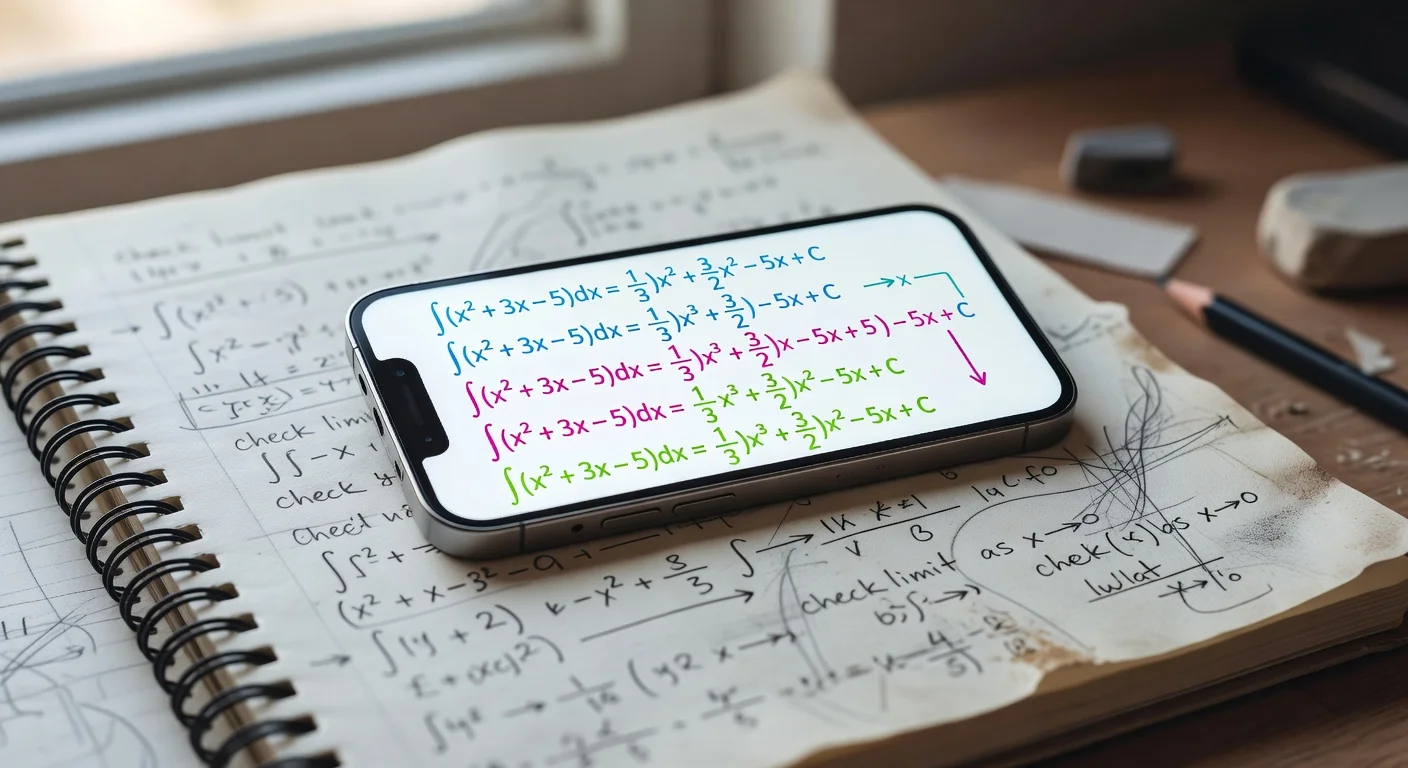
An app to solve math problems with steps is a mobile tool that uses optical character recognition (OCR) to read handwritten math and outputs line-by-step solutions. Unlike basic calculators, it breaks down the underlying logic so you understand the specific mechanics behind the final answer.
Massive user forums like r/HomeworkHelp show the landscape shifted dramatically in late 2025. Standard physical calculators are basically obsolete after testing 14 different mobile calculators this semester.
Textbook answer keys waste time. When you are stuck at 11 PM, you do not need just the final number. You need to know exactly which line of algebra you butchered.
How do AI math solver apps actually work?
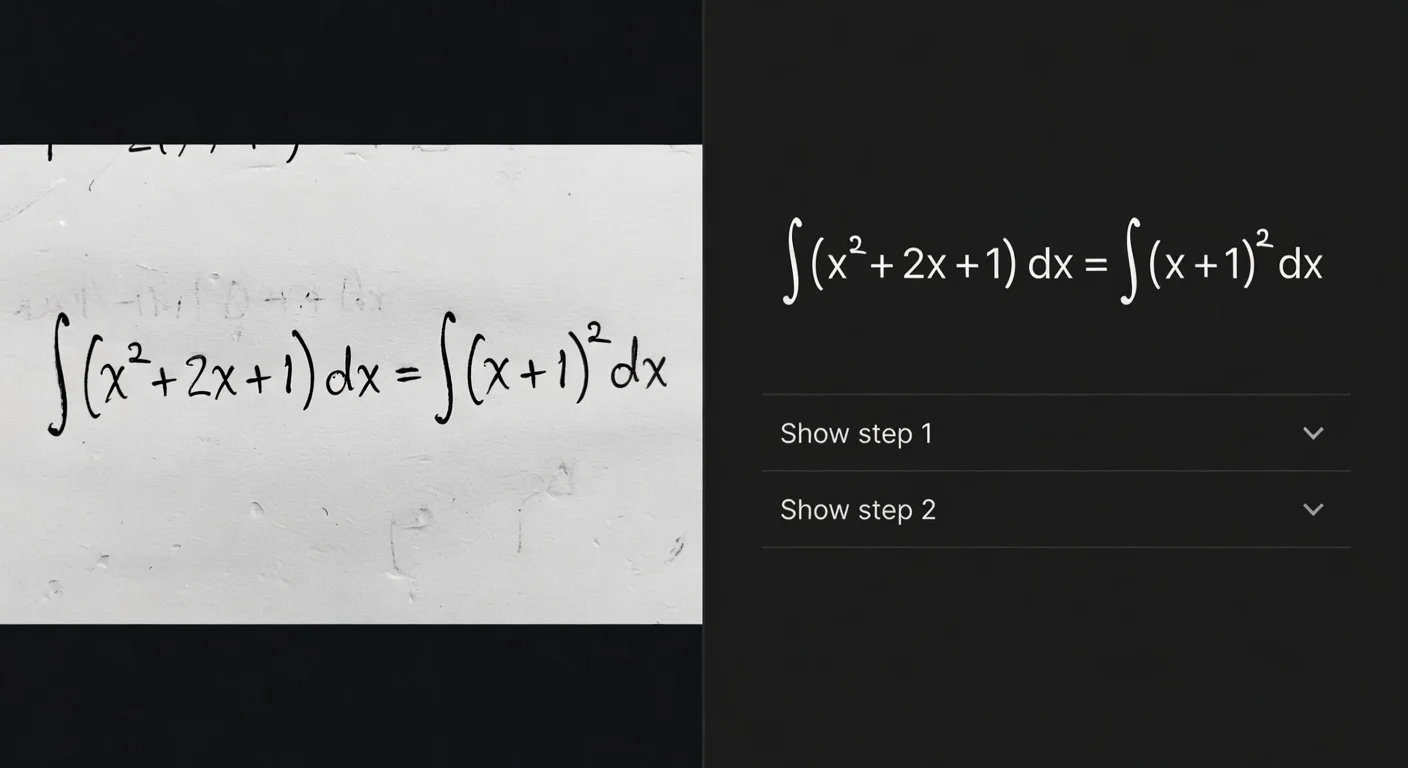
They function by combining image recognition algorithms with a cloud-based mathematics engine. When you take a photo, the camera isolates the numbers and operators, converts them to digital text, and processes them through an AI model trained on mathematical logic.
First, the software performs character isolation. This strips away notebook lines, shadows, and smudges.
Then, it builds a syntax tree. This means it figures out order of operations (PEMDAS) before it attempts to generate an answer.
Here is the exact data flow for a typical 2026 math app:
- Capture: The lens focuses on the equation (usually takes 0.5 seconds).
- Translation: Optical Character Recognition converts handwriting to machine-readable code.
- Computation: The app references a computer algebra system to solve the logical chain.
- Output: The interface renders the sequence back to you in human-readable steps.
Which are the top AI math solver apps for 2026?
The current market is dominated by tools that balance speed, pricing, and explanation depth. This baseline comparison shows exactly what you are paying for when you hit the App Store today.
If you are looking for an app that tells you the answer to homework, you need to ignore the basic calculators and focus on the ones that offer actual educational breakdowns. Right now, here is how the primary contenders stack up.
| App Name | Category Focus | Price (Monthly) | Best Feature |
|---|---|---|---|
| ThinkAssist | Best Value | $9.99 | AI tutor with detailed step explanations |
| Photomath | Best Offline | $9.99 | Operates without active Wi-Fi |
| Symbolab | Best for University | $6.99 | Deep calculus engine |
| Microsoft Math | Best Free Tier | Free | Completely free basic solver |
I use ThinkAssist almost daily because you just snap a photo of your homework and get step-by-step explanations instantly. It is aggressive on keeping things simple, which I appreciate when dealing with a massive assignment. Plus, it handles the subject detection automatically.
Photomath remains a powerhouse, especially since its offline mode is extremely reliable. Microsoft Math Solver is clunky, but you genuinely cannot beat the $0 price tag if you are totally broke.
Can AI math solver apps read cursive and messy handwriting?
Yes, most high-tier algorithms currently hit about 95% accuracy on cursive and sloppy handwriting. However, if your handwriting involves highly overlapping loops, faint mechanical pencil lead, or tiny fractions squeezed onto a single ruled line, the AI will fail.
I noticed that 4s and 9s are still frequent victims of misinterpretation. To get the best results, you need high contrast.
Follow these specific rules when you scan math homework to avoid errors:
- Use a dark pen or a heavy HB pencil.
- Write your fractions horizontally, not diagonally.
- Ensure your room is lit well enough to avoid casting phone shadows over the paper.
- Box your equation so the camera explicitly knows what to target.
Do AI math solver apps handle advanced calculus?
Yes, modern mobile applications utilize Computer Algebra Systems (CAS) to process complex limits, integrals, and derivatives seamlessly. They are no longer limited to middle-school algebra.
Back in 2023, most AI struggled with multi-variable calculus. Now, in 2026, finding a reliable homework solver app that tears through college-level engineering math is trivial.
How do AI math apps break down complex calculus limits and integrals?
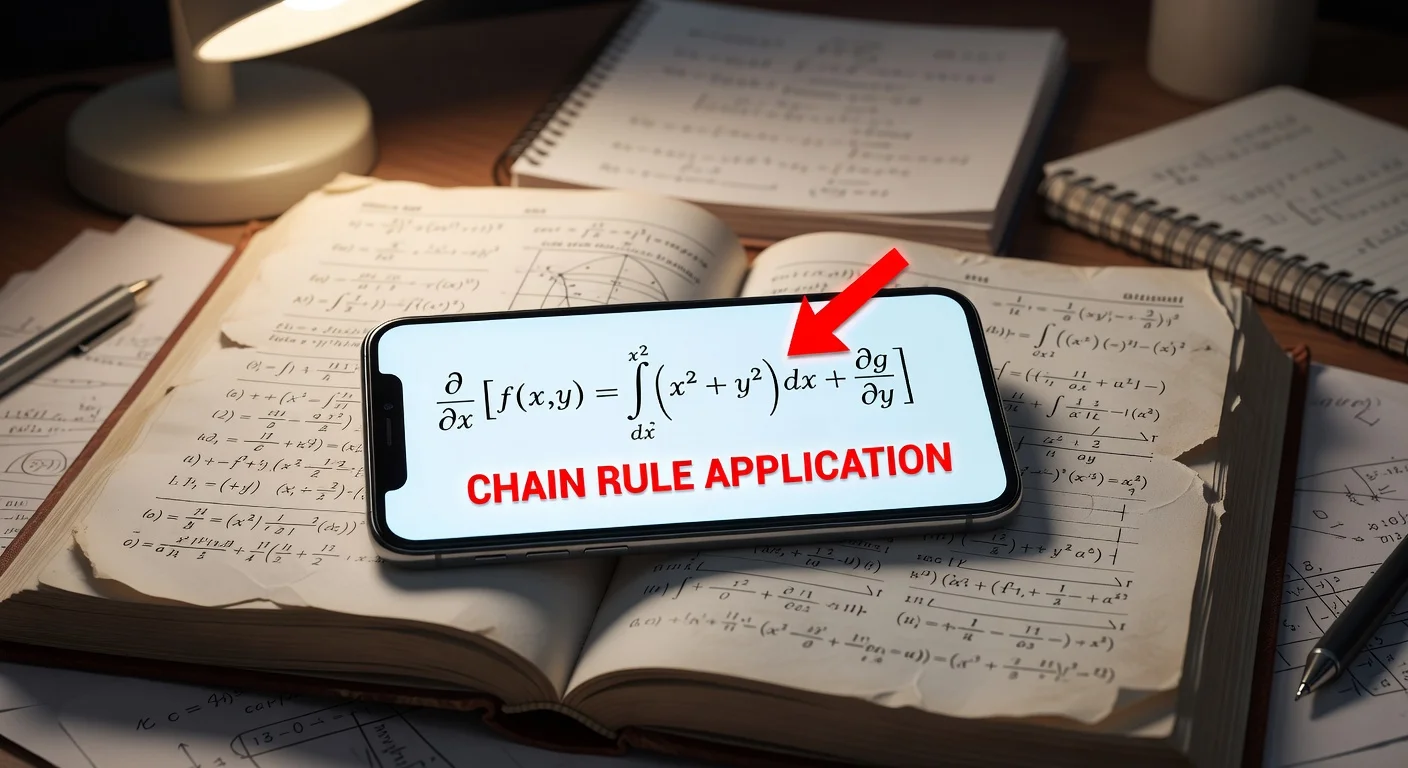
The engines break down complex problems by isolating specific rules, like the quotient rule or integration by parts. They do not just spit out a final polynomial.
For instance, if you feed Wolfram Alpha or ThinkAssist a complicated integral, the screen drops down menus. You can click into "Step 1" to see exactly where the constant was moved, and "Step 2" to see the substitution applied.
This level of granularity is exactly why millions of students switched from graphing calculators to smartphones. A $150 TI-84 just outputs a graph or a number. A $10/month app actually teaches you the methodology.
Are AI math solver apps a replacement for real tutors?
No, an app is a supplementary tool, structurally incapable of replacing human intuition and personalized teaching methods. While an algorithm can process a standard equation in 0.5 seconds, it struggles to adapt if you ask "Why did you multiply by negative one here?" differently three times.
Human tutors read frustration. They pause. They try a visual metaphor.
An app to solve math problems with steps is brilliant for tactical problems late at night. It is terrible for holistic knowledge gaps. If you are deeply confused by the concept of variables, step-by-step logic will just look like an alien language.
You should use these apps strictly for error-checking. Do the math on your own scratchpad first. Try your hardest to fail forward. Then, use the camera.
Does using AI math solvers count as cheating in 2026?
Whether using an AI math solver constitutes cheating depends entirely on the classroom policy and how the student applies the output. Schools are incredibly divided on this topic today.
Some universities embrace these tools as democratizing access to 24/7 tutoring. Other school boards are frantically banning phones in classrooms just to stop students from farming out their assignments.
If you just snap a photo and copy lines 1 through 5 onto your worksheet, you are cheating yourself. You will inevitably crash and burn on the proctored midterm.
To use these tools ethically and effectively:
- Try the problem for at least 5 minutes before reaching for your phone.
- Scan the equation, but only look at the very first step the AI generates.
- Put the phone face down.
- Attempt to finish the rest of the problem using that single hint.
Can AI math solver apps handle geometry and word problems?
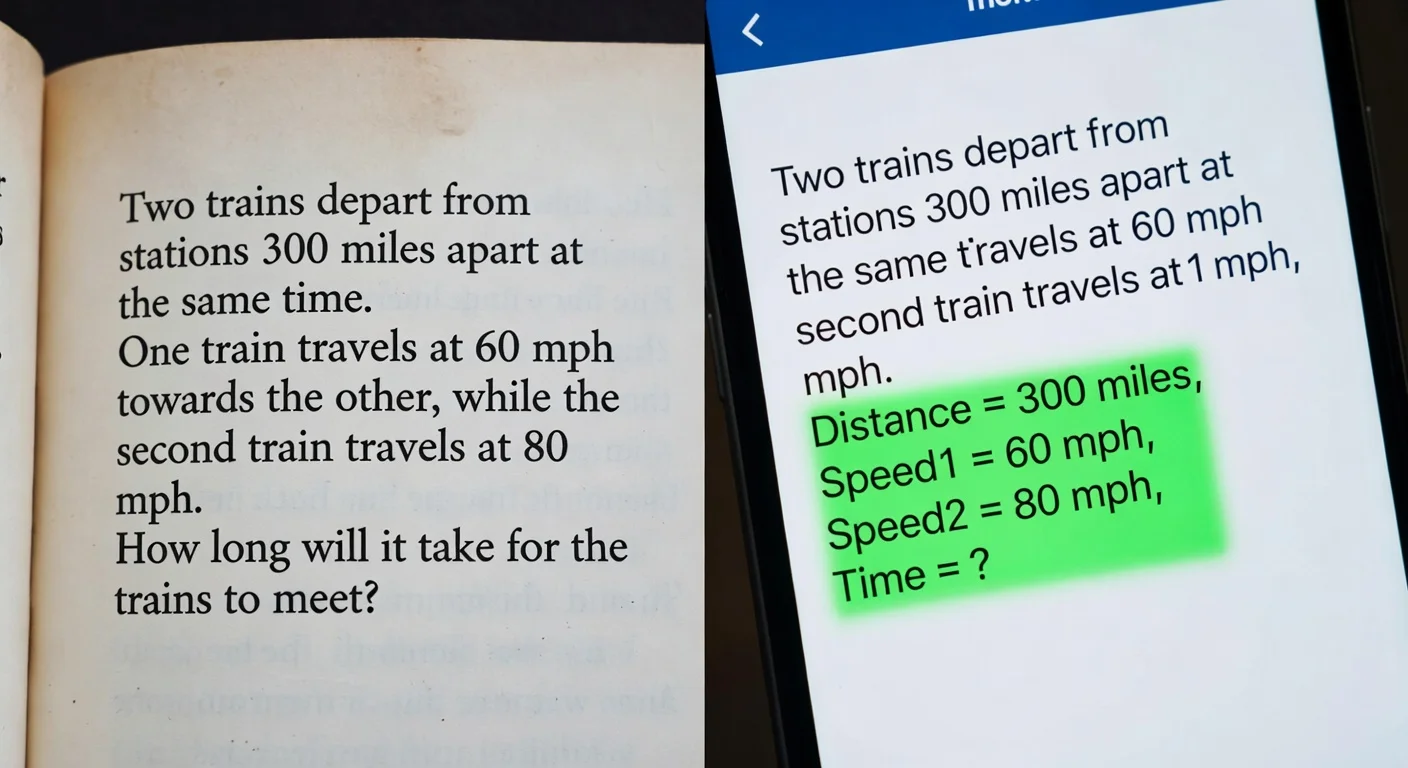
Camera-based math solvers still struggle significantly with translating English word problems into algebraic equations. They also have a hard time interpreting unlabelled, hand-drawn geometric shapes.
If a question asks, "Train A leaves Chicago at 60mph...", a standard app that will solve math problems often freezes. OCR is built for numbers, not narrative nuance.
However, multimodal LLMs (like the integrations we are seeing roll out heavily in mid-2026) are bridging this gap. Instead of just reading the math syntax, they read the paragraph, construct the formula themselves, and then solve the formula.
But be warned. AI hallucination is notoriously high when converting text to math. Always double-check that the equation it built actually matches the premise of the word problem.
What are the hidden costs of free math solver apps?
While many "free" math solver apps exist, they frequently restrict step-by-step explanations behind hard paywalls or aggressive video ads. A totally free app is rarely a frictionless app.
I've tested apps that force you to watch a 30-second unskippable ad just to see "Step 2" of a quadratic equation. If you are trying to complete 20 questions in one evening, that friction is infuriating.
Most premium subscriptions hover between $7 to $15 per month. If you are struggling with a course that requires heavy computation, paying 10 bucks a month to avoid ads and unlock deeper explanations is the highest-ROI investment you can make for your GPA.
If you refuse to pay, you will usually get the final answer for free. Just don't expect the app to hold your hand through the specific logical derivations.
Frequently Asked Questions
Is there a free app that solves math problems with steps?
Yes, there are several free options available, though most use a freemium model. You can scan equations for free, but detailed step-by-step breakdowns might require a premium subscription.
Can AI math solver apps read messy handwriting?
Most modern apps handle cursive and messy handwriting with high accuracy. However, faint pencil marks or highly overlapping numbers can still cause OCR failures.
Do math solver apps work offline?
Some older apps rely on static, on-device logic for basic algebra offline. However, advanced calculus and word problems usually require an active internet connection to ping cloud servers.
Are step-by-step AI math solvers cheating?
It depends entirely on how you use them. If you blindly copy the final answer, yes. If you use the steps to figure out where you made a mistake on your own paper, they act as an on-demand tutor.
Can AI apps solve geometry problems?
Geometry is still a weak point for many camera-based solvers. While they handle coordinate geometry and area formulas well, they struggle to interpret complex, unlabelled hand-drawn shapes.
What is the best app for college calculus?
For university-level calculus, you need tools backed by strong Computer Algebra Systems rather than basic OCR calculators. Apps that offer deep logic chains are mandatory for integrations and limits.