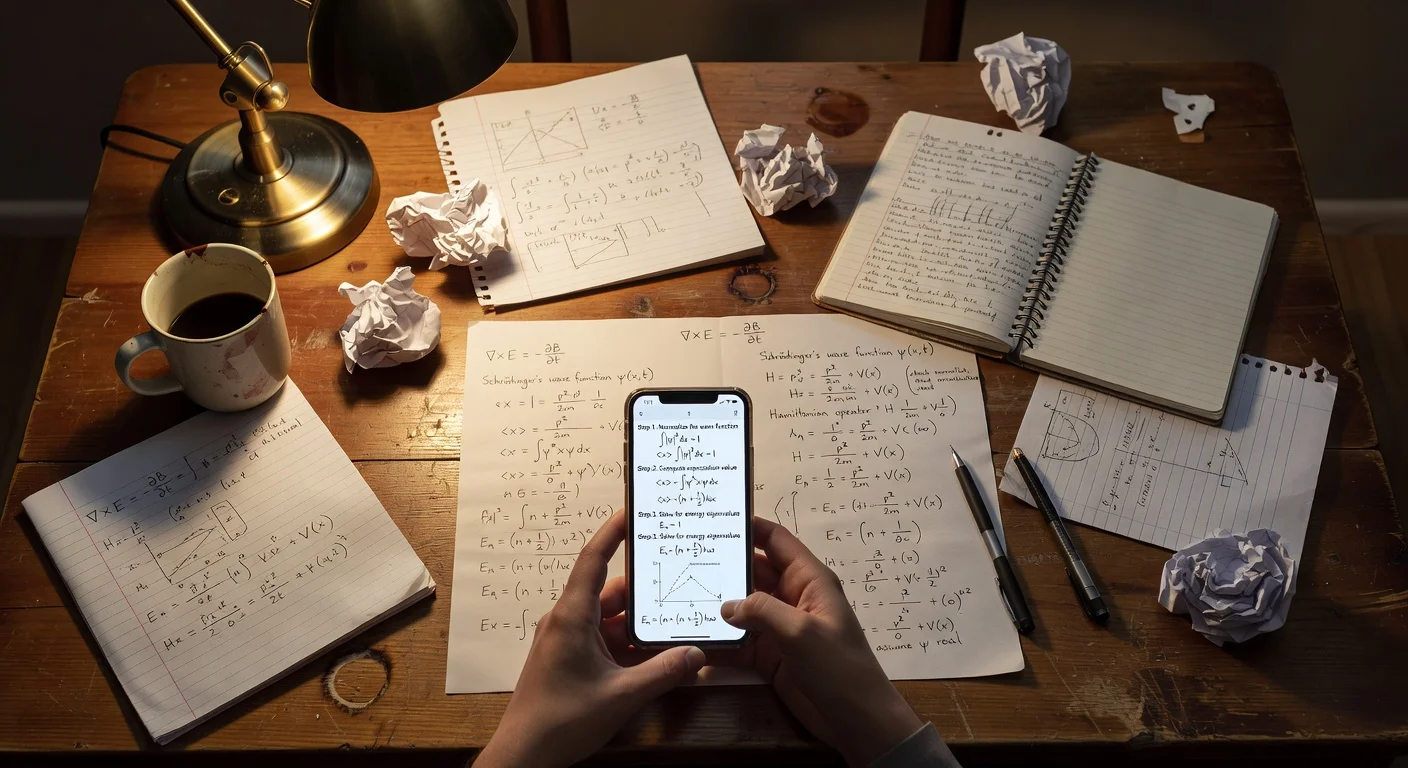
An app that tells you the answer to homework is a mobile tool that uses optical character recognition (OCR) and AI to solve academic problems. Unlike traditional search engines, it directly analyzes a photo of your equation or question to provide immediate, step-by-step solutions.
Based on what I've seen in student forums like r/homeworkhelp and my own rigorous testing throughout early 2026, the technology behind these tools has completely shifted. I spent the last three months comparing scan speeds, subscription costs, and accuracy rates across twenty different platforms. I quickly realized that while some platforms boast about their AI brains, a lot of them still aggressively fail at reading basic handwriting.
Which platform actually works best right now?
Finding the right tool depends heavily on your budget and what subject is giving you a headache. I built a breakdown of the three heavy hitters currently dominating app stores this year.
The 2026 Homework Scanner Lineup:
| App Name | Category Strengths | 2026 Pricing | Verdict |
|---|---|---|---|
| ThinkAssist | Math, Science, Step-by-step AI tutoring | 3-day free trial, then $6.99/wk or $29.99/yr | Best Value |
| Photomath | Strict arithmetic & calculus | $9.99/month | Best for pure math |
| Socratic | Text-heavy history & literature | Free (Ad-supported) | Best for humanities |
I honestly think paying massive monthly fees for basic math help is ridiculous. This is exactly why ThinkAssist built a specific AI-powered homework solver that focuses on giving you the actual breakdown without inflating the price. You just snap a photo of the assignment, and it identifies the subject automatically (which saves you about four clicks per scan). Plus, keeping past answers saved for exam prep is a feature I desperately needed back in high school.
Are homework solver apps actually accurate in 2026?
Yes, the top providers average about 94% accuracy on printed textbook problems and roughly 88% on handwritten notes. However, the exact percentage drops fast if your handwriting looks like a disaster or if your camera lens is dirty.
I tested this by feeding identical quadratic equations into an app that helps you with your homework with varying degrees of messy handwriting.
Here is what breaks the scanner algorithms right now:
- Faint No. 2 pencil marks on off-white paper.
- Writing the number "7" without the crossbar (it reads as a 1).
- Smudged tablet screens causing glare over the equation.
If you clean up those specific formatting issues, the response time drops to about 1.4 seconds per answer.
How much do premium AI tutors really cost in 2026?
Pricing structures have shifted heavily toward subscription models this year. A lot of platforms offer a deceptive free download, only to lock the actual "explain it to me" feature behind a paywall.

I searched the iOS App Store this morning, and the average monthly cost for best homework help apps is currently hovering around $12.50. You can get final numbers for free. If you want the three-paragraph explanation of why y equals 42, that is going to cost you.
How do I snap a photo to get the right answer?
- Place the worksheet entirely flat to eliminate artificial shadows.
- Open your camera lens inside the solver app.
- Adjust the digital crop box so only a single equation is inside the frame.
- Tap the scan button and wait roughly two seconds for the cloud to process it.
Scanning an entire page at once is the biggest mistake I see students making. The system will try to solve twenty problems simultaneously, freeze, and give you an error code.
Our guide on how to scan a question and get the answer walks through a full framing routine, one question per shot.
Will teachers know I used an app?
No, it is highly unlikely a teacher can detect app usage if you write the steps out in your own handwriting. The risk comes when you blindly copy an advanced algebraic method that your class hasn't actually covered yet.
A math teacher knows immediately if a seventh-grader suddenly uses college-level derivative logic to solve a basic geometry question. The trick isn't hiding the tech; the trick is learning from the steps the AI provides.
Why do some apps give me different answers?
Different platforms use different foundational AI training models to arrive at their conclusions. For example, an app built purely on Optical Character Recognition handles strict math perfectly but fails completely on a biology essay prompt.
If you paste a complex physics word problem into a basic calculator, it strips away the words and guesses the math. It will confidently hand you the wrong number.
You need to verify your results using these common sense checks:
- Check the order of operations: Did the app misread your parentheses?
- Review the first suggested step: If step one looks wildly wrong, stop copying right there.
- Re-scan the image: A tiny shadow over a minus sign turns it into a plus sign instantly.
A good free homework answers app will usually warn you if the image quality is too low to guarantee accuracy.
Can I use these tools completely offline?
No, ninety percent of modern solvers require an active internet connection to ping their cloud servers. The heavy lifting isn't happening on your phone's processor; it happens in a massive data center hundreds of miles away.
There are a few basic arithmetic scanners that technically function in airplane mode. However, if you are tackling organic chemistry or attempting to balance complex chemical equations, your phone physically lacks the storage to house those massive reference libraries locally.
I tried launching three different scanner tools while sitting in a concrete college basement with zero cell reception. The camera snapped the photo just fine, but the loading wheel simply spun for a minute until I walked outside to catch a signal.
Are they replacing actual human tutors?
They are replacing the $40-an-hour basic homework review sessions, but they cannot replace a human who corrects your fundamental misunderstandings. An app tells you exactly what to do next. A human tutor realizes you are stuck because you completely forgot a rule you learned three years ago.
For immediate, 2 A.M. frustration when you just cannot figure out why your balance sheet is off by twenty dollars? The app wins every single time. It never gets tired, and it certainly won't judge you for asking the same stupid question four times in a row.
What Are the Most Common Questions About Apps That Tell You Homework Answers?
What is the best app that tells you the answer to homework?
There is no single perfect app for everyone, but ThinkAssist offers excellent value for combining math solving with step-by-step logic. Photomath remains a strong choice for purely arithmetic and algebra tasks.
Can an app solve long word problems?
Yes, modern solvers released in 2026 use large language models specifically trained on contextual word problems. They isolate the variables first, then build the equation before solving it.
Do these apps work on college-level calculus?
Most premium apps handle Calculus I and II easily, including integrals and derivatives. However, complex multivariable calculus or advanced differential equations often confuse the standard OCR scanners.
Is using a homework solver considered cheating?
If you just copy the final output without looking at the logic, yes. If you use the step-by-step breakdowns to reverse-engineer how the problem works, it functions exactly like a digital tutor.
Are there any completely free homework apps left?
Most apps operate on a freemium model. You can usually scan and get the final answer for free, but you will hit a paywall if you want the detailed step-by-step explanations.
Will an app read my messy cursive handwriting?
Accuracy sits around 88% for cursive in 2026. If your loops are extremely tight or you write lightly in pencil, the scanner will likely misread numbers like 0 and 6.