Basic physics equations are mathematical formulas that model fundamental physical relationships like motion, force, energy, and electricity. Unlike advanced physics that relies on multivariable calculus, these core algebraic equations quantify how physical objects move, interact, and exchange energy in everyday systems. Knowing these formulas allows students and engineers to predict vector direction, calculate force demands, and analyze system dynamics without high-level calculus.
When learning introductory physics, memorizing equations is rarely enough. Success requires understanding how variables interrelate when solving complex word problems. If you ever get stuck rearranging variables late at night, using an AI tool like ThinkAssist lets you snap a photo of your problem to get instant, step-by-step breakdowns from a 24/7 AI tutor.
What are the core basic physics equations?
The core basic physics equations span four main classical branches: kinematics, dynamics, energy, and wave mechanics. Each equation establishes a proportional relationship between measurable physical quantities like distance, mass, acceleration, and charge.
The table below summarizes the fundamental equations taught in introductory physics, alongside their primary variables and standard International System of Units (SI) according to the NIST SI Reference Guide.
| Physics Domain | Equation Name | Standard Formula | Primary Variables | SI Unit |
|---|---|---|---|---|
| Kinematics | Velocity Formula | $v = \frac{\Delta x}{t}$ | $v$ (velocity), $\Delta x$ (displacement), $t$ (time) | Meters per second (m/s) |
| Kinematics | Acceleration Formula | $a = \frac{\Delta v}{t}$ | $a$ (acceleration), $\Delta v$ (change in velocity), $t$ (time) | Meters per second squared (m/s²) |
| Dynamics | Newton's Second Law | $F = ma$ | $F$ (force), $m$ (mass), $a$ (acceleration) | Newtons (N) |
| Energy | Kinetic Energy | $KE = \frac{1}{2}mv^2$ | $KE$ (kinetic energy), $m$ (mass), $v$ (velocity) | Joules (J) |
| Energy | Gravitational Potential Energy | $PE = mgh$ | $PE$ (potential energy), $m$ (mass), $g$ (gravity), $h$ (height) | Joules (J) |
| Work | Mechanical Work | $W = Fd \cos\theta$ | $W$ (work), $F$ (force), $d$ (displacement), $\theta$ (angle) | Joules (J) |
| Electricity | Ohm's Law | $V = IR$ | $V$ (voltage), $I$ (current), $R$ (resistance) | Volts (V) |
| Waves | Wave Speed Equation | $v = f \lambda$ | $v$ (speed), $f$ (frequency), $\lambda$ (wavelength) | Meters per second (m/s) |
How do kinematic equations model motion?
Kinematic equations mathematically describe the motion of objects under constant acceleration without considering the forces that cause the movement. These formulas assume uniform acceleration, allowing you to calculate final velocity, displacement, or elapsed time from a known set of initial conditions.
According to textbook standards on OpenStax College Physics, classical mechanics relies on four basic kinematic equations to solve one-dimensional motion problems.
What is the primary velocity equation?
The primary velocity equation is $v = v_0 + at$, which calculates an object's final velocity based on its starting velocity, rate of uniform acceleration, and elapsed time.
This equation assumes acceleration remains strictly constant throughout the motion duration. If an object starts from rest ($v_0 = 0$), the final velocity scales directly with the product of acceleration and time.
How do you calculate displacement without final velocity?
You calculate displacement without final velocity using the equation $d = v_0 t + \frac{1}{2}at^2$.
This formula is useful when solving free-fall problems, where the final velocity at impact is unknown. In a standard free-fall scenario near Earth's surface, acceleration ($a$) is replaced by gravitational acceleration ($g \approx 9.8\text{ m/s}^2$).
What equations define force and Newton’s laws?
Force equations quantify how physical interactions alter the motion state or structural integrity of an object. Classical mechanics models forces as vectors, meaning every force has both a numerical magnitude and a specific physical direction.
When setting up force balance problems, understanding free body diagrams is essential for mapping individual vector components before applying algebraic formulas.
How does Newton’s second law relate force, mass, and acceleration?
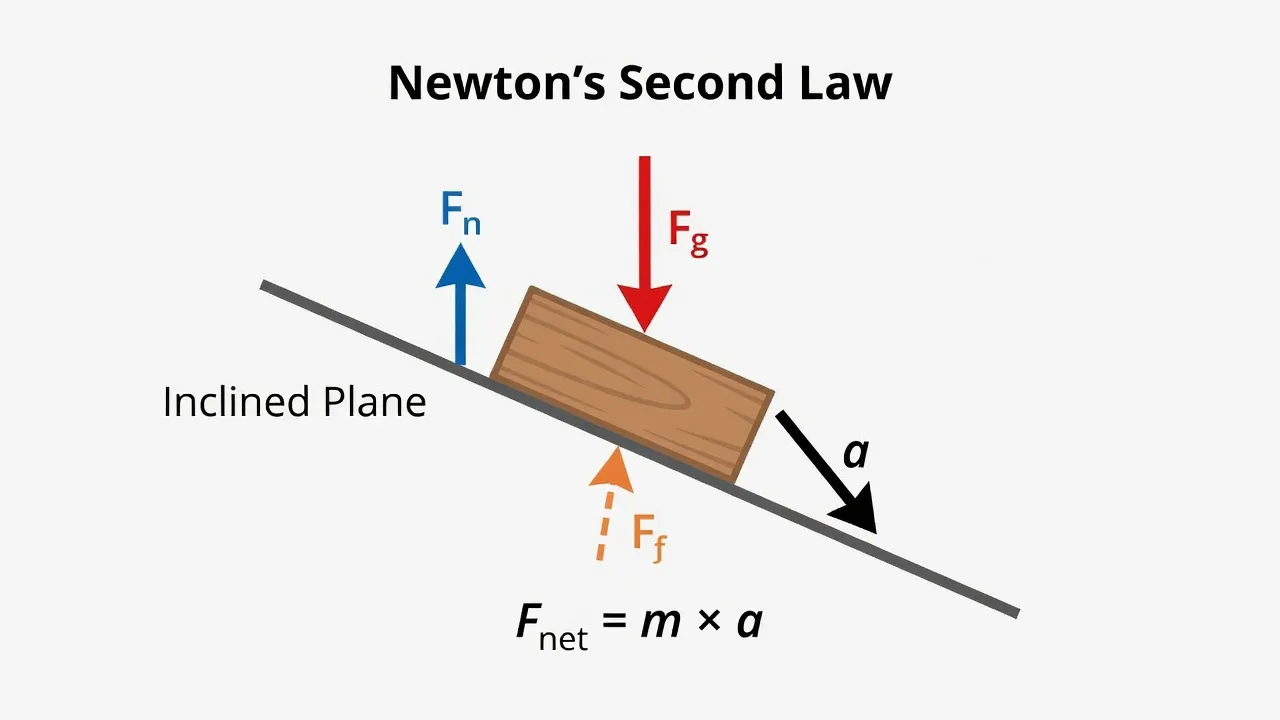
Newton's second law states that net force equals mass times acceleration ($F = ma$).
This formula shows that an object's acceleration is directly proportional to the net applied force and inversely proportional to its mass. As documented by HyperPhysics at Georgia State University, one Newton of force accelerates a one-kilogram mass by one meter per second squared ($1\text{ N} = 1\text{ kg}\cdot\text{m/s}^2$).
What equation determines weight versus mass?
Weight is calculated using the formula $W = mg$, where weight ($W$) is the gravitational force acting on a mass ($m$) within a gravitational field ($g$).
Mass remains constant regardless of location, whereas weight changes depending on local gravitational field strength. For example, a 70 kg person has a mass of 70 kg on Earth and Mars, but their weight on Earth is roughly 686 Newtons compared to only 260 Newtons on Mars.
How are work, power, and energy calculated?
Work and energy equations quantify how mechanical effort transfers through physical systems over distances. Energy cannot be created or destroyed; it merely transforms from kinetic energy into potential energy, heat, or work.
What is the formula for kinetic vs potential energy?
Kinetic energy is calculated as $KE = \frac{1}{2}mv^2$, while gravitational potential energy is expressed as $PE = mgh$.
Kinetic energy measures the energy of motion and scales quadratically with speed, meaning doubling an object's speed quadruples its kinetic energy. Gravitational potential energy measures stored mechanical energy based on an object's elevated position relative to a reference frame.
How do work and energy relate mechanically?
The work-energy theorem establishes that net work equals the change in kinetic energy ($\Delta KE$), defined mathematically by the equation $W = Fd \cos\theta$.
Work occurs only when an applied force causes a displacement along the direction of that force. If you apply a force perpendicular to an object's movement ($\theta = 90^\circ$), $\cos(90^\circ) = 0$, meaning zero mechanical work is performed on the object.
How do basic wave and electricity equations work?
Wave and circuit equations describe how energy travels through physical media or electrical conductors via field oscillations and charge movement.
What is Ohm’s law in basic circuit physics?
Ohm’s law dictates that voltage equals current multiplied by resistance ($V = IR$).
Voltage ($V$) acts as the electrical pressure pushing charges through a circuit, current ($I$) measures the flow rate of charge in Amperes, and resistance ($R$) measures opposition to flow in Ohms. Increasing circuit resistance drops current flow proportionally, assuming voltage remains constant.
How do wave speed, frequency, and wavelength interact?
Wave speed is defined by the formula $v = f \lambda$, where velocity equals frequency multiplied by wavelength.
Frequency ($f$) measures how many wave crests pass a fixed point per second, while wavelength ($\lambda$) represents the physical distance between consecutive crests. Because wave speed is fixed by the medium it passes through, increasing frequency forces wavelength to decrease.
Why do students struggle to rearrange physics formulas?
Most students struggle with physics equations not because of the physics concepts, but due to algebraic manipulation and unit conversion errors. Misinterpreting standard algebraic order of operations or failing to track dimensional units throughout multi-step calculations frequently leads to incorrect numerical answers.
Common technical tripwires include:
- Failure to convert units to SI base standards: Plugging kilometers per hour into a formula requiring meters per second guarantees an incorrect answer.
- Confusing scalar values with vector directional components: Treating speed and velocity identically when calculating directional momentum.
- Misapplying algebraic inverse operations: Failing to isolate targeted variables correctly when equations contain radical roots or squared terms like $v^2$.
Understanding scalar and vector components requires a strong grasp of magnitude in physics to prevent sign errors in vector equations.
If you struggle to spot where an algebraic conversion broke down in a late-night assignment, reviewing static textbook keys often isn't enough. With the ThinkAssist iOS app, you can snap a photo of any written physics question to receive an immediate visual walkthrough showing step-by-step variable isolation and unit cancellations.
How to solve physics word problems in 5 steps
Solving physics word problems systematically requires converting qualitative context into explicit variables before selecting an equation. Following a standardized routine prevents algebraic confusion and reduces unit mismatch errors.
-
Identify Given Variables and Required Target
-
Convert All Measurements to Standard SI Units
-
Select the Formula Matching Your Known Variables
-
Isolate the Target Variable Algebraically
-
Substitute Numerical Values and Calculate
-
Identify given variables: Read the problem statement to list known parameters like $v_0$, $a$, or $m$, then write down the unknown target variable you need to calculate.
-
Convert variables to standard SI units: Verify all measurements match metric standards (e.g., convert grams to kilograms, or minutes to seconds).
-
Select the correct equation: Match your catalog of known and unknown variables to a single formula that contains only one unknown term.
-
Isolate the variable algebraically: Rearrange the formula to solve for the target variable before plugging in numbers to avoid arithmetic missteps.
-
Execute substitution and check units: Insert values into the isolated formula, perform the arithmetic, and confirm your final answer carries correct SI units.
When prepping for standardized exams like the AP test, practicing worked problems step-by-step builds speed. For high school physics students, working through an AP Physics 1 FRQ study guide helps reinforce how algebraic kinematic derivations are evaluated on free-response questions.

Step-by-Step Example: Solving a Kinematic Motion Problem
To see how these steps work in practice, let's solve a real world-style kinematics problem step-by-step.
Problem Statement: A car accelerates uniformly from rest at a rate of $3.5\text{ m/s}^2$ over a period of $6.0\text{ seconds}$. Calculate the total displacement covered by the car during this time frame.
Step 1: List given variables and target
- Initial velocity ($v_0$) = $0\text{ m/s}$ (since it starts from rest)
- Acceleration ($a$) = $3.5\text{ m/s}^2$
- Elapsed time ($t$) = $6.0\text{ s}$
- Target variable = Displacement ($d$)
Step 2: Select the correct kinematic formula
We need a formula that connects $v_0$, $a$, $t$, and $d$ without requiring final velocity ($v$). Looking at our standard kinematic list:
$$d = v_0 t + \frac{1}{2}at^2$$
Step 3: Substitute known values and evaluate
Because $v_0 = 0\text{ m/s}$, the term $v_0 t$ evaluates to zero:
$$d = (0\text{ m/s})(6.0\text{ s}) + \frac{1}{2}(3.5\text{ m/s}^2)(6.0\text{ s})^2$$
$$d = 0 + \frac{1}{2}(3.5)(36)$$
$$d = 1.75 \times 36 = 63\text{ meters}$$
The car travels a total displacement of 63 meters.
Working through problems manually builds strong intuition over time. However, when you face difficult problem sets under tight deadlines, ThinkAssist helps streamline study sessions. It is free to download on iOS with a 3-day trial (and costs $6.99/week after). The app automatically detects physics topics from photos of your homework, providing step-by-step explanations and saving past solutions so you can review them easily during exam prep.
Frequently Asked Questions
What are the four main kinematic equations?
The four main kinematic equations are $v = v_0 + at$, $d = v_0 t + \frac{1}{2}at^2$, $v^2 = v_0^2 + 2ad$, and $d = \frac{v_0 + v}{2}t$. They calculate uniform acceleration motion when specific initial variables are known.
How do I know which physics equation to use?
You choose a physics equation by identifying your known variables and the unknown target variable from the problem statement. Match those parameters to a formula where the target variable is the only unknown value.
What is the difference between velocity and speed in equations?
Velocity is a vector quantity that includes both magnitude and physical direction, whereas speed is a scalar value measuring magnitude alone. Kinematic formulas require directional positive or negative signs for velocity.
What are SI base units in physics?
SI base units are international standard units used for metric calculations. The standard SI base units for basic mechanics are meters for length, kilograms for mass, and seconds for time.
Why is gravity acceleration written as negative in some formulas?
Gravity is assigned a negative value (-9.8 m/s²) when the upward vertical direction is designated as positive in your coordinate system. Because gravity pulls downward toward Earth's surface, its vector direction is negative.
What is Ohm's law and why is it important?
Ohm's law is expressed as V = IR, defining the mathematical relationship between voltage, current, and resistance in electrical circuits. It allows engineers and students to calculate circuit current or component power requirements.
How does potential energy convert into kinetic energy?
Potential energy converts into kinetic energy as an object moves downward or releases stored mechanical force, causing stored position energy to transform into energy of motion while conserving total mechanical energy.