
In physics, magnitude is the quantitative size, extent, or absolute numerical value of a physical quantity, expressed purely as a non-negative number regardless of direction. Whether measuring a scalar property like mass or calculating the length of a force vector, magnitude answers the fundamental question of "how much" or "how big."
Understanding magnitude is essential for high school and college physics courses because every physical measurement relies on it. Without magnitude, concepts like acceleration, velocity, and gravitational attraction lose their mathematical foundation.
What is magnitude in physics and why does it matter?
Magnitude defines the absolute scale of a physical quantity, stripped of any directional information or spatial orientation. In practical terms, it is the pure number combined with a unit that tells you the size of a physical measurement.
In basic mechanics, if a car travels at 60 miles per hour toward the east, the speed of 60 mph represents the magnitude, while "east" gives the direction. If you reverse direction and drive west at 60 mph, the magnitude remains exactly 60 mph.
Understanding this distinction prevents costly algebraic errors in coursework. If you are struggling with vector mechanics on homework assignments, using an AI-powered study helper like ThinkAssist can clarify how magnitude isolates pure size from spatial direction before you plug values into equations.
What is the difference between scalar and vector magnitude?
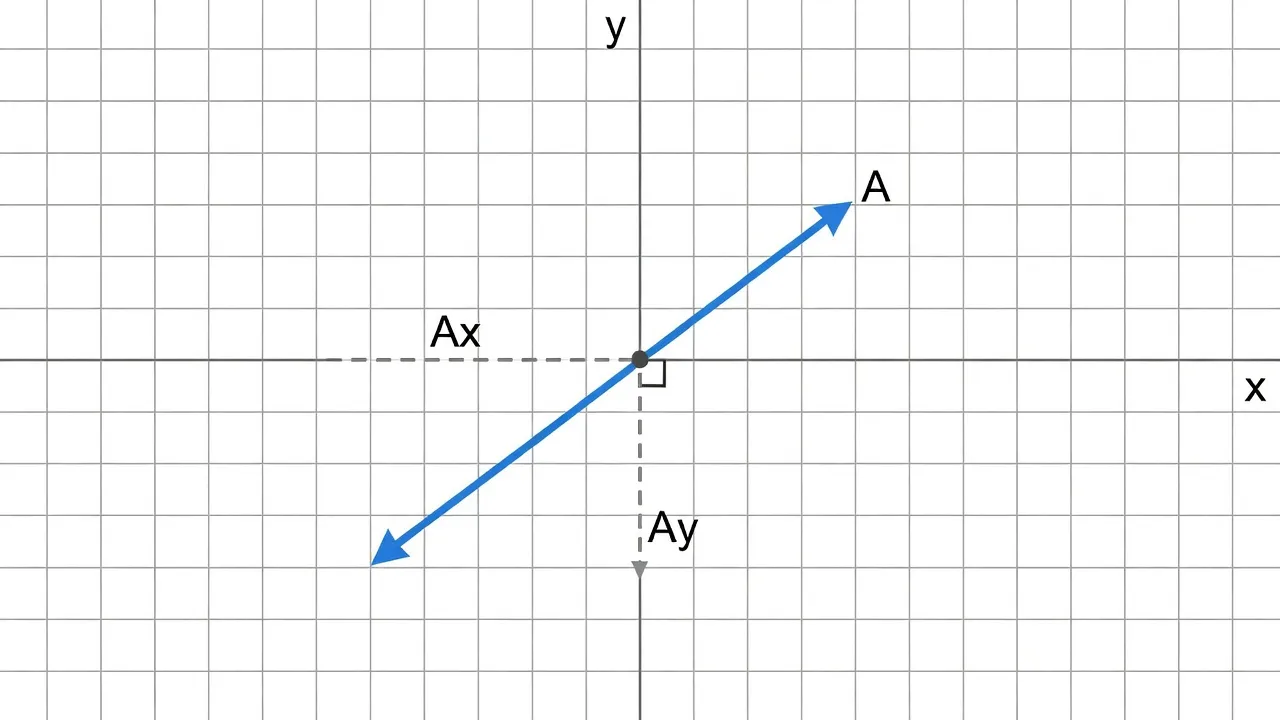
Scalar magnitude represents the entire physical measurement, whereas vector magnitude represents only the length or size component of a multi-dimensional value.
Scalar quantities possess only magnitude. When you measure a temperature of 20 degrees Celsius or a mass of 5 kilograms, the number and unit fully describe the state of the object. Direction does not apply to mass or temperature.
Vector quantities require both magnitude and direction for a complete physical description. Velocity, force, momentum, and electric fields are all vector quantities. The magnitude of a vector is mathematically expressed using absolute value bars around the vector symbol, such as $||\vec{v}||$ or $|\vec{F}|$.
| Physical Quantity | Quantity Type | Magnitude Definition | Directional Requirement | SI Unit Example |
|---|---|---|---|---|
| Distance | Scalar | Total path length covered | None | Meters (m) |
| Displacement | Vector | Straight-line distance between points | Specific direction required | Meters (m) |
| Speed | Scalar | Rate of motion along a path | None | Meters per second (m/s) |
| Velocity | Vector | Rate of position change | Specific direction required | Meters per second (m/s) |
| Mass | Scalar | Total matter in an object | None | Kilograms (kg) |
| Force | Vector | Push or pull intensity | Direction of application | Newtons (N) |
How do you calculate the magnitude of a vector?
To calculate the magnitude of a vector, apply the Pythagorean theorem to its perpendicular components.
For a two-dimensional vector with components along the horizontal axis ($A_x$) and vertical axis ($A_y$), the magnitude formula is:
$$||\vec{A}|| = \sqrt{A_x^2 + A_y^2}$$
When working in three-dimensional spatial coordinates with components $A_x$, $A_y$, and $A_z$, expand the Euclidean formula:
$$||\vec{A}|| = \sqrt{A_x^2 + A_y^2 + A_z^2}$$
How do you find magnitude from component vectors?
Find magnitude from component vectors by squaring each individual component, adding those squared values together, and taking the principal square root of the sum.
For instance, suppose a force vector acts with a horizontal component of 3 Newtons and a vertical component of 4 Newtons.
- Square each component: $3^2 = 9$ and $4^2 = 16$.
- Add the results: $9 + 16 = 25$.
- Compute the square root: $\sqrt{25} = 5\text{ N}$.
Educational guidelines published by OpenStax College Physics emphasize that component magnitude calculations form the backbone of rigid-body equilibrium and projectile motion problems.
What is an order of magnitude in physics estimations?
An order of magnitude is an approximation of a physical quantity scaled to the nearest power of 10.
Physicists use orders of magnitude to make quick sanity checks, estimate vast cosmic distances, or calculate atomic dimensions. An order of magnitude increase means multiplying a value by ten, while a decrease means dividing by ten.
For example, the diameter of an atom is approximately $10^{-10}$ meters, whereas the diameter of the Earth is roughly $10^7$ meters. The difference between these two entities spans 17 orders of magnitude ($10^{17}$).
| Order of Magnitude | Scale | Example |
|---|---|---|
| 10^-15 m | Proton radius | |
| 10^-10 m | Atom radius | |
| 10^0 m | Human height scale | |
| 10^7 m | Earth diameter | |
| 10^11 m | Earth-Sun distance |
According to data maintained by the NIST Physical Measurement Laboratory, fundamental physical constants like Planck's constant ($6.626 \times 10^{-34}\text{ J}\cdot\text{s}$) depend heavily on scientific notation to handle extreme orders of magnitude without rounding errors.
Can magnitude ever be negative in physics?
No, magnitude in physics can never be negative because it represents a distance or absolute quantity.
By mathematical definition, magnitude is a norm, which yields a real number greater than or equal to zero ($||\vec{V}|| \ge 0$). While a vector component can carry a negative sign indicating direction along a coordinate axis (such as $-9.8\text{ m/s}^2$ for acceleration due to gravity), the magnitude of that vector remains strictly positive ($9.8\text{ m/s}^2$).
Why do some physics equations use negative signs?
Negative signs in physics equations denote direction, relative position, or attractive force fields, rather than negative magnitude.
In Hooke's Law ($F = -kx$), the negative sign shows that the restoring force acts opposite to the direction of displacement. The magnitude of the force itself is simply $|F| = k|x|$.
Similarly, negative universal gravitational potential energy indicates a bound physical state, but the magnitude of the force pulling those masses together is always positive.
How to solve magnitude physics problems without getting stuck
Solving magnitude problems reliably requires isolating component directions, verifying proper SI units, and evaluating vectors step by step.
When physics word problems get chaotic, breaking down complex setups into basic geometric components prevents algebra mistakes.
If you get stuck trying to decompose forces on an inclined plane, the ThinkAssist homework app provides quick relief. You can snap a photo of your assignment, and its AI-Powered Homework Solver provides step-by-step explanations and solutions for multi-step vector calculations.

For students preparing for standardized exams, review guides like our breakdown of the ap physics 1 frq show how free-body diagrams map directly into scalar component equations. You can also reference our physics c equation sheet to check standard vector equations.
Where do students make mistakes with physics magnitude?
The most common mistake students make with physics magnitude is forgetting to take the square root after summing squared components.
Because vector math relies on the Pythagorean formula, leaving off the final square root calculation leaves you with magnitude squared ($||\vec{A}||^2$) rather than the magnitude itself.
Here are the four specific error traps that rule out correct answers on physics exams:
- Confusing directional negative signs with magnitude: Assigning a negative sign to a final magnitude answer when the component was negative.
- Adding vector components directly: Writing $3\text{ m/s} + 4\text{ m/s} = 7\text{ m/s}$ for perpendicular vectors instead of finding the hypotenuse ($5\text{ m/s}$).
- Mishandling scientific notation exponents: Adding exponents directly during order-of-magnitude additions without matching base powers of 10.
- Calculator angle modes: Computing trigonometric components ($A_x = A \cos\theta$) while your calculator is set to radians instead of degrees.
Detailed vector documentation on HyperPhysics at Georgia State University notes that failing to resolve perpendicular components remains the single largest cause of error in introductory college physics mechanics examinations.
How does order of magnitude estimation work in real applications?
Order of magnitude estimation works by rounding physical values to the nearest power of 10 before performing calculations.
Also known as Fermi problems, these estimations allow scientists and engineers to assess feasibility without waiting for high-precision laboratory data.
To calculate an order of magnitude estimate:
- Express all input variables in scientific notation ($N \times 10^b$).
- If $N$ is less than $10^{0.5}$ (approximately 3.16), round $N$ down to 1 (keeping the magnitude at $10^b$).
- If $N$ is greater than or equal to 3.16, round $N$ up to 10 (increasing the magnitude exponent to $10^{b+1}$).
- Perform the remaining multiplication or division using exponent addition rules.
As of August 2026, astronomical research relies heavily on order-of-magnitude constraints to estimate orbital decay times for near-Earth asteroids before spending supercomputer runtime on precise trajectory simulations.
How ThinkAssist helps master magnitude calculations
ThinkAssist turns confusing vector equations into easy-to-follow visual steps.
When you encounter complex force vectors, 3D coordinate problems, or unit conversion challenges, ThinkAssist helps you work through the problem without getting lost in the math.
- Snap a Photo: Capture any handwritten textbook problem or digital assignment instantly.
- Automatic Subject Detection: The app recognizes vector mechanics, kinematics, or electromagnetism automatically.
- Step-by-Step Explanations: View clear line-by-line calculations that explain how components yield final magnitudes.
- 24/7 Support: Get full tutoring assistance anytime you hit a wall during late-night study sessions.
Instead of guessing whether a negative sign belongs in your final answer, you can double-check your logic against clear, verified solutions.
Frequently Asked Questions
What is magnitude in simple terms?
Magnitude is simply the numerical size or amount of something, regardless of its direction. For example, if you run 5 miles, the magnitude of your distance is 5 miles.
Is magnitude always positive in physics?
Yes, magnitude is always positive or zero. Because magnitude represents scalar length or absolute size, it cannot be a negative number.
How do you find magnitude without components?
If components are unknown, you can calculate vector magnitude using the Law of Cosines if you know two side lengths and their enclosed angle ($C = \sqrt{A^2 + B^2 - 2AB\cos\theta}$).
What is the difference between magnitude and direction?
Magnitude tells you how much of a physical quantity exists, while direction specifies where that quantity points in space.
What is the symbol for magnitude in physics?
Magnitude is typically represented by placing double or single vertical bars around a vector letter, such as $||\vec{A}||$ or $|\vec{A}|$, or simply writing the vector letter without an arrow ($A$).
How does order of magnitude differ from exact magnitude?
Exact magnitude provides the precise calculated numerical value with exact decimal precision, whereas an order of magnitude rounds the value to the nearest power of 10 for quick estimation.
Is speed the magnitude of velocity?
Yes, speed is the scalar magnitude of the velocity vector. Velocity includes both speed and direction of travel.