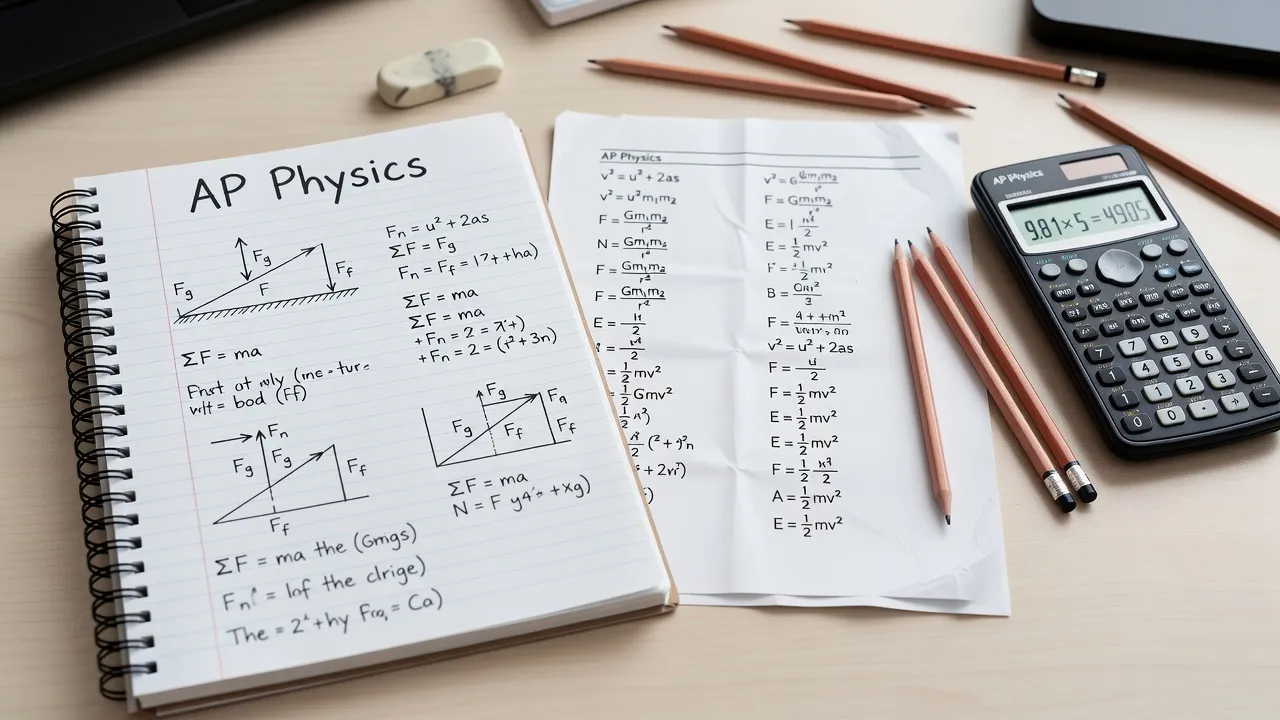
The AP Physics 1 FRQ section consists of four free-response questions worth 50% of your total exam score, testing mathematical routines, experimental design, representation translation, and qualitative reasoning over a 90-minute period. To maximize your score, you must master algebraic derivations without numbers, write clear physics justifications, and understand how AP readers assign partial credit.
Understanding how to approach these open-ended prompts is often the difference between a 3 and a 5. While multiple-choice questions test rapid recall, the free-response questions (FRQs) measure your ability to communicate physical principles clearly. As of the 2026 exam cycle, students who focus on conceptual derivations and structured lab design consistently earn higher rubric marks than those who simply memorize formulas.
If you struggle to break down complex word problems or multi-part physics diagrams at home, using an ai homework helper app like ThinkAssist allows you to scan tricky FRQ prompts and receive instant, step-by-step derivations 24/7.
How is the AP Physics 1 FRQ section structured?
The AP Physics 1 free-response section gives you 90 minutes to complete four distinct questions that account for half of your overall exam grade. You are provided with an official equation sheet and a scientific or graphing calculator throughout the entire section.
According to the official College Board AP Central guidelines, the four questions are timed to average roughly 20 to 25 minutes each. Each prompt targets a specific set of science practices, ranging from quantitative calculations to written explanations.
- Total Time: 90 minutes
- Total Questions: 4 FRQs
- Exam Weight: 50% of total score
- Tools Allowed: Graphing calculator and AP Physics 1 equation sheet
What are the 4 main AP Physics 1 FRQ question types?
The four AP Physics 1 FRQ types are Mathematical Routines, Translation Between Representations, Experimental Design and Analysis, and Qualitative/Quantitative Reasoning with a Paragraph Response. Each type tests a different aspect of your physics skill set, requiring a mix of algebraic manipulation, graphical interpretation, and technical writing.
How do you solve Mathematical Routines FRQs?
Mathematical Routines questions require you to derive expressions using given symbolic variables rather than numerical values. You must start from fundamental physics equations found on your formula sheet and show every algebraic substitution clearly.
AP readers award partial credit for identifying correct starting principles, such as conservation of energy or Newton's second law. Avoid plugging in numbers early; final answers must usually be expressed strictly in terms of stated constants like $m$, $g$, $L$, or $\theta$.
What is expected in Translation Between Representations FRQs?
Translation Between Representations FRQs test your ability to convert physical scenarios across graphs, energy bar charts, free-body diagrams, and mathematical equations. A typical prompt might ask you to sketch a velocity-time graph based on a physical description and then derive a matching displacement equation.
Consistency across your representations is critical. If your free-body diagram shows a net upward force, your acceleration graph in the next part must show a positive value.
How are Experimental Design and Analysis FRQs scored?
Experimental Design FRQs score you on your ability to outline a realistic laboratory procedure, identify independent and dependent variables, and analyze synthetic experimental data. You are usually asked how to minimize experimental error or how to linearize non-linear data to calculate a physical constant from a graph's slope.
Always list the specific lab equipment needed, such as photogates, motion detectors, or meter sticks. Describe a clear step-by-step process that another student could follow in a lab setting.
How do you write a Paragraph Argument Response FRQ?
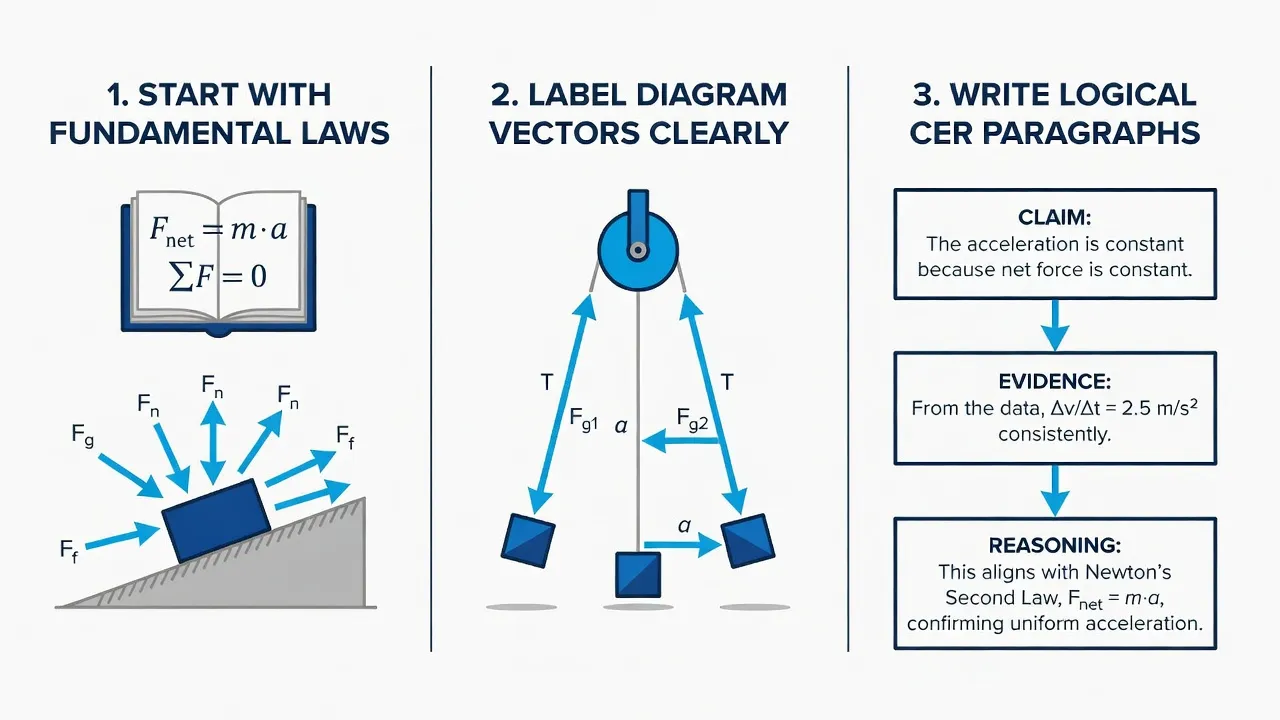
The Paragraph Argument FRQ requires a coherent, logically organized paragraph that explains a physical phenomenon using claim, evidence, and reasoning (CER). You must cite specific physics principles without relying solely on mathematical equations.
Focus on clear cause-and-effect language. Start with a direct claim, state the governing physical law (such as conservation of momentum), and explain how that law applies to the scenario described.
What are the 5 best AP Physics 1 FRQ study methods?
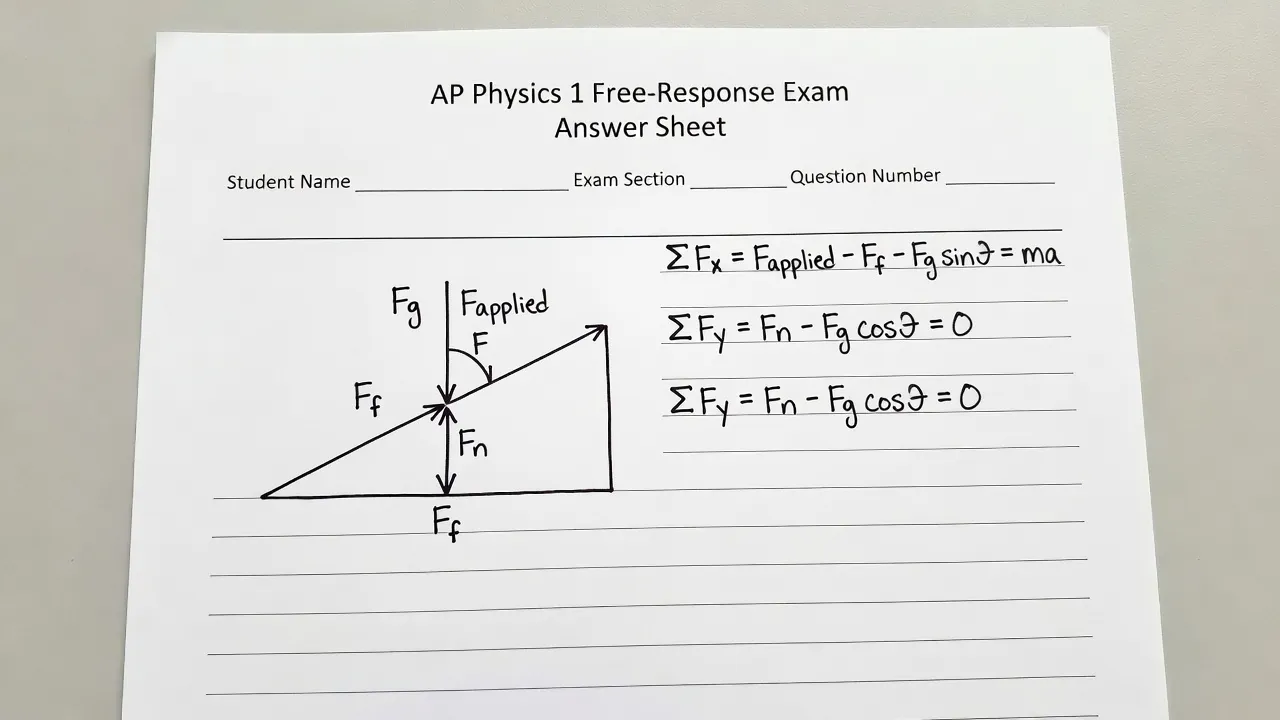
The five best AP Physics 1 FRQ study methods are AI photo-solver tools, official College Board past exams, interactive practice modules, collaborative peer study groups, and review prep books. Ranking these methods helps you prioritize active problem-solving over passive reading as exam day approaches.
1. ThinkAssist AI Physics Solver
What it is: ThinkAssist is an AI-powered homework helper app that lets you snap a photo of complex physics problems to receive instant, step-by-step solutions and variable derivations.
Why it made the list: When practicing FRQs at night or over the weekend, getting stuck on a multi-part algebraic derivation can stall your entire study session. ThinkAssist acts as a 24/7 personal tutor, providing automatic subject detection to break down force vectors, torque balances, and energy equations instantly.
Key trade-off: Relying on instant answers without attempting the problem yourself first can create a false sense of security before the actual paper exam.
2. Official College Board Past Released FRQs
What it is: A vast archive of actual free-response prompts and official scoring guidelines released publicly from past exam administrations.
Why it made the list: Nothing mirrors the actual test better than authentic questions created by the AP test development committee. Reviewing official scoring rubrics reveals exactly how AP readers assign individual points for diagrams, units, and algebraic steps.
Key trade-off: Past scoring keys are static and do not explain why an alternative mathematical approach you took might be incorrect.
3. Khan Academy AP Physics 1 Practice Modules
What it is: A free online learning platform featuring video explanations and targeted practice sets developed in partnership with College Board.
Why it made the list: As documented in OpenStax Physics documentation, mastering conceptual fundamentals like rotational kinematics and simple harmonic motion requires structured practice. Khan Academy's AP Physics 1 course provides immediate feedback on core concepts.
Key trade-off: The platform offers more multiple-choice questions than long-form, paragraph-writing FRQ prompts.
4. Collaborative Peer Whiteboard Groups
What it is: Group study sessions where students take turns solving past FRQs on a whiteboard while explaining their physical reasoning out loud.
Why it made the list: Explaining your logic to a peer forces you to practice the exact skills needed for the Paragraph Argument FRQ. It highlights gaps in your conceptual understanding that quiet reading hides.
Key trade-off: Group sessions can easily lose focus or reinforce incorrect physical assumptions if no teacher or answer key is available to verify the work.
5. Standard AP Prep Review Books
What it is: Published study guides from commercial publishers containing full-length practice exams and topic reviews.
Why it made the list: Review books offer realistic paper-and-pencil exam practice, which helps you build the physical endurance required for the 90-minute free-response section.
Key trade-off: Commercial prep books sometimes feature prompts that do not perfectly align with recent updates to College Board scoring guidelines.
How do FRQ practice options compare on price and features?
Comparing study tools based on pricing structures, availability, and specific features helps you build an affordable, effective preparation strategy. Prep options range from completely free public archives to subscription-based mobile applications and physical textbooks.
The table below outlines how top study tools compare as of August 2026:
| Study Option / Tool | Primary Use Case | Key Features | Pricing & Potential Traps |
|---|---|---|---|
| ThinkAssist | Instant 24/7 step-by-step FRQ problem breakdowns | Snap a photo, automatic subject detection, saved past explanations | Free download with affordable premium tiers; watch out for recurring app store subscriptions if you only need short-term exam prep |
| College Board Past FRQs | Calibrating work against official scoring rubrics | Official past exam prompts, reader rubrics, sample student responses | 100% Free on AP Central; trap is the lack of interactive step-by-step hints when you get stuck |
| Khan Academy | Building conceptual topic foundations | Video lessons, immediate concept checks, skill tracks | Free access; trap is assuming multiple-choice mastery translates directly to long-form FRQ writing |
| Peer Whiteboard Groups | Verbal practice for Paragraph Argument prompts | Peer feedback, group problem-solving, active dialogue | Free; trap is wasting time on incorrect derivations without a verified key |
| Prep Review Books | Timed paper-and-pencil full exam simulations | Printed practice tests, structured chapter summaries | $20-$35 one-time print cost; trap is buying outdated editions that don't reflect current FRQ formats |
When choosing tools, avoid overpaying for expensive private tutoring ($50-$150/hour) before testing flexible digital tools. Pairing free official resources with good study apps gives you complete coverage without unnecessary costs.
How can you maximize points on AP Physics 1 FRQs?
To maximize points on AP Physics 1 FRQs, focus on earning partial credit by showing clear starting equations, drawing accurate diagrams, and using precise physics vocabulary. AP readers use positive scoring, meaning they look for reasons to award points rather than simply deducting marks for final mathematical mistakes.
If you struggle with wordy setups, learning how to solve word problems in math translates directly into analyzing physics scenarios efficiently.
What are the most common mistakes students make on physics FRQs?
The most common FRQ mistakes include dropping vector direction signs, writing vague prose explanations, and plugging in numbers too early. Students often write statements like "it moves faster because of force" instead of specifying "the net unbalanced force causes a constant horizontal acceleration."
- Plugging in numbers immediately: Always derive symbolic equations first.
- Missing vector labels: Label every arrow on free-body diagrams clearly (e.g., $F_g$, $F_N$).
- Vague Paragraph Arguments: Avoid buzzwords; explain the explicit physical mechanism using principles like conservation of energy or angular momentum.
- Ignoring graph axes: Check whether a graph shows position vs. time or velocity vs. time before calculating slopes or areas.
Frequently Asked Questions
How many FRQs are on the AP Physics 1 exam?
There are four free-response questions on the AP Physics 1 exam. You have 90 minutes to complete the entire section, which accounts for 50% of your total exam score.
Can you use a calculator on the AP Physics 1 FRQ section?
Yes, you are allowed to use a scientific or graphing calculator on the entire FRQ section. You are also provided with an official College Board AP Physics 1 equation sheet.
How is the Paragraph Argument FRQ scored?
The Paragraph Argument FRQ is scored using a holistic rubric that evaluates your physical claim, supporting evidence, and logical reasoning. Points are awarded for clear organization and correct application of fundamental physics laws without mathematical contradictions.
What happens if I make a calculation error early in an FRQ?
AP readers use consistent logic scoring. If you make an arithmetic error in part (a) but correctly use that wrong value in part (b) using proper physics steps, you can still earn full credit for part (b).
Is work required for symbolic derivation questions?
Yes, you must show explicit intermediate algebraic steps starting from fundamental equations. Simply writing down a final derived expression without showing your starting principles will result in lost partial credit.
How do I practice experimental design FRQs at home?
Practice outlining procedures that specify measurable quantities and the exact equipment used (like photogates or meter sticks). Focus on describing how to reduce error and how to linearize raw data using graphs.
Are equation derivations harder than numerical calculations?
Symbolic derivations require a deeper conceptual understanding because you cannot rely on calculator checks. However, they eliminate tedious decimal calculations, allowing readers to grade your pure physical logic.