
Examples of word problems in math range from basic single-step addition scenarios in elementary school to complex multi-variable systems and rate equations in high school algebra. A math word problem presents a real-world scenario in text form, requiring you to identify known values, define unknown variables, and set up a mathematical equation to find the solution.
To master math word problems, students must learn how to filter out extraneous details, spot keyword operations, and translate English phrases into mathematical symbols. Whether you are working through elementary arithmetic or preparing for college entrance exams, practicing specific types of word problems builds the logical framework needed to tackle them efficiently.

What are the main types of math word problems?
The five main types of math word problems are single-step arithmetic, multi-step algebra, rate and distance scenarios, mixture problems, and inequality constraints.
Each category requires a distinct approach to set up the governing equation. According to the National Council of Teachers of Mathematics, framing mathematical concepts within contextual scenarios improves long-term conceptual retention compared to practicing isolated mechanical calculations.
When working through homework assignments, taking a photo of a problem with an AI-powered math helper like ThinkAssist allows you to instantly extract the governing variables and view a step-by-step solution breakdown.
The table below breaks down the common word problem scenarios, their core mathematical requirements, and the best framework for solving each.
| Scenario / Problem Type | Math Core Requirement | Typical Solution Tool / Approach | Best Fit Scenario |
|---|---|---|---|
| ThinkAssist AI Solver | Automatic Subject & Text OCR | ThinkAssist iOS App ($6.99/wk after 3-day trial) | Instant photo breakdown of complex handwritten or printed word problems |
| Single-Step Arithmetic | Basic addition, subtraction, multiplication | Manual translation matrix / flashcards | Elementary foundation and early confidence building |
| Linear System Equations | Simultaneous multi-variable algebra | Graphing calculators or substitution | Problems involving two unknowns (e.g., ticket sales, coins) |
| Distance & Work Rates | Formula application ($d = rt$ or $W = rt$) | Motion table or grid mapping | Standardized test prep (SAT/ACT) and high school physics |
| Inequality Constraints | Boundary parameters ($\le, \ge, <, >$) | Number line plotting and interval bounds | Budgeting and real-world financial planning problems |
Scenario 1: Basic single-step word problems for elementary math
Single-step word problems require performing only one mathematical operation—addition, subtraction, multiplication, or division—to find the unknown quantity.
These problems focus on building vocabulary recognition, helping younger students connect words like "altogether," "difference," or "shared equally" to arithmetic operations. Younger students practicing fundamental concepts can explore specialized guides like word math problems for 4th graders to practice age-appropriate problem sets.
Example Problem
Maya has 14 apples. She gives 6 apples to her brother. How many apples does Maya have left?
Step-by-Step Breakdown
- Identify the given values: Total apples = 14; Given away = 6.
- Identify the signal word: "Left" indicates subtraction.
- Set up the equation: $14 - 6 = x$.
- Solve: $x = 8$. Maya has 8 apples left.
Key Word Translation Guide
- Addition: "Combined," "total," "altogether," "increased by," "sum."
- Subtraction: "Fewer than," "how many more," "difference," "remains," "decreased by."
- Multiplication: "Times as many," "product of," "per," "each group has."
- Division: "Split evenly," "ratio of," "shared among," "out of."
Scenario 2: Multi-step linear equation word problems
Multi-step linear word problems require combining two or more arithmetic operations to isolate the target variable.
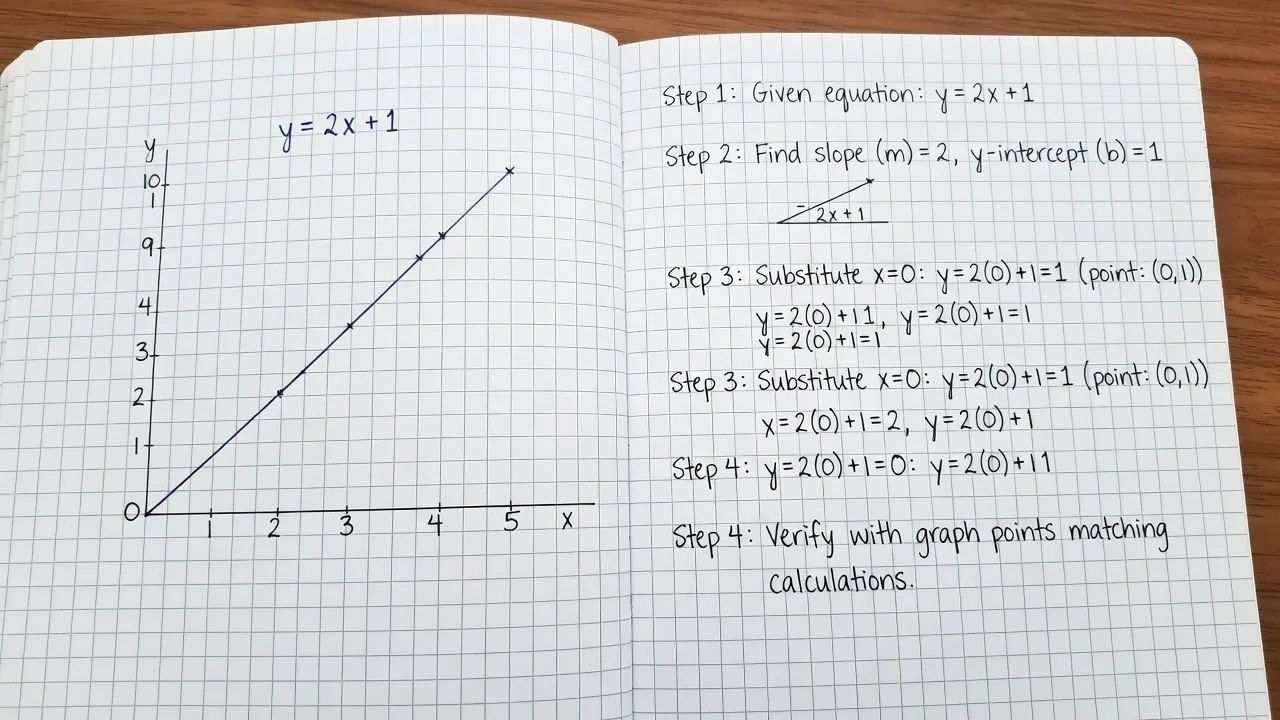
In middle school algebra, word problems transition from simple counting scenarios into relationships governed by the slope-intercept form equation $y = mx + b$. As documented in Khan Academy's algebra curriculum, mastering linear setups is the foundation for high school STEM coursework.
Example Problem
A local gym charges a flat registration fee of $30 plus $15 per month. If Marcus paid a total of $105, for how many months was he a member?
Step-by-Step Breakdown
- Define the variable: Let $m$ equal the number of months.
- Identify the fixed and variable costs: Fixed fee = $30$; Recurring monthly cost = $15m$.
- Write the equation: $15m + 30 = 105$.
- Subtract the flat fee from both sides: $15m = 75$.
- Divide by the monthly rate: $m = 5$. Marcus was a member for 5 months.
To practice isolated variable operations before tackling contextual prompts, working through a one step equations worksheet helps build mechanics without sentence clutter.
Scenario 3: Distance, rate, and time word problems
Distance, rate, and time word problems use the core physics formula Distance equals Rate multiplied by Time ($d = r \times t$) to calculate motion values.
These problems appear frequently on college entrance exams. They present scenarios involving two vehicles moving toward each other, moving in opposite directions, or travelling at different speeds over the same distance.
Example Problem
Train A leaves a station traveling east at 50 mph. Two hours later, Train B leaves the same station traveling east on a parallel track at 70 mph. How many hours after Train B departs will it catch up to Train A?
Step-by-Step Breakdown
- Define variables: Let $t$ be the travel time of Train B in hours. Train A's travel time is $(t + 2)$ hours.
- Apply $d = r \times t$ for both trains:
- Distance for Train A: $d_A = 50(t + 2)$
- Distance for Train B: $d_B = 70t$
- Set distances equal (since Train B catches Train A): $50(t + 2) = 70t$.
- Expand and simplify: $50t + 100 = 70t$.
- Subtract $50t$ from both sides: $100 = 20t$.
- Solve for $t$: $t = 5$ hours. Train B catches Train A 5 hours after setting off.
Scenario 4: Inequality word problems with real-world constraints
Inequality word problems model situations where a quantity must stay above, below, or within a specific numerical threshold rather than matching an exact equal value.
Instead of an equals sign ($=$), these problems use inequality symbols ($\le, \ge, <, >$). They frequently cover real-world logistics like budget limits, maximum weight capacities, or minimum score targets.
| Symbol / Phrase | Meaning |
|---|---|
| At least / Minimum | >= (Greater than or equal to) |
| No more than / Maximum | <= (Less than or equal to) |
| Exceeds / More than | > (Strictly greater than) |
| Under / Fewer than | < (Strictly less than) |
Example Problem
Elena is planning a banquet. The venue charges $250 to rent the hall plus $20 per guest. If Elena's total budget cannot exceed $1,000, what is the maximum number of guests she can invite?
Step-by-Step Breakdown
- Define the unknown: Let $g$ be the number of guests.
- Translate "cannot exceed": This phrase means "less than or equal to" ($\le$).
- Formulate the inequality: $20g + 250 \le 1000$.
- Isolate the variable term: $20g \le 750$.
- Divide by 20: $g \le 37.5$.
- Interpret the constraint: Elena cannot invite half a guest, so she can host a maximum of 37 guests.
For a broader review of boundary conditions and number line solutions, see our dedicated guide on math inequality word problems.
Scenario 5: System of equations and mixture word problems
Mixture and system word problems involve combining two or more distinct solutions, items, or rates to produce a final blend with a specific concentration or price.
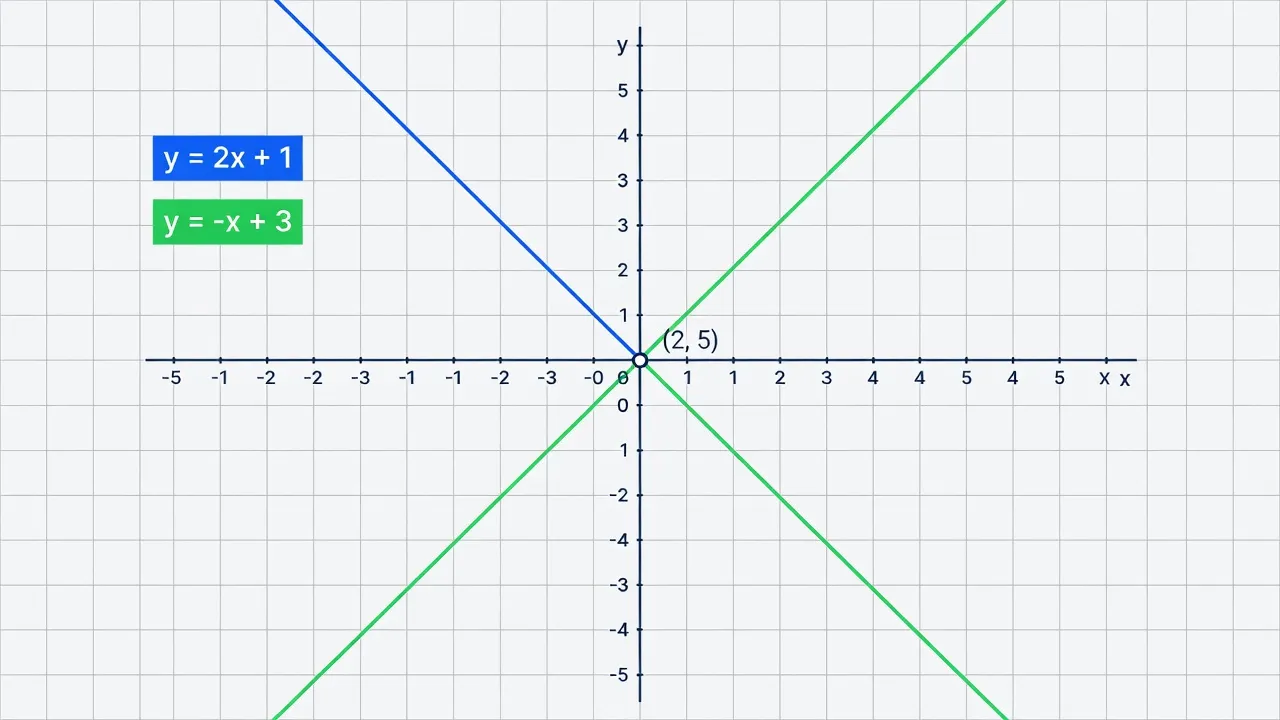
These multi-variable problems require creating two independent equations: one tracking the total volume or item count, and another tracking the component value or concentration. Computational tools like Wolfram Alpha process these multi-equation systems symbolically to verify solutions.
Example Problem
A chemist needs 10 liters of a 40% acid solution. She has a 20% acid solution and a 70% acid solution available. How many liters of each solution should she mix together?
Step-by-Step Breakdown
- Define two variables: Let $x$ = liters of 20% solution, and $y$ = liters of 70% solution.
- Write the volume equation: $x + y = 10$.
- Write the concentration equation: $0.20x + 0.70y = 0.40(10)$, which simplifies to $0.20x + 0.70y = 4$.
- Isolate $x$ in the volume equation: $x = 10 - y$.
- Substitute into the concentration equation:
$$0.20(10 - y) + 0.70y = 4$$
$$2 - 0.20y + 0.70y = 4$$
$$2 + 0.50y = 4$$
$$0.50y = 2 \implies y = 4$$ - Solve for $x$: $x = 10 - 4 = 6$. The chemist needs 6 liters of 20% solution and 4 liters of 70% solution.
How to solve any math word problem in 4 steps
You can solve any math word problem by following a four-step framework: Read for context, Define your variables, Set up and solve the equation, and Check the answer against real-world constraints.
- Read and summarize the problem: Read the entire text once without writing anything down. Identify the core question being asked and eliminate fluff details (like colors or names).
- Define variables clearly: Choose letters to represent unknown quantities (e.g., $t = \text{time in hours}$). Write down explicit units.
- Translate text into an equation: Replace key verbal phrases with mathematical operations. Draw a diagram, grid, or chart if the problem involves motion, geometry, or mixtures.
- Evaluate and sanity-check: Solve the algebraic equation, then re-read the original question. Ensure your answer makes sense in context. A calculated time of $-3$ hours or an attendance limit of $42.8$ people indicates an error in your setup.
Using ThinkAssist to master word problem setups
ThinkAssist helps students break down complex math word problems by transforming photos of handwritten or printed questions into instant, step-by-step explanations.
When studying for high-stakes exams, relying on standard answer keys often leaves gaps in understanding how an equation was derived from the text.
- Snap Photo of Problem
- Automatic Subject Detection
- Step-by-Step Translation & Solution
As of September 2026, ThinkAssist includes specialized subject detection algorithms that automatically parse geometry, algebra, and calculus word problems without requiring manual keyboard formatting.
- Snap a Photo: Point your mobile camera at any printed textbook question or handwritten problem set.
- Step-by-Step Explanations: View the exact logical steps used to convert descriptive text into algebraic expressions.
- Exam Preparation: Automatically save past solved word problems to build personalized practice lists before midterm exams.
The app is free to download on iOS, featuring a 3-day free trial followed by a $6.99/week plan for full access to 24/7 step-by-step math tutoring. If you are preparing for standardized tests, combining app assistance with a standardized sat math formula sheet ensures both your setup logic and core geometric identities remain sharp.
Frequently Asked Questions
What are math word problems?
Math word problems are narrative exercises that present mathematical scenarios through descriptive text rather than numeric equations. Solvers must read the prompt, identify the mathematical operations required, and set up an equation to find the unknown value.
Why are word problems in math so difficult for students?
Word problems are challenging because they require reading comprehension, language decoding, and mathematical reasoning simultaneously. Students must translate ambiguous natural language into precise algebraic expressions while filtering out irrelevant context.
What are the key signal words for mathematical operations in word problems?
Common signal words include "sum," "total," and "altogether" for addition; "difference," "less than," and "remains" for subtraction; "product," "per," and "times" for multiplication; and "ratio," "split," and "per" for division.
How do you set up a linear equation from a word problem?
To set up a linear equation, identify the fixed starting quantity (the y-intercept) and the rate of change per unit (the slope). Combine them into the standard form equation y = mx + b, where m is the rate and b is the flat starting value.
What is the d = rt formula used for in math problems?
The d = rt formula stands for Distance equals Rate multiplied by Time. It is used in algebra and physics word problems to calculate speed, travel duration, or distance traveled for moving objects.
How can mobile apps help with solving word problems?
Mobile math apps use optical character recognition to read printed or handwritten word problems from a camera photo. They analyze the context, identify the core variables, and present step-by-step solutions showing how to convert the text into an equation.