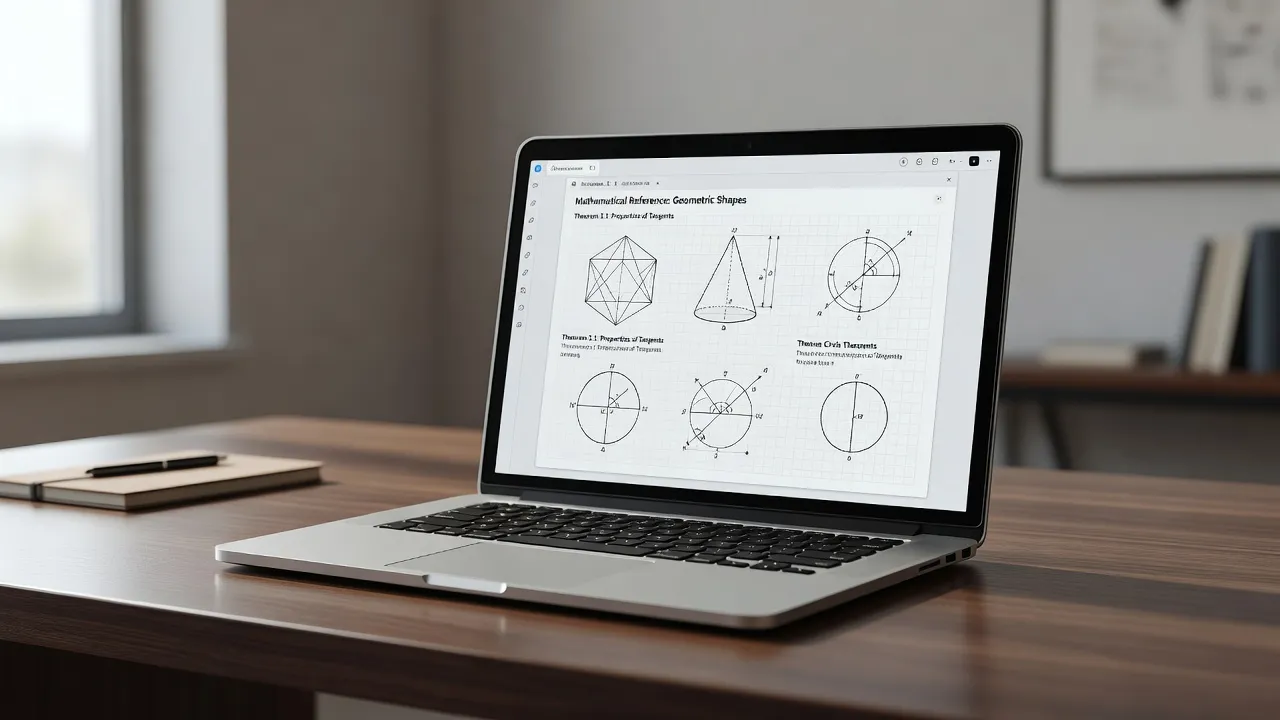
The official SAT math formula sheet provides 12 standard geometry formulas and 3 conversion constants at the top of every Digital SAT math section. While College Board provides area, volume, and right triangle rules on every test, relying on this reference pop-up during the timed exam is one of the biggest time-wasters for high school students.
Most test-takers make the mistake of assuming the reference sheet covers algebra, statistics, and trigonometry. It does not.
If you spend your test clicking back and forth to check basic geometry facts, you lose precious seconds that should go toward solving complex word problems. To maximize your score on the Digital SAT, you need to know exactly what is on the sheet, where to find it in the test interface, and—most importantly—which formulas you must memorize on your own.
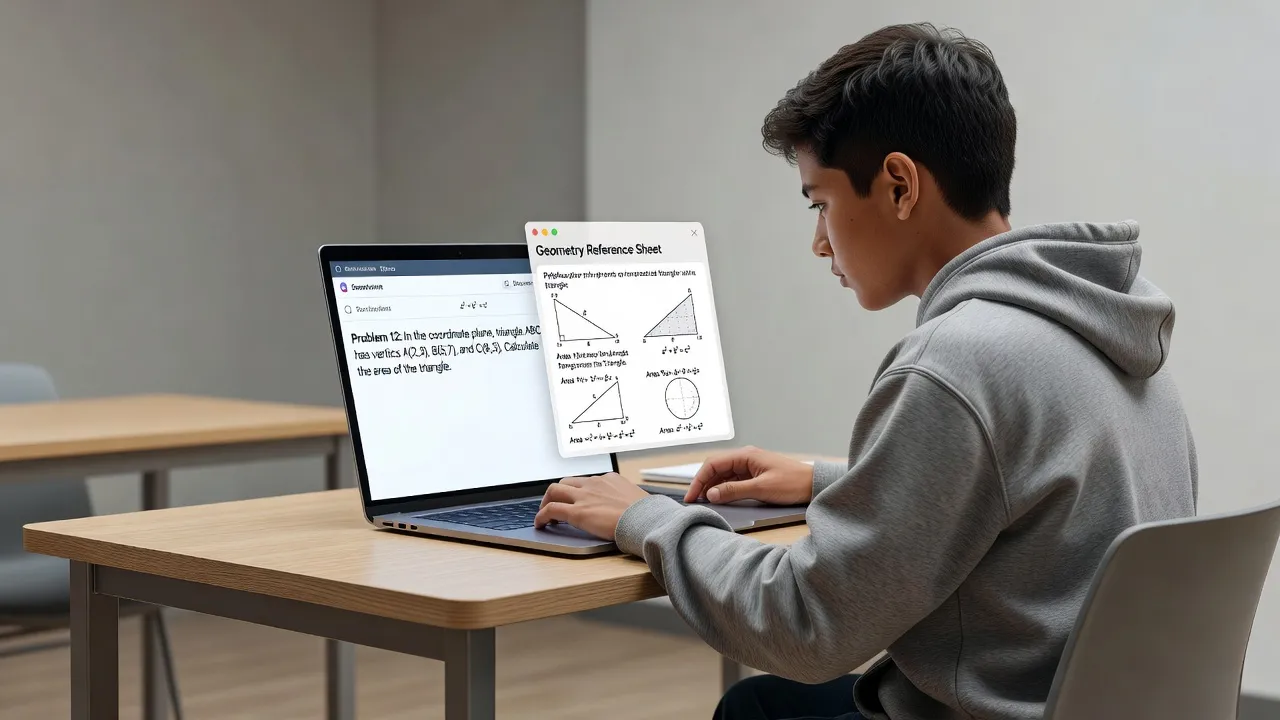
Where can you find the official SAT Math Reference Sheet PDF from College Board?
You can download the official SAT Math Reference Sheet PDF directly from College Board's SAT Suite website or print it from any official practice test inside the Bluebook app.
Downloading the PDF before test day allows you to print a hard copy for your daily study sessions. Keeping a physical sheet next to your scratch paper helps you memorize the layout so you never have to search for a formula during the actual exam.
To get the exact PDF used on the test:
- Navigate to the official College Board SAT Suite download portal.
- Open any official Digital SAT practice test PDF or student guide.
- Scroll to the first page of the Math section to view the reference panel.
Having a printed copy while practicing helps you spot which geometry values are given automatically and which algebraic rules require independent study. If you struggle with breaking down complex practice questions, using an AI-powered homework solver like ThinkAssist allows you to snap a photo of any problem and get step-by-step explanations instantly.
Where is the reference sheet located in the Bluebook app?
In the Bluebook application, the reference sheet is accessed by clicking the "Reference" button located in the top-right toolbar of the active test interface.
The Reference button sits right next to the line reader and calculator tools during Module 1 and Module 2 of the Math section. Clicking this button opens a clean, draggable pop-up window over your question screen.
The reference sheet is located in the upper right corner of the Bluebook app interface, next to the Calculator button. The Calculator and Reference buttons appear in the header alongside the Bluebook Interface Header, to the right of the question content area.
Here is how the Bluebook reference tool behaves during the exam:
- Instant Overlay: Clicking "Reference" opens a window containing all 12 geometry diagrams and conversion rules.
- Draggable Window: You can move the pop-up across your screen so it does not block the problem statement.
- No Page Flipping: Unlike the old paper SAT where you turned back to page one, the digital pop-up stays available with one click on every math question.
The trap most students fall into is opening this window five or six times per module. Every time you open, drag, and close that reference box, you split your cognitive focus and waste roughly 10 to 15 seconds.
What formulas are on the SAT Math Reference Sheet?
The SAT Math Reference Sheet includes 12 explicit geometry formulas covering area, perimeter, volume, the Pythagorean theorem, and special right triangles, along with 3 basic circle and degree constants.
The reference section focuses almost entirely on measurement and geometry. According to Khan Academy's SAT Math guide, geometry and trigonometry account for roughly 15% of the total questions on the Digital SAT, meaning the provided reference sheet is irrelevant for the vast majority of algebra and advanced math questions on your test.
| Formula Category | Provided Formulas & Rules | What It Is Used For |
|---|---|---|
| 2D Area & Perimeter | $A = \pi r^2$, $C = 2\pi r$, $A = lw$, $A = \frac{1}{2}bh$ | Circles, rectangles, and standard triangles. |
| 3D Volume | $V = lwh$, $V = \pi r^2 h$, $V = \frac{4}{3}\pi r^3$, $V = \frac{1}{3}\pi r^2 h$, $V = \frac{1}{3}lwh$ | Rectangular prisms, cylinders, spheres, cones, and pyramids. |
| Right Triangles | $c^2 = a^2 + b^2$, $x:x\sqrt{3}:2x$ (30-60-90), $x:x:x\sqrt{2}$ (45-45-90) | Missing side lengths and special angle ratios. |
| Constants | 360 degrees in a circle, $2\pi$ radians in a circle, 180 degrees in a triangle | Angle unit conversions and interior angle totals. |
Notice what is missing from this table: linear equations, quadratic formulas, exponent rules, probability equations, and coordinate geometry. If a problem asks for the vertex of a parabola or the slope between two points, opening the reference sheet will not help you.
What specific formulas are listed (Pythagorean theorem, circle, area, volume, special right triangles)?
The official reference sheet specifically lists formulas for circle area ($A=\pi r^2$), circle circumference ($C=2\pi r$), rectangle area ($A=lw$), triangle area ($A=\frac{1}{2}bh$), rectangular prism volume ($V=lwh$), cylinder volume ($V=\pi r^2 h$), sphere volume ($V=\frac{4}{3}\pi r^3$), cone volume ($V=\frac{1}{3}\pi r^2 h$), pyramid volume ($V=\frac{1}{3}lwh$), the Pythagorean theorem ($a^2+b^2=c^2$), and ratios for 30-60-90 and 45-45-90 special right triangles.
Understanding how these specific equations appear on the page ensures you never waste time second-guessing basic geometric measurements.
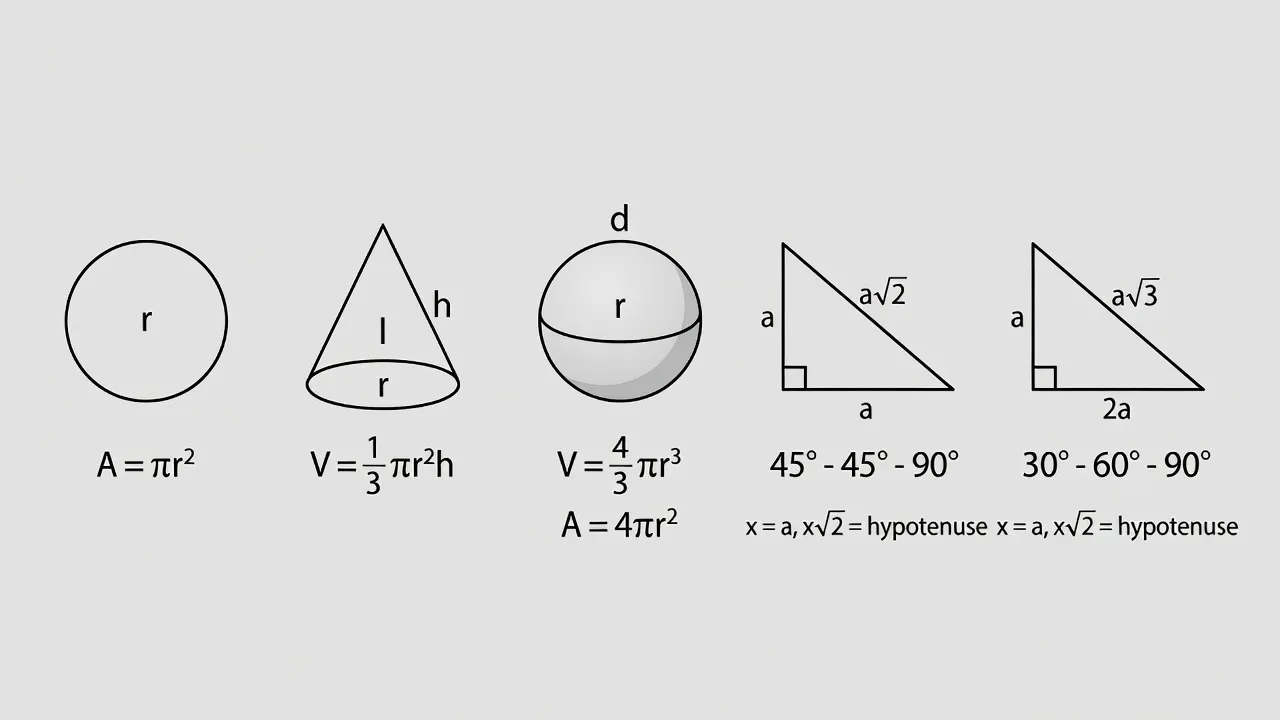
2D Shape Area and Circumference
The first section of the reference sheet focuses on flat geometric figures:
- Circle Area: $A = \pi r^2$ (where $r$ is the radius).
- Circle Circumference: $C = 2\pi r$ or $C = \pi d$ (where $d$ is the diameter).
- Rectangle Area: $A = lw$ (length times width).
- Triangle Area: $A = \frac{1}{2}bh$ (base times perpendicular height).
3D Solid Volume
The middle block of the sheet gives you volume equations for five standard solids:
- Rectangular Prism: $V = lwh$
- Right Circular Cylinder: $V = \pi r^2 h$
- Sphere: $V = \frac{4}{3}\pi r^3$
- Right Circular Cone: $V = \frac{1}{3}\pi r^2 h$
- Square Pyramid: $V = \frac{1}{3}lwh$
Right Triangle Rules
The final visual block covers fundamental right triangle relationships:
- Pythagorean Theorem: $a^2 + b^2 = c^2$, where $c$ is always the hypotenuse.
- 30°-60°-90° Triangles: The sides follow the ratio $x : x\sqrt{3} : 2x$ opposite to the 30°, 60°, and 90° angles respectively.
- 45°-45°-90° Triangles: The legs are equal ($x$), and the hypotenuse is $x\sqrt{2}$.
Provided Reference Notes
At the bottom of the reference sheet, College Board adds three brief sentence facts:
- The number of degrees of arc in a circle is 360.
- The number of radians of arc in a circle is $2\pi$.
- The sum of the measures in degrees of the angles of a triangle is 180.
The 7 Crucial SAT Math Formulas NOT Included on the Reference Sheet
The biggest mistake test-takers make is assuming the provided reference sheet is complete. Over 80% of the Digital SAT Math section focuses on algebra, advanced math, and data analysis. None of those topics have formulas on the official sheet.
If you do not memorize these seven non-provided formulas, you will struggle to finish the test on time.
1. Slope and Slope-Intercept Form
Linear equations appear constantly on the SAT. You must know how to calculate slope ($m$) between two points $(x_1, y_1)$ and $(x_2, y_2)$ and how to format the line:
$$m = \frac{y_2 - y_1}{x_2 - x_1}$$
$$y = mx + b$$
In this equation, $m$ represents the slope (rate of change) and $b$ represents the y-intercept (starting value). If you get stuck on linear modeling questions, practicing how to solve word problems in math helps you pull these variables out of dense text paragraphs quickly.
2. Quadratic Formula and Discriminant
When a quadratic equation $ax^2 + bx + c = 0$ cannot be factored easily, you must use the quadratic formula to find the roots:
$$x = \frac{-b \pm \sqrt{b^2 - 4ac}}{2a}$$
The expression under the radical ($b^2 - 4ac$) is called the discriminant. It tells you how many real solutions the equation has:
- If $b^2 - 4ac > 0$, there are 2 distinct real solutions.
- If $b^2 - 4ac = 0$, there is 1 real solution.
- If $b^2 - 4ac < 0$, there are 0 real solutions (2 complex solutions).
3. Vertex Form of a Parabola
Finding the maximum or minimum value of a quadratic function is a favorite topic for College Board question writers:
$$y = a(x - h)^2 + k$$
In vertex form, the point $(h, k)$ is the exact vertex of the parabola. If $a > 0$, $k$ is the minimum value; if $a < 0$, $k$ is the maximum value.
4. Exponential Growth and Decay
Word problems involving compound interest, population growth, or radioactive decay require the general exponential equation:
$$y = a(1 \pm r)^t$$
Here, $a$ is the initial amount, $r$ is the percentage rate of growth or decay expressed as a decimal, and $t$ is time. For compounding interest over $n$ periods per year, the formula expands to $A = P\left(1 + \frac{r}{n}\right)^{nt}$.
5. Equation of a Circle in the Coordinate Plane
While the reference sheet gives you the area and circumference of a circle, it completely omits the standard coordinate equation for a circle centered at $(h, k)$:
$$(x - h)^2 + (y - k)^2 = r^2$$
where $(h, k)$ represents the center point of the circle and $r$ is the radius. You will frequently need to complete the square on an expanded polynomial equation to rewrite it into this standard format.
6. Sine, Cosine, and Tangent (SOH CAH TOA)
Basic trigonometry on the SAT requires memorizing the basic right triangle trigonometric ratios:
$$\sin(\theta) = \frac{\text{Opposite}}{\text{Hypotenuse}}, \quad \cos(\theta) = \frac{\text{Adjacent}}{\text{Hypotenuse}}, \quad \tan(\theta) = \frac{\text{Opposite}}{\text{Adjacent}}$$
You must also know the complementary angle relationship: $\sin(x^\circ) = \cos(90^\circ - x^\circ)$. This simple identity appears regularly on hard-level math modules.
7. Percent Change and Percent Error
Data analysis questions require quick percentage calculations:
$$\text{Percent Change} = \frac{\text{Amount of Change}}{\text{Original Amount}} \times 100$$
Always divide by the original starting value, not the new updated value.
How to Master SAT Math Formulas Using ThinkAssist
Studying formulas in isolation is rarely enough to score above 700 on SAT Math. The real challenge is recognizing which formula to apply when a question is hidden inside a complicated word problem or graphic.
This is where integrating modern AI study tools transforms your prep routine.
- Snap a Photo: Take a picture of any tricky problem
- Auto-Detection: App identifies algebra vs. geometry
- Step-by-Step: Breaks down exact formula application
- Archive & Review: Saves past solutions for test day
If you get stuck on a difficult coordinate circle problem or a systems of equations question late at night, you can use the ThinkAssist iOS App to capture the problem instantly.
ThinkAssist works as a 24/7 digital tutor designed to get you top grades:
- Snap a Photo: Take a picture of any printed or digital math problem from your practice tests.
- Automatic Subject Detection: The app identifies whether you are looking at quadratic functions, system of linear inequalities, or geometry.
- Step-by-Step Solutions: Instead of giving just a final letter answer, it shows you the exact formulas used and how to rearrange the algebra step-by-step.
- Easy Exam Prep: It automatically saves your past solved questions and explanations so you can review your specific weak points right before test day.
When you practice with structured step-by-step guidance, you build the muscle memory needed to recall unprovided equations in seconds under real test conditions.
Comparing Your Tools: Reference Sheet vs. Built-in Desmos vs. ThinkAssist Prep
Navigating the Digital SAT requires knowing when to use your built-in tools versus when to rely on your own preparation. As of September 2026, every Digital SAT test-taker has access to an embedded Desmos graphing calculator inside the Bluebook software.
Here is how your test-day tools compare against external prep solutions when handling math formulas:
| Solution / Tool | Primary Strengths | Major Limitations | Ideal Use Case |
|---|---|---|---|
| Official Reference Sheet | Always available in Bluebook; guaranteed accurate for basic 2D/3D shapes. | Covers zero algebra, probability, or coordinate geometry; opens in an overlay. | Verifying volume formulas ($V = \frac{4}{3}\pi r^3$) or special right triangle ratios. |
| ThinkAssist AI Tutor | Snaps photos of problems; provides instant step-by-step formula breakdowns; archives practice history. | External study app; cannot be brought inside the physical SAT testing center. | Daily homework, self-study, and mastering unprovided formulas before test day. |
| Embedded Desmos Calculator | Solves systems of equations visually; finds intercepts, vertices, and intersections instantly. | Requires graphing speed; easy to make syntax errors under time pressure. | Finding parabolic vertices or checking linear slopes directly on screen. |
| Personal Memory | Zero speed penalty; zero screen clutter; works instantly across all question types. | Subject to human memory slips or panic during timed conditions. | Essential algebra formulas (Quadratic formula, Circle equations, Exponent rules). |
According to official documentation on the Desmos Graphing Calculator portal, students can graph implicit equations like circles and parabolas instantly. However, relying entirely on Desmos without understanding the underlying algebraic formulas can slow you down on harder Module 2 questions.
3 Common Mistakes Students Make with the SAT Math Reference Sheet
Understanding what is on the sheet is only half the battle. Avoiding operational mistakes during the test is what preserves your clock.
1. Searching for Algebra Rules on a Geometry Sheet
We see students open the reference window searching for line slope equations, midpoint formulas, or logarithm rules. As noted, College Board provides zero algebra formulas on the reference screen.
If you are working on an algebra or data question, keep the reference window closed. Searching for rules that are not there wastes 30 to 45 seconds per question.
2. Manual Calculations for Special Right Triangles
The 30-60-90 and 45-45-90 right triangle diagrams on the reference sheet are extremely helpful, but writing out full algebraic proportions for every basic triangle problem takes too long.
Memorize the core multiplier rules ($x\sqrt{3}$ for the long leg of a 30-60-90; $x\sqrt{2}$ for the hypotenuse of an isosceles right triangle). You should only open the reference window to double-check yourself if you feel uncertain on a high-stakes problem.
3. Ignoring the Built-in Unit Conversions
The bottom of the reference sheet lists radian-to-degree conversion bases ($2\pi \text{ radians} = 360^\circ$, meaning $\pi \text{ radians} = 180^\circ$).
Many students try to memorize complex conversion fractions and end up flipping the numerator and denominator under pressure. When converting between radians and degrees, take one second to look at the bottom note on the sheet to make sure your conversion factor is oriented correctly.
Smart Test Strategy: How to Handle Formula Questions on Test Day
When taking Module 1 and Module 2 of the Math section, follow this three-step tactical approach to manage formulas efficiently:
- Memorize the "Big 7" Unprovided Formulas First: Spend your prep weeks drilling the quadratic formula, vertex form, slope-intercept, circle equations, exponential growth, percent change, and basic trig ratios.
- Use Desmos for Graphical Shortcuts: When faced with finding the vertex of a parabola or solving a system of equations, type the functions directly into the Bluebook Desmos calculator rather than executing lengthy hand algebra.
- Reserve the Reference Sheet for Volume and Arc Calculations: Only open the Bluebook "Reference" tab when you encounter 3D shapes (spheres, cones, pyramids) or need to confirm a radian angle conversion.
If you struggle with interpreting word problems involving inequalities or systems, reviewing targeted guides on math inequality word problems gives you structured methods to translate wordy prompts into simple equations.
For students who also plan to take the ACT as a backup, practicing with standardized materials like an ACT practice test PDF is a great way to contrast how different testing boards frame their math reference rules.
By committing the key unprovided formulas to memory early and using ThinkAssist during your daily practice sessions to break down challenging questions, you ensure that test day runs smoothly without relying on a reference pop-up.
Frequently Asked Questions
Do you get a physical formula sheet on the Digital SAT?
No, physical paper formula sheets are not handed out during the Digital SAT. The reference sheet is integrated directly into the Bluebook testing app as a digital pop-up window that you can open or close at any time during the math section.
Is the SAT Math formula sheet the same for both modules?
Yes, the identical reference panel is available in both Module 1 and Module 2 of the Math section. You can access it on any math question regardless of difficulty level.
Do I need to memorize the quadratic formula for the SAT?
Yes, the quadratic formula is not provided on the official SAT reference sheet. You must memorize $x = \frac{-b \pm \sqrt{b^2 - 4ac}}{2a}$ along with how to calculate the discriminant ($b^2 - 4ac$).
Are trigonometry formulas on the SAT Reference Sheet?
No, the SAT formula sheet does not include basic trigonometric ratios like Sine, Cosine, or Tangent (SOH CAH TOA), nor does it include complementary angle rules. Only basic 2D and 3D geometry formulas are provided.
Can I bring my own printed formula sheet into the SAT exam room?
No, you cannot bring external reference sheets, notes, or printed papers into the official test center room. You may only use scratch paper provided by the test center proctor and the digital reference pop-up inside Bluebook.
How do I convert radians to degrees using the SAT reference sheet?
The bottom note on the sheet states that $2\pi \text{ radians} = 360^\circ$, which simplifies to $\pi \text{ radians} = 180^\circ$. To convert radians to degrees, multiply the radian measure by $\frac{180}{\pi}$.
Does the SAT formula sheet change from year to year?
No, the official geometry formulas provided on the SAT reference sheet have remained consistent across the transition from the paper SAT to the Digital SAT format.