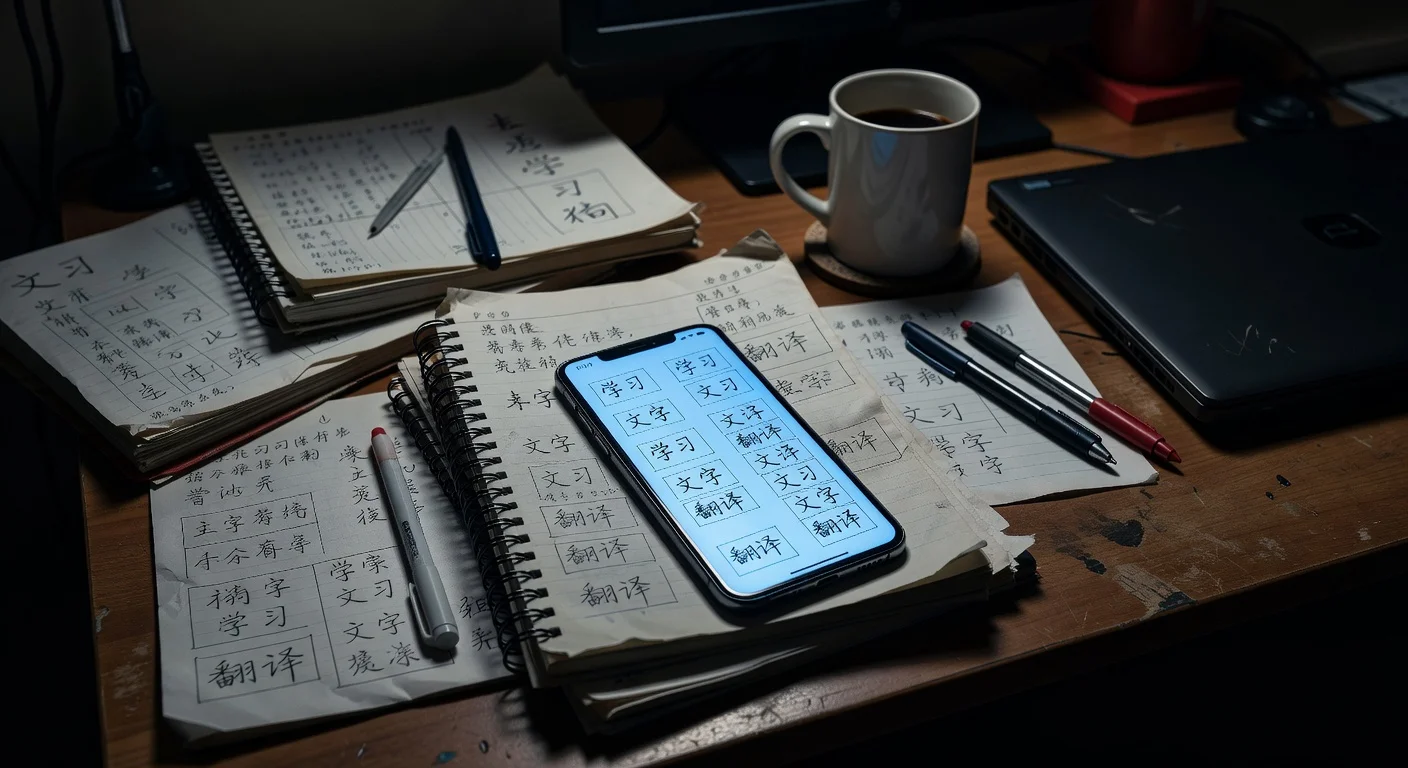
A learn Chinese app is mobile software that uses spaced repetition and AI to teach Mandarin vocabulary, tones, and character recognition. Unlike a textbook, it tracks your retention and reviews material at the moment you are about to forget it — which is the only mechanism that actually builds long-term memory.
I spent most of late 2025 running through every major tool on the App Store and play store — 14 subscriptions at peak, now down to three. My phone is a graveyard of colorful language apps I deleted because they were built for tourists, not students. If you are trying to pass a graded Mandarin class or hit an HSK benchmark, that distinction matters enormously.
Why do standard Chinese language apps fail intermediate students?
Most consumer apps are designed to give you dopamine hits, not grammar competency. You tap colorful flashcards, earn digital streaks, and feel productive — right up until a real assignment shows up and you realize you cannot parse a single sentence without the hint system.
The specific gaps I kept running into:
- They skip complex stroke order entirely. You can "learn" 500 characters and still be unable to write a single one correctly by hand.
- Their built-in dictionaries have no context for idioms (chengyu). Knowing the literal meaning of each character tells you nothing about what a four-character proverb actually means.
- You cannot feed them your actual coursework. When your professor hands you a printed passage, a basic app is useless — you cannot type 200 unknown characters into a search bar if you do not know their Pinyin.
The deeper problem is what happens at the speaking level. App recordings are slow and clean. Real people speak roughly 40% faster and run syllables together. Students who rely exclusively on gamified apps tend to score well on multiple-choice quizzes, then freeze the first time a native speaker asks a basic question. That gap between recognition and production is where most intermediate learners stall.
How long does it take an English speaker to learn basic Chinese?
According to FSI language difficulty rankings, Mandarin is a Category IV language — the hardest tier for native English speakers. The estimate is roughly 400 to 600 hours of dedicated study to reach basic conversational fluency (approximately HSK 3).
At 30 minutes a day, a 600-hour goal takes over three years. Bump to 90 minutes a day and the timeline drops to about 13 months. These numbers are useful not to scare you but to set realistic expectations — and to explain why tool selection matters more for Mandarin than for almost any other language.
What is the most effective app stack for graded classes?
No single app covers everything well. The right approach is to segment your tools by task: one for core curriculum, one for solving assignments you cannot read, one for reference.
| App | Primary Use Case | 2026 Pricing | What It Does Well |
|---|---|---|---|
| ThinkAssist | Homework assignments | ~$9.99/mo | AI OCR scans printed or handwritten text for instant breakdown |
| HelloChinese | Core curriculum | $8.99/mo | Best structured foundation for absolute beginners; accurate voice recognition |
| Pleco | Dictionary & OCR | Free (add-ons vary) | Offline database, handwriting input, mandatory reference tool |
| Skritter | Character writing | $14.99/mo | Forces stroke order via tactile screen tracing |
The stack I recommend for any student in a graded class: HelloChinese for the curriculum, Pleco always open in the background, and ThinkAssist for when an assignment hits you with a block of text you cannot decode.
How do I scan a Chinese workbook for specific assignment help?
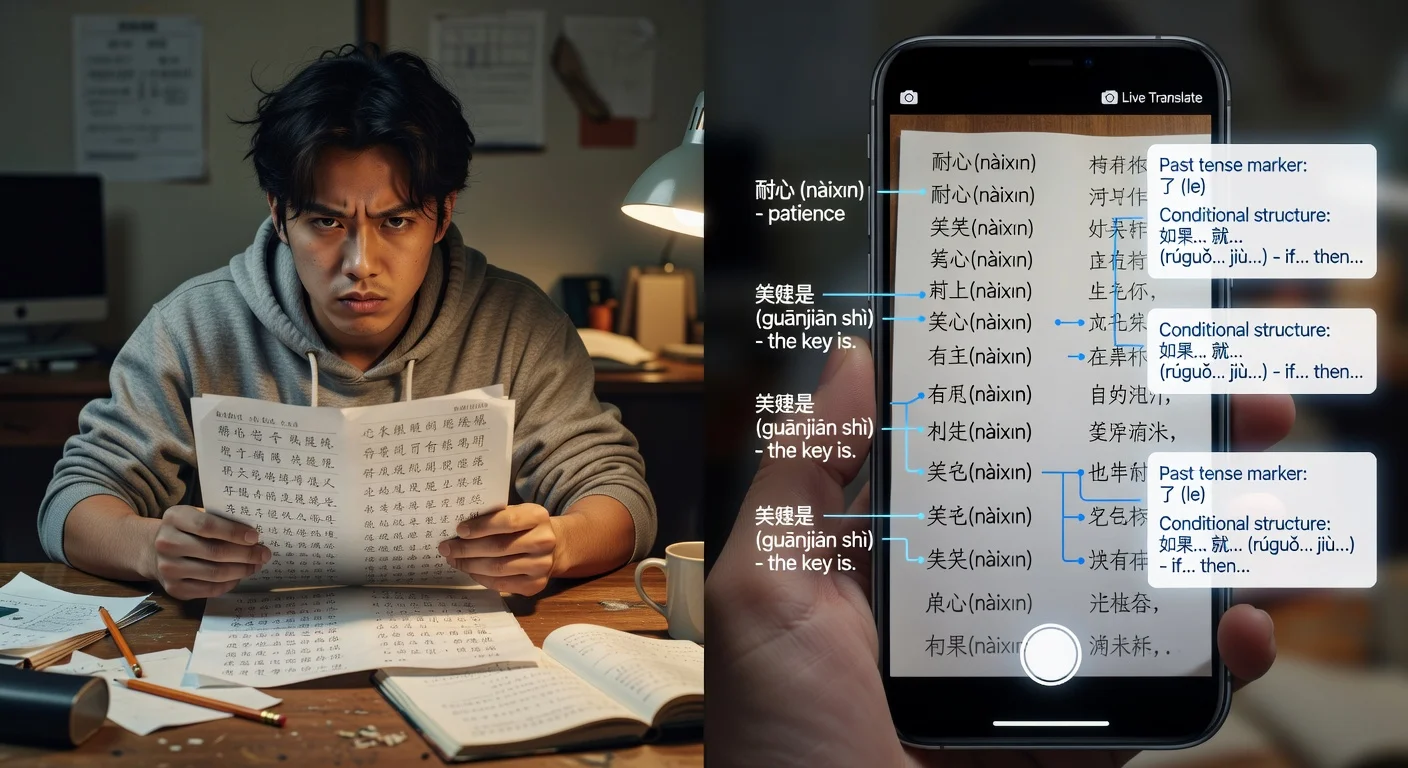
This is the workflow that replaced most of my manual dictionary time. When a passage looks incomprehensible, I open ThinkAssist and use its camera on the printed or handwritten text. The app detects Mandarin automatically and generates:
- A character-by-character breakdown with pinyin above each one
- The grammatical structure (subject, verb, object — which sit in different positions than English)
- An explanation of why specific particles (like 了 or 的) appear where they do
What used to take 45 minutes of cross-referencing dropped to about two minutes of review. The "Past Answers" history also means your past problem sessions become a study log — useful for reviewing specific grammatical patterns before an HSK exam rather than rereading the whole textbook. For a broader look at how AI solvers fit into homework workflows, the AI homework helper guide goes deeper.
You can download ThinkAssist on the App Store here.
Can I learn to write Chinese characters with just an app?
You can learn the stroke order rules on a screen. You will not build actual muscle memory without physical paper.
Glass offers no friction. Your brain processes a finger swipe differently than the drag of a ballpoint pen on a character grid. Most serious learners figure this out around the 150-character mark — the screen tracing starts to feel hollow and retention drops.
The practical split: use an app like Skritter for the rules and sequence, then drill those same characters on paper. If your class requires handwritten exams, the paper practice is non-negotiable.
Should I prioritize simplified or traditional Chinese characters?
Simplified if your goal is mainland China. Traditional if you are focused on Taiwan, Hong Kong, historical literature, or classical texts.
I made the mistake of ignoring traditional characters early on, then felt completely lost reading a Taiwanese menu. The good news: every serious app in 2026 has a toggle in settings. Check it is active before you build a vocabulary deck — unlearning a character variant later is more painful than starting with the right one.
What is the real cost of free versus paid Mandarin apps?
Free tiers are effective through HSK 1 and HSK 2 — roughly the first 300 words. That is enough for two to three months of casual study. Once you hit HSK 3 territory, grammar gets genuinely complex, and that is precisely where companies install the paywall. They know you are invested at that point.
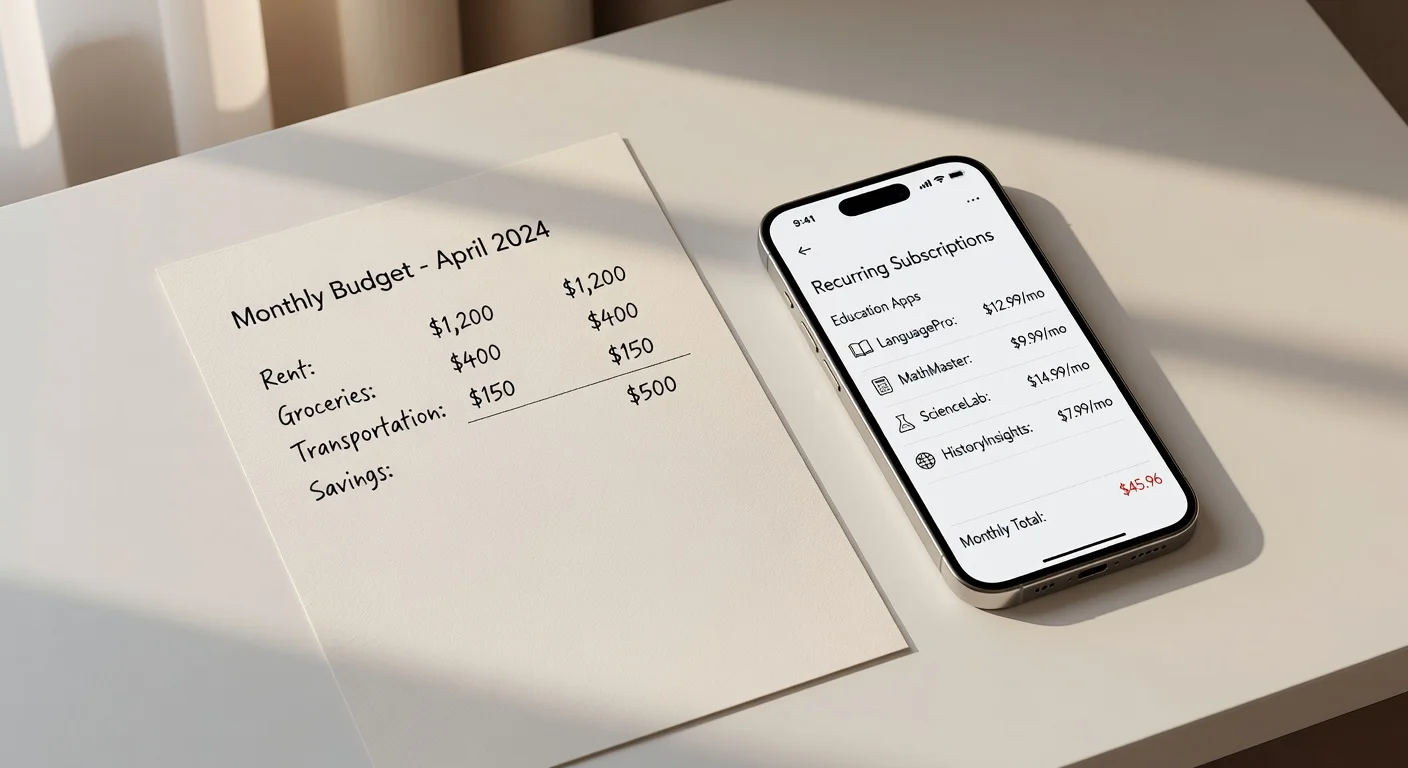
Expect to pay $9–$15/month for any tool that covers intermediate content. If you are running the three-app stack above (HelloChinese + Pleco + ThinkAssist), total cost lands around $20–$25/month. Compared to a private tutor at $25/hour — where you need at minimum 50 hours of awkward broken-Chinese practice before you start sounding functional — the math is straightforward.
Why is voice recognition unreliable in older apps?
Older apps use phonetic matching algorithms that cannot reliably distinguish Mandarin's four tones. They will pass your pronunciation even when you say mǎ (horse) instead of mā (mother). That is a serious liability — you are training yourself to produce wrong sounds and receiving confirmation that they are correct.
Newer AI-based apps process audio against sentence context, not just phoneme matching, which catches tonal errors more accurately. If your app regularly accepts sloppy tones without flagging them, delete it now. Unlearning bad tone habits is significantly harder than learning them correctly the first time.
How do I build a daily study habit that actually sticks?
Willpower fails. The only habit structure that works long-term is anchoring study sessions to existing non-negotiable routines.
- Morning anchor: Review 10 flashcards while coffee brews. Takes 3 minutes. A dedicated flashcard builder app makes deck creation faster than typing cards by hand.
- Commute anchor: 15-minute audio lesson on the train or bus.
- Evening anchor: Scan and complete one grammar worksheet before opening anything else for entertainment.
On daily volume: 20 minutes minimum to counteract the natural forgetting curve. Three hours on Sunday and nothing the rest of the week results in losing about 60% of what you covered. Language acquisition is driven by frequency, not volume. Two 15-minute blocks — one morning, one evening — consistently outperform a single exhausting 45-minute session.
For structuring what you study alongside how, the best study apps guide covers the full system for managing STEM and language coursework together.
Frequently Asked Questions
Are Mandarin learning apps actually effective?
Yes, for building vocabulary and Pinyin they work well. They will not produce fluency on their own — real speaking practice with a human is still necessary to close the gap between recognition and production.
How long does it take an English speaker to learn basic Chinese?
FSI data puts it at 400 to 600 hours to reach HSK 3 (basic conversational level). At 30 minutes a day that exceeds three years; at 90 minutes a day, roughly 13 months.
How much does a good Chinese learning app cost in 2026?
Most premium apps run $9–$15 per month. Free tiers typically cover HSK 1 and 2 (first 300 words). Expect a paywall once grammar complexity increases at HSK 3 and beyond.
Can an app help me with physical workbook assignments?
Yes, with OCR. ThinkAssist snaps a photo of any printed or handwritten text and returns translations, pinyin, and grammar structure — no typing required.
Do gamified language apps teach you character stroke order?
Most skip it entirely. For proper stroke order you need a dedicated tool like Skritter that requires you to trace the correct sequence on screen.
What is the best dictionary app for Mandarin students?
Pleco. Its offline database and OCR handwriting recognition have been the industry standard for years, and nothing in 2026 has come close to replacing it.
Should I study simplified or traditional characters?
Simplified for mainland China; traditional for Taiwan, Hong Kong, and classical texts. Confirm the toggle is set correctly in your app before building any large vocabulary deck.
How many characters do I need to be conversational?
Around 1,000 frequent characters for basic daily conversation. Reading standard news fluently requires closer to 2,500 to 3,000.