
The Physics GRE is a standardized 100-question multiple-choice exam administered by ETS that tests core undergraduate physics concepts for graduate school admissions. Spanning classical mechanics, electromagnetism, optics, thermodynamics, quantum mechanics, atomic physics, special relativity, and laboratory methods, the test measures your ability to solve complex physics problems rapidly under strict time constraints.
Navigating physics graduate school admissions requires understanding how this exam is structured, which study tools yield the highest score returns, and whether your target programs even require it today.
Is the Physics GRE subject test still offered?
Yes, the Physics GRE is still actively offered by ETS, but its administration format and university requirement policies have shifted significantly in recent years. As of September 2026, ETS offers the test in a computer-delivered format at official testing centers during specific testing windows in April, September, and October.
While the test remains available worldwide, the landscape of graduate admissions has evolved. Prior to 2020, almost every top-tier physics PhD program in the United States required the GRE Subject Test. Today, policy changes across major research universities have created a split:
- Required: A smaller subset of specialized programs and international institutions still mandate the Physics GRE for all applicants.
- Optional / Strongly Recommended: Many top-ranking departments allow applicants to submit scores to supplement their academic records, especially if coming from non-traditional backgrounds.
- Not Accepted / Blind: A growing number of universities, including departments listed on the MIT Physics Admissions page, refuse to review GRE Subject Test scores altogether to eliminate financial and testing barriers.
Before spending months preparing, check the exact application requirements on each university's department website for the current application cycle.
What are the best study materials for the Physics GRE?
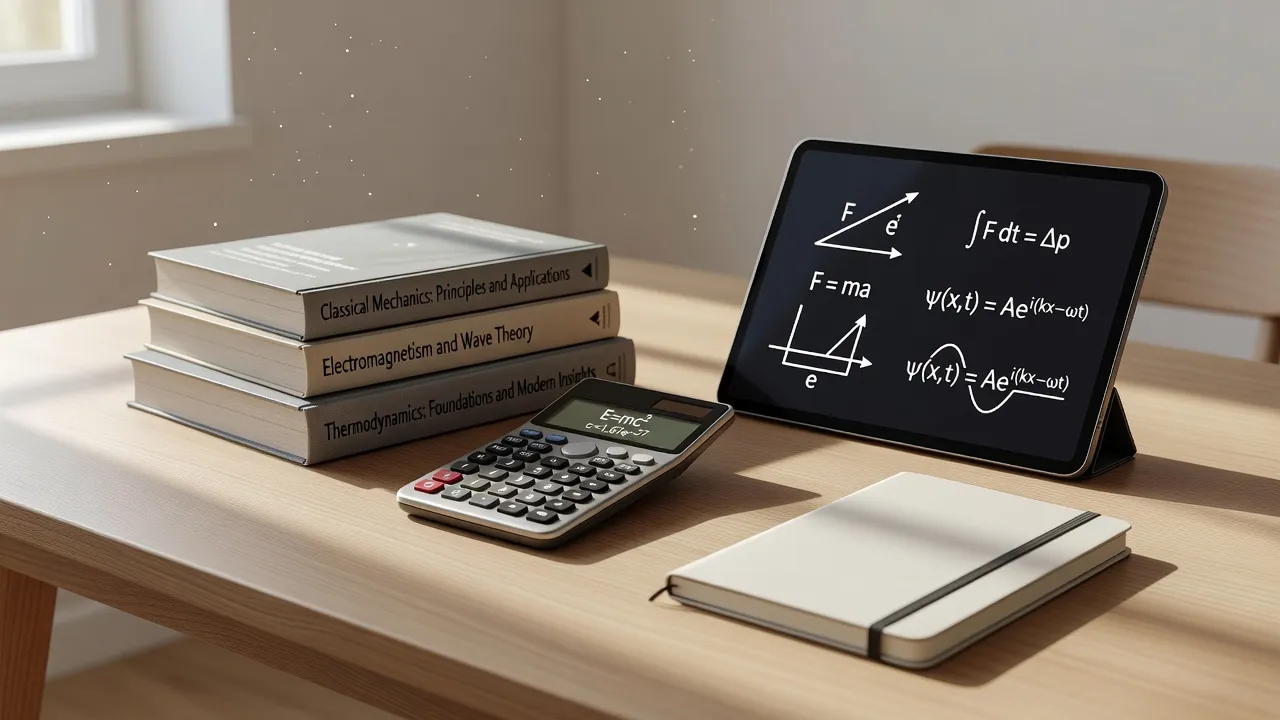
The best study materials for the Physics GRE combine a comprehensive strategy guide, standard upper-level undergraduate textbooks, and all officially released ETS practice exams. Because the exam tests speed as much as subject mastery, high-scoring students rely on materials that emphasize dimensional analysis, limiting cases, and fast order-of-magnitude estimation.
To prepare effectively, your prep stack should include three core categories of study aids:
- Dedicated Prep Books: Specialized books designed specifically for the test's structure, offering subject reviews and fast problem-solving heuristics.
- Undergraduate Reference Textbooks: Standard physics texts used to clear up conceptual gaps in quantum mechanics, electrodynamics, and statistical mechanics.
- AI Homework and Problem Solvers: Mobile study tools like ThinkAssist allow you to snap photos of stubborn practice problems to get instant step-by-step solutions and mathematical breakdowns when working through dense problem sets.
- Official Released ETS Tests: The single most accurate representation of question formatting, trick choices, and time pacing.
Building a balanced toolkit keeps you from getting stuck on difficult derivations during self-study. When revising foundational concepts like simple harmonic motion equations or rotational dynamics, combining classic textbook problems with quick digital step-by-step checks prevents lost study time.
What textbooks are recommended for the Physics GRE (Griffiths, Kleppner, Schaum, Jackson, Tipler)?
The recommended textbooks for Physics GRE review are Griffiths for Electrodynamics and Quantum Mechanics, Kleppner & Kolenkow for Classical Mechanics, and Schaum's Outlines for fast problem-solving drill work. Graduate-level texts like Jackson are far too advanced for this exam and should be avoided during test prep.
The exam focuses entirely on undergraduate-level physics. Reading high-level graduate texts will waste your time on lengthy derivations when the exam only tests rapid execution of basic principles.
| Textbook | Author(s) | Physics GRE Subject Weight | Recommended Use Case |
|---|---|---|---|
| ThinkAssist App | ThinkAssist | All Topics (Instant Solver) | Mobile step-by-step problem breakdown, formula verification, and 24/7 exam prep |
| Introduction to Electrodynamics | David J. Griffiths | ~18% (Electromagnetism) | Core conceptual review for Maxwell's equations and wave optics |
| Introduction to Quantum Mechanics | David J. Griffiths | ~12% (Quantum Mechanics) | Reviewing 1D potentials, harmonic oscillators, and angular momentum |
| An Introduction to Mechanics | Daniel Kleppner & Robert Kolenkow | ~20% (Classical Mechanics) | Mastering central force motion, kinematics, and rigid body rotation |
| Schaum's Outline of Physics for Engineering and Science | Michael Browne | All Topics | High-volume drill practice for rapid calculation speed |
| Physics for Scientists and Engineers | Paul A. Tipler & Gene Mosca | General Overview | Reviewing introductory topics like thermodynamics and optics |
| Classical Electrodynamics | John David Jackson | None (Graduate Level) | Do not use: Too advanced and mathematically heavy for this exam |
Focus your textbook review on concepts that appear frequently on the test. For example, practicing vector calculus and drawing accurate free body diagrams from Kleppner helps build the visual intuition needed to eliminate wrong answers in seconds.
Is 'Conquering the Physics GRE' a good book?
Yes, 'Conquering the Physics GRE' by Yoni Kahn and Adam Anderson is widely considered the absolute best preparation book available for the exam. Unlike general physics review guides, this book was written specifically to target the exact structure, shortcuts, and subject weightings of the ETS test.
The book excels in three specific areas:
- Targeted Content Summaries: It condenses four years of undergraduate physics into high-yield summaries that focus exclusively on equations and principles tested on the exam.
- Exam-Specific Tactics: It teaches candidates how to use dimensional analysis, extreme values, and symmetry arguments to eliminate incorrect options without solving integrals.
- Realistic Practice Problems: It contains three full-length practice tests that match the difficulty and style of modern ETS exams.
While the conceptual review is dense, pairing the book with an interactive tool like the ThinkAssist iOS app helps clarify difficult practice questions. If you hit a wall on a complex step in a practice test explanation, capturing the problem with your phone gives you an immediate breakdown of the underlying math.
Is there an official ETS Physics GRE practice test?
Yes, ETS has published several official Physics GRE practice tests over the past decades, which are available as free downloadable PDFs online. These exams represent real tests administered in previous years and are the single most valuable resource for predicting your actual score.
According to the historical archives hosted on the APS Physics Education resources page, ETS has officially released six full-length exams. You can identify them by their four-digit form numbers:
- GR1777: The most recently released official exam, reflecting modern scoring distributions and question styles.
- GR0877: An excellent representation of current difficulty levels across quantum and statistical mechanics.
- GR0177, GR9677, GR9277, GR8677: Older exam forms that remain exceptional practice sources for basic mechanics and electromagnetism drills.
Because ETS reuses question structures and conceptual patterns, taking these exams under strict timed conditions is non-negotiable. Save form GR1777 for your final mock exam two weeks before your test date to gauge your score accurately.
What Physics GRE practice tests are recommended?
The most recommended practice tests are the six official ETS released forms, supplemented by the three practice exams in 'Conquering the Physics GRE'. Unofficial practice exams from third-party test prep companies often fail to mimic the specific trick options and time traps characteristic of real ETS questions.
To get the highest return on your practice test regimen, structure your practice exams in three stages:
1. Diagnostic Phase (Un-timed)
Start by taking an older ETS form, such as GR9277, without a clock. Work through all 100 questions to identify your weak subject areas. If you find high school or lower-division concepts rusty, reviewing foundational resources like an AP Physics 1 FRQ study guide can quickly rebuild your speed in basic kinematics and work-energy theorems.
2. Speed and Accuracy Phase (Timed)
Take GR0177 and GR0877 under strict timed conditions: exactly 170 minutes for 100 questions. This translates to 1.7 minutes per question. Learn to skip questions that require more than two minutes of calculation.
3. Final Simulation Phase
Complete GR1777 and the practice exams from Kahn & Anderson under full testing conditions. Use official ETS bubble answer sheets to practice physical bubbling speed if taking a paper administration, or practice using the digital interface on a screen.
How to structure your Physics GRE revision schedule
A successful Physics GRE study plan requires 12 to 16 weeks of dedicated preparation, totaling approximately 150 to 200 hours of study time. Because physics is hard to cram at the last minute, spreading your preparation across distinct phases ensures long-term retention of complex formulas.
Week 1-4: Diagnostic Test & Core Subject Review (Mechanics & E/M)
Week 5-8: Secondary Topics Review (Quantum, Thermo, Special Relativity)
Week 9-12: High-Volume Practice Tests & Dimensional Analysis Tactics
Week 13-16: Full Timed Exam Simulations & Weak-Point Remediation
Key Principles for Daily Practice
- Master Shortcut Heuristics: Practice checking units, evaluating limits (such as setting $m \to 0$ or $\theta \to 0$), and using symmetry to eliminate 3 out of 5 answer choices immediately.
- Log Every Mistake: Maintain an error log detailing every question you missed on practice tests. Categorize errors by conceptual misunderstanding, mathematical mistake, or misread question stem.
- Automate Solution Analysis: Use ThinkAssist to quickly solve practice problems you get wrong. The app acts as a 24/7 tutor, providing automated step-by-step explanations and saving solutions for fast review during final test-week prep.
Frequently Asked Questions
What is a good Physics GRE score for graduate school?
A score above 800 (roughly the 70th percentile) is competitive for most top-50 physics PhD programs in the U.S. For elite top-10 programs, applicants typically aim for scores of 900 or higher (around the 85th percentile).
How many questions are on the Physics GRE, and how long is the exam?
The Physics GRE consists of 100 multiple-choice questions. Test takers are given 170 minutes (2 hours and 50 minutes) to complete the exam.
Is there a penalty for guessing on the Physics GRE?
No, there is no negative marking penalty on current ETS Physics GRE exams. Your raw score is based solely on the number of questions answered correctly, so you should answer every question before time expires.
What math concepts are tested on the Physics GRE?
The exam tests calculus-based mathematics, including vector calculus, differential equations, linear algebra, matrix transformations, Fourier series, and complex variables, as applied to physical problems.
How much does the Physics GRE cost to take?
As of 2026, the GRE Subject Test registration fee is $150 globally. Additional fees apply for late registration, test center changes, or sending extra score reports to universities.
Can you use a calculator on the Physics GRE?
No, calculators are strictly prohibited during the Physics GRE. All calculations are designed to be completed by hand or using mental math, estimation, and dimensional analysis.
How long are Physics GRE scores valid?
ETS keeps Physics GRE scores on record and valid for official report submission for five years following your test date.