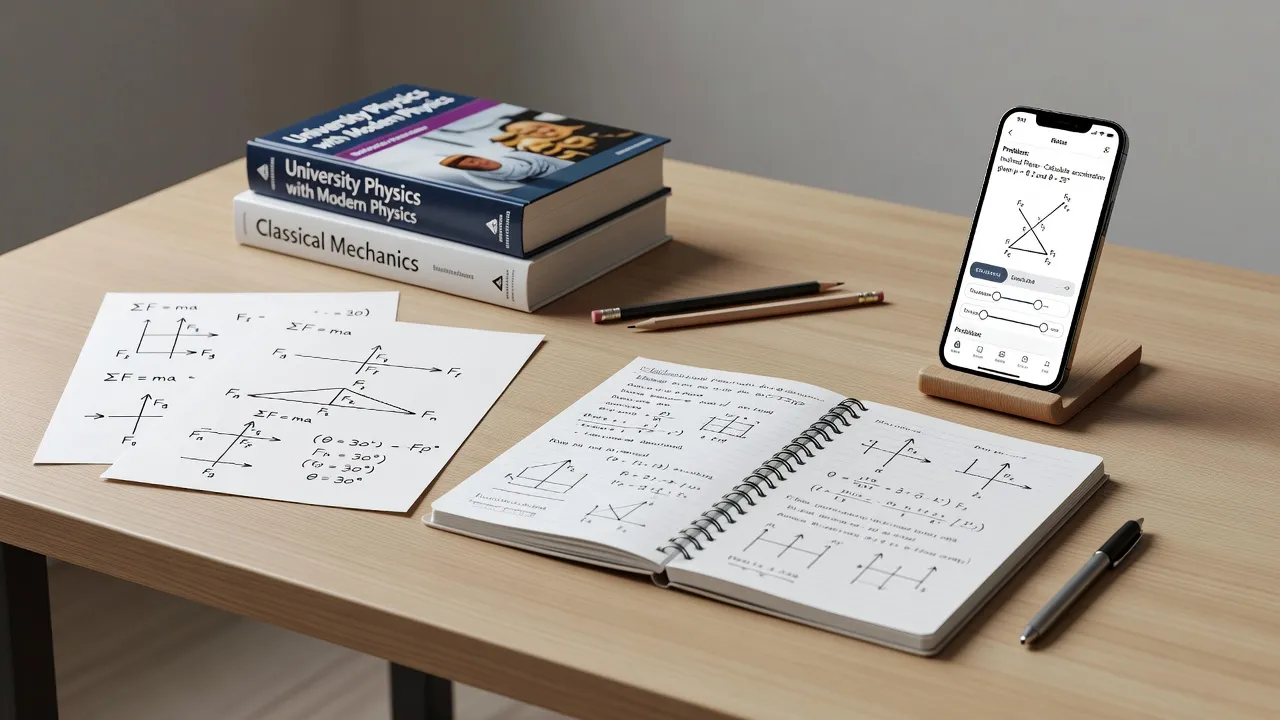
Physics is hard because it requires simultaneous fluency in abstract mathematical models, spatial reasoning, and real-world physical intuition, forcing students to translate verbal word problems into calculus or algebra before they can begin calculating. Unlike subjects that rely primarily on memorization or straight numerical computation, physics demands that you identify invisible forces, set up coordinate systems, and apply general principles to completely unfamiliar scenarios. According to score data published on College Board AP Central, AP Physics 1 consistently posts one of the lowest passing rates among all Advanced Placement exams, with only 48% of students scoring a 3 or higher as of September 2026.
Why is physics so hard compared to other subjects?
Physics is exceptionally difficult because it forces your brain to bridge three distinct mental disciplines at once: physical intuition, symbolic math, and spatial geometry. In a typical chemistry or biology course, memorizing structures and applying defined formulas will get you through most exams. Physics, however, penalizes rote memorization because two problems that look identical on paper often require entirely different governing equations based on subtle physical conditions.

When you encounter a force problem, you cannot simply plug numbers into a formula. You must first construct a free-body diagram, assign vector directions, evaluate mass distributions, and decide whether friction or air resistance applies.
If you get stuck on the initial translation from text to diagram, modern tools can help you visualize the underlying concepts instantly. Using an AI-powered study tool like ThinkAssist, you can snap a photo of any written physics question to get an immediate, step-by-step breakdown of how to set up the problem. Its automatic subject detection identifies whether you are looking at Newtonian mechanics, thermodynamics, or electromagnetism, saving you from applying the wrong physical laws.
What makes physics problems so confusing for students?
Physics problems confuse students because they rely on invisible physical quantities and abstract notation that often conflict with everyday human experience. In daily life, you observe that moving objects eventually stop on their own, which leads to the intuitive (but physically incorrect) assumption that continuous motion requires continuous force.
Why does math feel different in a physics class?
Math feels different in physics because variables represent real physical properties with dimensions and directions, rather than simple numbers on an x-y axis. In a pure algebra class, solving $x + 5 = 12$ is an isolated numerical exercise. In physics, that same equation might represent a dynamic system where $x$ represents net force in Newtons, requiring you to track units, vector orientation, and physical constraints throughout the solution.
If you struggle to identify whether a given variable has both magnitude and direction, reviewing fundamental concepts like magnitude physics can help clarify how scalar quantities differ from vectors.
What is the "cognitive split" in physics problem-solving?
The cognitive split occurs when a student must hold three separate processing tasks in working memory at the same time: conceptual analysis, mathematical setup, and numeric calculation. Educational research detailed on Wikipedia's Cognitive Load page shows that working memory overload happens rapidly when learners face complex multi-step tasks without adequate structural scaffolding.
The Physics Cognitive Load
- Concept Translation: What forces or fields are acting here?
- Mathematical Modeling: Which equations represent these laws?
- Computational Execution: Isolating variables and solving units.
When all three layers hit your brain simultaneously, mental fatigue sets in quickly. Eliminating just one layer of stress, such as verified step-by-step math execution, allows your brain to focus on understanding the core physical principles.
How do physics study options compare in cost and effectiveness?
Choosing the right study resource depends on whether you need targeted homework help, exam preparation, or continuous 1-on-1 tutoring, with costs ranging from free web apps to over $100 per hour. Many private tutoring services carry steep hourly rates and rigid scheduling, while static textbook answer keys often show final numbers without explaining the logical steps required to get there.
| Study Option | Primary Use Case | Cost & Pricing Traps | Key Strength |
|---|---|---|---|
| ThinkAssist App | 24/7 instant homework problem solving and exam prep | No hidden hourly fees; unlimited problem scanning | Snaps photos of physics problems to break down step-by-step logic automatically |
| Private Physics Tutor | Highly individualized, live 1-on-1 instruction | Expensive ($50–$150/hour); minimum hour billing traps | Personal accountability and customized pacing |
| Textbook Solution Keys | Checking homework numbers against official manuals | Subscription paywalls ($15–$25/month); missing work steps | Direct match for standard university textbook sets |
| Online Video Libraries | Visual explanations of core theoretical physics | Free access, but non-interactive; cannot solve custom questions | Excellent for high-level conceptual overviews |
As shown in the comparison, dedicated AI helpers solve the main drawback of traditional study materials by providing immediate, interactive problem breakdowns without forcing you into expensive hourly tutoring contracts.
How can you make physics easier to learn?
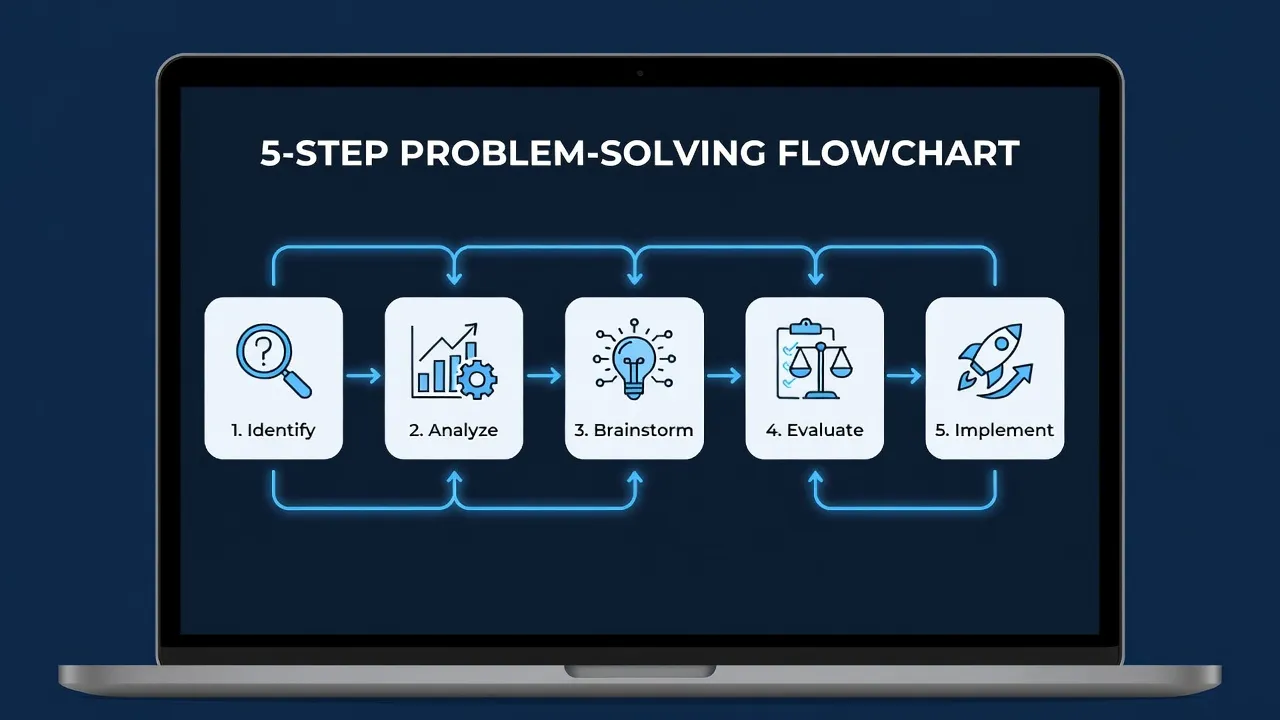
You can make physics significantly easier by breaking every problem into five consistent structural steps rather than trying to calculate the final answer immediately. Most students panic when reading a complex physics scenario because they try to jump straight from the problem statement to an equation.
- Draw a physical diagram: Never start a problem without a visual map. Draw vector arrows for every force, velocity, or field present in the scenario.
- List all knowns and unknowns: Write down every numeric value given in the text, including its units (e.g., $m = 50\text{ kg}$, $v_0 = 0\text{ m/s}$).
- Select the governing physical principle: Decide whether the system conserves energy, conserves momentum, or obeys Newton's Second Law.
- Isolate the target variable algebraically: Rearrange your formula before plugging in any numerical values to avoid arithmetic errors.
- Check the units and sign sanity: Verify that your final unit matches what was asked (e.g., Joules for energy) and that the positive or negative sign makes physical sense.
When studying specific motion topics, practicing exact formulas like the simple harmonic motion equation using this step-by-step approach prevents you from misinterpreting acceleration vectors at amplitude extremes.
Why traditional study methods fail in physics (and what works instead)
Traditional study methods like re-reading textbooks and highlighting notes fail in physics because passive reading does not build spatial or mathematical problem-solving skills. Physics requires active application. You cannot learn to solve a complex trajectory problem by looking at a solved example any more than you can learn to play an instrument by reading sheet music.
According to workforce and education trend tracking from the American Institute of Physics, students who engage in active, problem-based learning show significantly higher retention rates in undergraduate physics courses than those taught via traditional passive lectures.
| Study Method | Approach |
|---|---|
| PASSIVE (Fails in Physics) | Highlighting text, reading formulas |
| ACTIVE (Works in Physics) | Re-working failed problems from scratch |
To build true mastery, you should adopt active study techniques:
- Solve problems without looking at the answer first: Attempt the question for at least 10 minutes before checking a solution guide.
- Keep an error log: Document every problem you get wrong, noting whether the mistake was conceptual, algebraic, or a simple reading error.
- Use past exam questions for practice: If you are preparing for AP tests, working through realistic prompts like an AP Physics 1 FRQ study guide builds familiar pattern recognition under timed conditions.
- Leverage a 24/7 digital tutor: When you get stuck late at night, using ThinkAssist allows you to analyze where your step-by-step logic broke down, keeping your momentum going without waiting for office hours.
- Study with an official equation sheet: Get comfortable navigating resources like the physics c equation sheet early in the school year so you know exactly where constants and formulas are located during exams.
Frequently Asked Questions
Why is physics harder than calculus?
Physics is often considered harder than calculus because calculus focuses on executing defined mathematical rules, whereas physics requires you to determine which rules apply to an unstructured real-world setup before you can perform the math.
Can I pass physics if I am bad at math?
Yes, you can pass physics if you focus heavily on understanding underlying physical concepts, because much of physics relies on logical translation and spatial relationships rather than advanced mental arithmetic.
Why do I understand physics in class but fail the homework?
You likely understand physics during class because the teacher provides the initial conceptual setup, but on homework, you must construct that setup independently from blank paper.
Is AP Physics 1 the hardest AP exam?
AP Physics 1 regularly records one of the lowest pass rates among all AP subjects, primarily because its exam questions focus heavily on conceptual justification rather than simple formula calculations.
How many hours a week should I study for college physics?
Most university physics departments recommend spending roughly two to three hours studying outside of class for every one hour of lecture time to master problem-solving techniques.
Does memorizing formulas help in physics?
Memorizing formulas provides minimal benefit in physics because formula sheets are usually provided during exams, and success depends on knowing when and how to apply those formulas to specific physical scenarios.
How can AI apps help me study physics?
AI study apps help by breaking down complex word problems into clear, sequential steps, letting you snap a photo of any problem to identify missing formulas and check your work instantly.