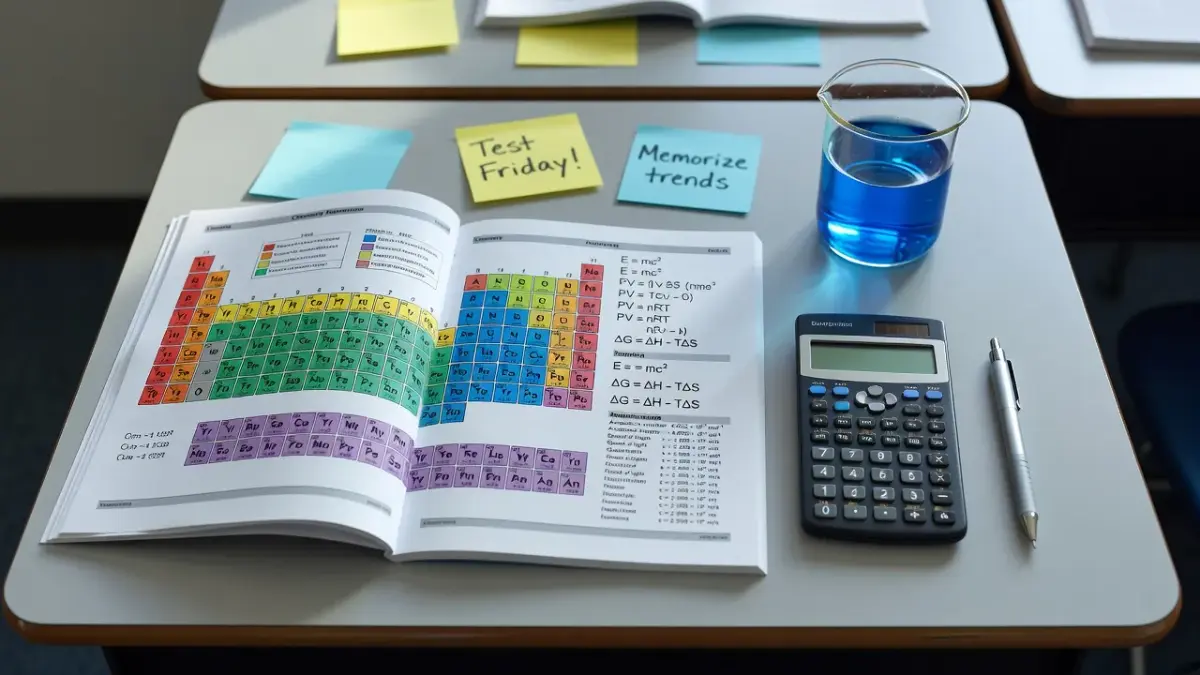
The AP Chemistry formula sheet is College Board's official exam-day reference: a periodic table plus two "Equations and Constants" pages, available on both exam sections. The sheet gives you the equations but not the hard part (picking the one a question needs). Some formulas students count on, like M₁V₁ = M₂V₂ for dilutions, aren't on it at all.
You can download the same pages free from College Board. To practice choosing the right equation, I'd photograph a practice problem with ThinkAssist, an iPhone app that explains each step of the solution. That way you see which line of the sheet every step uses.
Where can I download the official College Board AP Chemistry formula sheet PDF?
The official AP Chemistry equation sheet is a free PDF on College Board's AP Central site: the AP Chemistry Equations and Constants sheet, linked from the AP Chemistry exam page. It's three pages: a cover, then the two equations and constants pages. The periodic table is a separate page in the same set of exam materials.
I'd avoid the redrawn "AP chemistry cheat sheet" PDFs that show up in search results. They often add formulas that aren't on the real sheet, or drop constants that are. If you practice with a padded version, you'll reach for a formula in May that isn't there.
Three official places carry the real version:
- AP Central exam page: the standalone equations and constants PDF.
- The Course and Exam Description (CED): the same sheet and periodic table, bound into the full course document.
- Released free-response questions: past FRQ booklets on AP Central include the reference pages, so you can practice under real conditions.
The sheet students used for the May 2026 exam is the one you'll find there now. If you're preparing for May 2027, check the exam page again in spring before you print your final copy.
What equations and constants are on the AP Chemistry formula sheet?
The AP Chemistry equation sheet covers five areas: atomic structure, equilibrium, kinetics, gases/liquids/solutions, and thermodynamics/electrochemistry. Each area is paired with its constants. The top of the first page also lists the unit symbols (g, mol, L, atm, mm Hg, J, V, C and the rest), unit conversions and metric prefixes, so you never have to guess what an abbreviation means.
| Section | Equations on the sheet | Constants given |
|---|---|---|
| Atomic structure | E = hν, c = λν; Coulomb's law, F ∝ q₁q₂/r² | h = 6.626 × 10⁻³⁴ J s; c = 2.998 × 10⁸ m s⁻¹; Avogadro's number = 6.022 × 10²³ mol⁻¹ |
| Equilibrium | Kc, Kp, Ka, Kb expressions; Kw = [H₃O⁺][OH⁻] = Ka × Kb; pH, pOH, pKw = 14 = pH + pOH; pH = pKa + log([A⁻]/[HA]); pKa, pKb | Kw = 1.0 × 10⁻¹⁴ at 25°C |
| Kinetics | [A]t − [A]0 = −kt; ln[A]t − ln[A]0 = −kt; 1/[A]t − 1/[A]0 = kt; t½ = 0.693/k | None |
| Gases, liquids, solutions | PV = nRT; P₁V₁/T₁ = P₂V₂/T₂; Dalton's law and mole fraction; n = m/M; K = °C + 273.15; D = m/V; KE = ½mv²; molarity; A = εbc | R = 8.314 J mol⁻¹ K⁻¹ = 0.08206 L atm mol⁻¹ K⁻¹; 1 atm = 760 mm Hg = 760 torr; STP = 273.15 K and 1.0 atm; 22.4 L mol⁻¹ at STP |
| Thermodynamics / electrochemistry | q = mcΔT; ΔS°, ΔH°, ΔG° as products minus reactants; ΔG° = ΔH° − TΔS° = −RT ln K = −nFE°; I = q/t; E = E° − (RT/nF) ln Q | F = 96,485 C per mole of electrons; 1 V = 1 J/C |
Why are the constants rounded the way they are?
The sheet rounds constants to four significant figures, which is enough for any AP problem. The NIST reference on fundamental constants lists Planck's constant as exactly 6.62607015 × 10⁻³⁴ J s since the 2019 SI redefinition. The AP sheet uses 6.626. Use the sheet's values on the exam, because the scoring guides are built on them.
What does "A = εbc" mean on the sheet?
A = εbc is Beer's law. Absorbance equals molar absorptivity (ε) times path length (b) times concentration (c), the same letters the Beer-Lambert law entry on Wikipedia uses. Older AP sheets printed it as A = abc, so some prep books still use a for absorptivity. On the AP exam, it's almost always used in spectrophotometry lab questions.
Which formulas are not on the AP Chemistry reference sheet?
Several formulas you'll use all year are missing from the AP Chem reference sheet, so you have to memorize them. That gap is where students lose points. Someone who knows the sheet by heart is still stuck on a lab question if they assumed the percent yield formula would be printed.
| Missing from the sheet | Where it shows up |
|---|---|
| Arrhenius equation | Temperature, activation energy and rate (tested qualitatively) |
| Percent yield and percent error | Stoichiometry and lab FRQs |
| Dilution, M₁V₁ = M₂V₂ | Solution prep and titration questions |
| Formal charge | Lewis structure questions |
| Solubility rules and polyatomic ion names | Net ionic equations and precipitate questions |
Two things also aren't on the sheet but get handed to you inside individual questions:
- The specific heat of water.
- Specific Ka or Ksp values.
You don't need to memorize those. You do need to recognize when a problem expects you to use one it just gave you.
How should I use the AP Chemistry formula sheet on the exam?
Use the sheet to check your work, not to find your approach. You should already know which equation a question needs before you look at the page. The exam is long: College Board's AP Chemistry student page lays it out as 60 multiple-choice questions in 90 minutes, then 7 free-response questions (3 long, 4 short) in 105 minutes. That's about 90 seconds per multiple-choice question, which doesn't leave time to scan the page from the top.
Here's how I'd handle it in practice:
- Know the sheet's layout cold. If you can picture equilibrium in the second block and thermo at the bottom, finding a constant takes seconds, not a full skim.
- Use it for constants, not concepts. R comes in two versions with different units, and picking the one that doesn't match yours (0.08206 when you need joules, 8.314 when you're working in liters and atm) is the most common mistake the sheet can actually prevent.
- Check units against the R value. If ΔG° = −RT ln K gives you a strange answer, you probably used 0.08206 instead of 8.314.
- Write the equation in your FRQ answer. Scorers award points for set-up, so copying the relevant line from the sheet before you plug in numbers shows your reasoning.
On the hybrid digital format, you answer multiple-choice questions in the Bluebook app and write free responses on paper. Practice with the reference pages in Bluebook before test day so you're not hunting for them under time pressure.
Is the Henderson-Hasselbalch equation on the sheet?
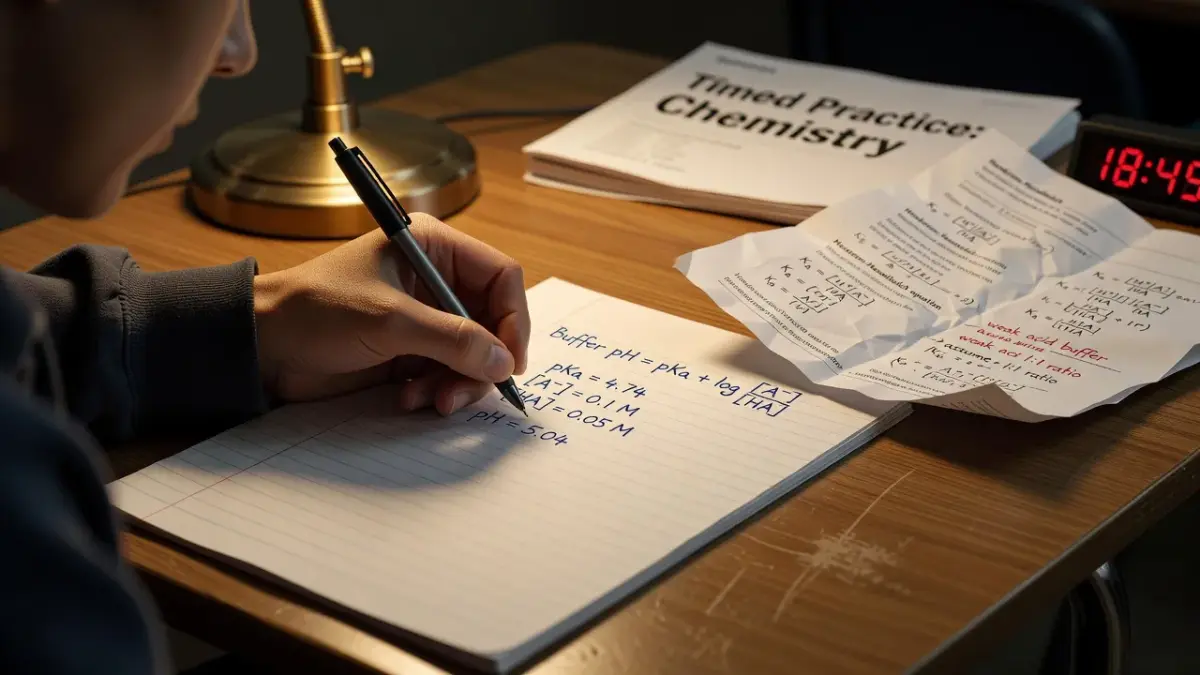
Yes, pH = pKa + log([A⁻]/[HA]) is printed in the equilibrium section. The Henderson-Hasselbalch equation gives you a buffer's pH. On the AP exam it also tests the half-equivalence point, where pH equals pKa. For more equilibrium practice beyond the formula itself, this Kw and water autoionization guide explains why Ka × Kb = Kw holds.
How does Khan Academy teach using the AP Chemistry formula sheet equations?
Khan Academy teaches the sheet's equations by deriving them in videos, then drilling them in practice sets organized by the College Board's course units. Its free AP/College Chemistry course follows the nine units in the CED. That means first-order kinetics, Henderson-Hasselbalch, and ΔG° = −RT ln K each show up in the unit where the exam tests them.
What I like about this approach:
- Derivation first: seeing where t½ = 0.693/k comes from (it's ln 2 divided by k) makes the formula hard to forget.
- Worked examples: problems are solved on screen, step by step.
- Unit tests: mixed practice at the end of each unit is closer to how the exam actually feels.
The weak spot is that Khan's practice sets tell you what topic you're in. On the real exam, nobody tells you "this is a kinetics question," and choosing the right equation is half the work. To close that gap, I'd mix in past FRQs and the timed sets in this AP Chemistry practice problems roundup.
Is the equation sheet in the AP Chemistry Course and Exam Description?
Yes, the AP Chemistry Course and Exam Description includes the full equations and constants sheet and the periodic table. Both appear in the exam information section, after the sample questions. The CED is free as a PDF from the AP Chemistry course page on AP Central.
The CED is worth more than the sheet alone because it lists the learning objectives behind each equation. For example, if an objective says you must explain the relationship between ΔG° and K, you'll see questions that ask for that reasoning in words, with no calculation. Some of the most-missed FRQ points come from those explain-without-numbers prompts.
How do I practice picking the right equation for each problem?
Work through mixed problems where the topic isn't labeled, and check the reasoning for each step, not only the final answer. That's the skill the sheet can't give you, and it's the reason students who own the sheet still freeze on exam day.
ThinkAssist works well for this. Snap a photo of a printed or handwritten practice problem, and the explanation shows which equation each step uses and why. If one step doesn't click, ask about it in the follow-up chat. Every answer is saved under Chemistry automatically, and you can search and filter that history by subject. By April, your saved problems have become a review set grouped by the topics you actually struggled with.
If you're comparing tools for the rest of your classes too, this guide to AI homework helpers covers the wider options.

Frequently Asked Questions
Can I bring my own cheat sheet to the AP Chemistry exam?
No. You can only use the official equations and constants sheet and periodic table that College Board provides. Personal notes or a homemade AP chemistry cheat sheet are prohibited and can get your score canceled.
Is the periodic table on the AP Chemistry formula sheet?
The periodic table is a separate page in the same set of reference materials. It lists element symbols, atomic numbers, and atomic masses, so you can calculate molar masses without memorizing them.
Did the AP Chemistry equation sheet change between 2025 and 2026?
The 2025 and 2026 sheets cover the same five sections and constants. The bigger recent change was the exam format, with multiple-choice questions now answered in the Bluebook app. Check AP Central in spring 2027 if you're testing next May.
Are calculators allowed on the AP Chemistry exam?
Calculators are allowed under College Board's rules, but the approved models and section rules are listed on its calculator policy page. Check that page for your exam year rather than trusting an older prep book, since multiple-choice calculator rules are what older books most often get wrong.
Does the AP Chem formula sheet include solubility rules?
No. Solubility rules, polyatomic ion names, and charges aren't on the sheet. Questions that depend on a specific solubility either give you the data or assume you know the basic rules (for example, nitrates and Group 1 salts are soluble).
Is the same equation sheet used for multiple choice and free response?
Yes. The same equations and constants page and periodic table are available for both sections, so the formulas you rely on in the multiple-choice section are also there for the FRQs.
Does the sheet give the specific heat of water?
No. The sheet gives q = mcΔT but not a value for c. Calorimetry questions state the specific heat when they need it, usually 4.18 J/(g·°C) for water.
Is a general chemistry formula sheet the same as the AP one?
Not quite. College general chemistry formula sheets often include the Arrhenius equation and colligative property formulas that the AP chemistry reference sheet leaves out. Study from the AP version so you know exactly what you'll have on exam day.