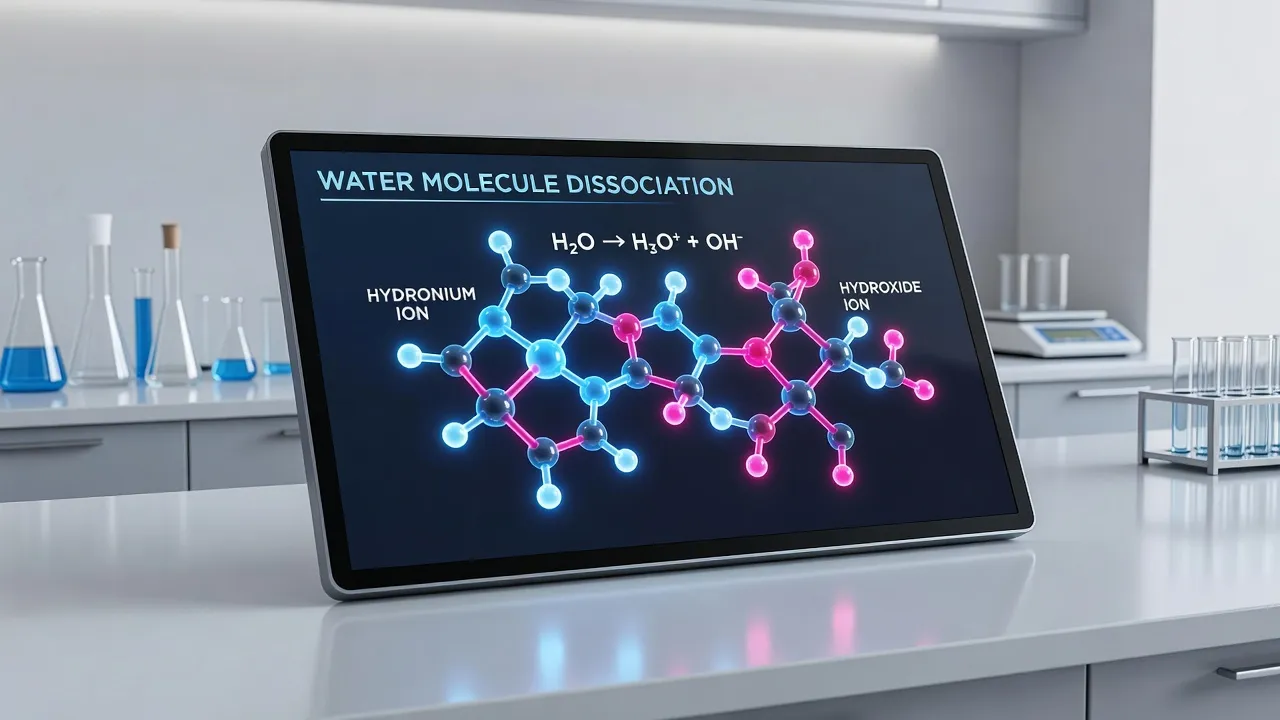
The water autoionization constant ($K_w$) is the equilibrium constant for the self-ionization of pure liquid water into hydronium ions ($H_3O^+$) and hydroxide ions ($OH^-$), equal to exactly $1.0 \times 10^{-14}$ at standard room temperature (25°C). This dimensionless thermodynamic value establishes the baseline balance for acid-base chemistry in aqueous solutions. Whenever an acid or base dissolves in water, the concentrations of hydrogen and hydroxide ions adjust dynamically, yet their mathematical product remains tied to $K_w$.
| Reactants | Products |
|---|---|
| 2 H₂O (l) | H₃O⁺ (aq) + OH⁻ (aq) |
This is an equilibrium reaction, indicated by the reversible arrow.
In basic coursework like general chemistry 1, $K_w$ serves as the foundational bridge connecting $pH$, $pOH$, $[H^+]$, and $[OH^-]$. Misunderstanding how this equilibrium shifts under changing physical conditions is one of the most common causes of lost points on exams. If you are stuck staring at a multi-step equilibrium problem late at night, launching the ThinkAssist AI solver lets you scan the equation instantly to double-check your algebraic steps.
What is the accepted value of Kw at 25°C?
The accepted value of $K_w$ at 25°C (298.15 K) is $1.008 \times 10^{-14}$, which is conventionally rounded to $1.00 \times 10^{-14}$ in general chemistry problems.
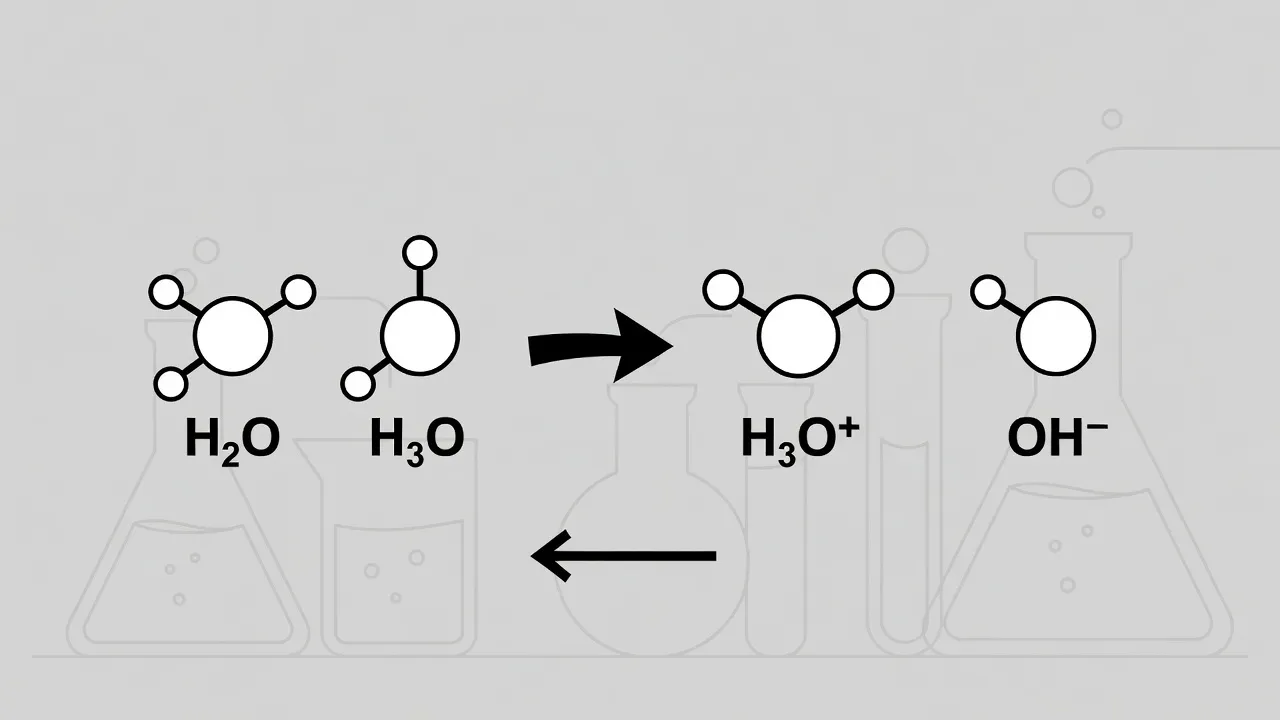
This constant represents the equilibrium reaction where two water molecules interact:
$$\text{H}_2\text{O}(l) + \text{H}_2\text{O}(l) \rightleftharpoons \text{H}_3\text{O}^+(aq) + \text{OH}^-(aq)$$
Alternatively, textbooks often simplify the equation to the dissociation of a single water molecule:
$$\text{H}_2\text{O}(l) \rightleftharpoons \text{H}^+(aq) + \text{OH}^-(aq)$$
Because pure liquid water is the solvent, its activity is assigned a value of 1 in chemical equilibrium calculations. Consequently, the equilibrium expression leaves out the denominator:
$$K_w = [\text{H}^+][\text{OH}^-]$$
In pure water at 25°C, autoionization produces equal amounts of hydrogen ions and hydroxide ions. Taking the square root of $1.0 \times 10^{-14}$ gives the exact molar concentration for each ion:
$$[\text{H}^+] = [\text{OH}^-] = \sqrt{1.0 \times 10^{-14}} = 1.0 \times 10^{-7} \text{ M}$$
Pure Water at 25°C:
[H+]  = 0.0000001 M (1.0 x 10^-7 M)
[OH-] = 0.0000001 M (1.0 x 10^-7 M)
Kw    = [H+] * [OH-] = 1.0 x 10^-14
Data curated by the NIST Chemistry WebBook confirms that precise measurement of water conductivity yields $K_w = 1.008 \times 10^{-14}$ at 298.15 K. For standard assignments, using $1.0 \times 10^{-14}$ provides sufficient precision.
What is the pKw value at 25°C (298.15 K)?
The $pK_w$ value at 25°C is exactly 14.00, calculated by taking the negative logarithm (base 10) of the autoionization constant $K_w$.
The operator "$p$" in chemistry signifies the negative logarithm ($-\log_{10}$). Applying this operator to the $K_w$ expression simplifies ionic concentration math into an easily manageable logarithmic scale:
$$pK_w = -\log_{10}(K_w)$$
$$pK_w = -\log_{10}(1.0 \times 10^{-14}) = 14.00$$
Because logarithmic identity dictates that $\log(A \times B) = \log(A) + \log(B)$, taking the negative logarithm of both sides of $K_w = [\text{H}^+][\text{OH}^-]$ gives the fundamental relationship for all aqueous solutions:
$$pK_w = pH + pOH$$
$$14.00 = pH + pOH \quad (\text{at 25°C})$$
This relationship dictates how acidity and basicity interact:
- Neutral Solution: $pH = 7.00$ and $pOH = 7.00$ (since $pH = pOH$).
- Acidic Solution: $pH < 7.00$ and $pOH > 7.00$ (meaning $[\text{H}^+] > [\text{OH}^-]$).
- Basic Solution: $pH > 7.00$ and $pOH < 7.00$ (meaning $[\text{H}^+] < [\text{OH}^-]$).
When working through complex homework sets or verifying automated solutions on systems like pearson mastering chemistry answers, keeping track of logarithmic sig figs is vital. Remember that for logarithmic values like $pH$ or $pK_w$, only the digits after the decimal point count as significant figures.
Why does Kw change with temperature?
$K_w$ changes with temperature because the autoionization of water is an endothermic process ($\Delta H^\circ > 0$), meaning it absorbs energy to break covalent $\text{O-H}$ bonds.
According to Le Chatelier’s principle, adding thermal energy to an endothermic system shifts the equilibrium position toward the product side. As temperature rises, liquid water molecules absorb energy and dissociate more readily into $\text{H}^+$ and $\text{OH}^-$ ions.
Endothermic Equilibrium Shift:
- Heat is added to the equilibrium: H₂O (l) ⇌ H⁺ (aq) + OH⁻ (aq)
- The equilibrium shifts right
- [H⁺] and [OH⁻] increase
- Kw becomes larger
As temperature increases, each of these changes follows in sequence.
Thermodynamically, the equilibrium constant relates directly to the standard Gibbs free energy change ($\Delta G^\circ$) via the van 't Hoff equation:
$$\ln(K_w) = -\frac{\Delta H^\circ}{R T} + \frac{\Delta S^\circ}{R}$$
Because $\Delta H^\circ$ for autoionization is approximately $+55.8 \text{ kJ/mol}$, the equilibrium constant grows larger as absolute temperature ($T$) increases. Standard chemical definitions published by the IUPAC Gold Book emphasize that all equilibrium constants are temperature-dependent values, making it incorrect to treat $K_w$ as a universal static 14.00 outside 25°C.
The Warm Water pH Trap
The most common misconception students fall into involves assuming that a change in $K_w$ alters the neutrality definition of pure water.
When you heat pure water to human body temperature (37°C), $K_w$ rises to approximately $2.4 \times 10^{-14}$. Calculating the new ion concentration:
$$[\text{H}^+] = \sqrt{2.4 \times 10^{-14}} \approx 1.55 \times 10^{-7} \text{ M}$$
$$pH = -\log_{10}(1.55 \times 10^{-7}) \approx 6.81$$
Even though the $pH$ of pure water drops to 6.81 at 37°C, the water is still 100% neutral. It is neutral because $[\text{H}^+]$ equals $[\text{OH}^-]$ exactly. The neutral $pH$ point moves lower because $pK_w$ dropped to 13.62.
What is the table of Kw values from 0 to 100°C?
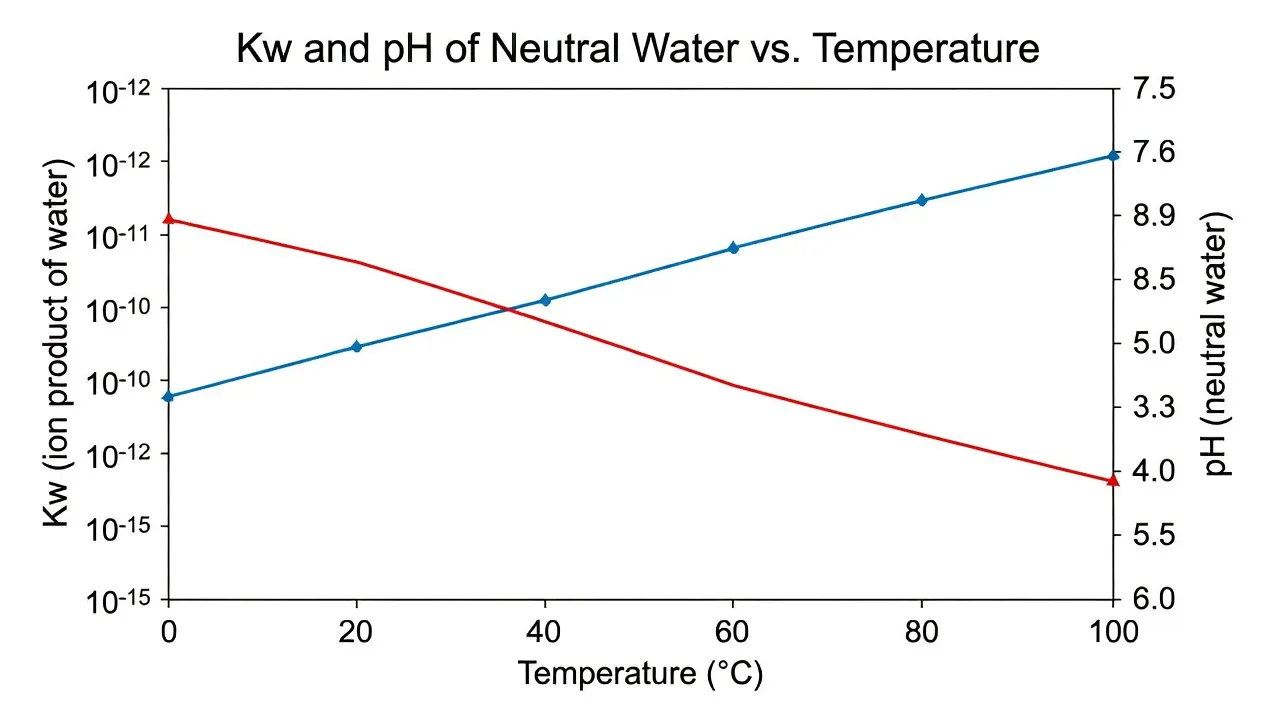
The value of $K_w$ spans more than two orders of magnitude between freezing (0°C) and boiling (100°C), rising from $1.14 \times 10^{-15}$ to $5.13 \times 10^{-13}$.
The reference table below outlines the precise experimental values for $K_w$, the corresponding $pK_w$, and the exact $pH$ of neutral pure water across standard laboratory temperature ranges:
| Temperature (°C) | Temperature (K) | $K_w$ ($\times 10^{-14}$) | $pK_w$ | Neutral Water $pH$ ($pK_w / 2$) |
|---|---|---|---|---|
| 0°C | 273.15 K | 0.114 | 14.94 | 7.47 |
| 10°C | 283.15 K | 0.292 | 14.53 | 7.27 |
| 20°C | 293.15 K | 0.681 | 14.17 | 7.09 |
| 25°C | 298.15 K | 1.008 | 14.00 | 7.00 |
| 30°C | 303.15 K | 1.471 | 13.83 | 6.92 |
| 37°C | 310.15 K | 2.420 | 13.62 | 6.81 |
| 50°C | 323.15 K | 5.470 | 13.26 | 6.63 |
| 75°C | 348.15 K | 19.90 | 11.70 | 5.85 |
| 100°C | 373.15 K | 51.30 | 11.29 | 5.65 |
Experimental values compiled from reference data available on LibreTexts Chemistry show that at boiling point, pure water has a $pH$ of 5.65. Assuming that $pH = 7$ is always the threshold for neutral conditions costs students heavy marks during thermodynamics exams.
If you struggle with equilibrium values across varied temperatures while preparing for exams, using an automated homework assistant saves hours of frustration. For quick help with multi-step equilibrium problems, download the iOS app for ThinkAssist to snap a picture of your assignment and get step-by-step breakdowns instantly.
What are the most common student mistakes with Kw chemistry?
The most frequent mistakes made in $K_w$ calculations stem from treating $pK_w$ as a fixed constant of 14, ignoring water autoionization in dilute acids, and messing up logarithmic sig figs.
When solving equilibrium sets or stoichiometry practice problems, watch out for these three specific pitfalls:
Common Mistakes Summary:
1. Assuming pH 7 always means neutral water at non-25°C temperatures.
2. Forgetting autoionization in ultra-dilute acid solutions (e.g., 10^-8 M HCl).
3. Incorrect significant figures in logarithmic pH conversions.
1. The Ultra-Dilute Acid Trap
Imagine a question asks for the $pH$ of a $1.0 \times 10^{-8} \text{ M HCl}$ solution.
A common student mistake is taking the negative log directly:
$$pH = -\log_{10}(1.0 \times 10^{-8}) = 8.00 \quad \text{(WRONG)}$$
An acidic solution cannot have a basic $pH$ of 8 at room temperature simply by adding pure water. You must account for the $1.0 \times 10^{-7} \text{ M H}^+$ already supplied by the autoionization of water.
Setting up the true equilibrium concentration:
$$[\text{H}^+]{\text{total}} = [\text{H}^+]{\text{acid}} + [\text{H}^+]_{\text{water}} = 1.0 \times 10^{-8} + x$$
Solving the quadratic equation with $K_w = (1.0 \times 10^{-8} + x)(x) = 1.0 \times 10^{-14}$ yields a realistic acidic $pH$ of approximately 6.98.
2. Miscalculating Significant Figures with Logarithms
In pH calculations, the digits to the left of the decimal point represent the power of ten (the characteristic), while the digits to the right represent the actual measured value (the mantissa).
If a concentration has two significant figures, such as $[\text{H}^+] = 3.5 \times 10^{-4} \text{ M}$, its $pH$ must be written with two decimal places ($pH = 3.46$). Writing $pH = 3.5$ drops half your precision.
3. Ignoring Non-Standard Temperatures
As established in our temperature table above, physiological reactions inside the human body occur at 37°C where $pK_w = 13.62$. Evaluating blood plasma or biochemical buffers using $14.00$ creates significant baseline error in theoretical calculations.
How to solve Kw problems step-by-step
Solving $K_w$ problems requires identifying whether temperature is standard, writing out the dissociation expression, substituting known concentrations, and taking the negative logarithm.
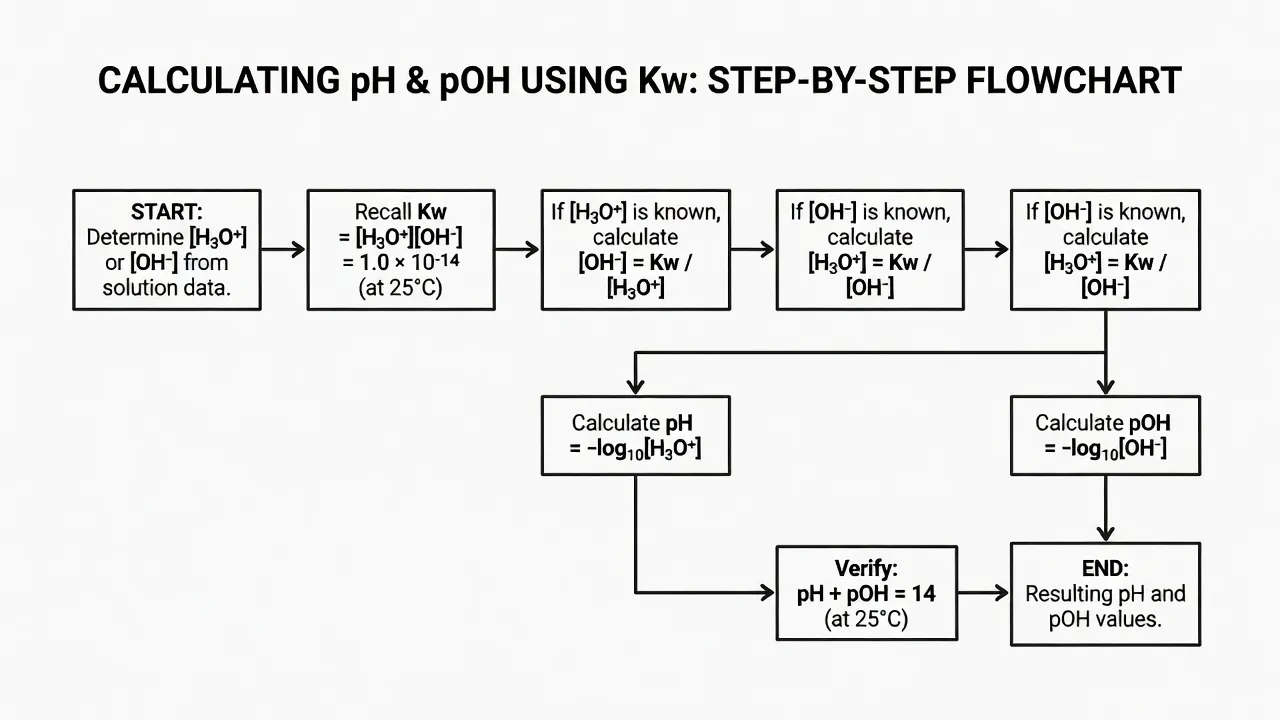
Here is the exact framework to tackle any basic or non-standard autoionization problem:
Step 1: Confirm the System Temperature
Check whether the problem takes place at 25°C or a non-standard temperature. If no temperature is specified, assume 25°C ($K_w = 1.0 \times 10^{-14}$). If a different temperature is given, pull the specified $K_w$ from your reference table.
Step 2: Set Up the Ion Product Expression
Write the basic mathematical expression:
$$K_w = [\text{H}_3\text{O}^+][\text{OH}^-]$$
Step 3: Substitute Known Values
If solving for a strong base like $0.05 \text{ M NaOH}$, assume complete dissociation so that $[\text{OH}^-] = 0.05 \text{ M}$. Rearrange the equation to isolate the unknown:
$$[\text{H}_3\text{O}^+] = \frac{K_w}{[\text{OH}^-]} = \frac{1.0 \times 10^{-14}}{0.05} = 2.0 \times 10^{-13} \text{ M}$$
Step 4: Convert to pH or pOH
Apply the negative logarithm to find the final value:
$$pH = -\log_{10}(2.0 \times 10^{-13}) = 12.70$$
Check your result against basic rules: a high hydroxide concentration must yield a basic $pH$ well above 7.
Streamlining chemistry study sessions with ThinkAssist
ThinkAssist is an AI-powered homework solver app designed to act as your personal 24/7 chemistry tutor. When dealing with multi-variable equilibrium problems, quadratic equations in weak acid dissociation, or complex temperature-dependent $K_w$ systems, getting stuck on a single line of algebra can stall an entire evening of studying.
How ThinkAssist Helps in Chemistry:
+ Snap a Photo: Instantly process printed or handwritten problem sets.
+ Automatic Subject Detection: Identifies chemistry, physics, or algebra automatically.
+ Step-by-Step Solutions: Shows every algebraic step, not just the final answer.
+ Exam Prep Vault: Automatically saves past queries for easy test review.
Instead of copying numbers blindly, students use ThinkAssist to examine the underlying logic of chemical equilibrium. The app is free to download on iOS, featuring a 3-day free trial, followed by a flexible $6.99/week subscription.
If you are preparing for upcoming midterms or final exams, having your entire history of scanned answers and step-by-step explanations saved in one place makes reviewing $K_w$ curves, acid-base titrations, and equilibrium constants simple and organized.
What is the relationship between Ka, Kb, and Kw?
The product of the acid dissociation constant ($K_a$) of a weak acid and the base dissociation constant ($K_b$) of its conjugate base equals the water autoionization constant ($K_w$).
This critical relationship is expressed mathematically as:
$$K_a \times K_b = K_w$$
Taking the negative logarithm of both sides yields:
$$pK_a + pK_b = pK_w = 14.00 \quad (\text{at 25°C})$$
This inverse relationship dictates conjugate acid-base strength:
- Stronger Weak Acid (Higher $K_a$, Lower $pK_a$): Possesses a weaker conjugate base (Lower $K_b$, Higher $pK_b$).
- Weaker Weak Acid (Lower $K_a$, Higher $pK_a$): Possesses a stronger conjugate base (Higher $K_b$, Lower $pK_b$).
Example: Finding Kb from Ka
Acetic acid ($\text{CH}_3\text{COOH}$) has a known acid dissociation constant of $K_a = 1.8 \times 10^{-5}$ at 25°C. To find the base dissociation constant ($K_b$) for its conjugate base, the acetate ion ($\text{CH}_3\text{COO}^-$):
$$K_b = \frac{K_w}{K_a} = \frac{1.0 \times 10^{-14}}{1.8 \times 10^{-5}} = 5.56 \times 10^{-10}$$
This equation allows chemists to calculate the $pH$ of salt solutions without needing to measure conjugate constants independently in the lab.
Frequently Asked Questions
What does Kw stand for in chemistry?
$K_w$ stands for the water autoionization constant, also known as the ion-product constant of water. The letter "K" represents an equilibrium constant, while the subscript "w" specifies water.
Is Kw always equal to 1.0 x 10^-14?
No, $K_w$ is only equal to $1.0 \times 10^{-14}$ at 25°C (298.15 K). Because autoionization is an endothermic reaction, $K_w$ increases as temperature increases and decreases at lower temperatures.
Why is liquid water excluded from the Kw expression?
Liquid water is the pure solvent in aqueous solutions, meaning its activity and concentration remain essentially constant at ~55.5 M. In dynamic chemical equilibrium constants, pure liquids and solids are assigned an activity of 1 and omitted from the denominator.
Can Kw be used for non-aqueous solutions?
No, $K_w$ applies specifically to aqueous (water-based) systems. Other solvents have their own self-ionization constants; for example, liquid ammonia self-ionizes into ammonium and amide ions with its own distinct constant ($K_{am}$).
How does Kw relate pH and pOH?
The negative logarithm of $K_w$ gives $pK_w$. Because $K_w = [\text{H}^+][\text{OH}^-]$, taking the logarithm yields $pK_w = pH + pOH$. At 25°C, this means $pH + pOH = 14.00$.
Is pure water at 60°C acidic if its pH is less than 7?
No, pure water at 60°C is completely neutral even though its $pH$ is approximately 6.5. Neutrality requires that $[\text{H}^+] = [\text{OH}^-]$, which remains true in pure water regardless of temperature. The neutral $pH$ benchmark simply shifts lower as temperature increases.
How do I calculate Kw if I only know pKw?
To find $K_w$ from $pK_w$, take the inverse negative logarithm (10 raised to the power of negative $pK_w$): $K_w = 10^{-pK_w}$. For example, if $pK_w = 13.62$, then $K_w = 10^{-13.62} = 2.4 \times 10^{-14}$.