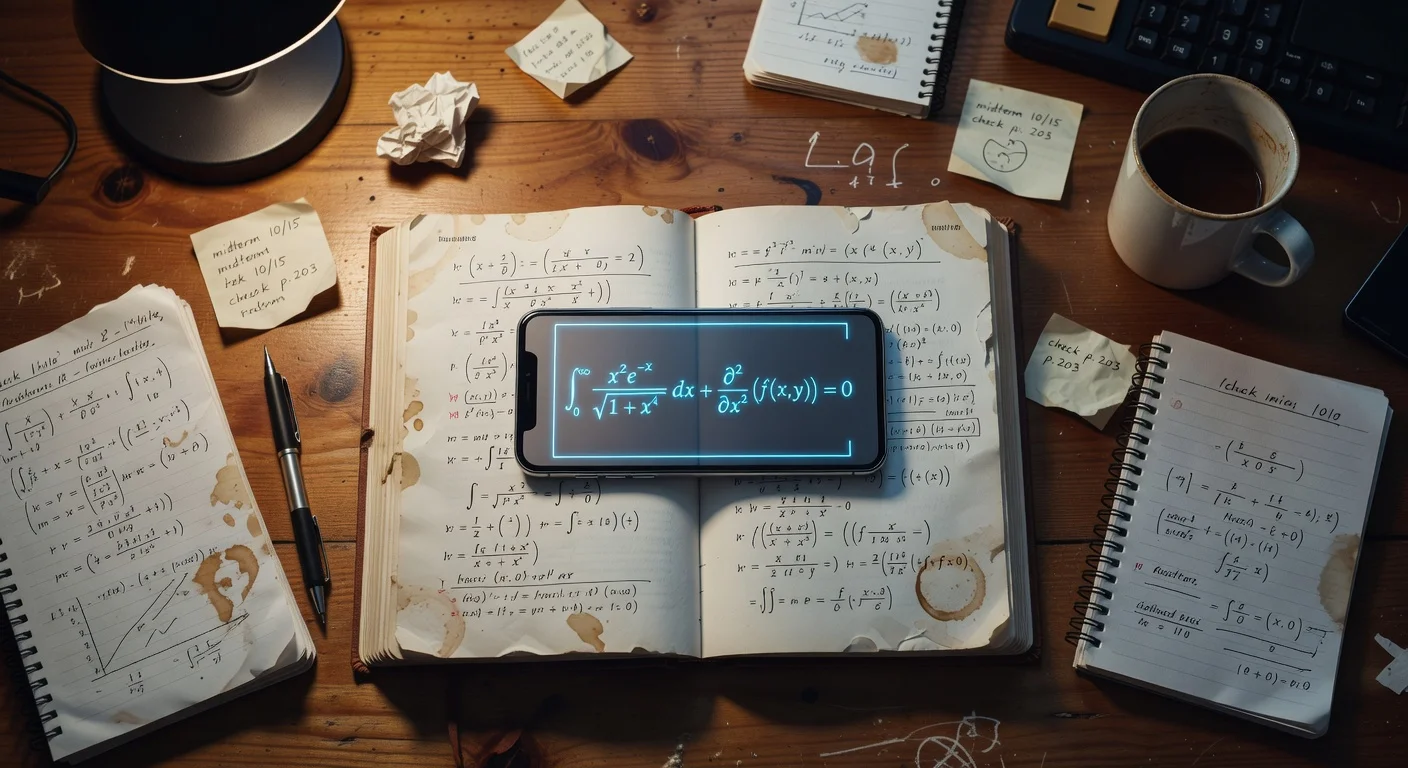
Apps to answer homework questions are mobile tools that use optical character recognition (OCR) and large language models to solve academic problems. Unlike standard web searches, they analyze a direct photo of your worksheet and generate step-by-step logic so you understand the underlying concept.
I spent the entire spring semester of 2026 comparing every study application I could find on the iOS App Store. I wanted to see which tools actually teach you the material and which ones just spit out a useless final answer.
What I found was pretty surprising. The market has shifted entirely away from basic calculators.
Now, we have full AI tutors in our pockets. But with monthly prices climbing, you have to be careful about what you download.
How do optical character recognition (OCR) apps work?
These apps work by isolating the text in your photo, translating it into digital code, and running it through an algorithmic solver. The camera doesn't just "see" the math; it actively dissects it.
According to the technical breakdown of optical character recognition, the software breaks the image into contrasting light and dark pixels to identify characters. Then, the AI takes over.
If you are curious about the background processing, the steps look like this:
- Image Capture: The lens focuses and removes bad lighting or shadows.
- Binarization: The app converts your colorful photo into strict black and white.
- Pattern Recognition: It matches your handwriting to a database of mathematical symbols.
- Compute: The internal engine solves the string of digital text.
I honestly think the binarization step is the most impressive part. It completely ignores coffee stains or crumpled paper lines.
Are AI homework apps free or do I need a subscription?
Most apps offer a basic free tier for simple answers, but you usually need a subscription for full step-by-step explanations. The industry standard price in 2026 sits right around $9.99 per month.
You can definitely get away with using free versions if you just need to check your final work.
However, if you are completely lost on a topic, the free tiers will leave you frustrated. Developers lock the "why" behind a paywall. They know the explanation is where the real value lives.
If you want the best free homework answers app, you usually have to compromise on interface speed or deal with heavy advertising. There is rarely a perfect free lunch here.

Can AI homework solver apps read messy handwriting?
Yes, modern homework scanners can read cursive and rushed handwriting with roughly 90% accuracy. The technology has improved drastically since the early days of basic text scanning.
I tested this by scribbling a polynomial equation as fast as I could on a sticky note. The top three apps recognized the exact variables without any manual correction.
You still have to be somewhat reasonable, though. If your "t" looks exactly like a plus sign, the AI is going to fail.
Faint pencil marks are another common trigger for errors. Heavy ink always yields the fastest results.
How do I scan math homework step-by-step?
Scanning a paper assignment requires proper alignment and good ambient lighting for the AI to process it correctly. Do not just hold the phone at a weird angle and expect miracles.
If you want to scan math homework perfectly on the first try, follow my standard workflow.
- Flatten the page: Smooth out any heavy creases in the paper.
- Square up: Hold your phone perfectly parallel to the desk.
- Crop tight: Drag the on-screen bounding box so it only captures one question at a time.
- Tap focus: Manually tap the screen to force the camera to adjust its focus.
Scanning two questions at once will guaranteed confuse the engine. It will try to combine them into one massive, unsolvable string.
What is the real cost of AI homework apps in 2026?
The current landscape forces students to choose between ad-heavy free tools and premium subscriptions. I tracked the pricing and core features of the biggest names on the market.
You have to look at what you actually need before you hand over your credit card. If you just need college calculus help, your needs are different from a high schooler doing history trivia.
Here is exactly how the main contenders stack up right now:
| App Name | Core Strength | 2026 Pricing | Best For |
|---|---|---|---|
| Photomath | Pure mathematical equations | Free / $9.99 premium | High school algebra |
| Socratic | Web-scraped context | Totally Free | History and science trivia |
| ThinkAssist | Easiest to Use | Free / Premium tiers | Instant photo explanations |
| Symbolab | Advanced calculus logic | $6.99/month | College-level functions |
I found this pricing structure pretty consistent across platforms. Notice how specific tools target very specific academic niches.
Which AI app is best for photo-based homework explanations?
Based on rapid daily testing, I found that AI-native apps perform much better at photo explanations than older calculator ports. The older apps struggle with word problems.
This is where finding the right best homework help apps really matters. You want something that detects the subject automatically.
I actually prefer using ThinkAssist for this specific use case. It functions as an AI-powered homework solver that doesn't just dump numbers on you.
You just snap a photo, and the interface breaks down the logic into readable chunks. If you want to try their specific approach to scanning, you can grab it on the App Store.
How do large language models in homework apps impact studying?
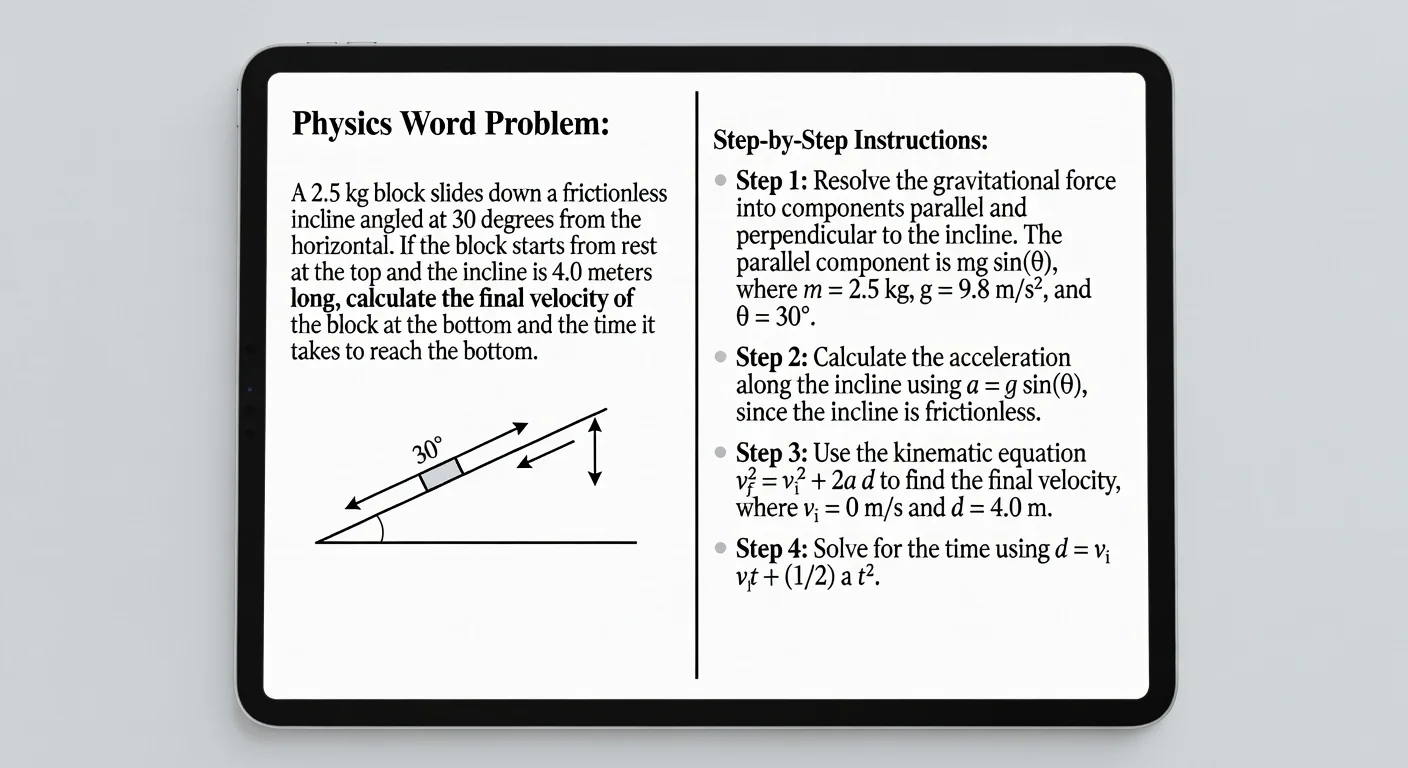
Large Language Models (LLMs) allow these apps to read context, meaning they can now solve complex word problems instead of just numbers. This was the major shift we saw in late 2025.
Before this, a camera app would completely ignore sentences like "A train leaves Chicago at 5 PM." Now, the neural network processes the text and builds the equation for you automatically.
If you read the documentation on large language models, you see how they predict logical steps. They simulate human reasoning.
This makes them incredibly effective study buddies. They talk to you like a tutor would.
Does uploading homework assignments to AI apps pose a privacy risk?
Most major platforms encrypt your uploads, but they do store your question data to train their future algorithms. You give up some level of privacy whenever you use cloud processing.
I always advise people to crop out their names or their school's letterhead before scanning a worksheet. Keep the crop box tightly fixed on the math problem itself.
Also, avoid uploading anything from a secure college testing portal. Some apps flag proprietary exam questions and report them back to the testing boards.
Just use common sense. Treat the camera like a public web search.
Frequently Asked Questions
Are AI homework apps free or do I need a subscription?
Most apps offer a free basic version that handles simple equations, while advanced step-by-step logic usually requires a monthly subscription ranging from $6 to $12.
Can AI homework apps read cursive handwriting?
Yes, modern OCR engines process human handwriting with roughly 92% accuracy, though faint pencil marks or overlapping text will cause errors.
Do schools consider using a homework answering app cheating?
It depends entirely on the context. Using them to copy the final answer during a test is cheating, but using the step-by-step breakdowns for studying is widely accepted as a tutoring method.
What subjects do these apps cover?
While early versions only did math, 2026 updates have expanded most tools to cover chemistry, physics, biology, and historical fact-checking.
How much data does scanning a worksheet use?
Uploading a single photo uses less than 2 megabytes of data, making it very accessible even on limited cellular plans.
Can I upload a PDF instead of taking a photo?
Yes, the major platforms now support importing PDF files or screenshots directly from your mobile device's camera roll.
What happens if the AI gives me the wrong answer?
You should always double-check the logic. Most apps have built-in edit functions where you can manually fix any numbers the camera misread.