The best sources for hard math problems with complete solutions are official competition archives like the IMO and Putnam contests, interactive platforms like Art of Problem Solving (AoPS) and Project Euler, and high-level problem books. Finding challenging math problems is rarely the hard part; the real hurdle is finding worked-out solutions that explain why a particular strategy works rather than just listing the final answer.
Whether you are preparing for international olympiads, studying university-level analysis, or building algorithmic logic, choosing the right problem set depends heavily on your mathematical foundation and target goals.
What are Putnam problems and solutions?
Putnam problems are proof-based undergraduate college math questions from the William Lowell Putnam Mathematical Competition, accompanied by rigorous step-by-step proofs. Held annually on the first Saturday of December, this university contest consists of 12 problems taken in two three-hour sessions. The scoring is famously strict: each problem is worth 10 points, but median scores across all university participants frequently hover between 0 and 2 points out of a total 120.
The complete history of questions and official solutions is available through the Mathematical Association of America (MAA) archives. Every solution requires a formal, written mathematical proof rather than a simple numerical calculation.
Key Requirements and Limits
- Prerequisites: You need a firm grasp of multivariable calculus, linear algebra, abstract algebra, differential equations, and number theory.
- Target Audience: Best suited for undergraduate math majors and advanced competition students.
- Limitation: If you have not taken university-level proof writing courses, these solutions will feel unreadable because they assume familiarity with formal notation and rigor.
What are Art of Problem Solving (AoPS) problems with solutions?
Art of Problem Solving (AoPS) provides a comprehensive digital wiki, forum, and textbook series containing thousands of contest problems from AMC 8 through IMO with user-submitted community solutions. AoPS is widely considered the central digital ecosystem for secondary school mathematics competitions in North America.
The platform hosts an extensive online community wiki where past problems from dozens of national and international competitions are categorized by topic (algebra, geometry, counting and probability, and number theory) and difficulty level.
Why AoPS Stands Out
- Multiple Solution Approaches: Unlike static answer keys, AoPS wiki pages usually list two to five distinct ways to solve a single problem, ranging from geometric construction to brute-force algebra.
- Community Discussion: Every problem links directly to a forum thread where users debate edge cases, point out common pitfalls, and offer simplified proofs.
- Structured Learning: If you struggle with abstract setup, practicing with examples of word problems in math on AoPS helps bridge the gap between middle school arithmetic and contest logic.
How to get instant step-by-step math problem breakdowns with AI
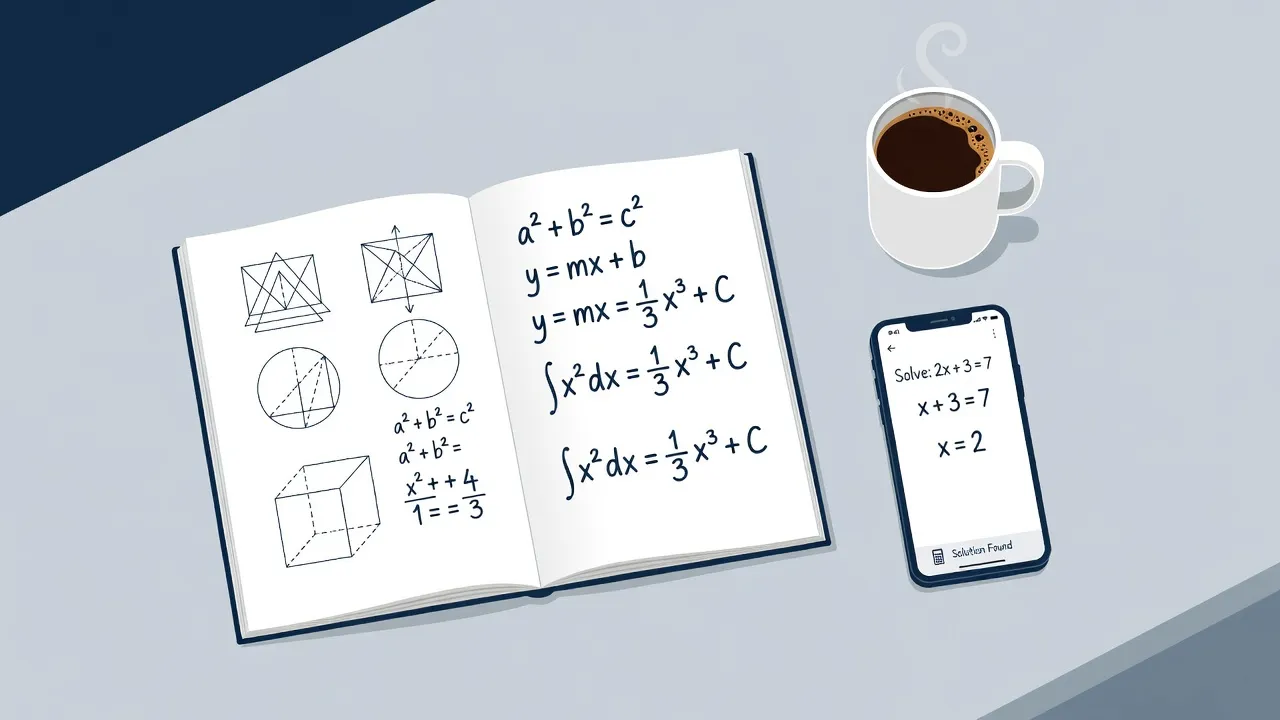
You can get immediate step-by-step breakdowns for challenging homework and contest preparation by using AI solvers that parse handwritten formulas and provide logical explanations. When practicing complex algebra or calculus problems late at night, getting stuck on a single line of working can derail an entire study session.
An AI-powered option like ThinkAssist acts as a personal 24/7 tutor designed to keep your practice moving forward.
Key Features of ThinkAssist
- Snap a Photo: Take a quick picture of any printed textbook question or handwritten problem on your scratch paper to parse the equation instantly.
- Get Step-by-Step Explanations and Solutions: Instead of dumping a raw final answer, the app breaks down the logical transformation at each stage so you learn the underlying principles.
- Easy Exam Prep: All past scanned answers and step-by-step explanations are automatically saved in your personal history library, making test review effortless before exams.
You can download ThinkAssist on iOS for free. It includes a 3-day free trial, after which full access costs $6.99/week.
Comparing the top sources for hard math problems with answers
The table below breaks down the most reliable repositories for hard math problems, their structural focus, and where each fits into your daily study routine.
| Source / Tool | Focus Area | Best Workflow Role | Cost / Accessibility |
|---|---|---|---|
| Official IMO & Putnam Archives | Proof-based competition math | Benchmark testing under real contest constraints | Free public access online |
| ThinkAssist AI App | Instant step-by-step problem solving | Daily homework verification and late-night tutoring support | Free download; 3-day free trial then $6.99/week |
| AoPS Online Community & Wiki | K-12 and contest problem sets | Exploring multiple solution paths for contest questions | Free online wiki and public forums |
| Project Euler | Computational math & programming | Algorithm design and numerical logic practice | Free online platform |
| 'Putnam and Beyond' (Book) | Advanced university math proofs | Structured textbook self-study for math majors | Paid physical or digital textbook |
What are the official IMO problems and solutions?
Official International Mathematical Olympiad (IMO) problems are six proof-based questions selected annually from pre-university mathematics, complete with official marking schemes and solutions published on the IMO website. The IMO represents the pinnacle of high school competitive mathematics worldwide, featuring national teams from over 100 countries.
The official competition archive hosted by the International Mathematical Olympiad contains every problem set from 1959 to the present year. Solutions include both the official shortlist commentary and detailed scoring rubrics used by international coordinators.
| Day | Problem 1 | Problem 2 | Problem 3 |
|---|---|---|---|
| Day 1 | Easy | Medium | Hard |
| Day 2 | Easy | Medium | Hard |
Critical Rules and Constraints
- Scope: Covers geometry, number theory, algebra, and combinatorics. Notably, calculus is explicitly excluded from the official IMO syllabus.
- Format: Six problems split over two consecutive days, with 4.5 hours allocated for three problems each day.
- Preparation Tip: If you are building foundational formula mastery for competitive or standardized tests, keeping a structured sheet—such as an SAT math formula sheet—helps clear basic identity checks before attempting olympiad-level proofs.
What are Project Euler problems with solutions?
Project Euler problems are a series of challenging computational mathematics and computer programming problems that require mathematical logic and algorithmic code to derive a single numerical answer. Created in 2001, the platform releases new problems regularly, designed to test both deep mathematical insight and software optimization.
As of October 2026, the platform hosts over 900 unique problems on the official Project Euler platform. While the site enforces a strict policy against publishing solutions publicly for the newest questions, the community offers confirmation keys once you solve a problem, opening access to dedicated solution forums.
Who Should Use Project Euler?
- Programming Required: You cannot solve most problems past #50 with pencil and paper alone; you must write efficient code in Python, C++, Java, or Rust.
- Time Limits: A brute-force program that takes hours to execute is considered an invalid approach. The "one-minute rule" dictates that a well-designed algorithm should return the answer within 60 seconds on modest hardware.
- Focus: Number theory, prime factorizations, combinatorics, and matrix operations dominate the problem catalog.
What are the solutions in 'Putnam and Beyond'?
The solutions in 'Putnam and Beyond' are fully written proof-based answers organized by mathematical discipline (algebra, calculus, geometry, and combinatorics) meant to prepare university students for elite math contests. Written by Răzvan Gelca and Titu Andreescu, the text is published by Springer and stands as one of the most respected problem-solving guidebooks in undergraduate education.
Unlike traditional contest archives that group questions by year, this book organizes problems by solution method—such as the pigeonhole principle, induction, generating functions, or invariants.
Trade-Offs to Consider
- High Entry Barrier: The book skips elementary explanations entirely. It assumes you already understand advanced concepts like linear transformations, abstract algebra, and real analysis.
- Solution Density: Solutions are extremely dense and often compress complex logical steps into a single sentence, requiring readers to work out intermediate algebra on paper independently.
What are the solutions in 'Problems from the Book' (Proofs from THE BOOK)?
'Proofs from THE BOOK' contains elegant, creative solutions to fundamental mathematical problems selected for their simplicity, aesthetic brilliance, and logical clarity. Inspired by the famous mathematician Paul Erdős—who spoke of a divine book in which God wrote down the most perfect proofs—authors Martin Aigner and Günter M. Ziegler compiled this volume to showcase answers that transform notoriously difficult questions into obvious insights.
The book spans topics across number theory, geometry, analysis, combinatorics, and graph theory.
Why It Differs From Standard Answer Keys
- Focus on Aesthetics: Standard solution manuals focus on getting to the answer by any means necessary. Proofs from THE BOOK specifically discards messy, brute-force calculations in favor of short, brilliant conceptual shortcuts.
- Practical Application: Studying these proofs teaches you how to reduce messy problems into simple statements. For example, mastering inequality proofs here makes handling complex math inequality word problems significantly faster in academic settings.
| Approach | Step 1 | Step 2 | Step 3 |
|---|---|---|---|
| Standard Proof Approach | Messy Algebra | Long Calculation | Result |
| "THE BOOK" Approach | Key Insight | Simple Identity | Elegant Result |
How to systematically tackle extremely hard math problems
To solve high-level math problems without getting stuck endlessly, you must follow a structured system of decomposition, pattern recognition, and step verification. Staring at a blank sheet of paper for hours leads to frustration rather than learning.
- Restate the Problem in Your Own Words: Convert abstract language into concrete variables, simple diagrams, or small numerical cases ($n=1, 2, 3$).
- Identify Invariants and Extremal Cases: Check what properties remain unchanged under the problem's operations, or test the boundary limits (zero, infinity, empty sets).
- Attempt Known Problem Strategies: Try algebraic transformations, modular arithmetic, mathematical induction, or geometric inversion.
- Consult Step-by-Step Breakdowns: When you reach a hard wall after 30–45 minutes, look up a single line of the solution rather than reading the entire answer. Using an interactive solver like ThinkAssist lets you verify your immediate step, allowing you to finish the rest of the proof independently.
- Re-write the Proof from Scratch: Never close a solution manual and assume you understand it. Cover the answer key and write out the entire logical path on blank paper.
Frequently Asked Questions
Where can I find hard math problems with step-by-step answers for free?
You can find thousands of hard math problems with free step-by-step solutions on the Art of Problem Solving (AoPS) Wiki, the official International Mathematical Olympiad (IMO) website, and the Mathematical Association of America (MAA) Putnam archives.
What is the hardest math problem ever solved?
Fermat's Last Theorem is widely considered one of the hardest solved math problems in history. Proposed by Pierre de Fermat in 1637, it remained unsolved for 358 years until mathematician Andrew Wiles published a complete 129-page proof in 1995.
Are Project Euler solutions free to access?
Project Euler problems are free to solve, but official solution forums are only unlocked after you submit the correct numerical answer to a problem. Publicly posting solutions for recent Project Euler questions is prohibited by the platform.
How do I practice math competition problems effectively?
To practice effectively, spend at least 30 to 45 minutes wrestling with a problem on your own before looking at any hint. When you do consult a solution, read only enough to get unstuck, then write out the remaining steps independently.
Can AI solve hard proof-based math problems accurately?
Modern AI math models can accurately solve standard textbook calculus, linear algebra, and high school contest problems step-by-step. However, highly advanced, novel research-level mathematical proofs still require human ingenuity and formal verification tools.
What prerequisites do I need for Putnam math problems?
Putnam competition problems require a strong foundation in undergraduate college mathematics, including multivariable calculus, linear algebra, differential equations, abstract algebra, and formal mathematical proof writing.
What is the difference between AMC, AIME, and IMO problems?
AMC (American Mathematics Competitions) features multiple-choice questions for middle and high school students. AIME (American Invitational Mathematics Examination) consists of 15 integer-answer questions of intermediate difficulty. IMO (International Mathematical Olympiad) requires six full, rigorous written proofs over two days.