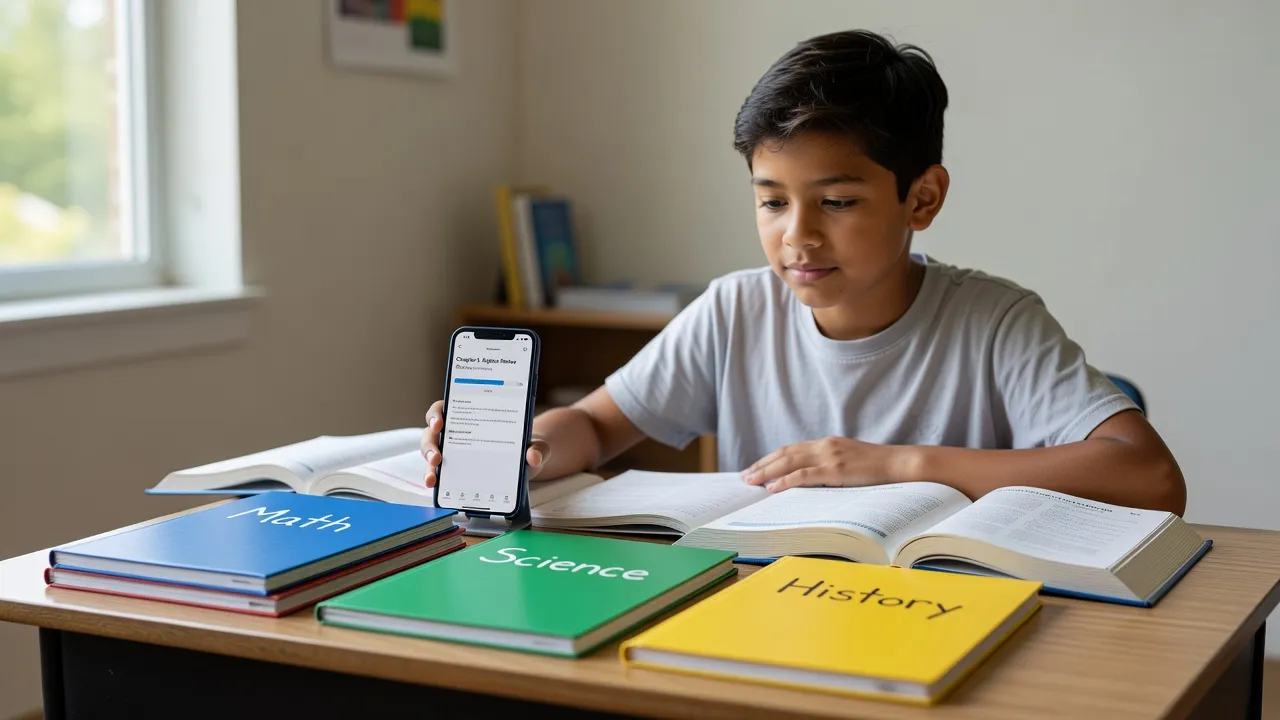
Junior high study skills are self-regulated learning habits—such as retrieval practice, spaced repetition, and digital task management—that help 11- to 14-year-olds transition from guided elementary learning to independent academic success. Moving into middle school brings multiple teachers, changing periods, and complex homework formats that quickly overwhelm students relying purely on memorization. Mastering specific cognitive strategies during these middle school years prevents academic burnout and builds the self-reliance needed for high school.
The core variable that determines which study method works best for a junior high student is their current level of executive functioning. A technique like interleaving requires significant focus and self-monitoring, while visual graphic organizers provide immediate structure for students who struggle to stay organized.
What are retrieval practice, spaced practice, and interleaving for study skills?
Retrieval practice, spaced practice, and interleaving are evidence-based cognitive strategies that strengthen memory retention by changing how information is recalled and scheduled.
Here is how each strategy functions during middle school study sessions:
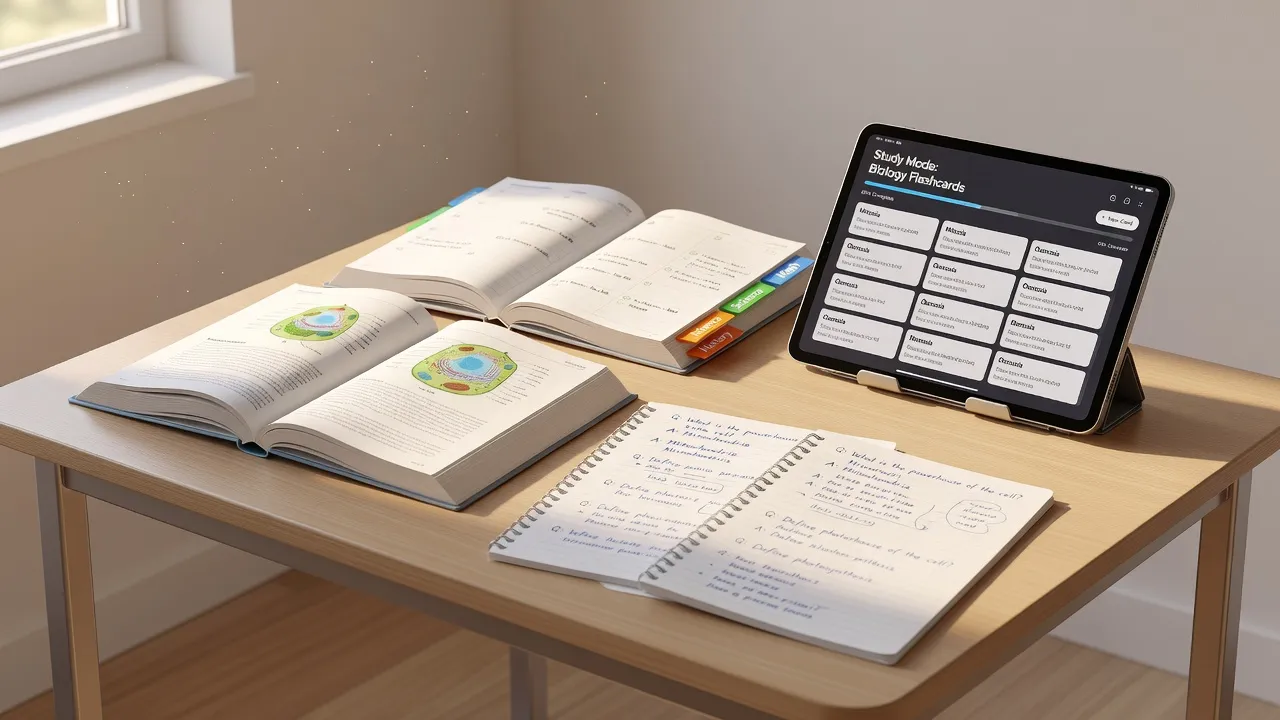
- Retrieval practice: Pulling facts out of your brain using flashcards, practice quizzes, or blank-sheet brain dumps without looking at notes first.
- Spaced practice: Spreading study sessions out over several days instead of cramming everything into one late-night session.
- Interleaving: Switching between related topics or math problem types during a single session rather than practicing one pattern repeatedly.
Most middle schoolers default to passive re-reading because it feels easier. However, forcing the brain to work harder during initial learning creates durable memory pathways that make test day far less stressful.
What do the Learning Scientists recommend for middle school study strategies?
The Learning Scientists recommend six specific cognitive strategies for effective learning: retrieval practice, spaced practice, interleaving, dual coding, elaboration, and concrete examples.
Founded by cognitive psychologists, The Learning Scientists translate peer-reviewed educational research into practical classroom methods. For middle schoolers, they emphasize pairing words with visual images (dual coding) and asking how and why things work (elaboration).
I strongly suggest starting young students with just two of these strategies—retrieval practice and dual coding—before adding complex scheduling tools. Asking a 12-year-old to implement all six cognitive strategies at once usually leads to frustration rather than better grades.
What does Dunlosky's 2013 review say about effective learning techniques?
John Dunlosky’s 2013 landmark review evaluated ten common study techniques and rated practice testing and distributed practice (spacing) as having the highest utility for long-term learning.
In his comprehensive study published in Psychological Science in the Public Interest, Dunlosky and his team analyzed decades of cognitive research. They rated popular student habits like highlighting, text re-reading, and imagery creation as "low utility" because they create a false sense of mastery without building recall.
| Study Technique | Research-Backed Utility Rating | Main Reason for Rating |
|---|---|---|
| Practice Testing | High | Forces direct mental retrieval and exposes knowledge gaps. |
| Distributed (Spaced) Practice | High | Prevents rapid forgetting by re-engaging memory over time. |
| Elaborative Interrogation | Moderate | Helps students connect new facts to prior knowledge. |
| Highlighting & Underlining | Low | Demands low cognitive effort and produces minimal long-term retention. |
| Re-reading Textbooks | Low | Consumes significant time while offering rapidly diminishing returns. |
If your child spends hours highlighting textbooks with bright neon markers, help them switch to practice quizzes instead. Highlighting feels productive, but research shows it yields minimal results on test day.
What does the Education Endowment Foundation recommend for study strategies?
The Education Endowment Foundation (EEF) recommends explicit instruction in metacognition and self-regulation, showing that teaching students how to plan, monitor, and evaluate their own learning adds up to seven months of additional academic progress.
According to research from the Education Endowment Foundation, middle schoolers perform best when teachers and parents model cognitive strategies out loud. This process involves three distinct steps:
- Planning: Setting a goal for the study session and selecting appropriate tools before starting.
- Monitoring: Checking comprehension mid-way through a chapter or homework set.
- Evaluating: Reviewing what worked well after completing an exam or project.
Building self-regulation early helps students know exactly what to do when they run into complex assignments.
What does the National Education Association recommend for study skills?
The National Education Association (NEA) recommends the "10-minute rule" for daily homework routines alongside dedicated organizational systems for tracking multi-subject assignments.
The National Education Association highlights that study habits should match a child's developmental stage. For middle schoolers (grades 6 through 8), total nightly homework and review should average between 60 to 80 minutes total.
The NEA also emphasizes consistent homework routines: maintaining a fixed study area, keeping an updated assignment planner, and breaking large long-term projects into manageable daily tasks.
What does the American Psychological Association recommend for study strategies?
The American Psychological Association (APA) recommends fostering intrinsic motivation and teaching students that intelligence is adaptable through effort and strategic practice.
In their publication on top psychological principles for pre-K to 12 education, the American Psychological Association highlights that student beliefs about learning directly alter academic achievement. When middle schoolers realize that struggling with a math concept is a normal sign of learning rather than proof of low ability, their persistence doubles.
The APA also advises setting clear, short-term goals instead of vague targets. Aiming to "complete five practice problems in 20 minutes" works much better for a 13-year-old than "study math for two hours."
The 7 Best Junior High Study Skills for Middle Schoolers (Ranked)
The best study skills for middle schoolers combine low-friction digital tools with active mental recall.
The right approach depends directly on your student's executive functioning skills. Students who lose physical papers need simple digital workflows, while students who struggle with attention benefit from short, timed focus blocks.
1. Active Retrieval (Self-Testing)
Active retrieval is the process of testing memory without looking at reference materials.
Instead of reading a history chapter three times, a middle schooler reads it once, closes the book, and writes down every date and name they remember. They then check their notes to spot missing information.
- Why it made the list: It yields the highest return on study time according to educational research.
- Key trade-off: It feels mentally tiring, so students often try to avoid it.
2. Spaced Repetition (The 3x3 Study Schedule)
Spaced repetition distributes short review sessions across several days to lock facts into long-term memory.
Instead of studying vocabulary for 90 minutes the night before a test, a student reviews it for 15 minutes a day across six days.
- Why it made the list: It reduces exam anxiety by eliminating late-night cramming.
- Key trade-off: It demands advance planning, which can be hard for disorganized middle schoolers.
3. AI-Assisted Step-by-Step Problem Verification
AI-assisted study verification uses smart tools to check student logic line-by-line during home study.
When working through a one step equations worksheet or complex science homework, students often get stuck on a single middle step. Modern apps like ThinkAssist allow students to snap a photo of their work to get immediate hints and structural guidance.
- Why it made the list: It prevents students from practicing errors repeatedly when parents aren't available to help.
- Key trade-off: Students must use it to understand the process rather than just copy the final answer.
4. Interleaving Related Topics
Interleaving involves mixing up subjects or problem categories during a single study session.
Rather than working on 20 identical fraction problems, a student mixes fractions, decimals, and word problems in the same sitting.
- Why it made the list: It trains the brain to identify which formula to use on mixed classroom tests.
- Key trade-off: Initial practice scores look lower because switching contexts requires extra mental effort.
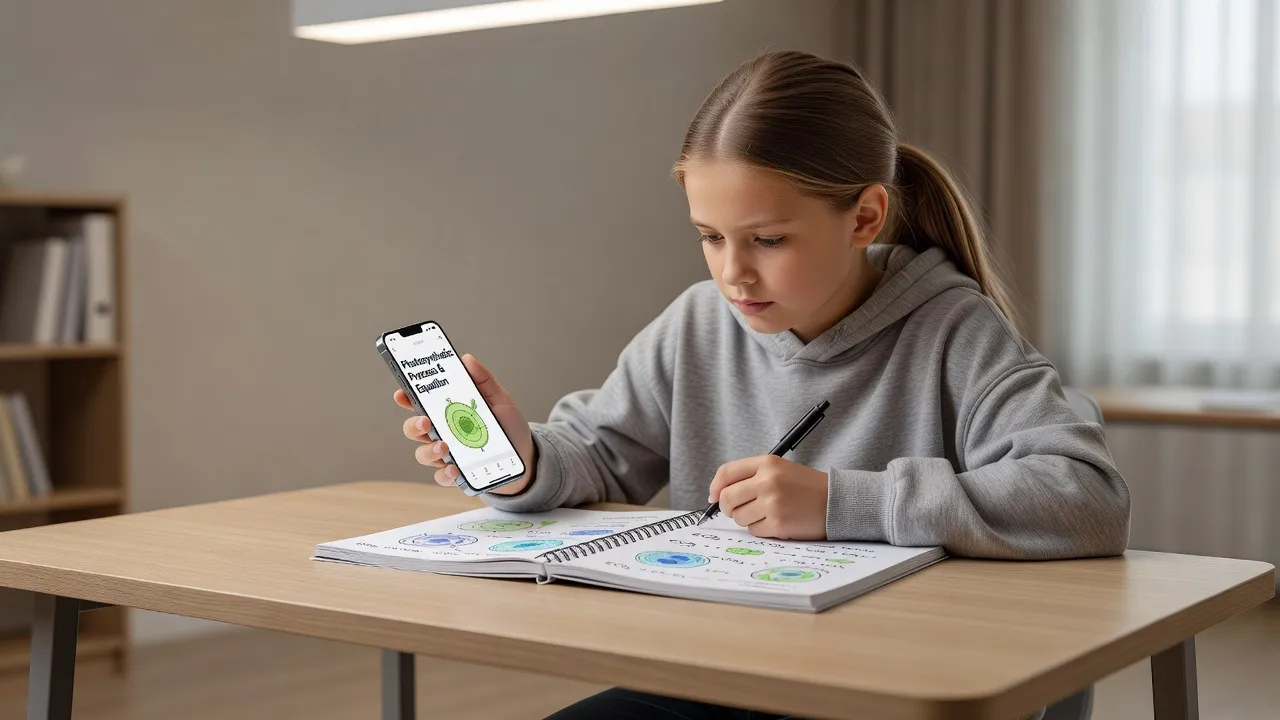
5. Visual Graphic Organization & Dual Coding
Dual coding pairs text notes with visual diagrams, flowcharts, or timelines.
Middle school science and social studies contain dense vocabulary. Creating a sketch of a cell alongside labeled definitions engages both visual and verbal processing channels in the brain.
- Why it made the list: It makes abstract concepts easier to understand and recall.
- Key trade-off: Drawing detailed diagrams can take up too much time if students get caught up in artistic details.
6. The Pomodoro Technique with Intentional Breaks
The Pomodoro Technique breaks study time into 20- or 25-minute focus periods separated by short 5-minute breaks.
Middle school attention spans hit a hard wall after 30 minutes of continuous focus. Taking planned, short breaks keeps mental fatigue at bay.
- Why it made the list: It makes starting daunting homework assignments feel much manageable.
- Key trade-off: Taking an unstructured break can disrupt focus if students open social media or video games. For better options, review these research-backed study break methods.
7. Environmental and Task Management Controls
Environmental control means building a distraction-free space paired with a centralized planner system.
A successful routine requires charging smartphones outside the bedroom during study hours and keeping all assignment dates in one planner app or notebook.
- Why it made the list: It cuts out the lost time spent searching for missing papers or checking notification alerts.
- Key trade-off: It requires strict household rules and daily parental check-ins at the start.
Comparing Middle School Study Tools and Frameworks
Choosing the right study tool comes down to whether your student needs simple memorization help or guided problem-solving assistance.
The comparison table below outlines how common study methods and applications stack up across key feature areas as of October 2026.
| Tool / Framework | Primary Learning Benefit | Instant Feedback Feature | Subject Focus | Cost / Tier Floor |
|---|---|---|---|---|
| Paper Flashcards | Strong tactile memory building | No (Requires manual key check) | General Vocabulary & Formulas | Free (Cost of index cards) |
| Quizlet | Digital flashcard sets & matching games | Partial (Multiple-choice automated keys) | Language & General Terms | Free tier; optional paid plans |
| ThinkAssist | Step-by-step logic checks via camera scan | Yes (24/7 step guidance via photo snap) | STEM, Math & General Homework | Free download; 3-day trial then $6.99/wk |
| Traditional Tutoring | Personalized 1-on-1 human guidance | Yes (Live conversation) | Comprehensive | $30–$80 per hour average |
If your middle schooler frequently hits roadblocks with hard math problems with answers, standard flashcard tools fall short because they only store static definitions. An interactive option like ThinkAssist helps fill that gap by walking students through the exact logic needed for multi-step problems. You can explore the app on the Apple App Store to see how instant problem breakdown fits your child's home routine.
How AI Homework Apps Support Middle School Self-Regulation
AI homework tools help middle school students build self-regulation by offering immediate feedback when parents or teachers are unavailable.
When a student runs into a difficult problem at 7:00 PM, waiting until the next school day for feedback often breaks their momentum. Using an AI-powered tutor helps bridge that gap safely and productively.
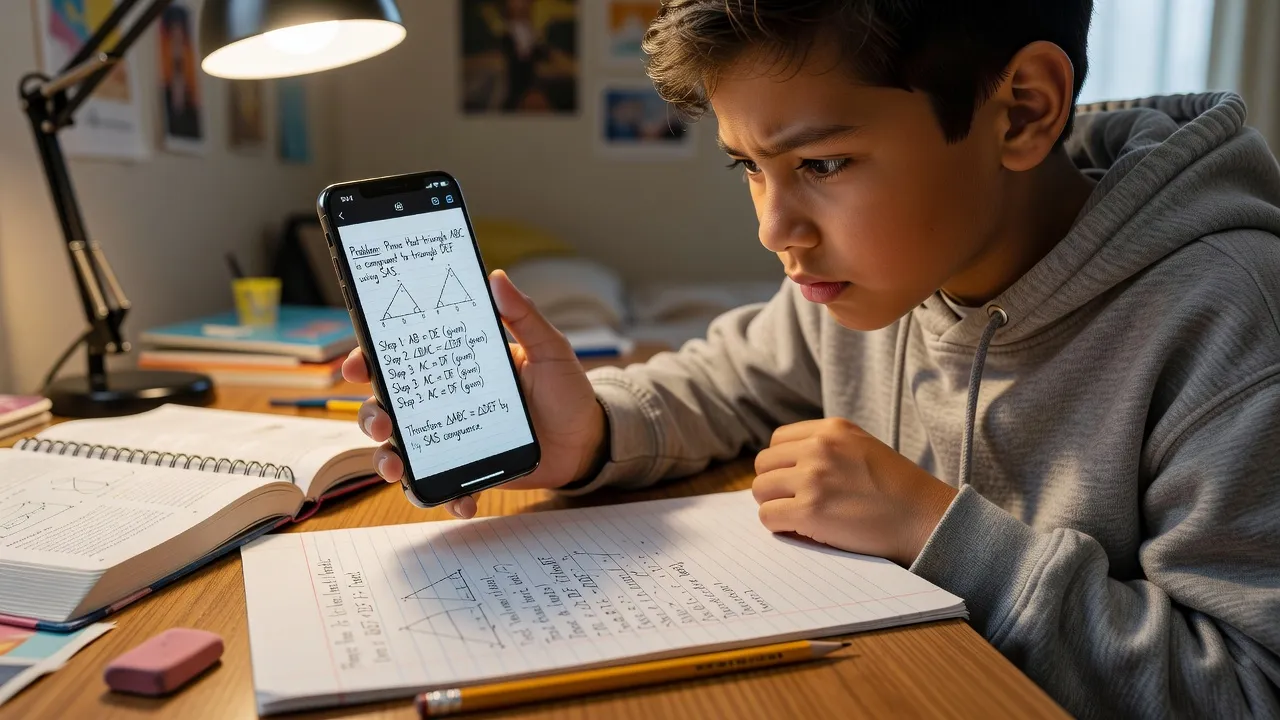
Here is how smart digital apps improve daily study routines:
- Instant step breakdowns: Students get immediate explanations for complex equations instead of getting stuck or giving up.
- Automatic subject detection: Modern tools automatically identify whether an assignment is algebra, biology, or history, adjusting explanations to match.
- Saved revision history: Past explanations remain stored in the app, serving as an automated study guide for end-of-unit tests.
Tools like ThinkAssist act as a round-the-clock homework helper for students learning to work independently. It keeps students moving forward on tough assignments without handing out unearned answers.
Frequently Asked Questions
How many hours a day should a junior high student study?
A junior high student should spend between 60 to 90 minutes per day on homework and review combined. Research from the National Education Association suggests following the 10-minute per grade rule, meaning 6th graders target 60 minutes while 8th graders target 80 minutes.
What are study skills for middle schoolers that work best for math?
The best study skills for middle school math are active retrieval practice, step-by-step error analysis, and interleaving different problem types. Rather than reading over completed worksheets, students should solve fresh problems without looking at answer keys first.
How can parents help middle schoolers organize their homework?
Parents can help middle schoolers by setting up a dedicated, distraction-free study space and establishing a daily planner check-in routine. Focus on keeping all digital and paper assignments in one central tracker rather than managing tasks across separate apps.
Is highlighting notes an effective study skill for junior high students?
No, highlighting notes is rated as a low-utility study skill in cognitive research. Highlighting requires very little mental effort and creates a false sense of mastery without helping students recall information during an exam.
How does spaced repetition help middle school students prepare for tests?
Spaced repetition breaks study time into short, regular sessions spread across several days. This approach challenges the brain to pull facts from memory repeatedly, which strengthens long-term retention far better than cramming the night before.
Why do middle school students struggle with studying independently?
Middle school students struggle with independent study because their brain's prefrontal cortex—which manages planning and impulse control—is still developing. Moving from elementary school's guided instruction to middle school's complex schedules requires explicit teaching of organizational skills.
Can AI apps help middle school students learn study habits?
Yes, AI apps can help middle school students build strong study habits by giving instant step-by-step feedback and breaking complex problems into smaller parts. This immediate guidance keeps students from getting frustrated and helps them work through difficult homework independently.