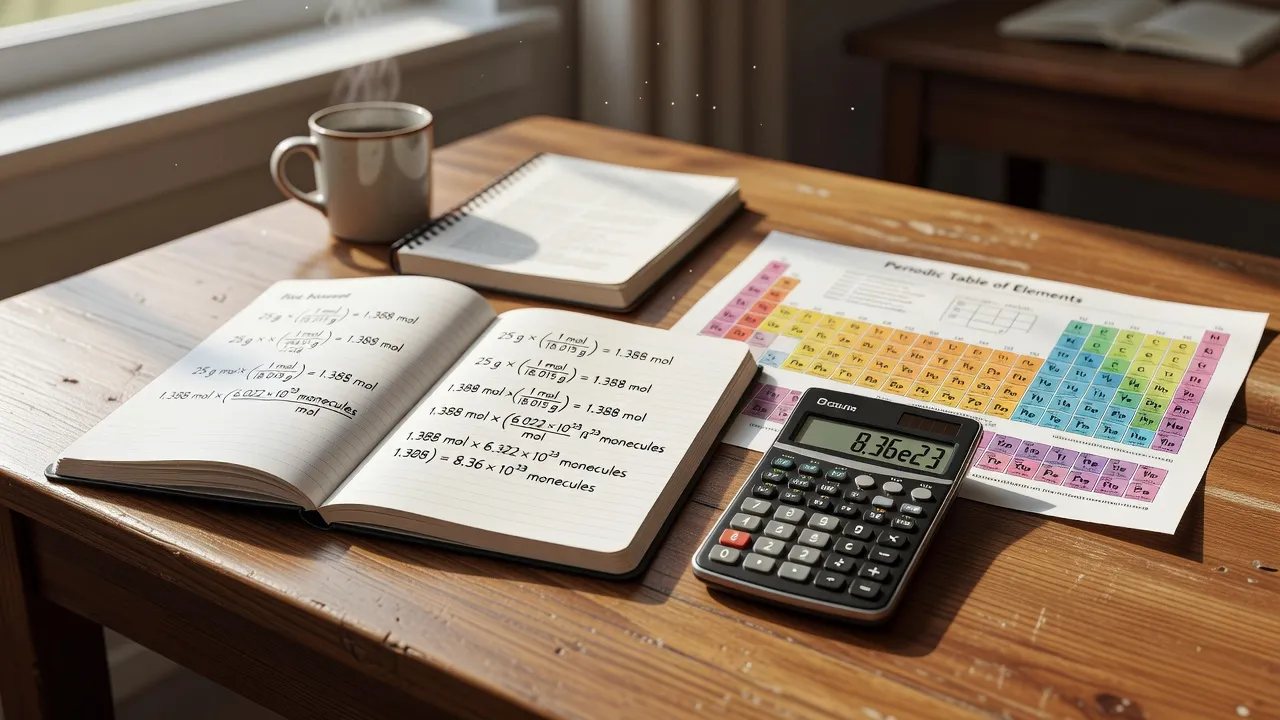
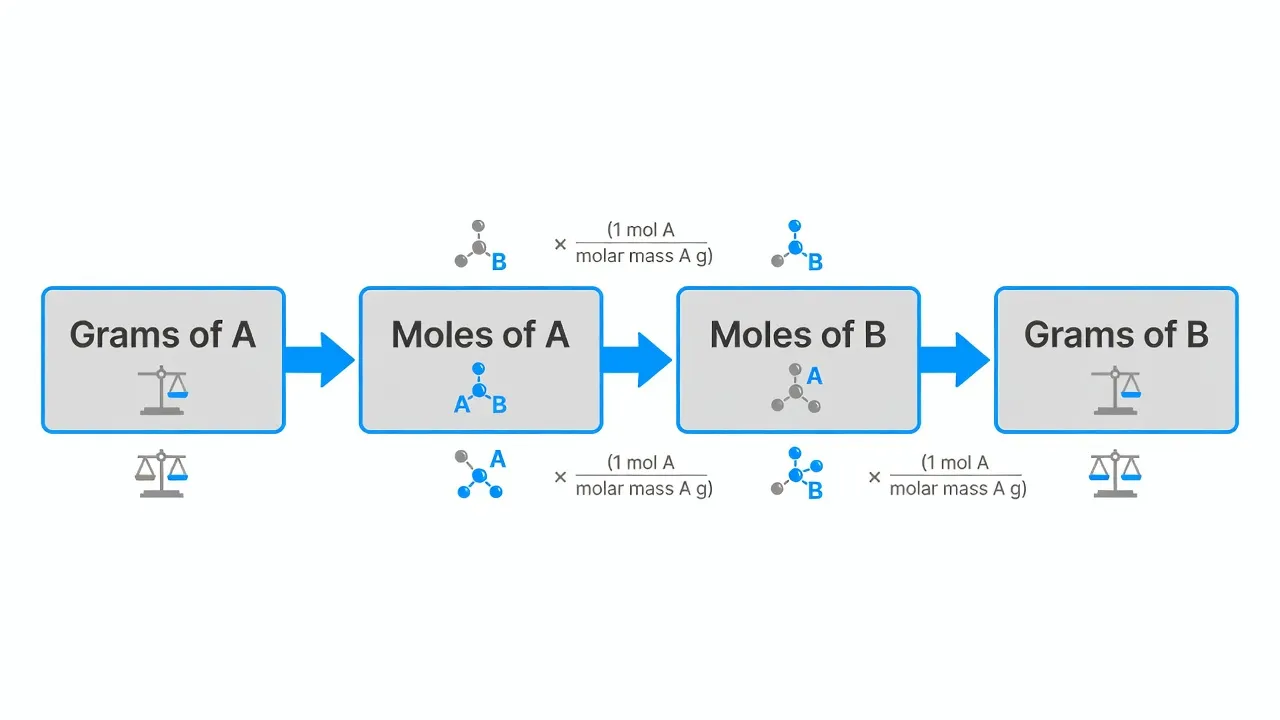
You can solve any stoichiometry practice problem in four steps by balancing the chemical equation, converting given quantities to moles, applying the mole ratio, and converting to your target units. Following this exact sequence eliminates guessing and handles mass-to-mass, gas volume, and limiting reactant calculations in under five minutes per problem.
Stoichiometry trips students up because it forces you to track units, chemical formulas, and mathematical ratios at the same time. If you skip a conversion factor or misplace a coefficient, the entire answer falls apart.
Here is the four-step workflow at a glance before we break down individual practice problems step by step.
| Step | Action | Required Input | Typical Time |
|---|---|---|---|
| Step 1: Balance Equation | Equalize atoms on reactant and product sides | Unbalanced chemical formula | 1-2 minutes |
| Step 2: Convert to Moles | Divide given mass or volume by molar mass or molar volume | Given mass (g), volume (L), or particles | 1 minute |
| Step 3: Mole Ratio Bridge | Multiply by (Moles of Unknown / Moles of Given) | Coefficients from balanced equation | 30 seconds |
| Step 4: Convert to Target | Multiply by target molar mass, gas volume, or concentration | Target unit specification | 1 minute |
Step 1: Balance the Chemical Equation First
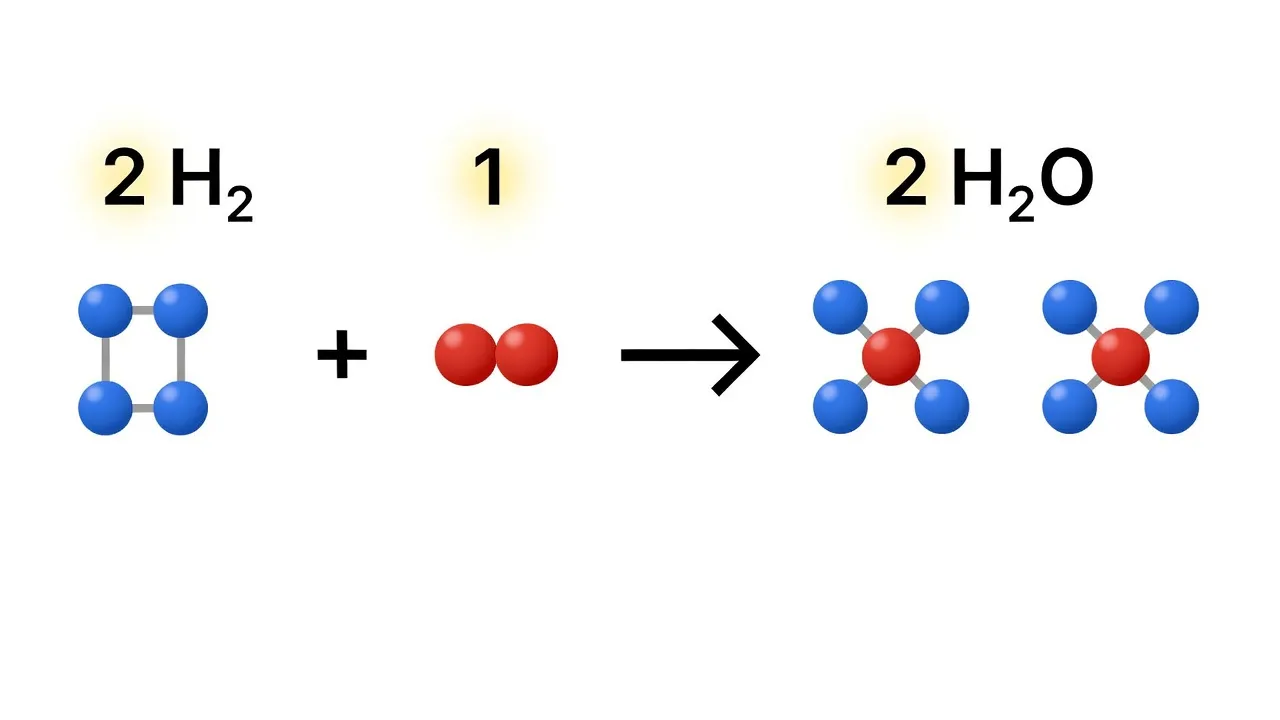
Before touching a calculator, you must verify that your chemical equation obeys the law of conservation of mass by having equal atom counts on both sides. Coefficients represent the exact molar proportions between reactants and products.
If you try to run stoichiometric calculations using an unbalanced equation, your mole ratios will be incorrect from the start. For instance, in the combustion of propane ($\text{C}_3\text{H}_8$), reacting propane with oxygen yields carbon dioxide and water:
$$\text{C}_3\text{H}_8 + 5\text{O}_2 \rightarrow 3\text{CO}_2 + 4\text{H}_2\text{O}$$
Notice that 1 mole of propane requires exactly 5 moles of oxygen gas to produce 3 moles of carbon dioxide and 4 moles of water. As outlined in OpenStax Chemistry, these quantitative relationships are the foundation for all reaction yield calculations.
Step 2: Convert Given Units to Moles
To move between two different substances in a reaction, you must first express your starting material in moles. Chemical reactions occur on a molecule-by-molecule basis, not a gram-by-gram basis.
Depending on what your practice problem gives you, use one of these standard conversion routes:
- From Mass (Grams): Divide given grams by the substance's molar mass ($\text{g} / \text{molar mass} = \text{moles}$).
- From Gas Volume at STP: Divide liters by $22.4 \text{ L/mol}$.
- From Solution Concentration: Multiply molarity ($\text{M}$) by volume in liters ($\text{L}$).
If you need a quick refresher on metric prefixes or unit factors before doing these calculations, reference this chemistry conversion chart.
Checking atomic weights on the NIST Chemistry WebBook ensures your calculated molar masses are accurate to two decimal places. If you ever get stuck setting up dimensional analysis grids on paper, uploading a quick snapshot to ThinkAssist gives you instant step-by-step feedback on your setup before you compute the final number.
Step 3: Apply the Mole Ratio from the Balanced Equation
The mole ratio acts as your bridge to convert moles of your starting substance into moles of your target substance. You construct this ratio directly from the coefficients in your balanced equation.
Place the coefficient of the substance you want to find in the numerator, and place the coefficient of the substance you currently have in the denominator:
$$\text{Moles of Given} \times \left( \frac{\text{Coefficients of Unknown}}{\text{Coefficients of Given}} \right) = \text{Moles of Unknown}$$
For example, using the balanced propane equation ($\text{C}_3\text{H}_8 + 5\text{O}_2 \rightarrow 3\text{CO}_2 + 4\text{H}_2\text{O}$), if you know you have $0.50 \text{ moles}$ of $\text{C}_3\text{H}_8$, your mole ratio to find $\text{CO}_2$ is $3 \text{ mol CO}_2 / 1 \text{ mol C}_3\text{H}_8$.
Multiplying $0.50 \times (3 / 1)$ gives $1.5 \text{ moles of CO}_2$.
Step 4: Convert Moles to the Target Unit
Once you hold moles of your target substance, multiply by that substance's molar mass or molar volume to reach the requested units. Most general chemistry exam questions ask for an answer in grams, liters, or total molecules.
To finish your dimensional analysis setup:
- For Grams: Multiply target moles by target molar mass ($\text{moles} \times \text{g/mol} = \text{grams}$).
- For Gas Volume: Multiply target moles by $22.4 \text{ L/mol}$ (at STP).
- For Particles/Molecules: Multiply target moles by Avogadro's number ($6.022 \times 10^{23} \text{ particles/mol}$).
Stringing all four steps into one continuous conversion line prevents rounding errors mid-calculation.
Worked Stoichiometry Practice Problems with Answers
Working through real problems is the fastest way to build confidence before a quiz or exam. Below are three fully solved problems ranging from simple mole-to-mole conversions to mass-to-mass and limiting reactant scenarios.
Problem 1: Mole-to-Mole Stoichiometry Practice
Question: How many moles of water ($\text{H}_2\text{O}$) are produced when $4.50 \text{ moles}$ of oxygen gas ($\text{O}_2$) react completely with excess hydrogen gas?
Balanced Equation:
$$2\text{H}_2(g) + \text{O}_2(g) \rightarrow 2\text{H}_2\text{O}(g)$$
Solution Steps:
- The equation is already balanced ($4 \text{ H}$ and $2 \text{ O}$ on both sides).
- The given quantity is already in moles ($4.50 \text{ mol O}_2$).
- Apply the mole ratio between $\text{O}_2$ and $\text{H}_2\text{O}$ ($2 \text{ mol H}_2\text{O} / 1 \text{ mol O}_2$).
$$4.50 \text{ mol O}_2 \times \left( \frac{2 \text{ mol H}_2\text{O}}{1 \text{ mol O}_2} \right) = 9.00 \text{ mol H}_2\text{O}$$
Answer: $9.00 \text{ moles of H}_2\text{O}$ are produced.
Problem 2: Mass-to-Mass (Gram-to-Gram) Stoichiometry Practice
Question: Calculate the mass in grams of carbon dioxide ($\text{CO}_2$) produced by the complete combustion of $22.0 \text{ grams}$ of propane gas ($\text{C}_3\text{H}_8$).
Balanced Equation:
$$\text{C}_3\text{H}_8 + 5\text{O}_2 \rightarrow 3\text{CO}_2 + 4\text{H}_2\text{O}$$
Molar Mass Calculations:
- Molar mass of $\text{C}_3\text{H}_8 = (3 \times 12.011) + (8 \times 1.008) = 44.10 \text{ g/mol}$
- Molar mass of $\text{CO}_2 = (1 \times 12.011) + (2 \times 15.999) = 44.01 \text{ g/mol}$
Solution Steps:
Convert grams of propane to moles:
$$22.0 \text{ g C}_3\text{H}_8 \times \left( \frac{1 \text{ mol C}_3\text{H}_8}{44.10 \text{ g C}_3\text{H}_8} \right) = 0.4989 \text{ mol C}_3\text{H}_8$$
Apply the mole ratio to find moles of carbon dioxide:
$$0.4989 \text{ mol C}_3\text{H}_8 \times \left( \frac{3 \text{ mol CO}_2}{1 \text{ mol C}_3\text{H}_8} \right) = 1.4967 \text{ mol CO}_2$$
Convert moles of carbon dioxide to grams:
$$1.4967 \text{ mol CO}_2 \times \left( \frac{44.01 \text{ g CO}_2}{1 \text{ mol CO}_2} \right) = 65.87 \text{ g CO}_2$$
Answer: $65.9 \text{ grams of CO}_2$ (rounded to three significant figures).
Problem 3: Limiting Reactant and Theoretical Yield Problem
Question: If $28.0 \text{ grams}$ of nitrogen gas ($\text{N}_2$) react with $9.00 \text{ grams}$ of hydrogen gas ($\text{H}_2$), which reagent is the limiting reactant, and what is the theoretical yield of ammonia ($\text{NH}_3$) in grams?
Balanced Equation:
$$\text{N}_2(g) + 3\text{H}_2(g) \rightarrow 2\text{NH}_3(g)$$
Molar Masses:
- $\text{N}_2 = 28.02 \text{ g/mol}$
- $\text{H}_2 = 2.016 \text{ g/mol}$
- $\text{NH}_3 = 17.03 \text{ g/mol}$
Solution Steps:
Calculate maximum product possible from $\text{N}_2$:
$$28.0 \text{ g N}_2 \times \left( \frac{1 \text{ mol N}_2}{28.02 \text{ g}} \right) \times \left( \frac{2 \text{ mol NH}_3}{1 \text{ mol N}_2} \right) \times \left( \frac{17.03 \text{ g NH}_3}{1 \text{ mol NH}_3} \right) = 34.03 \text{ g NH}_3$$
Calculate maximum product possible from $\text{H}_2$:
$$9.00 \text{ g H}_2 \times \left( \frac{1 \text{ mol H}_2}{2.016 \text{ g}} \right) \times \left( \frac{2 \text{ mol NH}_3}{3 \text{ mol H}_2} \right) \times \left( \frac{17.03 \text{ g NH}_3}{1 \text{ mol NH}_3} \right) = 50.68 \text{ g NH}_3$$
Compare results:
Nitrogen gas ($\text{N}_2$) produces less total product ($34.03 \text{ g}$) than hydrogen gas ($50.68 \text{ g}$). Therefore, $\text{N}_2$ runs out first.
Answer: Nitrogen gas ($\text{N}_2$) is the limiting reactant. The theoretical yield of ammonia is $34.0 \text{ grams}$.
Working through problem sets on platforms like WebAssign or looking up Pearson Mastering Chemistry answers often requires entering these multi-step setups under strict time limits. Practicing this linear dimensional analysis format builds speed and accuracy.
How to Avoid the 3 Most Common Stoichiometry Mistakes
Most students lose points on stoichiometry exams not because the math is hard, but because they rush through setup details. Modern online homework software automatically flags unit mismatches and wrong significant figures.
I see these three preventable errors on chemistry papers more than anything else:
1. Forgetting to Balance the Equation First
If you take mole ratios from coefficients on an unbalanced equation, your math is doomed instantly. Always count each element's atoms on the left and right sides before touching your calculator.
2. Inverting the Mole Ratio Fraction
Students frequently place the given substance coefficient in the numerator instead of the denominator. Remember the golden rule of dimensional analysis: Units you want to eliminate go on the bottom; units you want to keep go on the top.
3. Miscalculating Molar Masses from the Periodic Table
Do not round atomic masses to whole numbers unless your teacher explicitly tells you to do so. Using $12 \text{ g/mol}$ for Carbon instead of $12.011 \text{ g/mol}$ skews your multi-gram calculations enough to trigger incorrect flags on automated homework systems.
As defined by the IUPAC Gold Book, relative atomic mass scale precision directly affects yield calculations in quantitative analysis.
If you want to test your general chemistry foundation beyond stoichiometry, try taking a quick chemistry quiz or reviewing core concepts like quantum numbers chemistry.
Using AI Homework Helpers for Step-by-Step Chemistry Practice
When you get stuck on a late-night practice problem with no answer key, having an automated tutor step through the dimensional analysis saves hours of frustration. Practice is only valuable if you can identify where your calculation went off track.
ThinkAssist Snap & Solve
- Photo of Chemistry Worksheet is sent to AI Auto-Detection
- AI Auto-Detection processes the image and feeds into Step 1: Balanced Eq
- Step 1: Balanced Eq feeds into Step 2: Moles
- Step 2: Moles feeds into Final Mass
Downloading the ThinkAssist iOS App gives you an AI-powered homework solver that acts as a 24/7 personal chemistry tutor. Instead of giving you a flat final number, the app uses automatic subject detection to recognize handwritten chemistry equations and walk you through every conversion factor.
Key features for chemistry students include:
- Snap a Photo: Take a picture of any printed or handwritten stoichiometry problem from your textbook or test review.
- Step-by-Step Explanations: View full dimensional analysis grids, including molar mass breakdowns and mole ratio bridges.
- Easy Exam Prep: Save past answers and step explanations directly in the app to review right before midterm or final exams.
Whether you are struggling with gas stoichiometry, solution concentrations, or limiting reagents, seeing the exact steps laid out keeps your study momentum moving forward.
Frequently Asked Questions
What is the simple definition of stoichiometry?
Stoichiometry is the mathematical relationship between the quantities of reactants and products in a chemical reaction. It allows chemists to calculate how much product will form from a given amount of starting material.
What are the 4 main steps to solve stoichiometry problems?
The four steps are: 1) Balance the chemical equation, 2) Convert the given starting quantity into moles, 3) Multiply by the mole ratio from balanced equation coefficients, and 4) Convert target moles into the requested units (grams, liters, or particles).
How do you identify the limiting reactant in stoichiometry practice problems?
Calculate the maximum amount of product each reactant can produce independently. The reactant that yields the smaller amount of final product is your limiting reactant and runs out first.
What is the difference between theoretical yield and actual yield?
Theoretical yield is the maximum amount of product calculated mathematically from stoichiometry. Actual yield is the amount of product physically collected and measured in a lab experiment.
Why do you need a balanced equation for stoichiometry?
A balanced chemical equation reflects the law of conservation of mass. The coefficients provide the precise molar proportions required to convert between different chemicals in a reaction.
How do I convert grams to moles in a stoichiometry problem?
Divide your given mass in grams by the molar mass of the compound (found by adding atomic masses from the periodic table).
Can stoichiometry be used for gases and solutions?
Yes, stoichiometry applies to solids, liquids, solutions, and gases. For gases at STP, use 22.4 L/mol; for solutions, use molarity (Moles/Liter) to convert volume to moles.