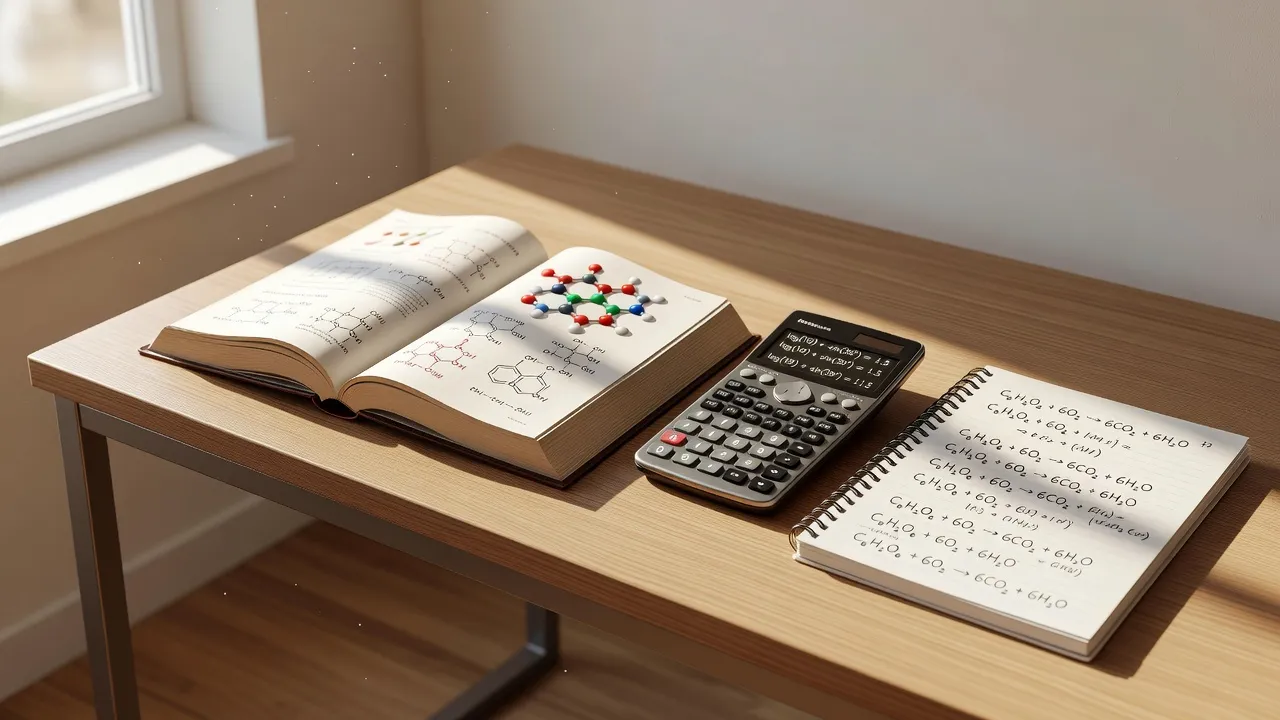
General Chemistry 1 is a foundational college-level course covering atomic structure, chemical bonding, stoichiometry, thermochemistry, and gas laws. Designed primarily for science majors, pre-med students, and engineers, the course pairs mathematical calculation with theoretical models to explain how matter behaves at the molecular level.
For most students, General Chemistry 1 (often abbreviated as Gen Chem 1) serves as their first academic hurdle in college STEM pipelines. The course demands both algebraic fluency and abstract spatial reasoning. While introductory high school chemistry focuses heavily on basic terminology, General Chemistry 1 forces you to apply quantitative principles to dynamic chemical systems. If you run into tricky problem sets while balancing lab write-ups, using an AI-powered study tool like the ThinkAssist app can help break down multi-step calculations late at night.
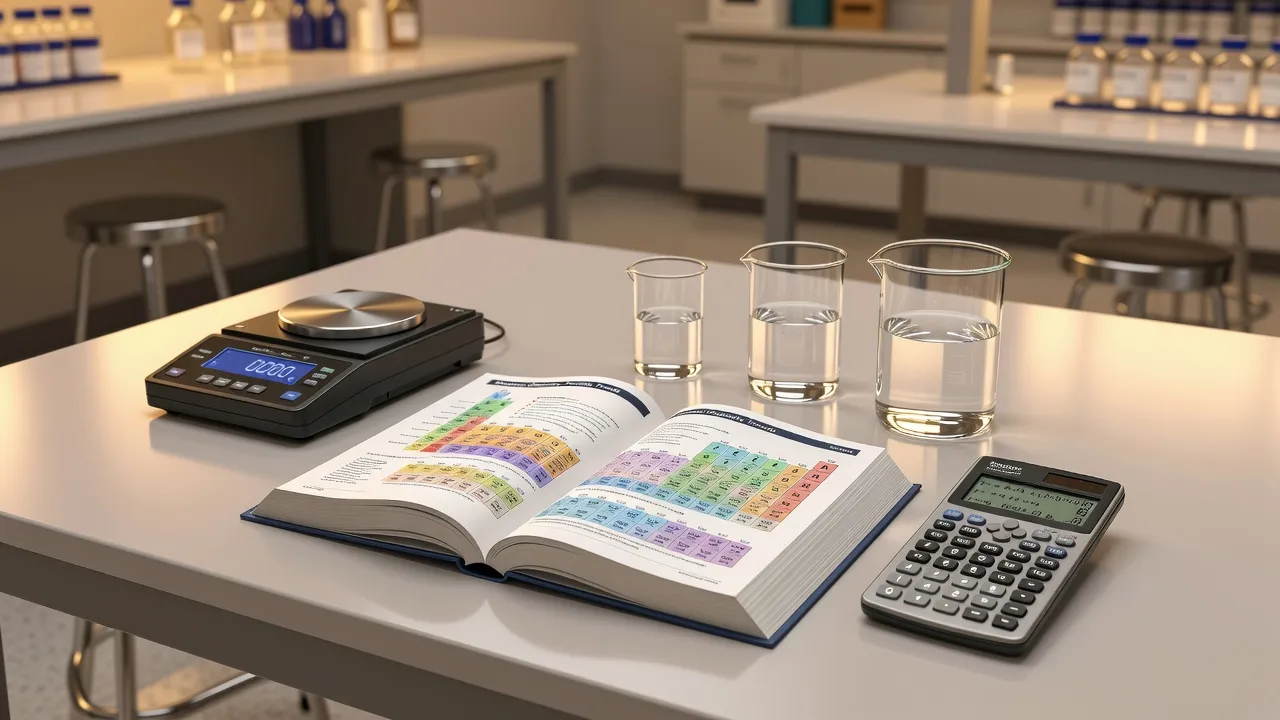
What are the most commonly used textbooks for General Chemistry I?
The most commonly used textbooks for General Chemistry I are Brown & LeMay's Chemistry: The Central Science, Tro's Chemistry: A Molecular Approach, Zumdahl's Chemistry, and OpenStax Chemistry 2e. University chemistry departments across the United States standardizing on these titles usually select them based on their problem-set difficulty, online platform integration, and alignment with American Chemical Society (ACS) curricular guidelines.
| Text / Resource | Primary Format | Access Cost (As of 2026) | Key Strength / Best Used For |
|---|---|---|---|
| OpenStax Chemistry 2e | Open-Access PDF/Web | 100% Free | Zero-cost core conceptual reading |
| ThinkAssist Homework Solver | iOS Mobile App | Free download ($6.99/wk) | Step-by-step math & photo walkthroughs |
| Chemistry: The Central Science | Hardcover / eTextbook | $75 - $299 (pearson.com) | Deep theoretical rigor & end-of-chapter sets |
| Chemistry: A Molecular Approach | Hardcover / eTextbook | $80 - $280 (pearson.com) | Visual atom-first conceptual models |
| Zumdahl Chemistry | Hardcover / eTextbook | $85 - $310 (cengage.com) | Problem-solving frameworks for pre-meds |
Selecting the right study material often depends on your professor's syllabus demands. While traditional publisher texts cost several hundred dollars, many institutions have shifted toward open-access digital options to reduce student expenses.
Is 'Chemistry: The Central Science' (Brown & LeMay) used in General Chemistry I?
Yes, Chemistry: The Central Science by Brown, LeMay, Bursten, Murphy, and Woodward is one of the most widely adopted textbooks for General Chemistry I in North America. First published in 1977, the text is currently in its 15th edition through Pearson Education, making it a standard choice for flagship state universities and private research institutions alike.
Professors favor Brown & LeMay because of its rigorous approach to chemical equilibrium, thermodynamics, and quantitative problem sets. The textbook is typically bundled with digital homework systems like Mastering Chemistry, where students complete graded weekly problem sets. If you find yourself stuck on automated online homework systems, reviewing worked examples on pearson mastering chemistry answers can help clarify where your dimensional analysis went wrong.
Is Zumdahl's Chemistry textbook used in General Chemistry I?
Yes, Chemistry by Steven S. Zumdahl and Susan A. Zumdahl is extensively used in General Chemistry I courses, particularly for pre-health and science majors. Published by Cengage, Zumdahl is famous for its emphasis on systematic problem-solving strategies rather than simple algorithmic memorization.
The textbook structures its chapters around central chemical principles, leading students through complex quantitative topics like enthalpy, electron configurations, and reaction yields. Its end-of-chapter questions are structured in tiers, moving from basic concept checks to advanced multi-step analytical challenges. Because Zumdahl places high demands on algebraic manipulation, students who struggle with unit conversions or chemical stoichiometry often find themselves spending substantial study hours outside of class.
Is Tro's 'Chemistry: A Molecular Approach' used in General Chemistry I?
Yes, Nivaldo J. Tro's Chemistry: A Molecular Approach is widely used in General Chemistry I to teach students how microscopic particle behavior drives macroscopic chemical observations. Tro’s textbook stands out for its visual presentation, utilizing extensive multi-panel diagrams to connect atomic models directly to real-world physical reactions.
The book follows an atom-first or macro-to-micro approach depending on the specific edition used by your university. Tro emphasizes physical intuition before presenting heavy mathematical formulas. This visual emphasis makes it especially popular at universities catering to engineering and physics majors who need a clear spatial understanding of molecular geometry and atomic orbitals.
Is OpenStax Chemistry adopted for General Chemistry I courses?
Yes, Chemistry 2e from OpenStax is formally adopted by hundreds of colleges and universities as a free, peer-reviewed textbook for General Chemistry I. Produced by Rice University and funded by educational foundations, the text is fully available online at the official OpenStax Chemistry page without purchase codes or subscription fees.
| OpenStax Chemistry Feature | Advantage for Gen Chem 1 Students |
|---|---|
| Zero-Cost Web & PDF Access | Removes financial barrier entirely |
| Standard 21-Chapter Scope | Matches traditional syllabus sequence |
| Peer-Reviewed Faculty Writing | Rigorous explanations equal to paid books |
| Web-Based Interactive Simulations | Direct links to PhET lab applets |
Because OpenStax covers identical topics to paid publisher texts—ranging from periodic trends to ideal gas behavior—many faculty members choose it to lower course costs. The material integrates smoothly with free online assessment platforms like OpenStax Tutor and WebAssign, making higher education more accessible without sacrificing academic rigor.
What online courses (Coursera, edX, Khan Academy, MIT OpenCourseWare) are used for General Chemistry I?
Khan Academy and MIT OpenCourseWare are the most frequently used online learning platforms for mastering General Chemistry I topics. While platforms like Coursera and edX host full university-backed certificate courses, Khan Academy serves as the primary supplementary tutorial site for students enrolled in traditional campus classes.
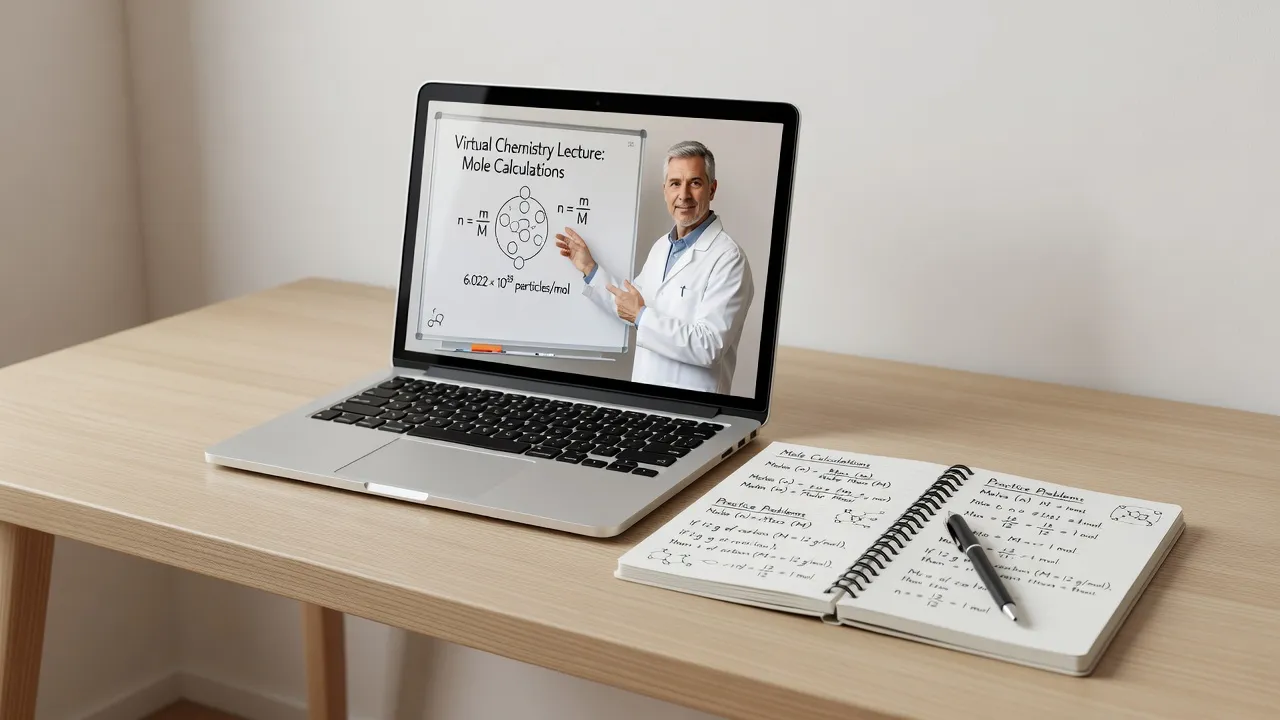
Students looking for free, self-paced video content rely heavily on these platforms:
- Khan Academy: Offers bite-sized video lessons paired with instant practice questions, covering everything from balancing equations to gas laws. Check out their official core module directly on Khan Academy Chemistry.
- MIT OpenCourseWare: Provides complete lecture playlists, actual exam archives, and recitation notes from MIT's 5.111 Principles of Chemical Science course, accessible via MIT OCW Chemistry.
- Coursera & edX: Host multi-week structured sequences created by institutions like Duke University and the University of Kentucky, useful for students needing formal college transfer credit or remedial preparation.
What Topics Are Covered in General Chemistry 1?
General Chemistry 1 covers seven core content pillars: measurement and unit conversion, atomic structure, chemical stoichiometry, aqueous reactions, thermochemistry, quantum mechanics, and molecular bonding models. Understanding how these topics interlock is vital for passing your exams.
| Unit Core Topic | Key Mathematical Skill Required | Common Student Stumbling Block |
|---|---|---|
| Stoichiometry & Molar Mass | Dimensional Analysis & Ratios | Limiting Reactants & Percent Yield |
| Thermochemistry & Enthalpy | Hess's Law & Calorimetry Math | Sign Conventions (+/- q and w) |
| Quantum Numbers & Orbitals | Electron Configuration Notation | Spatial Orientation of d/f Orbitals |
| Gas Laws & Kinetic Theory | PV = nRT & Combined Gas Equations | Non-ideal Gas Corrections (van der Waals) |
Stoichiometry and Molar Mass
Stoichiometry is the quantitative calculation of reactants and products in balanced chemical reactions. You will convert grams of compounds to moles, determine limiting reagents, and calculate theoretical yields. Working through extra stoichiometry practice problems is essential to build speed for timed midterm exams.
Quantum Numbers and Atomic Structure
Quantum mechanics explains how electrons inhabit specific energy levels surrounding an atomic nucleus. You will study principles like electron spin, principal quantum numbers, and electron orbital geometries. If assigned homework on orbital filling rules, reviewing dedicated guides on quantum numbers chemistry helps demystify how subshells behave.
Chemical Bonding and Molecular Geometry
This module covers how atoms form ionic, covalent, and metallic bonds. You will learn to draw Lewis structures, predict resonance patterns, and apply Valence Shell Electron Pair Repulsion (VSEPR) theory to calculate 3D bond angles.
Thermochemistry and Reaction Energy
Thermochemistry tracks energy transfer in chemical reactions using principles of heat capacity, calorimetry, and enthalpy ($\Delta H$). You will calculate reaction enthalpy using Hess’s Law and standard enthalpies of formation.
Why General Chemistry 1 Is a Filter Course (And How to Beat the Curve)
General Chemistry 1 acts as a filter course because it demands immediate transition from mechanical memorization to complex quantitative reasoning under severe time constraints. At many universities, failure or drop rates for General Chemistry 1 range between 20% and 35%, making it one of the toughest freshman courses for science majors.
To maintain your GPA and avoid dropping out of pre-health or engineering tracks, you must alter your high school study habits immediately.
- Master Dimensional Analysis First: Virtually every calculation in Gen Chem 1—from molarity to gas pressure—uses unit cancellation. If your conversion setup is wrong, your final answer will fail regardless of your calculator inputs.
- Do Problem Sets Daily: Reading your textbook gives a false sense of security. You must solve unworked problems without looking at answer keys to build real muscle memory.
- Utilize Instant Technical Help: When studying late at night, getting stuck on a single stoichiometry steps can stall your entire study session. Using an on-demand solver like ThinkAssist lets you snap a photo of any written equation to receive immediate step-by-step logic breakdowns, helping you understand how to solve the problem rather than just giving a final number.
- Take Simulated Exam Quizzes: Re-reading notes is passive. Test your knowledge weekly using targeted chemistry quiz sets to identify weak spots before exam day.
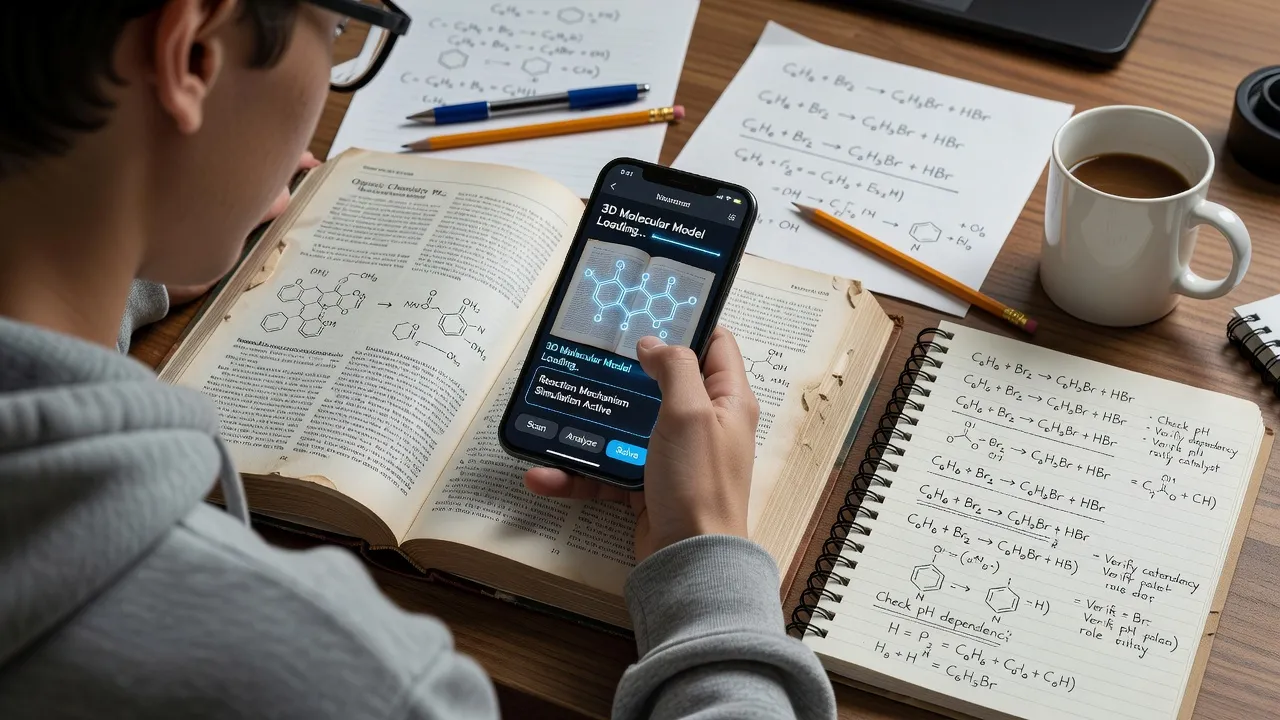
How ThinkAssist Helps You Conquer Chemistry Homework
ThinkAssist works as an AI-powered 24/7 tutor designed to guide students step-by-step through tough science and math coursework. When tackling multi-step General Chemistry 1 calculations, reading textbook solutions often leaves out key algebraic intermediate steps. ThinkAssist bridges that gap.
The app lets you snap a photo of any handwritten or printed chemistry problem, automatically detecting the problem type and generating clear, sequential explanations.
- Snap a Photo: Capture complex chemical equations, dimensional analysis setups, or thermochemistry problems directly from your notebook or textbook.
- Step-by-Step Explanations: Receive precise mathematical and theoretical walk-throughs so you learn the underlying rules instead of just copying answers.
- Easy Exam Prep: Save past solved problems into structured study lists, making it easy to review difficult concepts when midterms and finals arrive.
You can download the app for free with a 3-day free trial, followed by an affordable subscription plan at $6.99 per week on the Apple App Store.
Frequently Asked Questions
What math background is required for General Chemistry 1?
You need solid high school algebra skills, including solving multi-variable equations, working with logarithms, scientific notation, and basic unit conversions. Calculus is generally not required unless you are taking a specialized physical chemistry sequence.
How hard is General Chemistry 1 compared to High School Chemistry?
General Chemistry 1 moves much faster and requires deep conceptual application rather than simple memorization. High school chemistry often focuses on introductory terms, whereas college chemistry expects you to combine multiple principles to solve complex, multi-step word problems under strict exam time limits.
What is the difference between General Chemistry 1 and General Chemistry 2?
General Chemistry 1 focuses on foundational atomic theory, bonding, stoichiometry, gas laws, and basic thermochemistry. General Chemistry 2 applies those concepts to chemical kinetics, equilibrium states, acid-base chemistry, thermodynamics ($\Delta G$ and $\Delta S$), and electrochemistry.
Can I pass General Chemistry 1 without taking High School Chemistry?
Yes, you can pass General Chemistry 1 without high school chemistry, but you must work harder during the first month. You will need to rapidly catch up on fundamental concepts like chemical nomenclature, polyatomic ions, and dimensional analysis.
What is the American Chemical Society (ACS) General Chemistry 1 exam?
The ACS exam is a standardized end-of-course test used by many university chemistry departments in the United States as their final exam. It contains 70 multiple-choice questions covering the standard Gen Chem 1 curriculum, designed to evaluate national student performance benchmarks.
How many hours a week should I study for General Chemistry 1?
Most college instructors recommend studying 2 to 3 hours outside of class for every 1 credit hour of chemistry lecture. For a standard 4-credit course (lecture plus lab), you should plan to spend between 8 and 12 hours per week reviewing notes and solving practice problems.
Is General Chemistry 1 required for medical school?
Yes, medical schools across North America require a full year of General Chemistry with lab (General Chemistry 1 and 2). Achieving a high grade in these courses is essential for building a competitive pre-med academic profile and preparing for the MCAT.