Math word problems for third graders bridge abstract arithmetic and real-world reasoning by requiring students to extract equations from short written narratives. In third grade, these problems shift from single-step addition and subtraction to multi-step challenges involving multiplication, division, fractions, and measurement.
For parents and educators navigating curriculum expectations in October 2026, helping eight- and nine-year-olds decode these stories requires isolating the mathematical operations hidden inside text. If a student understands basic calculations but freezes when encountering a printed story problem, the roadblock is usually reading comprehension or cognitive load rather than computation skill. Using step-by-step tools like the ThinkAssist AI solver can clarify these narrative prompts by turning wordy questions into clear mathematical steps.
Are word problems effective for teaching math to third graders?
Yes, word problems are highly effective for teaching third-grade math because they force students to construct mental models rather than memorize numerical procedures. According to research syntheses published by the Institute of Education Sciences, instruction focused on schema-based word problem strategies significantly improves mathematical problem-solving skills in elementary students.
When children read a story problem, they cannot simply perform mechanical arithmetic. They must evaluate context, discard irrelevant details, and choose appropriate mathematical operations.
How word problems build conceptual thinking
- Contextual grounding: Students see how numbers represent physical objects, money, or time.
- Operation selection: Children learn to identify when multiplication represents groups rather than repeated addition.
- Error diagnosis: Word problems reveal whether a student actually grasps a concept or is just following a algorithmic script.
Where traditional word problems fail struggling readers
Word problems fail when text complexity masks the underlying math. If a third grader reads below grade level, the mental energy spent decoding vocabulary leaves no room for working memory to process calculations. In those cases, pure story problems measure reading fluency instead of math ability.
Are third grade math word problems aligned with Common Core standards?
Yes, third grade math word problems directly align with Common Core State Standards, specifically targeting operations, algebraic thinking, fractions, and measurement. The Common Core State Standards Initiative mandates that third-grade students solve two-step word problems using the four basic operations and represent these problems using equations with a letter standing for the unknown quantity.
Understanding standard alignments helps adults select practice materials that match classroom requirements rather than outdated worksheets.
Third Grade Math Standards Overview:
- 3.OA.A.3: Multiplication & division word problems (equal groups, arrays)
- 3.OA.D.8: Two-step word problems using +, -, ×, ÷ with unknown variables
- 3.NF.A.3: Fraction word problems (comparing parts of a whole)
- 3.MD.A.1: Measurement & elapsed time word problems
Key Common Core expectations for Grade 3
- Multi-step logic: Students must solve problems requiring two distinct operations (such as multiplying first, then subtracting).
- Variable representation: Children learn to use symbols or letters (like $x$ or $n$) to stand for unknown numbers.
- Estimation skills: Standards require students to assess whether their answers are reasonable using mental computation and rounding strategies.
Scenario 1: Multi-Step Addition and Subtraction Word Problems
Multi-step addition and subtraction word problems require third graders to perform two sequential calculations to reach a final answer. These tasks test whether a student can hold an intermediate number in memory while working through the second phase of the narrative.
The Problem
Maya had 145 stickers in her collection. She gave 28 stickers to her brother and 35 stickers to her friend. How many stickers does Maya have left?
Step-by-Step Breakdown
- Identify the starting quantity: Maya begins with 145 stickers.
- Calculate total stickers given away: Add $28 + 35 = 63$.
- Subtract the total given away from the start: Calculate $145 - 63 = 82$.
- Final Answer: Maya has 82 stickers left.
Where Students Get Stuck
The most common error occurs when a student performs only the first step ($145 - 28 = 117$) and assumes the problem is solved. Third graders frequently struggle to track multi-part goals.
For additional practice with algebraic structures, reviewing a one step equations worksheet guide helps clarify how single operations build into complex multi-step systems.
Scenario 2: Introductory Multiplication and Equal Groups
Multiplication word problems in third grade focus on the concept of equal groups, arrays, and scale factors rather than abstract memorization. Students transition from counting items one by one to grouping items efficiently.
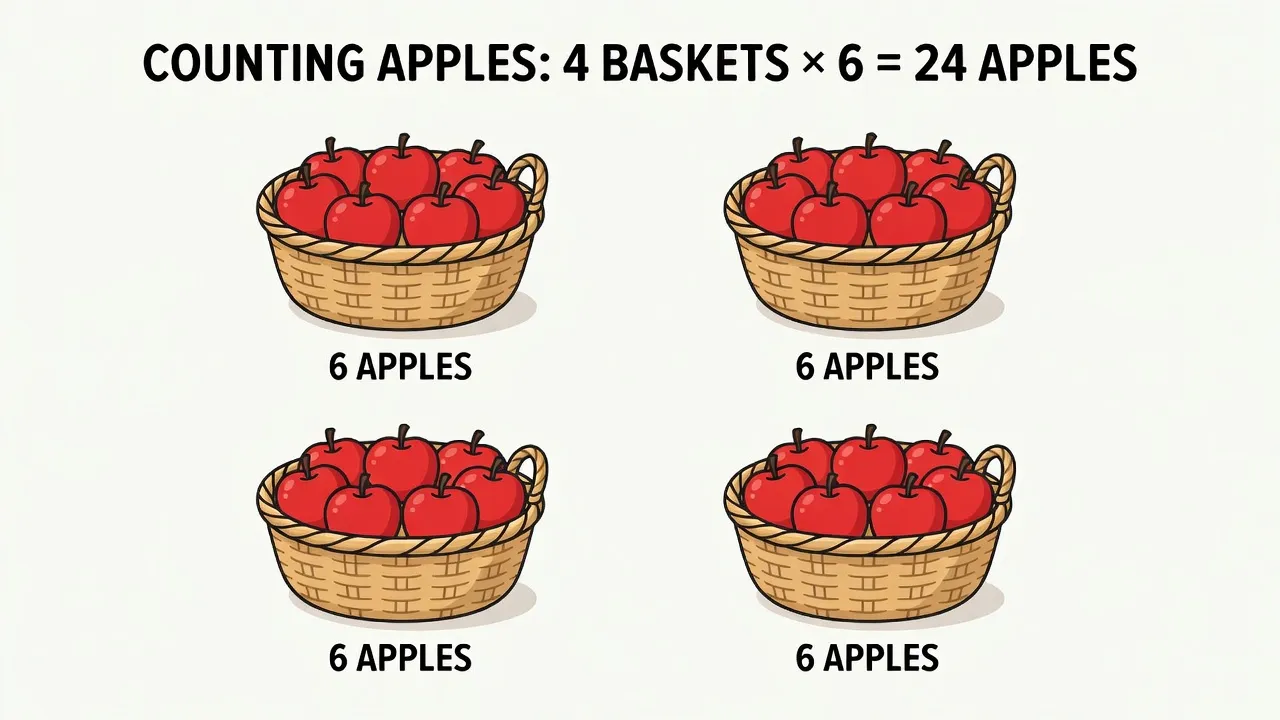
The Problem
A school garden has 4 rows of tomato plants. Each row has 6 plants. How many tomato plants are in the garden in total?
Step-by-Step Breakdown
- Identify group count and group size: There are 4 groups (rows) with 6 items (plants) per group.
- Write the multiplication expression: $4 \times 6$.
- Calculate the product: $4 \times 6 = 24$.
- Final Answer: There are 24 tomato plants in the garden.
Cognitive Limits to Watch For
If a child has not yet mastered basic multiplication facts, force-feeding them multi-step word math problems for 3rd graders creates frustration. Ensure they can visualize arrays or use skip-counting ($6, 12, 18, 24$) before removing visual support markers.
Scenario 3: Division and Fair Sharing Scenarios
Division word problems require third graders to partition quantities into equal sets or determine how many groups of a specific size can be made. Third-grade division standards focus on concepts without remainders to establish core structural understanding.
The Problem
Mr. Davis has 32 pencils to distribute equally among 8 student tables. How many pencils does each table receive?
Step-by-Step Breakdown
- Identify the total amount and target groups: Total is 32 pencils; number of groups is 8.
- Set up the division equation: $32 \div 8 = ?$.
- Relate division to multiplication: Ask, "What number times 8 equals 32?" ($8 \times 4 = 32$).
- Final Answer: Each table receives 4 pencils.
When students hit harder mathematical concepts later in school, these division concepts become critical foundation points. For instance, advanced topics like math inequality word problems depend entirely on mastering basic variable distribution early on.
Scenario 4: Fraction Word Problems with Visual Models
Third-grade fraction word problems introduce parts of a whole, focusing on equal shares, number line placements, and simple comparisons. At this stage, denominators are restricted to 2, 3, 4, 6, and 8 per standard guidelines.
The Problem
Liam and Noah bought identical personal pizzas. Liam ate $\frac{3}{4}$ of his pizza, and Noah ate $\frac{2}{4}$ of his pizza. Who ate more pizza, and how much more?
| Person | Eaten | Remaining | Total eaten |
|---|---|---|---|
| Liam's Pizza | X X X | 3/4 | |
| Noah's Pizza | X X | 2/4 | |
| Difference | X | 1/4 |
Step-by-Step Breakdown
- Verify common denominators: Both pizzas are cut into 4 equal slices.
- Compare numerators: Compare 3 and 2. Since $3 > 2$, Liam ate more.
- Calculate the difference: $\frac{3}{4} - \frac{2}{4} = \frac{1}{4}$.
- Final Answer: Liam ate more pizza; he ate $\frac{1}{4}$ more of a pizza than Noah.
Common Misconceptions
Children often assume larger numbers always mean larger fractions (e.g., thinking $\frac{1}{8}$ is bigger than $\frac{1}{4}$ because 8 is larger than 4). Using area models or fraction strips eliminates this mistake.
Matching 3rd Grade Math Scenarios to Support Strategies
Evaluating word problem types alongside student learning barriers ensures you apply the correct intervention. The table below outlines standard third-grade scenarios, their specific learning constraints, and effective support tools.
| Problem Scenario | Primary Skill Required | Student Barrier / Limit | Recommended Support Approach |
|---|---|---|---|
| Two-Step Addition / Subtraction | Multi-step memory & tracking | Reading fatigue; dropping step 2 | Graphic organizers; tape diagrams |
| All-in-One Homework Help | Multi-subject problem scanning | Storing multi-step logic | ThinkAssist AI Homework Solver for step-by-step breakdown |
| Equal Group Multiplication | Array visualization | Rote memory gaps in math facts | Concrete counters; skip-counting charts |
| Fair Share Division | Inverse multiplication facts | Confusion between factors & totals | Equal partition drawings; bar models |
| Fraction Comparisons | Unit fraction understanding | Misunderstanding denominator size | Fraction strips; visual number lines |
| Elapsed Time & Measurement | Number line distance | Base-10 vs. 60-minute time limits | Clocks with movable hands; timeline graphs |
Scenario 5: Measurement, Mass, and Elapsed Time Word Problems
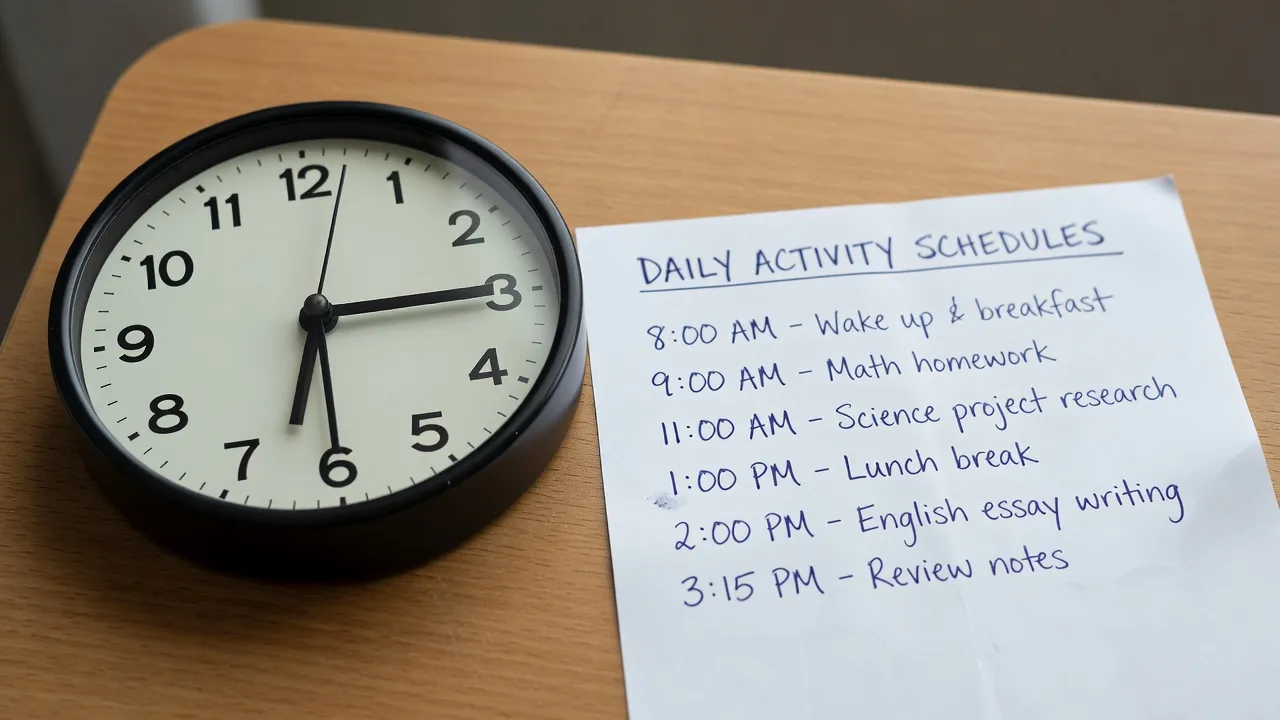
Elapsed time and measurement word problems connect arithmetic with physical quantities like liters, grams, and minutes. These problems are challenging because time operates on base-60 instead of standard base-10 arithmetic.
The Problem
Soccer practice starts at 3:15 PM and ends at 4:05 PM. How long does soccer practice last?
Step-by-Step Breakdown
- Count to the nearest hour: From 3:15 PM to 4:00 PM is 45 minutes.
- Add remaining minutes: From 4:00 PM to 4:05 PM is 5 minutes.
- Combine intervals: $45 \text{ minutes} + 5 \text{ minutes} = 50 \text{ minutes}$.
- Final Answer: Soccer practice lasts 50 minutes.
The Base-60 Pitfall
Students frequently try to subtract time using standard vertical subtraction ($405 - 315 = 90$), leading to incorrect conclusions like "90 minutes." Teaching students to jump to the nearest hour mark on a timeline avoids this error.
For students struggling with multi-step logical reasoning, exploring guides on hard math problems with answers provides insight into how complex structures can be broken down into clear steps.
How ThinkAssist Helps Third Graders Master Word Problems
When parent explanations run cold late in the evening, instant AI support can help bridge the gap without simply handing over answers.
The ThinkAssist app on iOS serves as a personal 24/7 tutor designed to guide students through difficult assignments. Available with a free download and a 3-day free trial (then $6.99/week), it features an AI-Powered Homework Solver that turns tricky word math problems for 3rd graders into digestible steps.
- Take Photo of Problem
- Automatic Subject Detection
- Instant Step-by-Step Solution
Key features for 3rd grade math support:
- Snap a Photo: Parents or students can take a quick picture of any word problem directly from a worksheet or textbook.
- Step-by-Step Explanations: Rather than showing just the raw answer, the app breaks down why an operation was chosen and how to calculate it.
- Saved Past Answers for Exam Prep: Review past word problems before classroom quizzes to reinforce problem-solving steps.
Using ThinkAssist as a guided assistant keeps homework sessions low-stress while building long-term problem-solving independence.
4 Strategies to Help Students Read and Solve Word Problems
Solving math word problems requires a structured strategy to translate English into mathematical operations. Without a systematic approach, children resort to "number grabbing"—plucking numbers from text and randomly adding or multiplying them.
1. The CUBE Method
- C: Circle the key numbers and units.
- U: Underline the question being asked.
- B: Box clue words (e.g., in all, left, each, shared equally).
- E: Evaluate the steps and eliminate unnecessary information.
2. Draw Bar Models (Tape Diagrams)
Bar models convert abstract narrative text into visual proportions.
Total: [        145 Stickers        ]
Part 1: [ 28 ]  Part 2: [ 35 ]  Remaining: [ ? ]
By visual drawing, children immediately see whether they are searching for a missing part or a whole total.
3. Read the Problem Three Times
- First Read: Understand the overall story (ignore the numbers).
- Second Read: Identify the mathematical quantities and facts.
- Third Read: Determine the exact mathematical question to solve.
4. Require Reasonableness Checks
Always ask your child: "Does your answer make sense?" If a problem asks how many apples remain after eating some, and the calculated answer is larger than the starting amount, the student knows an operation error occurred.
Frequently Asked Questions
What are the main types of math word problems for third graders?
Third-grade math word problems primarily cover two-step addition and subtraction, equal groups multiplication, fair-sharing division, basic fraction comparisons, and measurement tasks like elapsed time or area.
How do I know if my third grader is struggling with reading or math?
Read the word problem aloud to your child. If they can solve it easily when heard but freeze when reading it silently, the barrier is reading comprehension. If they still cannot identify the operations when read aloud, the issue lies in mathematical reasoning.
What are common keywords in third grade math word problems?
Addition keywords include altogether, in all, and combined. Subtraction keywords include how many more, difference, and left. Multiplication uses each, every, and per, while division relies on split, shared equally, and divided into.
How many steps should a 3rd grade math word problem have?
According to state academic standards, third graders should work with both single-step problems and two-step problems that combine two basic operations.
How can I help my child solve two-step word problems without getting confused?
Encourage your child to break the problem into two distinct questions. Have them solve the first calculation, write down the intermediate answer, and use that result to complete the second calculation.
Are calculators allowed for third grade math word problems?
Calculators are generally not recommended for third-grade word problems. The focus in Grade 3 is building operational fluency and conceptual understanding, which can be hindered by over-reliance on automatic computation tools.
What should I do if a word problem has extra information?
Teach your child to cross out details that do not relate to the final question. Practice identifying "distractor" facts during reading to build critical filter skills.