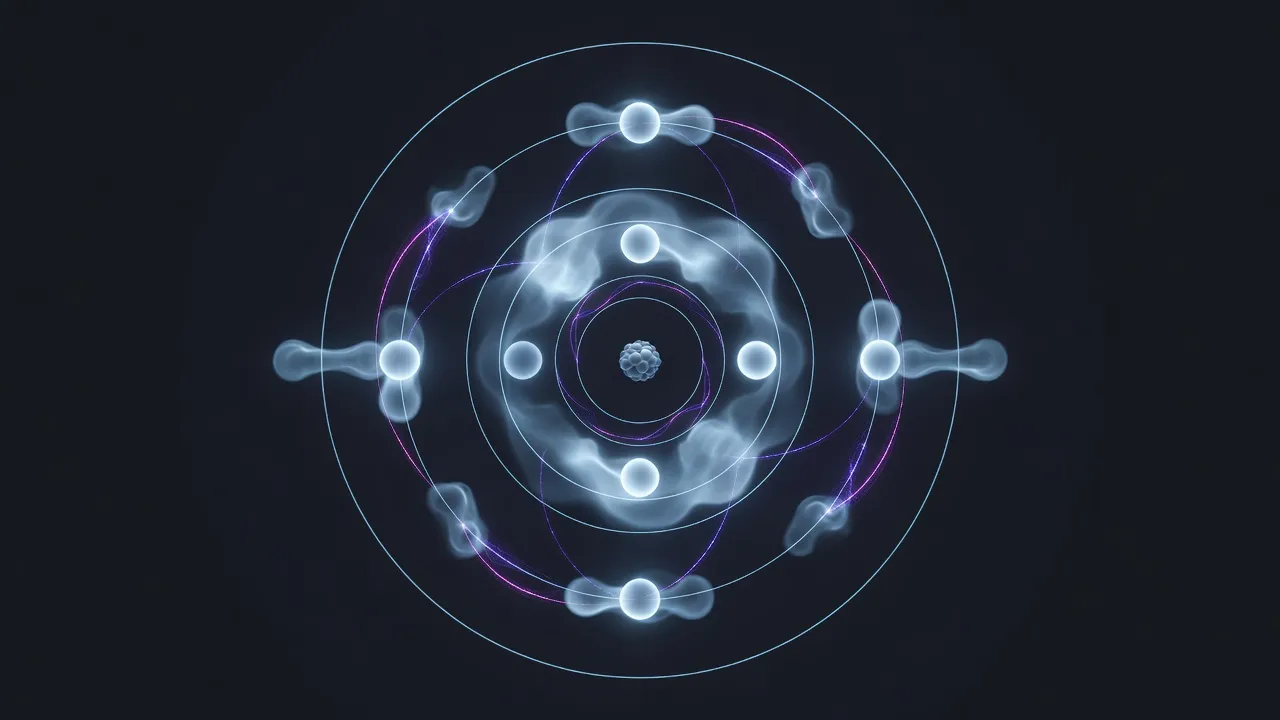
Quantum numbers in chemistry are a set of four numerical values ($n$, $l$, $m_l$, $m_s$) that completely describe the unique quantum state, energy level, subshell shape, spatial orientation, and spin orientation of an electron in an atom. Think of them as the precise multi-digit address for an electron's location relative to the atomic nucleus. Under the Pauli Exclusion Principle, no two electrons in the exact same atom can share the identical combination of all four quantum numbers.
If you are working through complex electron configuration worksheets or preparing for an exam, an AI-powered solver like ThinkAssist can quickly help you verify your quantum number assignments step-by-step.
An atomic shell (n) contains one or more subshells (l). Each subshell (l) contains one or more orbitals (m_l). Each orbital (m_l) contains two electrons: one with spin m_s = +1/2 and one with spin m_s = -1/2.
What are IUPAC's definitions of quantum numbers (principal, azimuthal, magnetic, spin)?
According to the International Union of Pure and Applied Chemistry (IUPAC), quantum numbers are mathematically derived variables from the Schrödinger wave equation that define the discrete energy states and spatial probability distributions of atomic electrons. The official definitions maintained in the IUPAC Gold Book establish the precise physical meaning of each of the four fundamental parameters.
Principal quantum number ($n$)
The principal quantum number ($n$) defines the main energy level and overall spatial size of an electron's shell. As $n$ increases, the electron sits farther from the nucleus, and its binding energy decreases. IUPAC defines $n$ strictly as a positive integer where $n \in {1, 2, 3, \dots}$.
Azimuthal quantum number ($l$)
The azimuthal quantum number ($l$), also known as the orbital angular momentum quantum number, determines the geometric shape of an atomic subshell. It specifies the magnitude of the orbital angular momentum for the electron state. For a given shell $n$, $l$ can take any integer value from $0$ to $n - 1$. In spectroscopic notation, $l$ values of 0, 1, 2, and 3 correspond to the $s$, $p$, $d$, and $f$ subshells.
Magnetic quantum number ($m_l$)
The magnetic quantum number ($m_l$) specifies the spatial orientation of a specific atomic orbital relative to an external magnetic field. It divides a subshell into individual orbitals that can each hold a maximum of two electrons. For a given azimuthal value $l$, $m_l$ spans all integer values from $-l$ to $+l$, yielding $2l + 1$ total orbitals per subshell.
Spin magnetic quantum number ($m_s$)
The spin magnetic quantum number ($m_s$) describes the intrinsic angular momentum, or spin orientation, of an individual electron. Unlike the first three numbers derived from spatial wavefunctions, spin is an inherent quantum property of the particle itself. IUPAC fixes $m_s$ to exactly two possible values: $+\frac{1}{2}$ (spin-up) and $-\frac{1}{2}$ (spin-down).
What is IUPAC's recommended notation for quantum numbers (principal, azimuthal, magnetic, spin)?
IUPAC recommends using lower-case italicized Latin letters—$n$, $l$, $m$ (or $m_l$), and $s$ (or $m_s$)—to represent the principal, azimuthal, magnetic, and spin quantum numbers. These standardized symbols prevent confusion with macroscopic physical quantities like mass ($m$) or total angular momentum ($J$).
In modern chemistry texts, subscripts distinguish spatial parameters from spin parameters clearly:
- $n$: Principal quantum number (denotes energy shell).
- $l$: Azimuthal or orbital angular momentum quantum number (denotes subshell shape).
- $m_l$: Orbital magnetic quantum number (denotes specific orbital spatial orientation).
- $m_s$: Spin magnetic quantum number (denotes intrinsic electron spin state).
When writing an electron state as a vector set, IUPAC standard notation orders them sequentially inside parentheses: $(n, l, m_l, m_s)$. For example, the outer electron of a ground-state sodium atom ($3s^1$) is formally written as $(3, 0, 0, +\frac{1}{2})$.
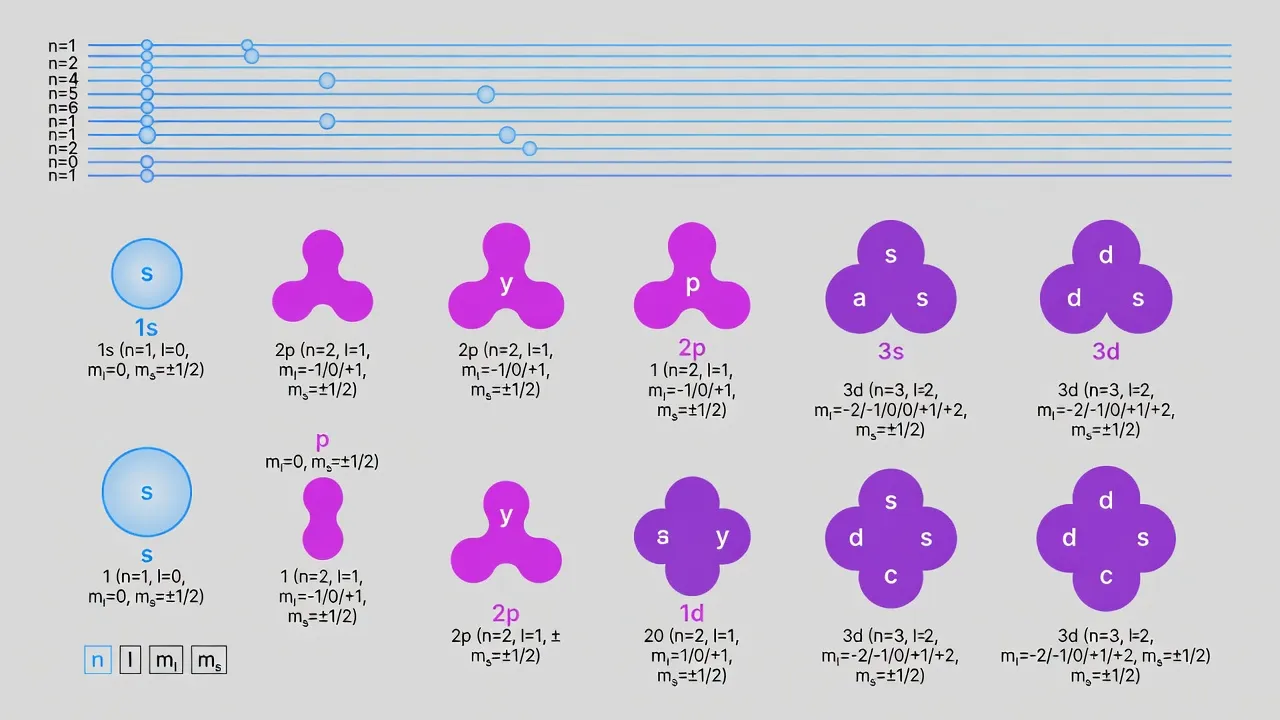
What is ACS's notation convention for quantum numbers (principal, azimuthal, magnetic, spin)?
The American Chemical Society (ACS) aligns directly with IUPAC standard notation, using $n$, $l$, $m_l$, and $m_s$ across its journals, textbooks, and standardized examinations. Authors submitting manuscripts to ACS journals must adhere to these conventions as set out in the ACS Guide to Scholarly Communication.
On ACS general chemistry exams, questions regularly evaluate whether students can identify allowed sets of quantum numbers. If you want to check your readiness before taking an exam, completing a timed chemistry quiz can help highlight gaps in your understanding of orbital boundaries.
The ACS convention strictly reinforces the allowed integer boundaries:
- Shell index ($n$): Integer value starting at 1.
- Angular subshell ($l$): Integer value capped at $n - 1$.
- Orbital orientation ($m_l$): Integer bounded between $-l$ and $+l$.
- Particle spin ($m_s$): Half-integer value limited to $\pm \frac{1}{2}$.
The four quantum numbers and their allowed values
The rules governing quantum numbers are strict. A single invalid digit invalidates the entire quantum state. As of August 2026, standard chemistry curricula use the following reference breakdown for allowed quantum values and physical caps.
| Quantum Number | IUPAC / ACS Symbol | Allowed Range / Values | Physical Meaning | Subshell / Shell Limit |
|---|---|---|---|---|
| Principal | $n$ | $1, 2, 3, 4, \dots$ | Main energy shell and size | Maximum $2n^2$ total electrons per shell |
| Azimuthal | $l$ | $0 \le l \le n - 1$ | Subshell shape ($0=s, 1=p, 2=d, 3=f$) | Maximum $2(2l + 1)$ electrons per subshell |
| Magnetic | $m_l$ | $-l \le m_l \le +l$ | Spatial orientation of orbital | $2l + 1$ individual orbitals per subshell |
| Spin | $m_s$ | $+\frac{1}{2}, -\frac{1}{2}$ | Intrinsic spin direction | Maximum 2 electrons per orbital |
How quantum numbers determine electron configuration and orbital shapes
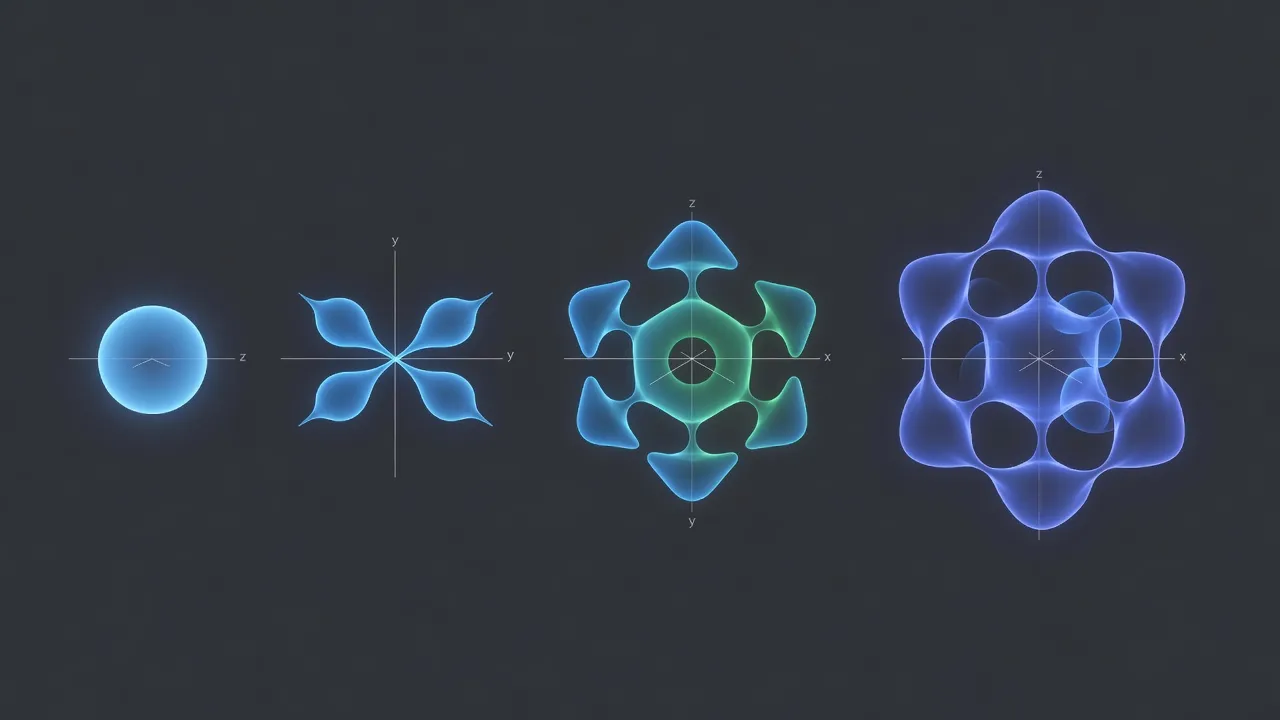
Quantum numbers form the mathematical backbone of electron configurations and the periodic table's layout. The primary shell number ($n$) determines which period (row) an element belongs to in its ground state, while the azimuthal number ($l$) splits those shells into distinct block types ($s, p, d, f$).
Detailed spectroscopy data managed by the NIST Atomic Spectra Database confirms that electron energy levels split predictably under magnetic fields—a direct result of variations in $m_l$ and $m_s$.
| Value of l | Subshell Letter | Orbital Shape | Number of Orbitals (2l + 1) |
|---|---|---|---|
| l = 0 | s | Spherical | 1 |
| l = 1 | p | Dumbbell-shaped | 3 |
| l = 2 | d | Clover-shaped | 5 |
| l = 3 | f | Complex multi-lobed | 7 |
When translating quantum values into standard electronic shorthand (like $1s^2 2s^2 2p^6$), keeping orbital letters aligned with numeric values is critical. If you ever mix up letter notations during study sessions, keeping a quick-reference chemistry conversion chart handy makes it easier to double-check subshell labels.
Solving quantum number problems with a digital study helper
Working out valid quantum sets for specific valence electrons requires applying multiple constraints at once. When homework problems get tricky, having an instant checking tool speeds up your learning process.
If you hit a roadblock on an assignment, you can take a photo of the problem using the ThinkAssist iOS app. ThinkAssist operates as an AI-powered homework solver that breaks down multi-step quantum mechanic equations into clear, digestible steps.
Why students use ThinkAssist for chemistry assignments:
- Snap a photo: Instantly capture printed or handwritten chemistry questions straight from your textbook or laptop.
- Automatic subject detection: The app recognizes chemistry equations, quantum state tables, and orbital notation automatically.
- Step-by-step explanations: Instead of just giving a final answer, it explains why an $l$ value is invalid or how $m_l$ was calculated.
- 24/7 tutor access: Get instant help late at night when study groups or teacher office hours aren't available.
Using a dedicated study helper ensures you learn the underlying principles rather than just copying down answers.
Common pitfalls when calculating allowed quantum states
The most common error in quantum chemistry problems is assigning an azimuthal value ($l$) equal to or greater than the principal quantum number ($n$). Because $l$ is strictly capped at $n - 1$, any quantum set where $l = n$ describes a physical state that cannot exist.
1. Letting $l$ equal $n$
- Invalid set: $(2, 2, 0, +\frac{1}{2})$
- Why it fails: If $n = 2$, the maximum allowed value for $l$ is $2 - 1 = 1$. A $2d$ orbital does not exist in nature.
- Corrected set: $(2, 1, 0, +\frac{1}{2})$ (represents a valid $2p$ orbital).
2. Allowing $m_l$ to exceed $l$
- Invalid set: $(3, 1, +2, -\frac{1}{2})$
- Why it fails: For $l = 1$ ($p$ subshell), $m_l$ can only equal $-1, 0,$ or $+1$. A value of $+2$ requires at least $l = 2$ ($d$ subshell).
- Corrected set: $(3, 1, +1, -\frac{1}{2})$ or change $l$ to $2$.
3. Using non-half-integer values for $m_s$
- Invalid set: $(1, 0, 0, 1)$
- Why it fails: Electron spin $m_s$ can only take values of $+\frac{1}{2}$ or $-\frac{1}{2}$. Whole integer values like $1$ or $0$ violate fundamental spin principles.
Frequently Asked Questions
Can the principal quantum number n be zero?
No, the principal quantum number $n$ cannot be zero. It must always be a positive integer ($n = 1, 2, 3, \dots$). A value of $n = 0$ would mean an orbital has zero spatial size and zero distance from the nucleus, which is physically impossible.
What does a spin quantum number of negative one-half mean?
A spin quantum number of $m_s = -\frac{1}{2}$ indicates that an electron's intrinsic magnetic spin vector points down relative to an external magnetic field. It distinguishes the second electron in a shared orbital from the first electron, which conventionally carries $m_s = +\frac{1}{2}$.
How many orbitals are in a d subshell?
There are 5 orbitals in a $d$ subshell. For a $d$ subshell, the azimuthal quantum number is $l = 2$, which gives five allowed magnetic quantum values ($m_l = -2, -1, 0, +1, +2$).
Why can't two electrons have the same four quantum numbers?
Two electrons cannot share the same four quantum numbers because of the Pauli Exclusion Principle. This fundamental principle of quantum mechanics states that two identical fermions cannot occupy the exact same quantum state simultaneously within a single system.
What is the value of l for a p orbital?
The value of $l$ for any $p$ orbital is always 1. The subshell letters $s, p, d,$ and $f$ correspond fixedly to $l = 0, 1, 2,$ and $3$ respectively.
Can m_l be larger than l?
No, $m_l$ cannot be larger than $l$. The magnetic quantum number $m_l$ is strictly constrained to the range $-l \le m_l \le +l$. For example, if $l = 1$, $m_l$ can only be $-1$, $0$, or $+1$.