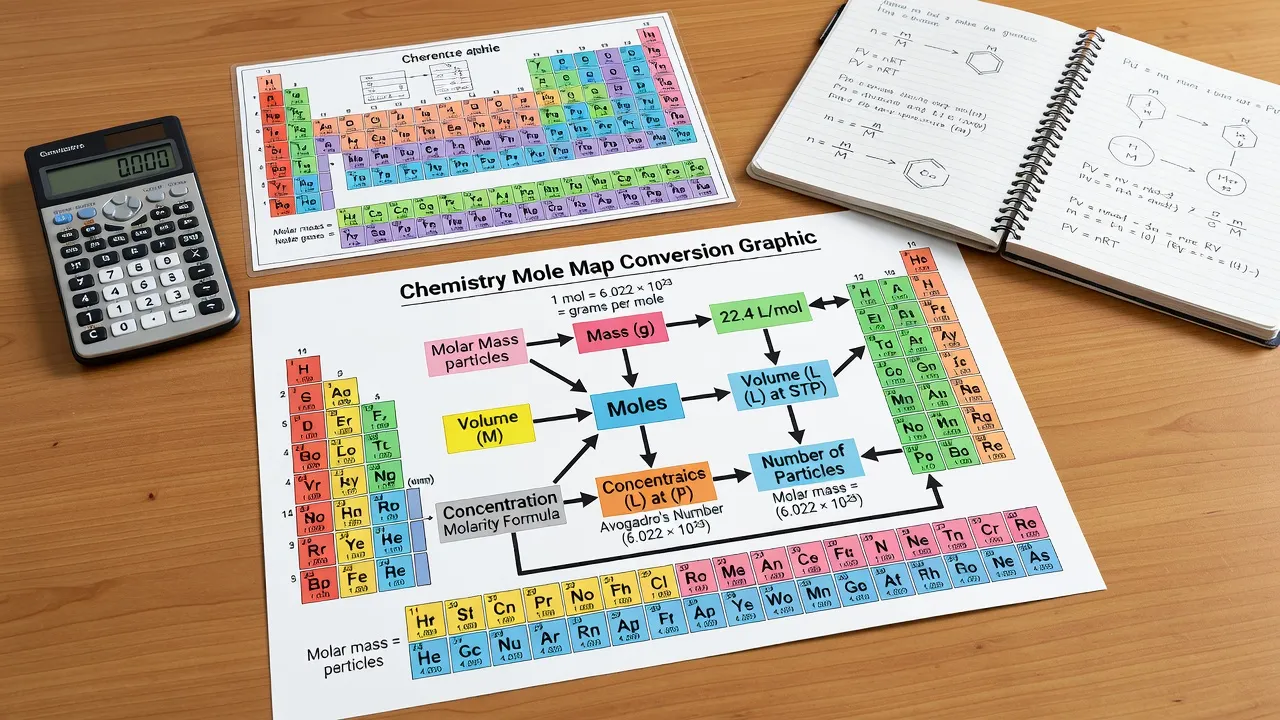
A chemistry conversion chart is a visual reference map that specifies the mathematical operations needed to convert between mass in grams, amount in moles, volume in liters, and total particle counts. It acts as a central hub for stoichiometry problems, placing the mole at the center to connect laboratory measurements with atomic-scale calculations.
When solving introductory or advanced chemistry assignments, trying to memorize every dimensional analysis equation quickly becomes overwhelming. Most chemistry courses rely on standard conversion pathways, but students often waste money hiring online tutors for basic stoichiometry help. Instead of paying $30 an hour for simple unit conversion guidance, understanding how to read a mole map gives you the exact blueprint needed for chemical calculations.
If you get stuck on a complex multi-step conversion during homework, using a tool like ThinkAssist allows you to snap a photo of your problem to see the step-by-step dimensional analysis worked out immediately.
How a Chemistry Conversion Chart Works
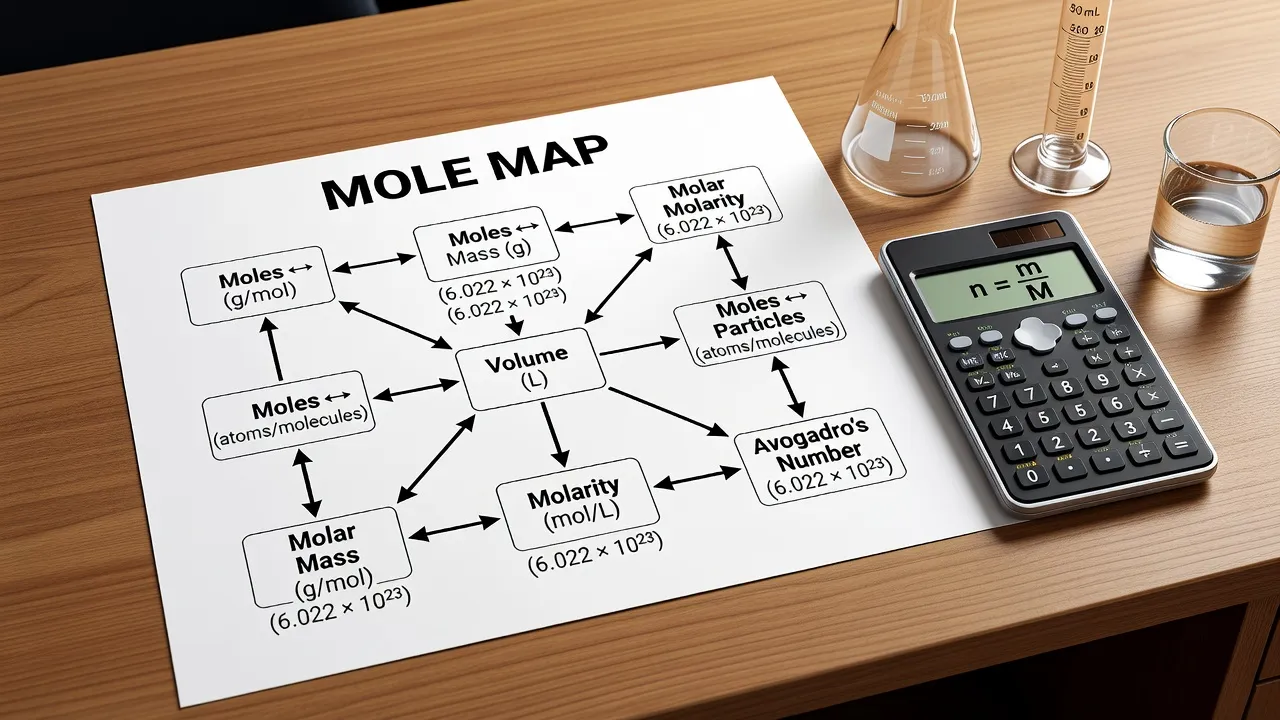
A chemistry conversion chart routes all stoichiometry calculations through the mole as the central bridging unit. Because balance scales measure mass in grams while chemical reactions occur based on particle ratios, the chart provides the mathematical bridge between what you can physically weigh and what reacts at the molecular level.
To navigate any chemistry conversion chart, you must identify your starting unit and your target unit. If you begin with mass in grams and need to find the number of atoms, you cannot jump directly across in a single step. You must convert grams to moles first using molar mass, and then convert moles to particles using Avogadro's number.
To convert between mass in grams and moles, divide or multiply by molar mass.
From moles, you can convert to any of the following by dividing or multiplying:
- Volume in liters
- Particles in atoms or molecules
- Energy in joules
Every arm of the conversion map uses a specific conversion factor. Multiplying or dividing by this factor depends entirely on whether you are moving toward the central mole or away from it toward a measured laboratory unit.
Core Stoichiometry Conversion Factors
The entire structure of a chemistry conversion chart rests on three fundamental constants and chemical properties. Memorizing these three operational rules allows you to solve almost any single-step or multi-step unit conversion in high school or college chemistry.
| Starting Unit | Target Unit | Conversion Factor | Mathematical Operation |
|---|---|---|---|
| Grams ($g$) | Moles ($mol$) | Molar Mass ($g/mol$) | Divide by Molar Mass |
| Moles ($mol$) | Grams ($g$) | Molar Mass ($g/mol$) | Multiply by Molar Mass |
| Moles ($mol$) | Gas Volume ($L$) at STP | $22.4,L/mol$ | Multiply by $22.4$ |
| Gas Volume ($L$) at STP | Moles ($mol$) | $22.4,L/mol$ | Divide by $22.4$ |
| Moles ($mol$) | Particles (atoms/molecules) | $6.022 \times 10^{23}$ | Multiply by Avogadro's Number |
| Particles | Moles ($mol$) | $6.022 \times 10^{23}$ | Divide by Avogadro's Number |
When working with an ai homework helper app, these conversion factors serve as the underlying logic engine. If your calculated answer differs from the app's output, check whether you multiplied by molar mass when you should have divided.
What does Chemistry LibreTexts say about the conversion factors table for moles, grams, and liters?
Chemistry LibreTexts defines the conversion factors table as a dimensional analysis roadmap anchored by three constants: molar mass, Avogadro's number, and standard molar volume. The platform emphasizes setting up conversion ratios so that unwanted units cancel out diagonally across fractions.
According to open-access material on Chemistry LibreTexts, converting between grams, moles, and liters of gas requires strict adherence to unit cancellation. LibreTexts stresses that the factor $22.4,L/mol$ applies exclusively to ideal gases at Standard Temperature and Pressure ($0^\circ\text{C}$ and $1\text{ atm}$). If a reaction takes place in aqueous solution rather than as a gas at STP, LibreTexts directs students to use molarity ($mol/L$) as the conversion factor instead of $22.4$.
LibreTexts also highlights that molar mass is never a fixed single constant on a chart. It must be recalculated for every individual element or chemical compound by summing the atomic weights from the periodic table.
What does IUPAC say about molar mass conversion from grams to moles?
IUPAC defines molar mass as the mass of a chemical substance divided by its amount of substance, strictly expressed in units of grams per mole ($g/mol$). The International Union of Pure and Applied Chemistry establishes the official definitions for chemical quantities and unit standardization worldwide.
In official standards published by IUPAC, the mole is defined as exactly $6.02214076 \times 10^{23}$ elementary entities. As of August 2026, IUPAC guidelines mandate that molar mass calculations use standard atomic weights derived from natural isotopic abundances. When converting grams to moles, IUPAC conventions require writing out explicit dimensional units rather than relying on informal shortcuts.
IUPAC technical notes caution against confusing molar mass with molecular weight. Molar mass carries physical dimensions ($g/mol$), whereas molecular weight is technically a dimensionless relative quantity, even though both share the same numerical value in stoichiometry.
Does NIST have a mole-to-gram/molar mass conversion chart?
NIST does not publish a standalone graphical conversion chart, but it provides the authoritative physical constants and atomic weight datasets used to build them. The National Institute of Standards and Technology sets the precision standards for fundamental physical values in the United States.
Data hosted on the NIST Physical Measurement Laboratory reference site gives researchers the precise values for Avogadro's constant and relative atomic masses. While NIST does not issue a simplified visual "mole map" handout for introductory chemistry students, textbook publishers and universities base their conversion tables directly on NIST fundamental constant determinations.
If you are building your own reference cheat sheet, relying on NIST values ensures your molar mass calculations match official standardized test keys like the AP Chemistry exam.
Does Khan Academy have a molar mass conversion chart for moles, grams, and liters?
Khan Academy uses step-by-step dimensional analysis flowcharts across its chemistry video modules rather than a single downloadable poster. The platform structures mole conversions through sequential fraction setups that emphasize tracking unit labels at every step.
In their chemistry curriculum, Khan Academy introduces conversion maps by treating units as algebraic variables. Their instructional diagrams place the mole in the middle box, showing branching arrows to mass, volume, and particle count. Khan Academy teaches students to set up conversion problems so that the starting unit sits in the denominator of the conversion factor, forcing it to cancel out algebraically.
Their materials highlight that molar volume ($22.4,L$) is restricted to gas phases, a common point of confusion for students trying to convert liquid volumes like water into moles.
Where can I find the Purdue/ChemCollective mole map conversion chart?
Purdue University and the ChemCollective digital repository provide free printable mole map conversion charts through their departmental chemistry portals. These educational resources are widely recognized across high school and university chemistry programs.
The chemistry education branch at Purdue University features detailed mole map graphics within its general chemistry lecture notes. These charts use color-coded arrows to distinguish between multiplying and dividing by molar mass or Avogadro's number. Similarly, the ChemCollective project—a virtual lab initiative backed by Carnegie Mellon University—offers interactive mole map tools that let students visually practice converting mass to particles.
These academic handouts are particularly helpful because they include clear visual indicators showing where chemical coefficients from balanced chemical equations enter the conversion process.
Is there a reliable university (.edu) PDF handout for a moles-grams-liters conversion chart?
Yes, numerous university chemistry departments host free, peer-reviewed mole map PDF handouts on their .edu domains. Institutions like Purdue, Texas A&M, and UC Berkeley offer downloadable reference guides designed for introductory stoichiometry.
To locate a high-quality PDF handout without paying for study platforms, search for terms like mole map conversion chart filetype:pdf site:.edu. These documents typically summarize all four major conversion branches on a single printable page:
- Mass to Moles: Uses molar mass from the periodic table ($g \rightarrow mol$).
- Particles to Moles: Uses Avogadro's number ($6.022 \times 10^{23} \rightarrow mol$).
- Gas Volume to Moles: Uses molar volume at STP ($22.4,L \rightarrow mol$).
- Solution Volume to Moles: Uses molarity ($M = mol/L$).
If you prefer using digital tools on your phone during late-night study sessions, downloading a scan question and get answer app like ThinkAssist gives you immediate access to step-by-step conversion solutions directly on iOS.
Common Pitfalls When Using Chemistry Conversion Charts
Even with a conversion chart in front of them, students regularly make repeatable mathematical errors. Understanding these pricing and execution traps saves both time and frustration during chemistry exams.
1. The STP Volume Trap
Assuming that $1\text{ mole} = 22.4\text{ liters}$ for every substance is one of the most frequent errors in introductory chemistry. The $22.4,L$ conversion factor is valid strictly for gases at Standard Temperature and Pressure. If your problem involves liquid water, solid sodium chloride, or a gas at non-standard conditions, using $22.4,L$ will yield an incorrect answer. For solutions, you must use molarity ($mol/L$), and for pure liquids or solids, you must use mass density ($g/mL$).
2. Confusing Atoms and Molecules
When converting moles to particles using Avogadro's number, pay close attention to the chemical formula. One mole of oxygen gas ($\text{O}_2$) contains $6.022 \times 10^{23}$ molecules of $\text{O}_2$, but it contains twice that number ($1.204 \times 10^{24}$) of oxygen atoms. Misreading whether a question asks for total molecules or individual atoms leads to off-by-factor errors.
3. Inverting Dimensional Fractions
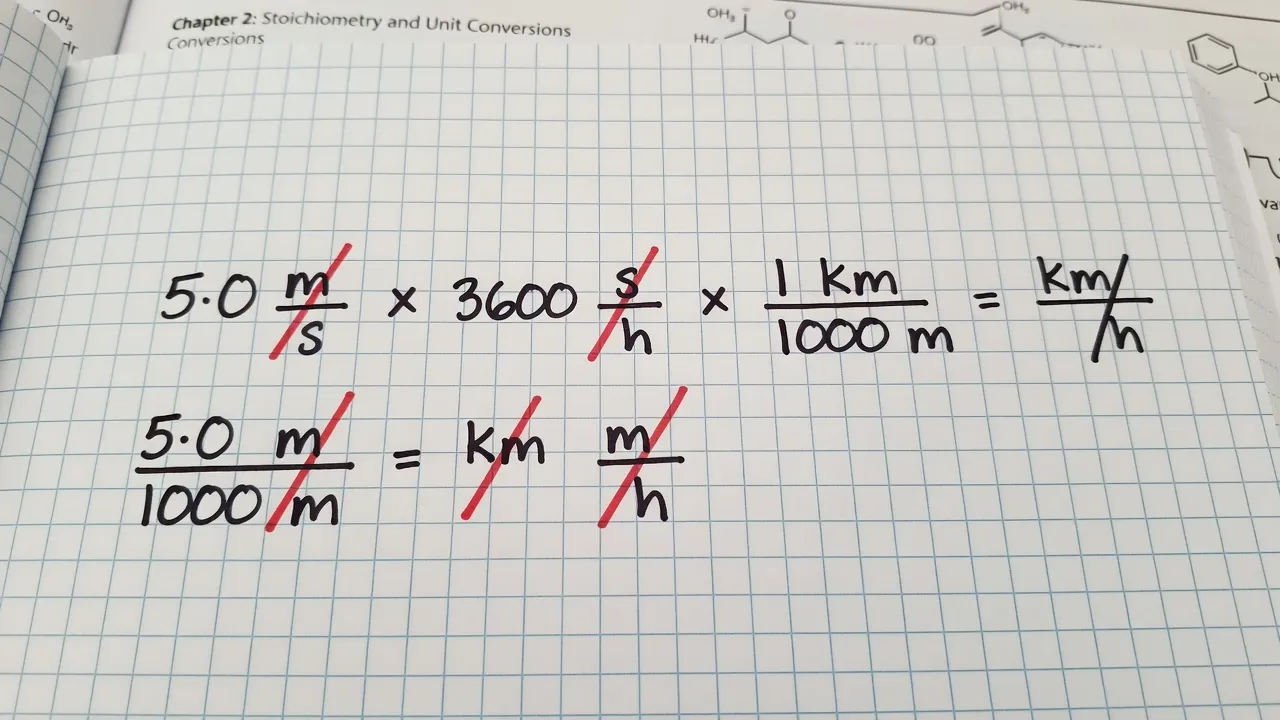
When setting up dimensional analysis, students often put the conversion factor upside down. For example, when converting $50\text{ grams}$ of carbon to moles, the correct calculation is:
$$50\text{ g C} \times \left( \frac{1\text{ mol C}}{12.01\text{ g C}} \right) = 4.16\text{ mol C}$$
If you mistakenly multiply 50 by 12.01 instead of dividing, your units become $\text{g}^2/\text{mol}$, which makes no physical sense. Always cross out matching units diagonally to ensure your target unit remains in the numerator.
Practice Conversion Problems using a Mole Map
To solidify your understanding, work through these three practical scenarios using the conversion factors detailed above.
Scenario A: Grams to Molecules
Problem: How many molecules of carbon dioxide ($\text{CO}_2$) are in a $22\text{-gram}$ sample?
- Find Molar Mass: $\text{C} = 12.01\text{ g/mol}$, $\text{O} = 16.00\text{ g/mol} \times 2 = 32.00\text{ g/mol}$. Total molar mass = $44.01\text{ g/mol}$.
- Convert Grams to Moles: Divide $22\text{ g}$ by $44.01\text{ g/mol} = 0.50\text{ moles}$.
- Convert Moles to Molecules: Multiply $0.50\text{ moles}$ by $6.022 \times 10^{23} = 3.011 \times 10^{23}\text{ molecules}$.
Scenario B: Liters of Gas to Mass
Problem: What is the mass in grams of $5.6\text{ liters}$ of chlorine gas ($\text{Cl}_2$) at STP?
- Convert Liters to Moles: Divide $5.6\text{ L}$ by $22.4\text{ L/mol} = 0.25\text{ moles}$.
- Find Molar Mass of $\text{Cl}_2$: $35.45\text{ g/mol} \times 2 = 70.90\text{ g/mol}$.
- Convert Moles to Grams: Multiply $0.25\text{ moles}$ by $70.90\text{ g/mol} = 17.725\text{ grams}$.
When practicing these setups, keeping a dedicated hw help app handy helps you verify whether your intermediate decimal steps match the standard textbook solutions.
How ThinkAssist Simplifies Chemistry Homework
While paper conversion charts show you the pathways, they cannot correct your arithmetic or check if you set up your fractions upside down. That is where digital study assistants provide real value.
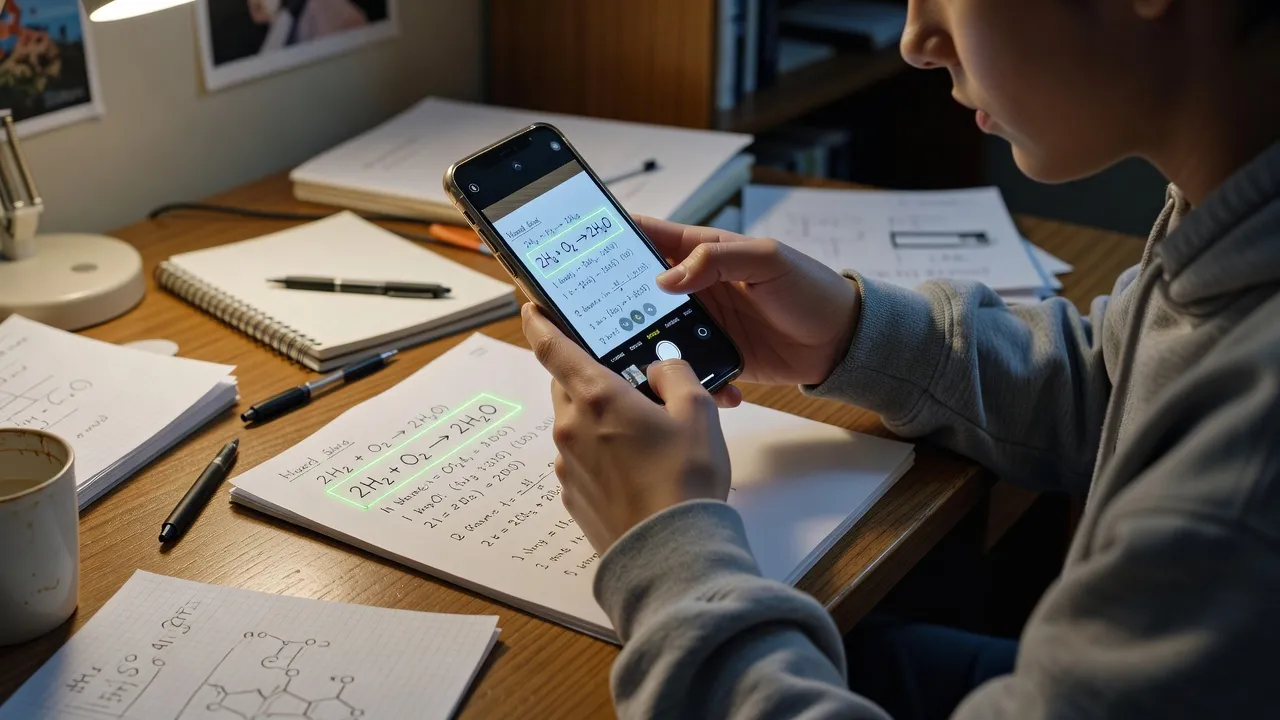
Rather than struggling through complex multi-step conversions alone, you can use the ThinkAssist iOS App to streamline your study process:
- Instant Photo Recognition: Point your iPhone camera at any hand-written or printed chemistry problem to extract the chemical formulas automatically.
- Step-by-Step Breakdown: See every step of the dimensional analysis written out, including explicit unit cancellations and molar mass calculations.
- 24/7 AI Chemistry Tutor: Ask follow-up questions about why a specific conversion factor was used if you get stuck mid-problem.
- Exam Preparation Storage: Save tricky stoichiometry problems to your history feed to review before midterm and final exams.
Whether you are double-checking gas volume conversions or verifying Avogadro calculations, combining a physical chemistry conversion chart with modern AI scanning tools gives you the ideal setup to master stoichiometry.
Frequently Asked Questions
What is a mole map in chemistry?
A mole map is a visual chart that displays the conversion pathways between mass in grams, amount in moles, gas volume in liters, and particle counts like atoms or molecules.
What is the standard molar volume of a gas at STP?
The standard molar volume of any ideal gas at Standard Temperature and Pressure (0 degrees Celsius and 1 atmosphere) is 22.4 liters per mole.
How do you convert grams to moles using a conversion chart?
To convert grams to moles, locate the mass section of the chart and follow the arrow to moles by dividing the sample mass in grams by the compound's molar mass in grams per mole.
What is Avogadro's number used for on a conversion chart?
Avogadro's number, equal to 6.022 times 10 to the 23rd power, is the conversion factor used to switch between amount of substance in moles and total number of individual particles, atoms, or molecules.
Why can't you convert grams directly to liters on a conversion chart?
Grams cannot be converted directly to liters because mass and gas volume represent different physical properties. You must convert grams to moles first using molar mass, and then convert moles to liters using molar volume.
Does molar mass change depending on the sample size?
No, molar mass is an intensive physical property expressed in grams per mole that remains constant for a specific chemical substance regardless of how large or small your sample size is.
Is $22.4,L/mol$ accurate for liquids and solids?
No, 22.4 liters per mole applies exclusively to gases at standard temperature and pressure. Liquids and solids require using their physical density or liquid molarity to convert between volume and mass or moles.
How do I find the molar mass of a molecule for my conversion setup?
To find the molar mass of a molecule, multiply the standard atomic weight of each element in the chemical formula by its subscript and sum all the values together using the periodic table.