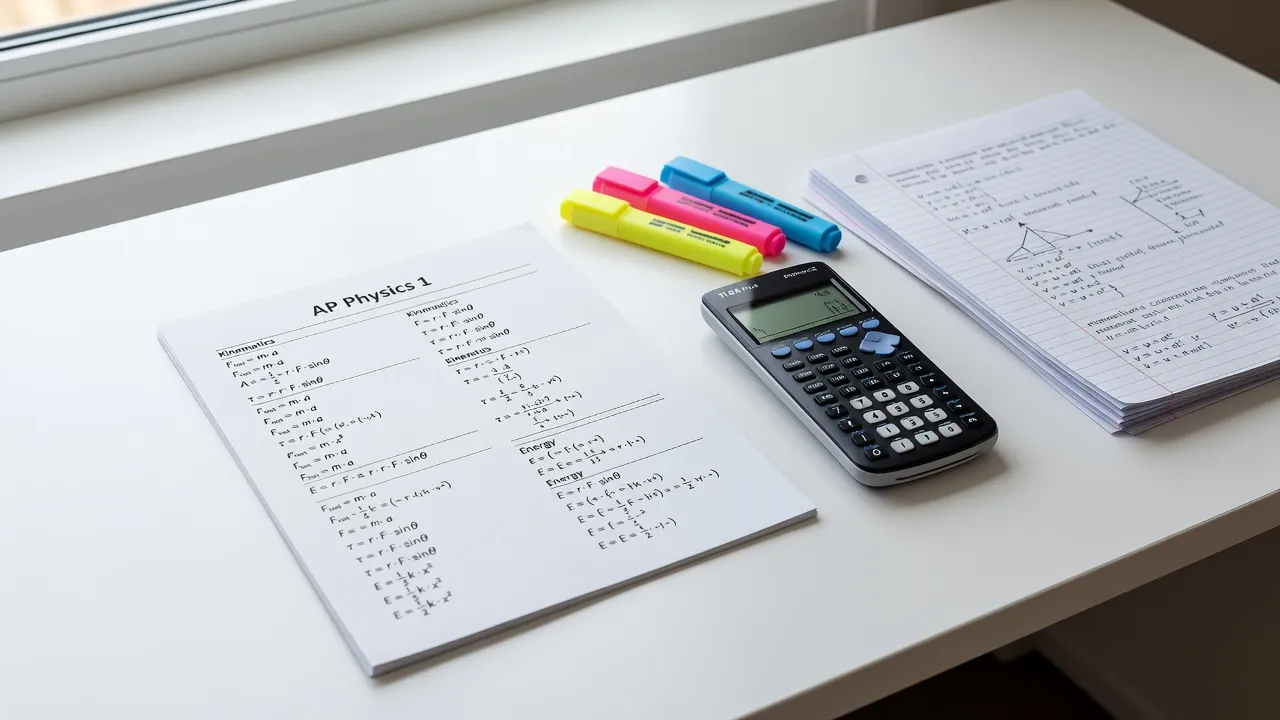
The AP Physics 1 reference sheet is an official document provided by the College Board during the exam containing physical constants, unit symbols, trigonometric values, and formulas for mechanics, electricity, waves, and fluid dynamics. The equation table reduces rote memorization, allowing students to focus on conceptual problem-solving and mathematical derivations during test day.
Older reference sheets from prior test cycles are now out of date. In the curriculum revision that took effect for the 2024-2025 school year and continues into the 2026-2027 academic year, College Board formally integrated fluid mechanics into the AP Physics 1 syllabus. As of October 2026, official test booklets and online testing platforms contain updated tables that include equations for density, hydrostatic pressure, buoyant force, and fluid flow.
Where can I find the official College Board AP Physics 1 equation sheet PDF?
You can download the official AP Physics 1 equation sheet PDF directly from the College Board's Course and Exam Description (CED) page on AP Central. The document is included in the appendix of the official syllabus PDF, which is publicly available to all students and educators.
To get your copy without navigating through full syllabus documents, follow these direct steps:
- Visit the official College Board AP Central portal.
- Navigate to the AP Physics 1: Algebra-Based course page.
- Click on The Exam tab or search for the "Course and Exam Description."
- Scroll to the back appendix to find the multi-page section titled "AP Physics 1 Tables and Equations."
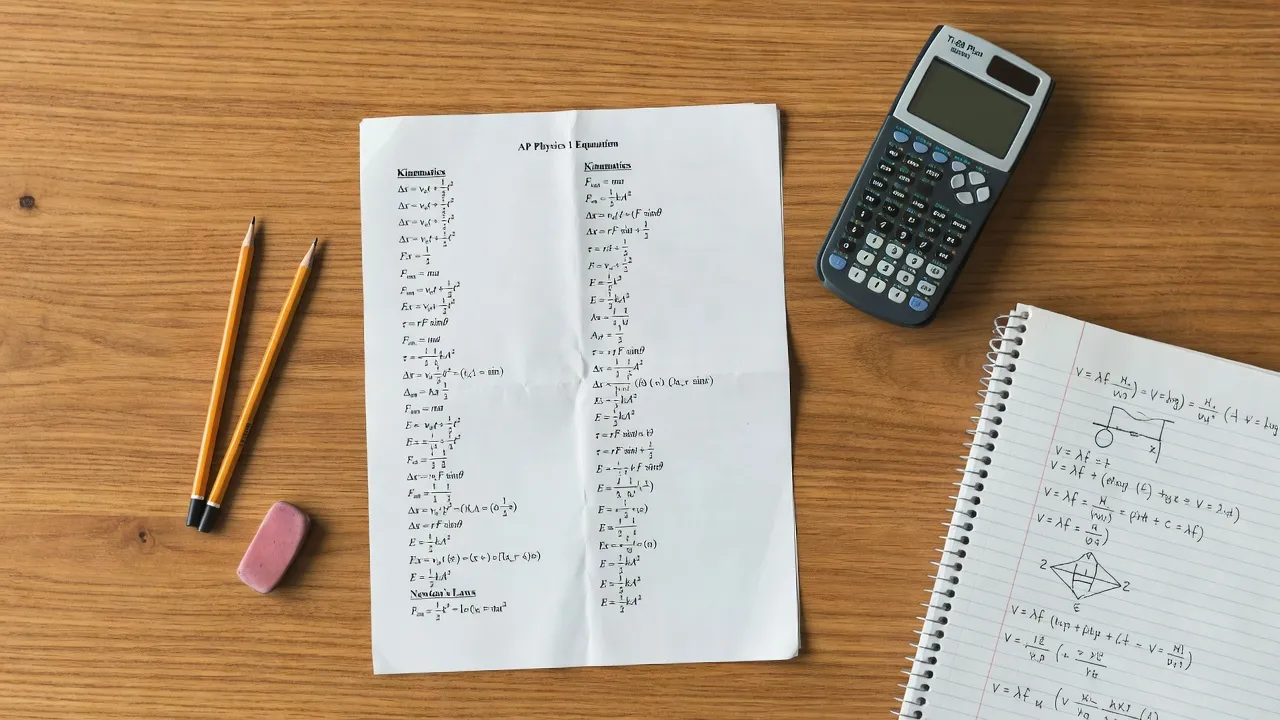
Is there a combined 'AP Physics 1 and 2' formula/equation sheet?
No, College Board does not issue a combined equation sheet for AP Physics 1 and AP Physics 2 on exam day. Each exam provides its own dedicated reference tables tailored specifically to the topics assessed in that course.
While both sheets share an identical first page detailing standard constants and unit prefixes, the formula pages differ significantly. The AP Physics 1 table isolates introductory mechanics, simple harmonic motion, rotational motion, rotational dynamics, simple circuits, and fluid dynamics. In contrast, the AP Physics 2 reference sheet expands into thermodynamics, electric field structures, magnetism, electromagnetic induction, optics, and modern quantum physics.
Using an outdated or combined third-party reference guide during your study sessions can backfire. Practicing with the exact single-course sheet you receive on test day prevents confusion when searching for equations under strict exam time limits.
How do I find the AP Physics 1 equation sheet on AP Classroom?
You can find the AP Physics 1 equation sheet inside AP Classroom under the 'Course Resources' section or within the toolbar of any online practice assessment. When your AP teacher assigns practice questions, the digital testing interface includes a reference pop-up button.
To access the file from your student dashboard:
- Log into your account at myap.collegeboard.org.
- Select your AP Physics 1 class section.
- Open the Course Resources tab on the left navigation menu.
- Download the reference sheet PDF stored under general exam reference materials.
If you are working through homework assignments outside of class and get stuck on how a formula applies, app tools can bridge the gap. Scanning a tricky equation with ThinkAssist gives you step-by-step explanations, breaking down how each variable on the reference table functions in specific problems.
What is included on the AP Physics 1 reference table?
The AP Physics 1 reference table is organized into distinct categories: physical constants, mathematical constants, unit symbols, prefixes, trigonometric values, mechanics, waves, basic electricity, and fluid mechanics. The document spans two to three pages depending on the formatting of your exam booklet.
The opening page outlines foundational physical constants that you will use throughout the test. According to values maintained by the National Institute of Standards and Technology (NIST), exact constant values must remain uniform across scientific calculations.
Here is what you will find listed on the primary reference page:
- Acceleration due to gravity near Earth's surface: $g = 9.8 \text{ m/s}^2$ (or $9.8 \text{ N/kg}$)
- Universal gravitational constant: $G = 6.67 \times 10^{-11} \text{ N}\cdot\text{m}^2/\text{kg}^2$
- Coulomb's law constant: $k = 8.99 \times 10^9 \text{ N}\cdot\text{m}^2/\text{C}^2$
- Speed of light in a vacuum: $c = 3.00 \times 10^8 \text{ m/s}$
- Electron charge magnitude: $e = 1.60 \times 10^{-19} \text{ C}$
| Prefix | Symbol | Factor |
|---|---|---|
| giga | G | 10^9 |
| mega | M | 10^6 |
| kilo | k | 10^3 |
| centi | c | 10^-2 |
| milli | m | 10^-3 |
| micro | μ | 10^-6 |
| nano | n | 10^-9 |
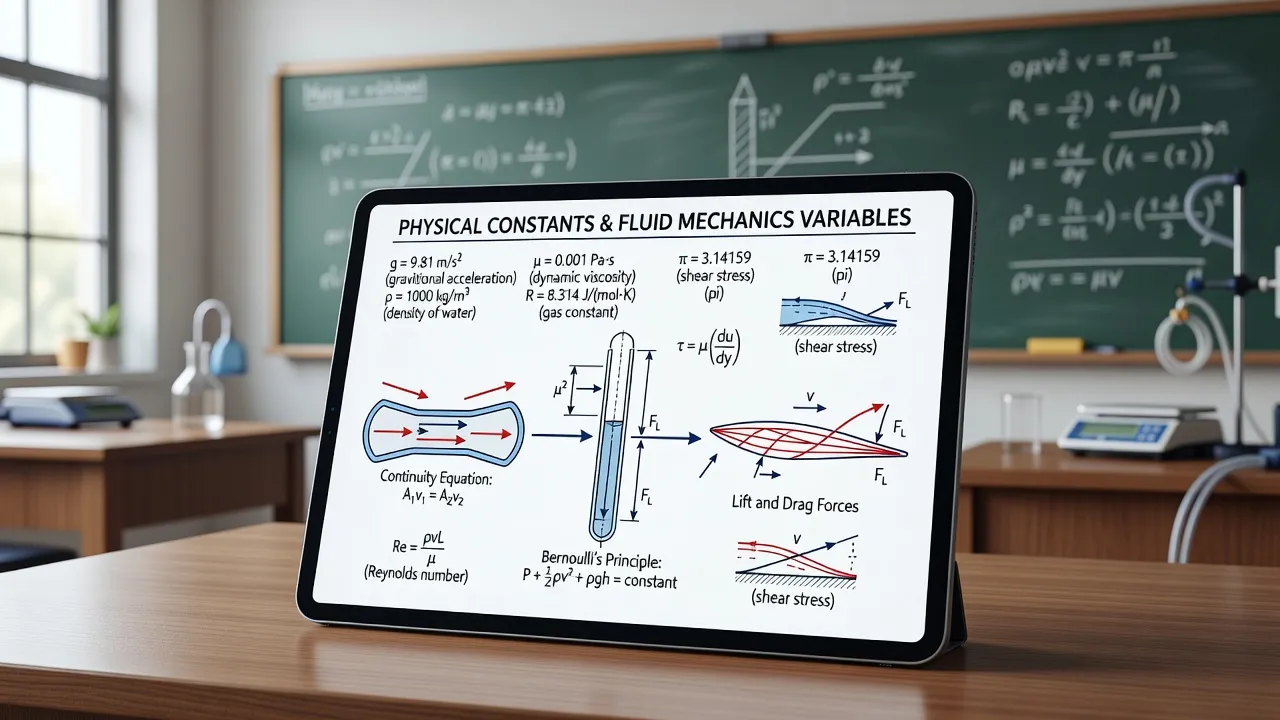
Breakdown of formulas by topic on the reference sheet
The formula pages group equations by physical domain so you can quickly locate expressions during both multiple-choice and free-response sections. Understanding how equations are grouped makes it far easier to navigate the sheet during high-pressure testing.
As of the current exam format, the sheet groups formulas into five primary domain blocks:
| Physics Domain | Key Included Formulas | Variables Defined | Common Student Mistake |
|---|---|---|---|
| Kinematics | $v_x = v_{x0} + a_x t$ $x = x_0 + v_{x0}t + \frac{1}{2}a_x t^2$ $v_x^2 = v_{x0}^2 + 2a_x(x - x_0)$ | $x$ = position $v$ = velocity $a$ = acceleration $t$ = time | Forgetting that direction matters for vector components like velocity and acceleration. |
| Forces & Dynamics | $\vec{a} = \frac{\sum\vec{F}}{m}$ | \vec{F}_{f} | \le \mu |
| Work, Energy & Power | $K = \frac{1}{2}m v^2$ $\Delta U_g = mg\Delta h$ $W = F d \cos\theta$ $P = \frac{\Delta E}{\Delta t}$ | $K$ = kinetic energy $U$ = potential energy $W$ = work $P$ = power | Using $\Delta U_g = mg\Delta h$ when the object moves far enough that gravity varies with distance. |
| Rotational Motion | $\theta = \theta_0 + \omega_0 t + \frac{1}{2}\alpha t^2$ $\omega = \omega_0 + \alpha t$ $\tau = r F \sin\theta$ $\alpha = \frac{\sum\tau}{I}$ | $\theta$ = angle $\omega$ = angular velocity $\alpha$ = angular acceleration $\tau$ = torque $I$ = rotational inertia | Confusing linear mass ($m$) with moment of inertia ($I$) in energy calculations. |
| Fluid Mechanics | $\rho = \frac{m}{V}$ $P = P_0 + \rho g d$ $F_b = \rho V g$ $A_1 v_1 = A_2 v_2$ | $\rho$ = fluid density $P$ = pressure $F_b$ = buoyant force $A$ = cross-sectional area | Confusing liquid density in buoyancy calculations with the submerged object's density. |
What equations are missing from the AP Physics 1 equation sheet?
The AP Physics 1 equation sheet deliberately omits derived formulas, specific geometry cases, and problem-specific algebra setups. College Board expects students to derive specialized equations from fundamental principles rather than memorizing every variation.
For instance, you will not find a formula for the range of a projectile on the sheet. You are expected to set up horizontal kinematics ($x = v_{x0}t$) and vertical kinematics ($y = v_{y0}t - \frac{1}{2}gt^2$) and solve for time manually.
Similarly, while the formula for centripetal acceleration ($a_c = \frac{v^2}{r}$) is provided, the net force equation for a satellite in orbit ($G\frac{m M}{r^2} = \frac{m v^2}{r}$) is absent. You must combine Newton's second law with the gravitational force equation yourself.
Understanding how to break down vector magnitudes is essential when working through these missing derivations. Reviewing guides on calculating magnitude physics can help clear up vector component math.
Common Derived Equations You Must Know How to Build:
- Range of a projectile on flat ground: R = (v^2 * sin(2θ)) / g
- Speed of a satellite in circular orbit: v = √(G M / r)
- Maximum static friction force: F_f,max = μ_s * m * g (on flat surfaces)
- Terminal velocity in a fluid: F_drag = F_gravity
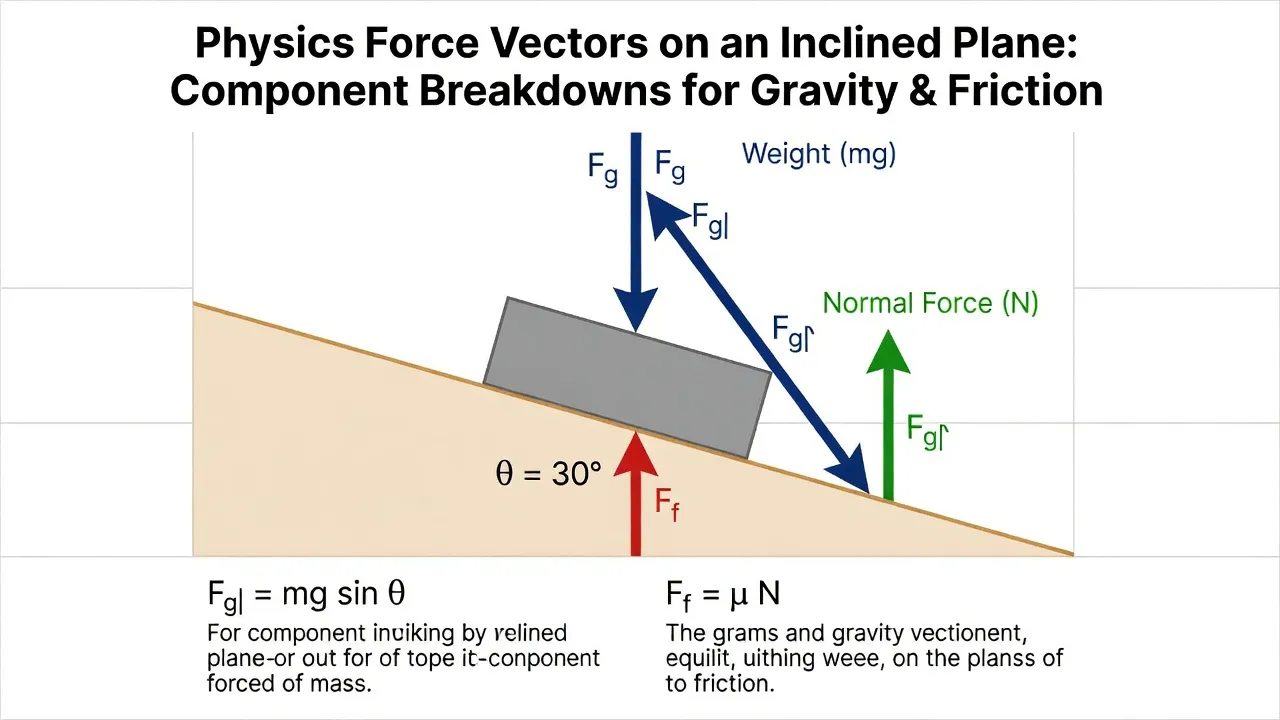
How to use the equation sheet to ace the AP Physics 1 exam
To use the equation sheet effectively on exam day, you must familiarize yourself with variable notations weeks before the test so you do not waste time searching for basic formulas. Many students assume that having a reference sheet means they do not need to study equations, which is a critical mistake.
The exam tests conceptual reasoning far more than mechanical calculation. If you spend three minutes flipping through pages to find a basic torque relationship, you will run out of time on the multiple-choice section.
Here are four practical strategies for mastering the equation sheet:
- Learn variable definitions cold: The sheet lists equations, but it does not define every symbol inline. Knowing that $I$ stands for moment of inertia in rotation but electric current in circuits saves critical seconds.
- Practice free-body diagrams alongside formulas: Formulas describe magnitude, but directional signs come from your setup. Master drawing a correct free body diagram physics before plugging numbers into force equations.
- Annotate your study sheet during homework: Keep a printed reference sheet next to you while solving practice sets. Highlight formulas you use frequently and note which ones require specific conditions (like constant acceleration).
- Prepare for free-response derivations: On the free-response section, AP graders look for explicit starting lines. Always state a fundamental equation directly from the sheet (like $\sum F = ma$) before substituting specific variables.
If you struggle with structuring your derivation steps on practice FRQs, checking an ap physics 1 frq guide can help you understand what graders look for.
How technology can help you master AP Physics 1 formulas
Using AI-powered homework solvers helps you understand how reference sheet equations apply to complex, real-world physics problems. Studying equation sheets in isolation often leaves students unsure of which formula fits a given scenario.
Many students feel overwhelmed when transitioning from basic algebra to multi-step physics problems, often feeling like physics is hard when they get stuck on homework derivations.
This is where digital tools make a significant difference in daily practice:
- Instant step-by-step guidance: When you encounter a challenging problem involving rotational inertia or fluid pressure, taking a photo with the ThinkAssist iOS app instantly identifies the underlying physics principle and shows you how to apply the reference sheet step by step.
- Automatic problem detection: You do not need to figure out whether a question requires energy conservation or impulse momentum; automatic subject recognition identifies the relevant formula category for you.
- Saved exam preparation history: All your scanned problems and step-by-step solutions are automatically archived. This makes reviewing tricky derivations before midterms and AP exam week fast and organized.
Relying on step-by-step explanations during practice builds the muscle memory needed to select the right reference sheet equation quickly under test-day constraints.
Frequently Asked Questions
Are calculators allowed alongside the AP Physics 1 reference sheet?
Yes, a scientific or graphing calculator is allowed on all sections of the AP Physics 1 exam. You can use your calculator alongside the official equation sheet for both the multiple-choice and free-response sections.
Are geometry formulas provided on the AP Physics 1 formula table?
Yes, basic geometry formulas including the area of a rectangle, triangle, and circle, along with the volume of a rectangular solid, cylinder, and sphere, are listed on the reference sheet. Basic trigonometric functions (sine, cosine, tangent) are also included.
Do I get a fresh reference sheet during the actual AP exam?
Yes, a clean, unannotated printout of the official AP Physics 1 tables and equations is included inside your exam booklet on test day. If taking the digital AP exam, an interactive reference sheet pop-up is accessible directly within the software.
Did the AP Physics 1 reference sheet change for recent exam years?
Yes, starting in the 2024-2025 school year and continuing through 2026, fluid mechanics was added to the AP Physics 1 curriculum. The reference table now includes equations for density, pressure, buoyancy, continuity, and Bernoulli's equation.
Can I bring my own annotated equation sheet into the AP exam room?
No, you cannot bring your own notes or annotated equation sheets into the examination room. You must use the official, unannotated copy provided inside the exam booklet or testing application.
Why are some standard physics formulas missing from the AP Physics 1 table?
College Board intentionally leaves out derived formulas to test whether students understand core physical principles. You are expected to combine fundamental laws listed on the sheet to solve specific problem scenarios.