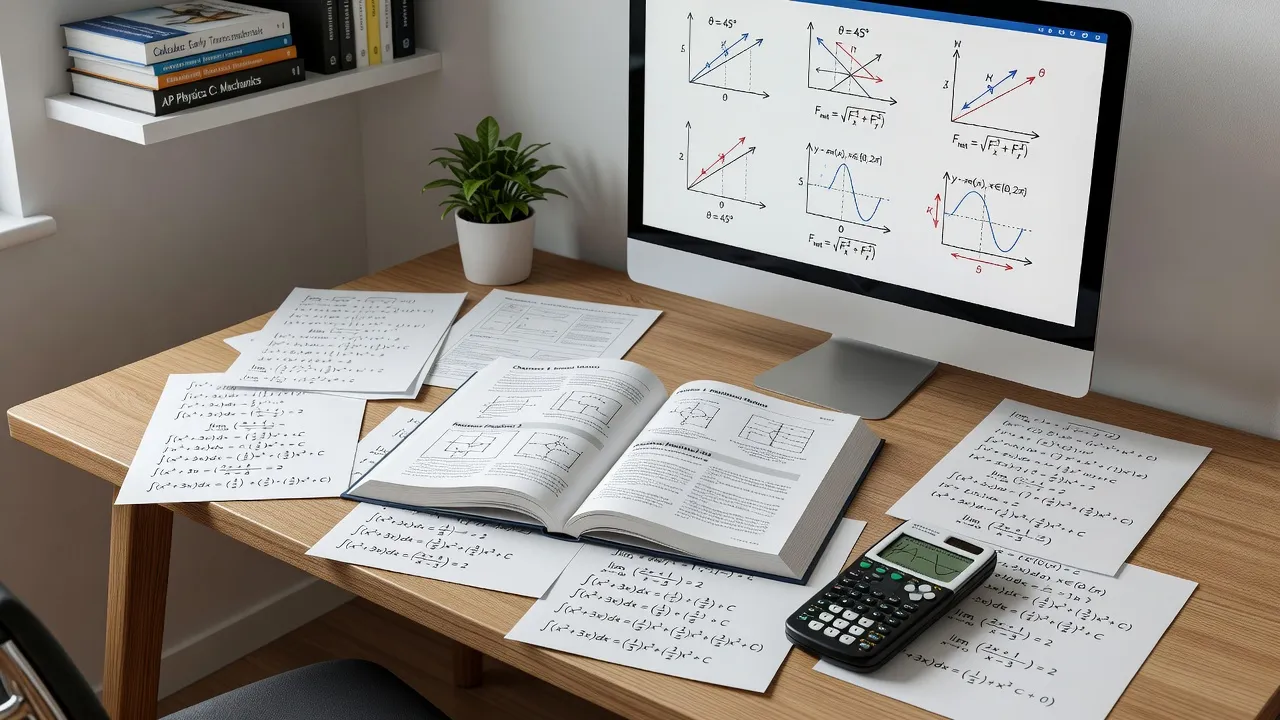
AP Physics C is a pair of calculus-based advanced placement courses—Mechanics and Electricity & Magnetism (E&M)—designed to mirror introductory college physics for physical science and engineering majors. Unlike algebra-based high school courses, Physics C requires students to set up and solve differential equations, apply vector calculus, and evaluate integrals across continuous charge distributions or variable force fields. As of September 2026, scoring a 4 or 5 on both exams grants calculus-based physics credit at hundreds of higher education institutions across North America.

What is AP Physics C and how does it work?
AP Physics C consists of two distinct, semester-long courses: AP Physics C: Mechanics and AP Physics C: Electricity and Magnetism. While many high schools teach them sequentially across a single academic year, the College Board AP Central portal treats them as separate exams with independent scores.
The biggest pitfall for students entering Physics C is assuming that strong algebra skills are enough to coast through the course. Relying strictly on high school algebra intuition usually results in lost points on free-response questions (FRQs) where partial credit depends on setting up proper calculus integrals.
- AP Physics C: Mechanics covers kinematics, Newton’s laws of motion, work, energy, power, linear momentum, rotational dynamics, oscillations, and gravitation.
- AP Physics C: Electricity & Magnetism covers electrostatics, conductors, capacitors, dielectrics, electric circuits, magnetic fields, and electromagnetism (including Maxwell’s equations in integral form).
Each exam lasts 1 hour and 30 minutes, featuring a multiple-choice section and a free-response section where derivation of formulas counts heavily toward your raw score.
What are the best AP Physics C review books for 2026?
The best AP Physics C review books for 2026 are Barron's AP Physics C for rigorous calculus practice, The Princeton Review for clear concept refreshers, and Sterling Test Prep for targeted practice drills. Selecting the wrong prep book is a costly mistake; buying an overly simplified guide can leave you completely unprepared for the complex multi-step calculus derivations on test day.
The table below outlines how the leading review resources and study tools compare as of late 2026:
| Resource / Tool | Best Suited For | Key Format | Price / Access |
|---|---|---|---|
| Barron's AP Physics C | Students aiming for a top score of 5 who need tough calculus-based problems | Physical book & online practice tests | ~$25 - $30 |
| ThinkAssist | Students who want step-by-step AI breakdowns of camera-scanned calculus and physics problems | iOS Mobile App | Free download (3-day free trial, then $6.99/week) |
| The Princeton Review | Students looking for thorough conceptual explanations and accessible walkthroughs | Physical book & digital strategy guides | ~$26 - $32 |
| 5 Steps to a 5 (McGraw Hill) | Students needing structured study schedules and step-by-step pacing | Physical book & mobile app add-on | ~$22 - $28 |
If you frequently get stuck deriving equations or working through rotational dynamics at home, instant homework assistance can bridge the gap between textbook theory and actual problem-solving. Downloading the ThinkAssist iOS App allows you to snap a photo of any tricky physics problem to receive step-by-step calculus explanations on demand.
Is the Barron's AP Physics C 2026 review book good?
Yes, Barron's AP Physics C is widely considered the gold standard review book for high-achieving students targeting a score of 5. Its primary strength lies in problem difficulty; the practice questions in Barron's are often slightly more challenging than the actual AP exam, which builds a strong safety margin for test takers.
However, the cost of relying solely on Barron's is potential frustration early in your review. If your core calculus or vector mechanics background is weak, Barron's explanations can feel dense and dry.
- Pros: Highly accurate calculus derivations, realistic FRQ formats, excellent coverage of Gauss's Law and rotational inertia integrals.
- Cons: Dense text layout, minimal hand-holding for fundamental calculus concepts.
Is the Princeton Review AP Physics C 2026 review book good?
Yes, The Princeton Review AP Physics C book is excellent for building baseline conceptual understanding and reviewing fundamental physics laws. It breaks down complex topics into digestible chapters, making it ideal if your high school physics teacher skipped key units or if you feel overwhelmed by textbook jargon.
The downside to Princeton Review is that its practice test questions tend to be slightly easier than real College Board FRQs. Students who rely exclusively on Princeton Review often report feeling caught off guard by the multi-variable calculus prompts on the actual exam.

What are the best online courses for AP Physics C in 2026?
The best online courses for AP Physics C in 2026 are AP Daily on College Board, Flipping Physics, and introductory college modules on edX. Relying on a single textbook is rarely enough for a subject as mathematically demanding as Physics C. Combining structured video instruction with active problem-solving yields the highest score outcomes.
- AP Daily (College Board): Free short-form video lectures accessible directly through AP Classroom. These videos cover every single learning objective in the official course framework.
- Flipping Physics: A popular online video series that uses humor, quantitative demonstrations, and clear visual breakdowns to explain Mechanics and E&M principles.
- edX (MIT & Georgetown Physics): University-level introductory calculus-based physics courses available to audit for free. They cover open content similar to the open-access OpenStax University Physics textbooks.
When video explanations leave gaps during late-night study sessions, using an AI-powered tutor like ThinkAssist helps clarify specific steps in a multi-part solution. Its automatic subject detection lets you scan everything from a complex resistance network to a calculus-based variable acceleration problem and get an immediate explanation.
Is Khan Academy good for AP Physics C?
Khan Academy is great for reviewing foundational AP Physics 1 and Calculus AB concepts, but it lacks a fully developed, dedicated AP Physics C course. While you can use Khan Academy to master derivatives, integrals, and basic rotational motion, it does not offer comprehensive coverage tailored specifically to the calculus-based FRQ formats used in AP Physics C: E&M.
If you choose to use Khan Academy for Physics C prep, use these specific tracks:
- Calculus AB / BC: Focus on differential equations, u-substitution, and definite integrals.
- AP Physics 1: Use it to review conceptual force interactions, work-energy theorem, and simple circuits—then elevate those concepts using calculus on your own.
What do Reddit r/APStudents recommend for AP Physics C review books and courses?
The r/APStudents community consistently recommends combining Barron's practice tests, Flipping Physics video lectures, and official past College Board FRQs. A major consensus on the r/APStudents subreddit is that doing official past exam FRQs under timed conditions is the single most effective way to score a 5.
Reddit users frequently point out three major traps that cost students high scores:
- Memorizing formulas instead of deriving them: The AP Physics C formula sheet leaves out specific derivations like the rotational inertia of a thin rod or the magnetic field of a solenoid.
- Neglecting calculus setup points: Scoring rubrics award points for correct integral limits and differential setups, even if your final arithmetic is wrong.
- Ignoring time management on E&M: The E&M section is notoriously fast-paced, leaving little time to re-read long prompts.
Key Differences: AP Physics C vs. AP Physics 1 and 2
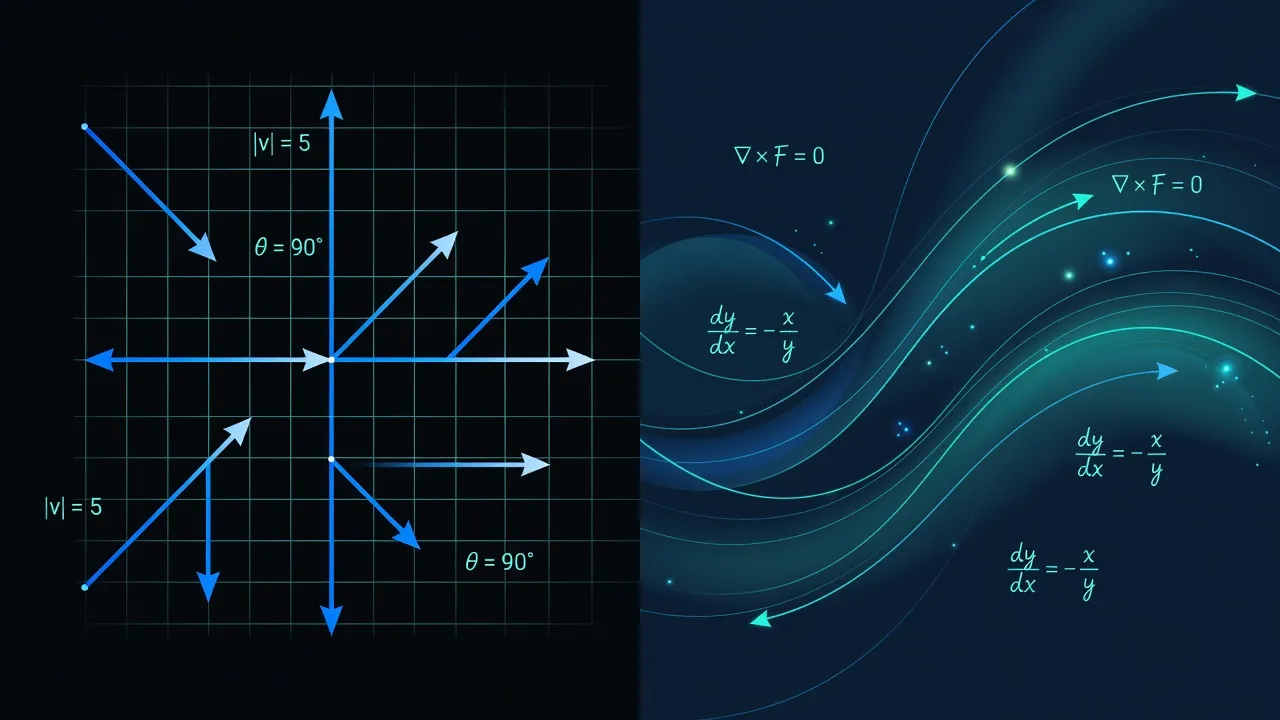
The core difference between AP Physics C and AP Physics 1/2 is the mathematical framework used to describe physical laws. AP Physics 1 and 2 rely on algebra and trigonometry to solve static or uniform scenarios. Physics C uses calculus to model dynamic systems where acceleration, force, electric fields, or magnetic flux change continuously over time or space.
Calculus vs. Algebra Applications
In AP Physics 1, acceleration is almost always constant, allowing you to use kinematic formulas. In AP Physics C, acceleration is frequently a function of time, position, or velocity—requiring integration to find velocity and position.
For instance, finding the period of an oscillating spring in Physics 1 involves applying the standard simple harmonic motion equation. In Physics C, you must set up the second-order differential equation for force balance and solve for the angular frequency directly.
Depth of Topics Covered
AP Physics C covers fewer distinct topics than AP Physics 1 and 2 combined, but it investigates them at a significantly deeper level.
- In algebra-based physics, electric fields are studied around point charges.
- In Physics C: E&M, you apply Gauss's Law to derive the electric field for continuous volume charge densities across spheres, cylinders, and non-conducting planes.
Before enrolling in Physics C, mastering vector mechanics—specifically calculating the magnitude of physics vectors in three dimensions—is essential for handling magnetic force cross-products.
How to Prepare for the AP Physics C Free-Response Questions (FRQs)
To score high on AP Physics C FRQs, you must prioritize clear calculus setups, proper vector notation, and complete free-body diagrams over quick numerical answers. College Board graders use strict point rubrics that award most credit for procedural logic rather than the final calculated line.
Master Free-Body Diagrams (FBDs)
Every mechanics FRQ usually begins with a request to draw a free-body diagram. Missing a single vector or drawing a force vector that doesn't touch the boundary of the object can immediately cost you 2 to 3 easy points. Practice drawing clear diagrams before setting up force balance equations; if you need a quick refresher, check out our guide on drawing an accurate free body diagram for physics.
Show Full Differential Setups
When deriving an equation, never jump directly to the final memorized solution. Always start from a fundamental physics principle listed on the official equation sheet:
- Write the fundamental equation (e.g., $F = ma$ or $oint B \cdot dl = \mu_0 I$).
- Substitute explicit variables and differential terms (e.g., $m \frac{dv}{dt} = -kv$).
- Separate variables and set explicit limits on your integral signs.
- Evaluate the integral and solve for the target variable.
If you struggle with structuring your derivation steps, compare your written work against similar problems solved in our AP Physics 1 FRQ study guide to build a consistent layout strategy.
Why AP Physics C Matters for Engineering and STEM Majors
Taking AP Physics C in high school demonstrates to college admissions officers that you can handle rigorous, calculus-based engineering coursework. Most university engineering programs do not grant degree credit for algebra-based AP Physics 1 or 2, because upper-level engineering courses require calculus as a prerequisite.
Earning credit for Physics C allows you to skip introductory freshman lecture halls with hundreds of students and move straight into specialized sophomore engineering design courses.
Even if your target college requires all engineering majors to take physics on campus regardless of AP scores, mastering the material in high school ensures you won't get weeded out during your freshman year.
Frequently Asked Questions
Is AP Physics C hard?
AP Physics C is widely considered one of the hardest AP courses due to its combined requirement of university-level calculus and abstract physical reasoning. However, its exam pass curves are historically generous compared to algebra-based physics exams.
Can you take AP Physics C without taking AP Physics 1?
Yes, you can take AP Physics C without taking AP Physics 1 if you have a strong background in calculus and physics fundamentals. However, concurrent enrollment or prior completion of AP Calculus AB or BC is mandatory.
What is the difference between AP Physics C Mechanics and E&M?
Mechanics focuses on physical motion, forces, energy, rotational dynamics, and gravity. Electricity and Magnetism focuses on electric charges, fields, circuits, magnetic interactions, and Maxwell's equations.
Do I need Calculus BC for AP Physics C?
Calculus AB provides enough mathematical foundation for AP Physics C: Mechanics. For AP Physics C: E&M, having Calculus BC exposure helps with vector calculus, infinite series approximations, and continuous integration concepts.
Which AP Physics C exam is harder?
Most students find AP Physics C: Electricity & Magnetism harder than Mechanics because magnetic fields and flux integrations are highly abstract and harder to visualize than physical rotating masses.
What score do you need on AP Physics C to get college credit?
Most public universities grant calculus-based physics credit for a score of 4 or 5. Elite engineering schools may require a score of 5 or evaluate Mechanics and E&M separately.
Can I use a calculator on the AP Physics C exam?
Yes, scientific or graphing calculators are allowed on both the multiple-choice and free-response sections of the AP Physics C exams.