
For most students, the best physics solver is ThinkAssist for instant photo-based word problem breakdowns, Wolfram Alpha for complex symbolic calculations, or Symbolab for structured algebraic step-by-step solutions. Choosing the right tool comes down to whether your problem requires multi-step word problem comprehension, visual free-body diagram interpretation, or advanced calculus integration. As of October 2026, modern AI image recognition and multi-step reasoning models have made mobile physics solvers vastly superior to old-school rigid equation lookups.
Navigating introductory physics requires turning messy real-world scenarios into precise mathematical models. Whether you are dealing with projectile motion, rotational dynamics, or circuit analysis, different tools solve different parts of that pipeline. Below is a breakdown of how the top physics solver tools compare across speed, reasoning capabilities, and platform costs.
Comparison of top physics solver tools for 2026
| Physics Solver | Primary Focus | Step-by-Step Breakdown | Standout Manual Constraint Removed | Pricing (as of October 2026) |
|---|---|---|---|---|
| ThinkAssist | Photo scans & AI tutoring | High (Interactive explanation) | Eliminates manual formula searching for word problems | Free download (3-day free trial, then $6.99/week) |
| Wolfram Alpha | Symbolic computing & data | Extremely Detailed (Pro tier) | Eliminates manual multi-variable symbolic integration | Free basic / $9.99/month Pro |
| Symbolab | Equation solving & calculus | High (Algebra focus) | Eliminates tedious algebraic isolations in mechanics | Free basic / $6.99/month Pro |
| Photomath | Printed equation OCR | Moderate (Math emphasis) | Eliminates typing long mathematical formulas by hand | Free basic / $9.99/month Plus |
| Chegg Study | Textbook QA & expert answers | Detailed (Human & AI mix) | Eliminates getting blocked on specific textbook problem sets | $15.95/month |
| Microsoft Math | Basic algebra & arithmetic | Moderate | Eliminates subscription costs for simple numeric physics | 100% Free |
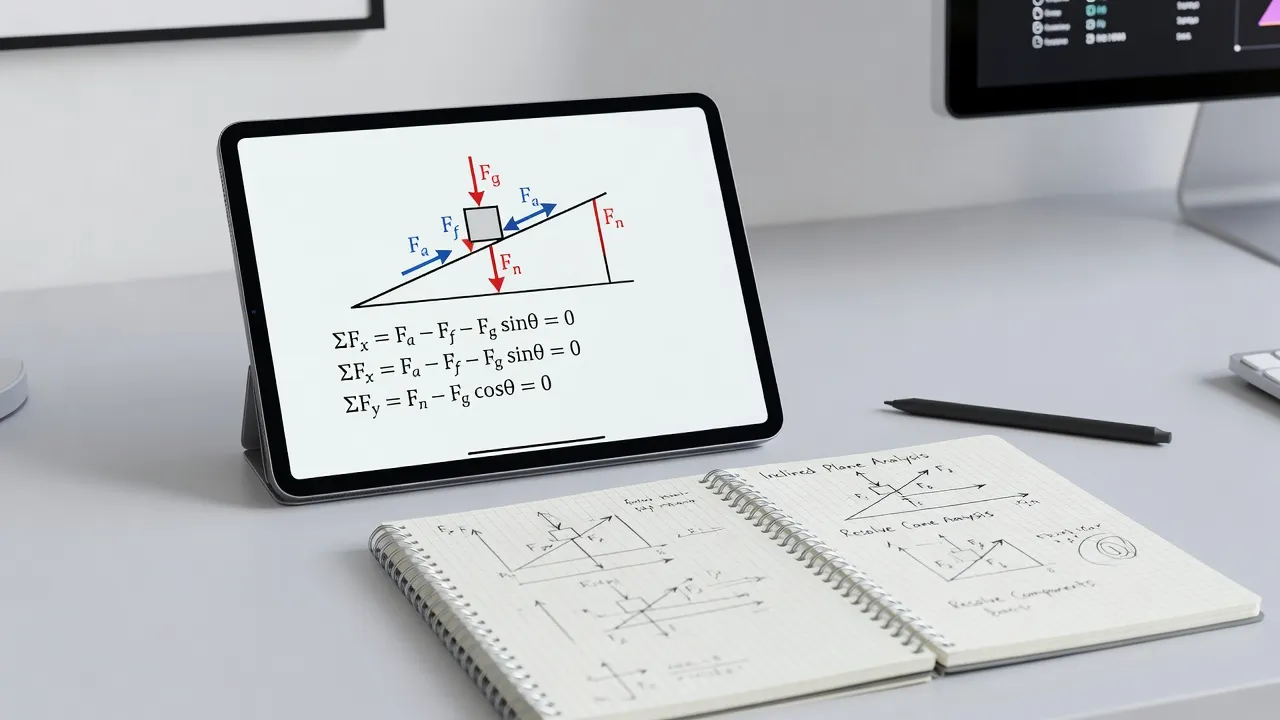
What makes ThinkAssist effective for mobile physics solving?
ThinkAssist works as an AI-powered homework solver that breaks down scanned physics word problems, free-body diagrams, and multi-step equations directly from your phone camera. Instead of requiring you to manually look up a basic physics equations sheet, the app uses automatic subject detection to parse given values, target variables, and relevant physical constants in seconds.
The main advantage of using an ai homework helper like ThinkAssist is how it bridges the gap between text comprehension and mathematical setup. Most standard calculators fail on word problems because they cannot read sentences. ThinkAssist parses the story, isolates the physical principles at play, and shows you line-by-line solutions so you actually understand the underlying logic.
For exam preparation, the app automatically saves past scanned answers and step-by-step breakdowns, letting you review tricky kinematics or electromagnetism problems right before test day. You can download the app for free with a 3-day free trial, after which access continues at $6.99/week on the ThinkAssist iOS App.
How well does Wolfram Alpha solve physics problems step by step, including Wolfram Alpha Pro features?
Wolfram Alpha solves complex physics problems across classical mechanics, thermodynamics, and quantum physics with unmatched computational power, but unlocking step-by-step solutions requires a Wolfram Alpha Pro subscription ($9.99/month in 2026).
Unlike standard search engines, Wolfram Alpha's computational knowledge engine computes answers directly from curated scientific data and algorithmic rules. According to Wikipedia's overview of physics calculations, mathematical physics relies heavily on exact unit management and differential equations—areas where Wolfram Alpha excels.
- Natural Language Input: You can type queries like "cannonball launched at 30 m/s at 45 degrees" and receive full trajectory profiles.
- Unit Tracking: The system automatically converts standard units (e.g., converting Joules to electron-volts) throughout every computation step.
- Step-by-Step Pro Workflows: Upgrading to Pro unlocks the step-by-step solver button, showing you the exact algebraic transformations and calculus derivations used.
The main limitation is input friction. Typing multi-variable vector calculus equations on a mobile keyboard can be slow compared to taking a rapid photo scan.
How well does Symbolab work as a physics solver with step-by-step solutions?
Symbolab serves as a strong physics solver for algebra-heavy and calculus-based mechanics, providing clear, line-by-line algebraic steps for solving physics variables.
Available via Symbolab's online platform, the system provides specialized physics calculators for topics like projectile motion, friction, momentum, and electric fields. It shines when you already have the working formula and need to isolate a tricky variable or integrate an expression over time.
- Automated Step Hints: Shows intermediate algebraic steps, factoring moves, and substitution choices.
- Dedicated Physics Templates: Offers pre-built input forms for common mechanics and thermodynamics formulas.
- Graphing Integration: Displays visual plots for position, velocity, and acceleration curves simultaneously.
While Symbolab is exceptional for pure math execution, its natural language processing can struggle with word problems that do not fit standard textbook templates.
How well does Photomath support physics problems with step-by-step solutions?
Photomath supports basic physics problems that rely on clear algebraic formulas, but it frequently struggles with word problems and visual physics diagrams.
According to Photomath's official support documentation, the platform's core optical character recognition (OCR) engine was built specifically for printed and handwritten mathematical expressions. If your physics homework consists of clean, isolated mathematical expressions—such as solving for time $t$ in $d = v_i t + \frac{1}{2}a t^2$—Photomath scans and steps through the algebra rapidly.
However, physics homework rarely consists of plain math equations. When presented with a paragraph describing inclined planes, pulley systems, or magnetic flux, Photomath cannot interpret the physical context. It is best treated as an algebraic support tool rather than a full physics tutor.
How are Chegg Study's physics solutions, step-by-step and in reviews?
Chegg Study provides comprehensive textbook solution sets and expert Q&A for physics courses, though user reviews often highlight its $15.95/month cost and variable response speeds for original homework questions.
Chegg's primary asset is its massive repository of step-by-step solutions for widely used college and high school textbooks (such as Halliday & Resnick's Fundamentals of Physics). If your instructor assigns specific problems directly from standard textbooks, Chegg almost always has verified answer paths.
- Textbook Match: High accuracy for standard numbered textbook exercises.
- Expert Q&A: Allows students to post custom physics questions for human tutors or specialized AI models to answer.
- User Feedback Realities: Reviews regularly point out that while textbook coverage is excellent, waiting for human expert answers on custom exam prep questions can take anywhere from 30 minutes to several hours.
How well does Microsoft Math Solver handle physics problems step by step?
Microsoft Math Solver handles introductory physics calculations and single-variable algebra for free, but it lacks the domain-specific physics intelligence required for advanced coursework.
Accessible via mobile app or Microsoft Math Solver's web engine, the tool is completely free with no paywalls. It allows drawing equations on screen, taking photos, or typing inputs.
For high school physical science or introductory linear kinematics, it breaks down linear systems and quadratic equations cleanly. However, because it lacks dedicated physics knowledge bases—such as built-in tables for specific heats, planetary masses, or material resistivity—you must manually feed every constant into the solver yourself.
How well does Cymath handle physics problems?
Cymath handles basic algebraic equation manipulations step by step, but it is purely a math engine with no support for physics word problems or physical units.
Cymath is useful when you have already reduced a physics problem down to an algebraic expression and need help factoring or differentiating. For example, if you need to solve for an unknown variable in a kinetic energy or gravitational potential equation, Cymath will show you the basic balance operations step by step.
Unfortunately, Cymath does not recognize physical units like meters per second ($m/s$), Newtons ($N$), or Joules ($J$). Inputting units will usually generate an syntax error, forcing you to strip out the physical context before solving.

What features should you look for in a physics solver app?
The best physics solver apps combine high-accuracy camera scanning, contextual natural language processing, unit management, and clear step-by-step explanations.
When selecting a tool for your coursework, evaluate these critical factors before paying for a subscription:
- OCR Capabilities for Word Problems: Physics homework is rarely written in pure math notation. Your solver must be able to read entire sentences and extract relevant physical variables automatically.
- Diagram Recognition: Advanced mechanics questions often depend on free-body diagrams, circuit schematics, or ray diagrams. Tools like ThinkAssist lead in interpreting visual inputs.
- Unit Consistency Checks: A good physics solver alerts you if you accidentally mix centimeters and meters or fail to convert minutes to seconds.
- Step-by-Step Transparency: Getting a single final answer number is useless for test preparation. Look for apps that show you why a specific equation was selected.
If you are studying for standardized exams, review your course's equation requirements—such as an ap physics 1 reference sheet—to ensure your solver's solution steps match the methods approved by your instructor.
How do physics solvers handle word problems vs raw equations?
Modern AI physics solvers handle word problems by using large language models to identify given quantities and unknown targets, whereas traditional math solvers only manipulate pre-formatted mathematical symbols.
Solving a physics word problem requires a multi-stage cognitive pipeline:
- Information Extraction: Identifying implicit facts (e.g., recognizing that "starts from rest" means initial velocity $v_i = 0$).
- Principle Identification: Deciding whether the problem involves conservation of energy, momentum, or Newton's second law.
- Equation Selection: Matching the extracted parameters to the correct physics formula.
- Mathematical Execution: Solvers perform the algebraic isolating, arithmetic, and unit tracking.
Standard calculators like Photomath or Cymath only execute Step 4. Next-generation AI platforms handle Steps 1 through 3 automatically, drastically reducing the manual setup time for students struggling with conceptual physics.
Is using an AI physics solver considered cheating?
Using an AI physics solver is not cheating if you use it as a step-by-step learning guide to understand problem-solving methodologies rather than simply copying final answers.
Academic integrity policies vary across schools, but most physics educators encourage using solvers as digital tutors during self-study. To use these tools ethically:
- Work the problem first: Attempt the setup on paper before taking a scan.
- Study the intermediate steps: If your calculated answer differs from the solver's result, check where your algebraic path diverged.
- Verify unit handling: Use the solver to double-check that your dimensional analysis and unit cancellations were executed correctly.
Relying on a solver to generate work you do not understand will leave you unprepared for closed-book classroom exams where digital assistance is banned.
Frequently Asked Questions
What is the best free physics solver available online?
Microsoft Math Solver and the basic tier of Wolfram Alpha offer the strongest free physics and math solving tools, though advanced step-by-step explanations usually require a subscription or trial.
Can Photomath solve physics word problems?
Photomath cannot parse complex physics word problems reliably because its engine is designed for direct mathematical notation rather than reading natural language context.
How does Wolfram Alpha compare to photo-scanning physics apps?
Wolfram Alpha is significantly more powerful for advanced calculus-based computational physics, but photo-scanning apps like ThinkAssist are faster and easier to use for high school and college word problems on mobile devices.
Can an AI physics solver interpret handwritten force diagrams?
Modern AI-powered solvers with advanced computer vision can analyze clean handwritten free-body diagrams, though drawing clear labels and vector arrows improves scanning accuracy.
Are physics solver apps accurate for college-level mechanics?
Yes, most modern solvers handle introductory college-level classical mechanics, fluids, and thermodynamics accurately, provided the problem input is clear and well-formatted.
What is the difference between a math solver and a dedicated physics solver?
A math solver purely manipulates numerical and algebraic expressions, while a physics solver tracks physical units, interprets conceptual word problems, and applies real-world physical laws.
How much do top physics solver apps cost per month?
Prices range from completely free options like Microsoft Math Solver to weekly or monthly subscriptions such as ThinkAssist ($6.99/week), Wolfram Alpha Pro ($9.99/month), and Chegg Study ($15.95/month).