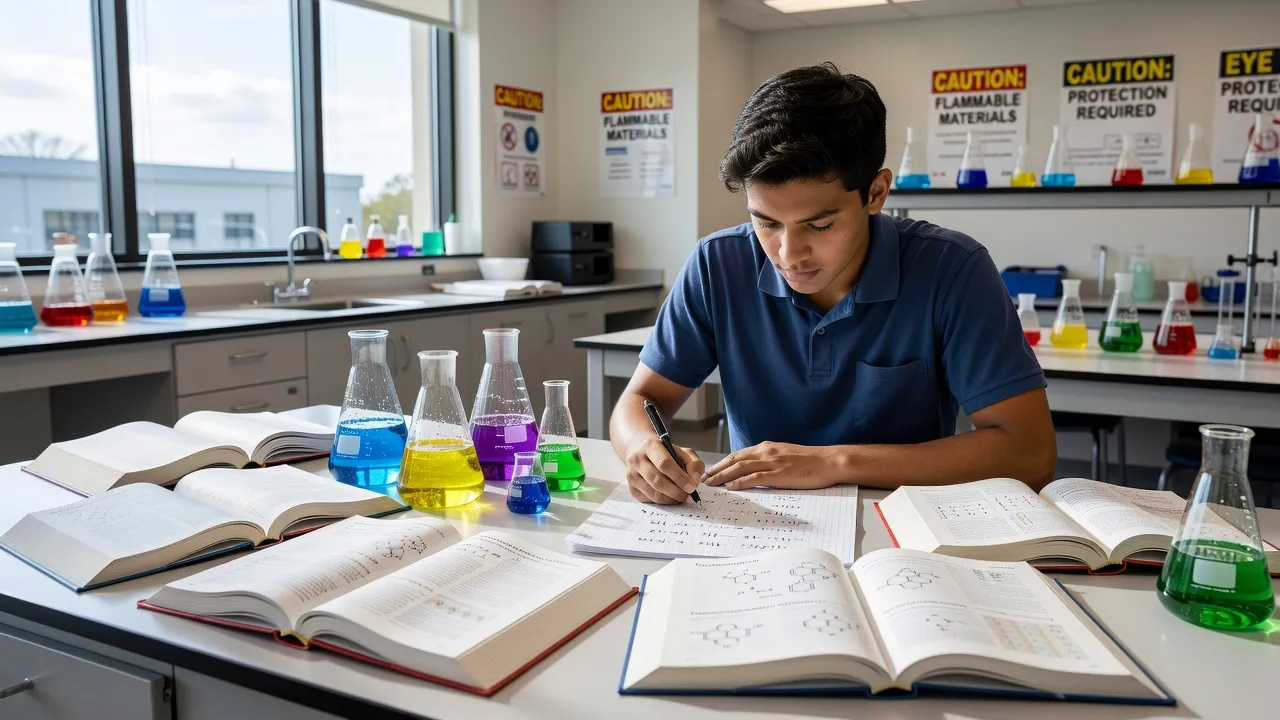
The Chemistry Olympiad is a multi-tier competitive examination series that tests advanced high school chemistry, culminating annually in the International Chemistry Olympiad (IChO). In the United States, the program is administered by the American Chemical Society (ACS), taking top-scoring high schoolers through local tests, national exams, and an intensive study camp to select the final four-student national team.
What is the Chemistry Olympiad and how does the competition structure work?
The Chemistry Olympiad operates as a staged elimination tournament designed to identify the top high school chemistry talent in each participating nation. Over 80 countries compete in the international program, with each country running its own multi-round qualifying exams.
In the United States, the selection funnel moves through four distinct tiers:
- Local Section Exam: Held every March, this 60-question multiple-choice test is open to all high school students. Local ACS sections set school quotas (usually capping nominees at two per school) to decide who advances.
- National Exam: Administered in April, this three-part exam includes 60 multiple-choice questions, eight written free-response problem sets, and two hands-on laboratory practical experiments.
- Study Camp: Held in June at the U.S. Air Force Academy, the top 20 scorers from the National Exam attend a two-week intensive training camp featuring advanced university-level lectures and lab practicals.
- International Chemistry Olympiad (IChO): Held every July, the top four students selected from the study camp represent the United States against 80+ country delegations in five-hour theoretical and laboratory examinations.
Mastering problem-solving skills across physical, analytical, organic, and inorganic chemistry requires hundreds of hours of practice. When working through complex multistep calculations late at night, having an instant tool like the ThinkAssist AI homework solver app helps students break down difficult homework assignments and past exam questions step-by-step.
What are the eligibility limits and requirements for USNCO and IChO?
To participate in the U.S. National Chemistry Olympiad (USNCO) and IChO, students must meet strict age, citizenship, and high school enrollment limits. Meeting the academic threshold is not enough; several institutional rules disqualify candidates every year before the first paper is graded.
Key administrative and eligibility constraints include:
- Age and Grade Limit: Candidates must be under 20 years old on July 1 of the competition year and enrolled in a high school (or home school) program. College students are strictly ineligible.
- Citizenship and Residency: To write the National Exam or represent the U.S. team, candidates must be U.S. citizens or lawful permanent residents (green card holders). Non-citizens can sit for the Local Section Exam for recognition but cannot advance.
- Per-School Nominee Caps: Local ACS sections enforce strict limits on how many students from a single school can advance to the National Exam (typically no more than two students per school, regardless of raw scores).
- Two-Year Camp Limit: A student can attend the U.S. National Study Camp a maximum of two times in their high school career.
- IChO Participation Cap: A competitor can attend the international IChO event no more than twice as a high school representative.
If you attend a competitive high school where dozens of students score near-perfect marks on the local exam, the per-school cap is often the hardest boundary to pass.
What books do International Chemistry Olympiad (IChO) medalists recommend?
International Chemistry Olympiad (IChO) medalists consistently recommend advanced university-level textbooks covering general, organic, physical, and inorganic chemistry rather than standard high school prep guides. Standard AP Chemistry resources cover less than 30% of the material tested on the National and International exams.

The standard reading list curated by former IChO gold medalists includes:
- General Chemistry: Chemical Principles: The Quest for Insight by Peter Atkins and Loretta Jones. This textbook provides the foundation in thermodynamics, chemical equilibria, and quantum theory required for the National exam.
- Organic Chemistry: Organic Chemistry by David Klein (for fundamentals) followed by Organic Chemistry by Jonathan Clayden, Nick Greeves, and Stuart Warren. Clayden is widely considered the gold standard for IChO organic mechanisms and synthesis problems.
- Inorganic Chemistry: Inorganic Chemistry by Gary L. Miessler, Paul J. Fischer, and Donald A. Tarr. Medalists use this book to master point groups, crystal field theory, and organometallic reaction pathways.
- Physical Chemistry: Physical Chemistry by Peter Atkins and Julio de Paula. Essential for advanced kinetics, electrochemistry, and phase equilibria calculations tested at the study camp level.
- Practical & Analytical: Vogel's Quantitative Chemical Analysis. Used by students to learn volumetric, gravimetric, and spectrophotometric techniques for the lab practical portion.
How do different Chemistry Olympiad preparation resources compare?
Choosing the right study resources depends on your current chemistry foundation, available budget, and whether you are targeting the Local, National, or International round. Textbooks build core theoretical concepts, past papers build exam technique, and direct tutoring platforms assist with immediate problem-solving bottlenecks.
As of September 2026, the primary study options for candidates stack up as follows:
| Resource Type | Best Suited For | Key Strengths | Main Limitations / Constraints |
|---|---|---|---|
| Standard Textbooks (e.g., Clayden, Atkins) | Comprehensive theoretical preparation for National & IChO rounds. | In-depth coverage of advanced mechanisms, orbital theory, and thermodynamics. | High cost ($150-$250 per book); no immediate feedback on practice problem errors. |
| ThinkAssist AI App | Daily problem-solving practice and clearing step-by-step homework blocks. | Snap-a-photo AI problem solver, instant step-by-step explanations, automatic subject detection, 24/7 availability. | Free to download with a 3-day trial ($6.99/week after); best used alongside official past papers rather than replacing full textbooks. |
| Official ACS Past Papers | Exam-format practice for Local and National exams. | Direct exposure to real question structures, timing constraints, and official answer keys. | Solutions are often brief answer keys without detailed step-by-step explanations for complex problems. |
| Private Olympiad Coaching | Top 20 Study Camp candidates targeting national team selection. | Highly tailored 1-on-1 strategy, lab advice, and custom mock problems. | Prohibitively expensive ($100-$200/hour); limited tutor availability. |
For students balancing high school coursework with Olympiad prep, using the ThinkAssist app on iOS offers an accessible middle ground. You can take a quick photo of a complex thermodynamics question or a tricky reaction mechanism to review step-by-step solutions instantly.
How hard is the USNCO exam compared to AP Chemistry?
The USNCO National Exam is significantly harder than the AP Chemistry exam, requiring organic reaction mechanism knowledge and university-level physical chemistry calculations. While AP Chemistry focuses on conceptual understanding of introductory principles, USNCO tests rapid mathematical execution and advanced topics rarely taught in high schools.
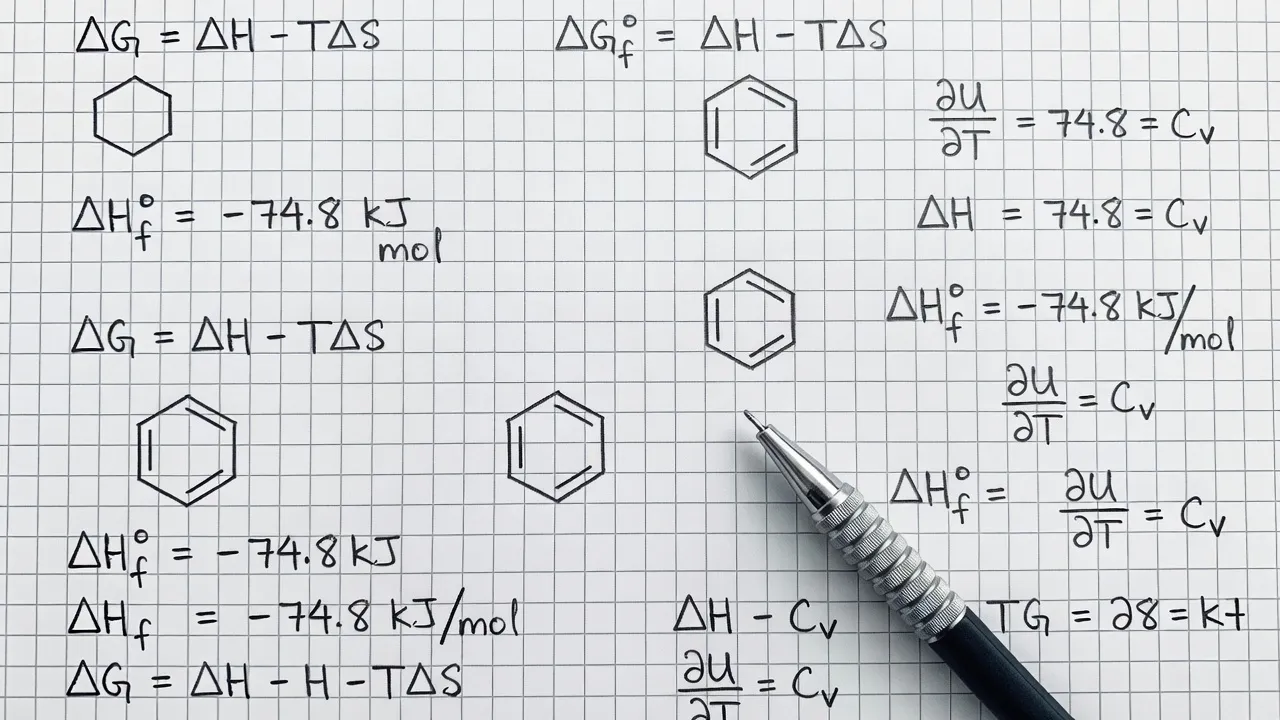
A direct comparison highlights the major gaps in scope and pacing:
- Mathematical Depth: AP Chemistry limits math to single-step equilibrium or rate law calculations. USNCO demands multi-step non-ideal gas equations, integrated rate laws for complex reaction orders, and advanced electrochemistry derivations.
- Organic Chemistry Scope: AP Chemistry covers basic functional groups and polarity. USNCO requires knowledge of nucleophilic additions, electrophilic aromatic substitutions, stereochemistry (R/S naming), and functional group transformations.
- Pacing Demands: The USNCO Local Exam forces candidates to answer 60 multiple-choice questions in 110 minutes (under 110 seconds per question), requiring instant recall without reference formula sheets.
- Laboratory Practical: AP Chemistry tests lab concepts via written free-response questions. The USNCO National Exam includes a 90-minute hands-on practical exam where students perform titrations and unknown chemical identification in a real laboratory.
If you can score a 5 on the AP Chemistry exam, you likely have the foundation needed to attempt the Local Section exam, but you will need substantial additional study to compete for a National Exam spot.
What key topics are tested on the Chemistry Olympiad exams?
The Chemistry Olympiad exams cover four main theoretical pillars: physical chemistry, organic chemistry, inorganic chemistry, and analytical chemistry. As you advance from the Local Exam to the National Exam, the proportion of organic mechanisms and complex physical derivations increases significantly.
The breakdown of essential concepts includes:
1. Physical Chemistry & Thermodynamics
- Stoichiometry and Gas Laws: Advanced gas law corrections (van der Waals equation), empirical formulas, and limiting reactant calculations. You can review fundamental concepts in our guide on stoichiometry practice problems.
- Chemical Thermodynamics: Enthalpy ($\Delta H$), entropy ($\Delta S$), Gibbs free energy ($\Delta G$), and spontaneity derivations under non-standard conditions.
- Reaction Kinetics: Differential and integrated rate laws, steady-state approximations, activation energy calculations via the Arrhenius equation, and catalysis mechanisms.
- Chemical & Ionic Equilibrium: Acid-base buffers, polyprotic acid titrations, solubility products ($K_{sp}$), and complex ion formation constants ($K_f$).
2. Atomic Structure & Inorganic Chemistry
- Quantum Mechanics & Electron Configurations: Periodic trends, shielding effects, molecular orbital (MO) diagrams, and energy states. For a detailed refresher, read our breakdown of quantum numbers chemistry.
- Coordination Chemistry: Crystal field theory (high spin vs. low spin complexes), d-orbital splitting, ligand field strength, and coordination complex geometries.
- Descriptive Chemistry: Main group element reactivity, flame test colors, redox trends across periods, and industrial chemical processes.
3. Organic Chemistry & Biochemistry
- Nomenclature & Stereochemistry: IUPAC naming rules, optical activity, enantiomeric excess calculations, Fischer projections, and chair conformations.
- Reaction Mechanisms: $S_N1$, $S_N2$, $E1$, and $E2$ reaction kinetics, electrophilic additions to alkenes/alkynes, aromatic substitution pathways, and carbonyl chemistry (aldol condensations, esterifications).
- Biomolecules: Basic structures and reactions of amino acids, peptide bonds, carbohydrates, nucleic acids, and lipids.
4. Analytical Chemistry & Spectroscopy
- Spectroscopic Techniques: Interpreting Infrared (IR), Mass Spectrometry (MS), $^1\text{H}$-NMR, and $^{13}\text{C}$-NMR spectra to deduce organic structures.
- Titrimetric Analysis: Redox titrations (permanganatometry, iodometry), complexometric titrations (EDTA), and precipitation titrations.
- Electrochemistry: Nernst equation calculations, galvanic and electrolytic cells, standard reduction potentials, and Faraday's laws of electrolysis. Candidates building their foundational skills can start by reviewing our introductory lessons on general chemistry 1.
What step-by-step strategy should students follow to qualify for the National Exam?
Qualifying for the USNCO National Exam requires a structured six-month preparation schedule focused on past paper practice, weak-area targeting, and timing mastery. Passive reading of textbooks rarely produces qualifying scores; active problem solving is essential.
Follow this strategic roadmap to maximize your chances:
- Master General Chemistry by November: Complete a college-level general chemistry textbook (like Zumdahl or Atkins). Ensure you can solve equilibrium and stoichiometry calculations rapidly without hesitation.
- Work Through Past Local Exams (December - January): Solve every ACS Local Section Exam from the last 15 years under timed conditions. Aim for a score above 50 out of 60 to be competitive in most ACS local sections.
- Target Organic and Analytical Gaps (February): Focus heavily on functional group reactions and basic NMR/IR spectroscopy, which frequently separate top scorers from average test-takers on the Local Exam.
- Prepare for the National Written & Practical Exam (March - April): If you pass the local round, immediately transition to National Exam Parts I, II, and III past papers. Practice writing clear, detailed step-by-step derivations for free-response questions.
- Simulate Lab Experiments: Review standard laboratory techniques, safety protocols, titrations, and qualitative ion analysis to prepare for the 90-minute Part III lab practical.
When tackling difficult homework assignments or past competition questions during test prep, saving previous solutions for quick review helps reinforce patterns. The ThinkAssist AI app automatically saves past answers and explanations, making it easy to review tricky concepts when preparing for exam day.
Frequently Asked Questions
What is the difference between the USNCO Local Exam and the National Exam?
The Local Exam consists entirely of 60 multiple-choice questions administered in 110 minutes. The National Exam is a three-part test including 60 multiple-choice questions (Part I), eight free-response problem sets (Part II), and a 90-minute hands-on laboratory practical (Part III).
Can homeschooled students participate in the Chemistry Olympiad?
Yes, homeschooled students are eligible to participate in the USNCO provided they meet the standard age, grade, and citizenship or permanent residency requirements. They must register through their local ACS section coordinator.
Is organic chemistry required for the Chemistry Olympiad Local Exam?
Yes, basic organic chemistry is required for the Local Exam, typically making up 10% to 15% of the questions. Topics cover functional group identification, basic IUPAC nomenclature, isomerism, and simple reaction types.
How many students advance from the Local Exam to the National Exam?
Approximately 1,000 to 1,200 students out of roughly 16,000 local participants across the U.S. qualify to sit for the USNCO National Exam each year, subject to per-school representation limits set by local ACS sections.
What score do I need on the Local Exam to qualify for the USNCO National Exam?
Cutoff scores vary by local section based on local competition density, but scoring 50 out of 60 or higher on the Local Section Exam generally puts a candidate in a strong position to advance.
Can non-U.S. citizens take the USNCO exam?
Non-U.S. citizens and non-green card holders living in the United States may sit for the Local Section Exam for local recognition, but ACS rules prevent them from advancing to the National Exam or U.S. Study Camp.
How are students selected for the International Chemistry Olympiad (IChO) U.S. team?
The top 20 scorers on the USNCO National Exam are invited to a two-week Study Camp in June. Based on performance on theoretical and practical exams held during the camp, the top four students are chosen to represent the United States at the IChO.
Is calculator use allowed on the Chemistry Olympiad exams?
Yes, simple scientific non-programmable calculators are allowed on USNCO exams. Graphing calculators or devices with memory storage, wireless capability, or QWERTY keypads are strictly prohibited.