
Math word problems for 2nd graders focus on single-step and two-step addition and subtraction within 100, organized into four primary problem structures: Add To, Take From, Put Together/Take Apart, and Compare. Unlike 1st grade math that relies on basic counting, 2nd grade word problems require kids to translate written stories into algebraic equations, interpret unknowns in all positions, and solve real-world scenarios involving money and measurement.
The single variable that decides whether a child succeeds with word problems is schema recognition—their ability to identify the underlying structural pattern of a problem rather than guessing operations based on "keywords."
What word problem solving strategies does NCTM recommend for 2nd grade?
The National Council of Teachers of Mathematics (NCTM) recommends schema-based instruction, tape diagrams (bar models), and mathematical modeling over traditional "keyword" memorization. According to NCTM's Principles to Actions standards, teaching children to look for trigger words like "in all" or "altogether" often backfires because those words fail when problems become multi-step or non-routine.
Instead, effective instruction focuses on three core strategies recommended for early elementary learners:
- Schema Identification: Teaching students to categorize story problems into specific types (e.g., joining amounts, separating amounts, or comparing two sets).
- Visual Representation: Using bar models or tape diagrams to draw the relationship between the known numbers and the unknown variable.
- Number Sentences with Unknowns: Writing an equation with a symbol (like a box or question mark) representing the unknown number before calculating the answer.
Tape Diagram
| Part 1 | Part 2 |
|---|---|
| 34 apples | 28 pears |
The parts combine to make a total of unknown value.
When children visually chunk the story into "parts" and "wholes," they spend less time guessing whether to add or subtract and more time understanding the quantitative relationships.
What are Common Core-aligned 2nd grade word problem examples?
Common Core standard 2.OA.A.1 requires 2nd graders to solve one- and two-step word problems involving addition and subtraction within 100 with unknowns in all positions. This means the mystery number isn't always at the end of the equation ($15 + 12 = ?$). It could be at the start ($? + 12 = 27$) or in the middle ($15 + ? = 27$).
Here are the five essential 2nd grade word problem scenarios every child encounters, broken down by their structural schema.
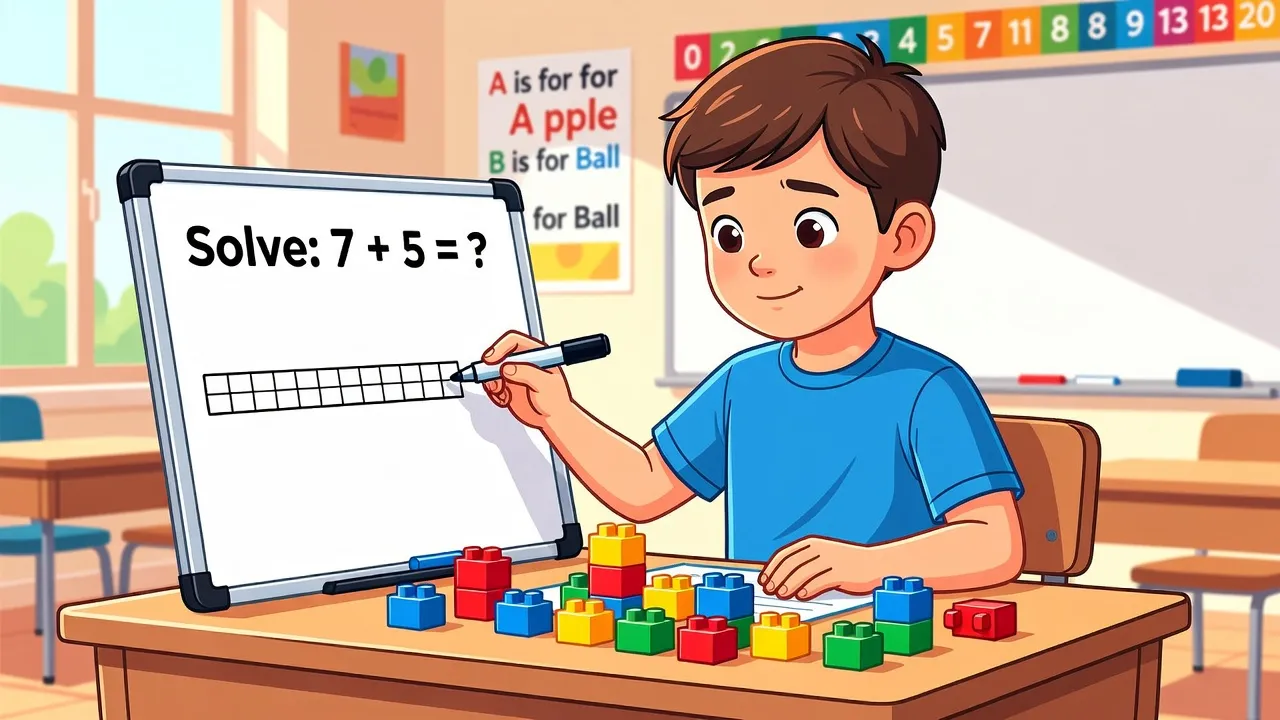
Scenario 1: "Add To" and "Take From" with Start Unknown
In "Start Unknown" problems, the initial quantity is missing, forcing kids to work backward using inverse operations. These are significantly more difficult for 7-year-olds than standard addition because the problem begins with an unknown value.
- Problem: Maya had some stickers. After her brother gave her 18 more stickers, she had 42 stickers in total. How many stickers did Maya have at first?
- Equation: $? + 18 = 42$
- How to Solve: Kids often see the word "more" and blindly add $18 + 42 = 60$, which is incorrect. A tape diagram shows that 42 is the whole, and 18 is one part. To find the missing starting part, the student must subtract: $42 - 18 = 24$.
Scenario 2: Comparative Word Problems ("How Many More" or "Fewer")
Compare problems ask kids to find the difference between two distinct quantities rather than joining or separating one set. These problems use terms like "more than," "fewer than," or "older than."
- Problem: Leo collected 63 sea shells at the beach. Sam collected 37 sea shells. How many fewer sea shells did Sam collect than Leo?
- Equation: $63 - 37 = ?$
- How to Solve: Children must map Leo’s bar (63) alongside Sam’s bar (37). The empty gap between the two bars represents the difference. Subtracting 37 from 63 gives the difference of 26 sea shells. Learning to solve word problems in math requires identifying that "fewer" asks for a comparison of two bars, not a loss of items.
Scenario 3: Two-Step Mixed Operation Word Problems
Two-step word problems require kids to complete an unstated intermediate calculation before solving the final question. As of August 2026, curriculum frameworks across most states emphasize two-step problems in the second half of 2nd grade to build stamina for 3rd grade multiplication contexts.
- Problem: A bakery had 85 muffins in the morning. They sold 48 muffins before noon. Then, the baker baked 25 more muffins. How many muffins does the bakery have now?
- Step 1 Equation: $85 - 48 = 37$ (Muffins left after morning sales)
- Step 2 Equation: $37 + 25 = 62$ (Total muffins after baking more)
- How to Solve: Encourage your child to solve Step 1 and write the hidden number above the sentence before attempting Step 2.
Scenario 4: Measurement and Length Word Problems (Standard 2.MD.B.5)
Measurement word problems apply addition and subtraction concepts to units of length like inches, feet, or centimeters. Kids must calculate differences in length or total distance along a number line.
- Problem: A blue ribbon is 54 centimeters long. A red ribbon is 19 centimeters shorter than the blue ribbon. How long is the red ribbon?
- Equation: $54 - 19 = ?$
- How to Solve: Have the student draw a simple number line spanning from 0 to 54, then jump backward by 19 (back 10 to 44, then back 9 to 35). The red ribbon is 35 centimeters long.
Scenario 5: Money Word Problems Involving Coins and Dollar Bills
Money word problems test both coin value recognition and two-digit mental math. Students must convert named coins (quarters, dimes, nickels) into numerical values before carrying out the arithmetic.
- Problem: Ethan has 2 quarters, 3 dimes, and 4 pennies in his pocket. He buys an eraser for 45 cents. How many cents does Ethan have left?
- Step 1 (Value Conversion): 2 quarters (50¢) + 3 dimes (30¢) + 4 pennies (4¢) = 84 cents.
- Step 2 (Subtraction): $84¢ - 45¢ = 39¢$.
What 2nd grade word problems does Khan Academy offer?
Khan Academy provides free, self-paced 2nd grade math modules organized by Common Core domains, complete with built-in hint structures and interactive practice sets. Their word problem practice sets are divided into two main units: Addition and subtraction within 100 word problems and Money and measurement word problems.
I frequently recommend Khan Academy because of how their platform handles student errors. When a child inputs a wrong answer, the platform doesn't just reveal the answer:
- Step-by-Step Hints: Breaks the text into a bar diagram.
- Scaffolded Video Explanations: Short 3-minute clips explaining how to sketch the quantities.
- Mastery Progression: Requires kids to get 4 consecutive correct answers to level up a skill.
Their platform is accessible online via the official Khan Academy 2nd Grade Math Hub.
What 2nd grade word problems does Illustrative Mathematics offer?
Illustrative Mathematics (IM) offers conceptual, open-ended word problem tasks that encourage classroom discussion and multiple solution paths. Rather than giving kids 20 identical drill problems, IM tasks focus on deep reasoning and real-world modeling.
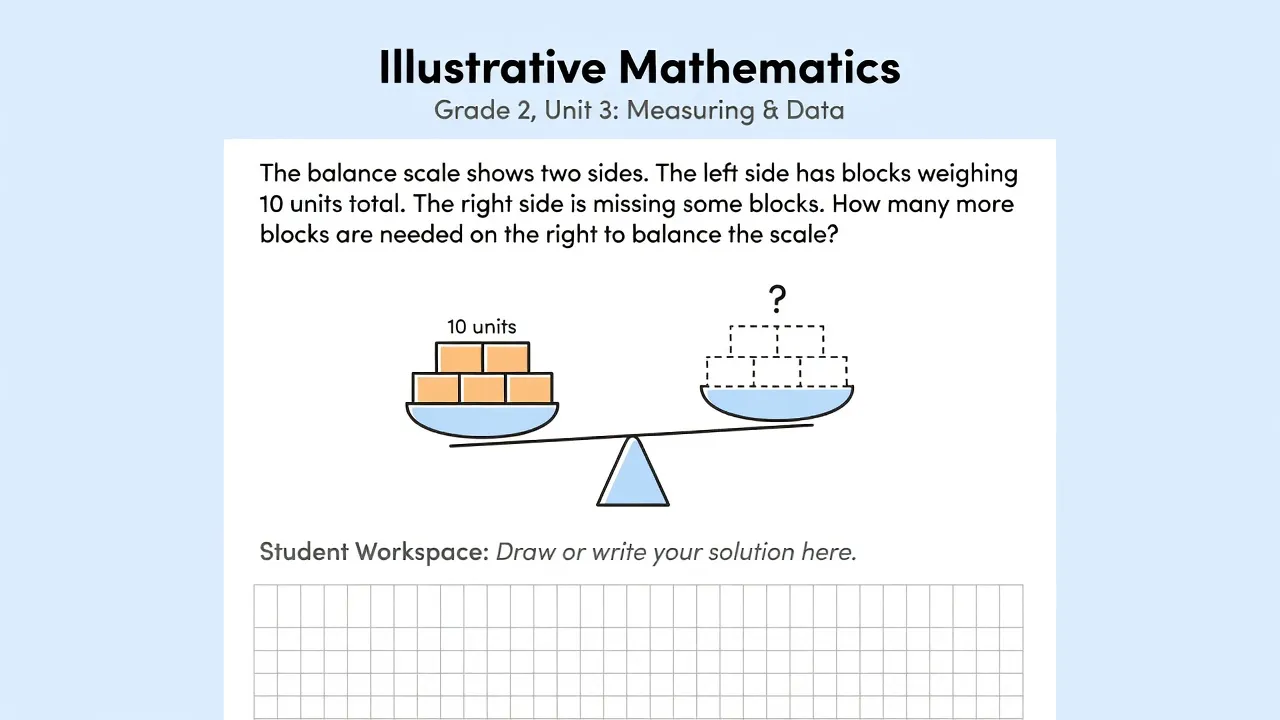
A classic example from their public task repository is the "Target Five" or "Grandma’s Apples" problem structure:
- IM Task Example: "Grandma has 36 apples. She puts some in a red bowl and some in a green bowl. List three different ways Grandma could arrange her apples."
- Educational Purpose: This task forces 2nd graders to engage with Part-Part-Whole structures where multiple correct responses exist ($30+6$, $20+16$, $18+18$). It breaks the habit of looking for a single "right answer" and builds a foundation for algebraic thinking.
Parents and teachers can access these free task units directly at the Illustrative Mathematics Curriculum Portal.
What are popular 2nd grade word problems on Teachers Pay Teachers?
Teachers Pay Teachers (TpT) offers teacher-created word problem resources, heavily emphasizing daily "Word Problem of the Day" calendars, schema-based graphic organizers, and hands-on task cards.
The top-rated 2nd grade word problem bundles on Teachers Pay Teachers generally fall into three design categories:
- Targeted Schema Journals: Spiral-bound workbooks that isolate one problem structure per week (e.g., Week 1 is all Compare problems; Week 2 is all Start Unknown).
- Read-and-Draw Task Cards: Printable cards featuring a two-sentence story alongside an empty box reserved specifically for a tape diagram sketch.
- Seasonal Color-by-Number Math Stories: Worksheets where solving addition and subtraction word problems yields a color key for a themed illustration.
What 2nd grade word problems does Scholastic offer?
Scholastic provides story-driven math printables and reading-passages that blend early literacy skill-building with grade-appropriate math reasoning. Because 2nd graders are still developing reading fluency, Scholastic's resources focus heavily on controlling text complexity so decoding issues don't block mathematical problem-solving.
Their materials—accessible through the Scholastic Teacher Store—typically incorporate:
- Controlled Vocabulary Stories: Short 2-sentence stories using high-frequency sight words so kids can read the text independently.
- Picture-Supported Story Problems: Word problems accompanied by illustrations of items (like apples, toy cars, or coins) that students can physically cross out or group.
- Math & Literacy Cross-Curricular Worksheets: Reading passages followed by two comprehension questions and two math calculation questions tied to the plot.
How to Choose the Right Word Problem Support Resource
Choosing the right approach depends on whether your child struggles with reading comprehension, mathematical calculation, or visualizing the math story.
| Learning Scenario / Need | Target Skill | Recommended Strategy | Recommended Tool / Option |
|---|---|---|---|
| Child guesses operations based on keywords | Schema recognition & bar modeling | Stop using keyword lists; introduce tape diagrams | Schema-based worksheets (NCTM method) |
| Child struggles to read the word problem | Reading decoding & math vocabulary | Controlled text complexity with visual cues | Scholastic Math Passages |
| Child needs instant, step-by-step guidance at home | Visual breakdown & immediate feedback | Snap a photo of homework for interactive, step-by-step step solutions | ThinkAssist AI Homework Solver |
| Child needs conceptual challenge and open math exploration | Algebraic flexibility & multiple solutions | Open-ended tasks with non-fixed answers | Illustrative Mathematics Open Tasks |
How AI Tutors Help 2nd Graders Master Complex Math Stories
When a 2nd grader sits down with a two-step word problem at the kitchen table, parents often struggle to explain the logic without just giving away the final number. This is where modern AI tools step in to act as an interactive study helper.
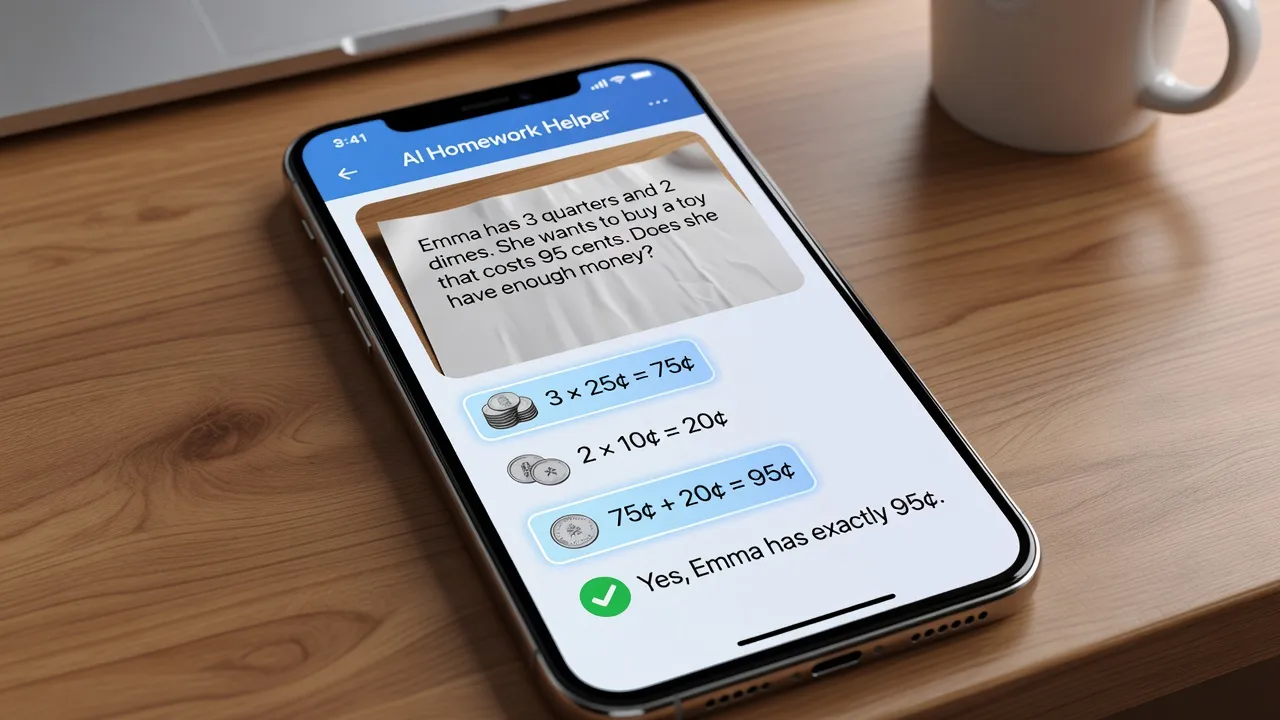
The ThinkAssist app is an AI-powered homework solver app designed to function as a 24/7 tutor for elementary and high school students. Rather than acting as a simple calculation engine that outputs just a raw number, the app helps kids understand the underlying steps behind complex word problems.
Here is how parents can use ThinkAssist to support 2nd grade math practice at home:
- Snap a Photo: Take a picture of any printed worksheet, textbook page, or handwritten word problem.
- Automatic Subject Detection: The app identifies the problem type—whether it's a 2-step money calculation, a length comparison, or a missing start equation—and categorizes it instantly.
- Step-by-Step Explanations: Instead of dumping an answer on the screen, ThinkAssist walks through the problem narrative step-by-step, showing how to set up the equation and solve it logically.
- Exam & Test Prep Archives: Past answers and step-by-step explanations are automatically saved in the app, allowing kids to review tricky problem schemas before classroom math assessments.
Whether your child is stuck on a tricky two step equations worksheet or trying to figure out how many cents are left over in a money story problem, using an instant mobile tool prevents homework frustration from slowing down learning.
Step-by-Step Parent Guide: Helping Your 2nd Grader Solve Word Problems
If your child freezes up when facing a paragraph of text in math class, follow this four-step coaching framework during daily homework sessions.
THE 4-STEP WORD PROBLEM FRAMEWORK
- READ & RETELL: Explain the story without numbers
- DRAW THE MODEL: Sketch a tape diagram or place-val
- WRITE EQUATION: Put a box [?] for the unknown
- CHECK & REASON: Does the final number make sense?
Step 1: Read and Retell (Remove the Numbers First)
Read the word problem aloud to your child, but completely cover up the numbers with your thumb. Ask them to retell the story in their own words.
- Parent: "Maya has some stickers and gets more from her brother. Now she has a bigger pile. What are we trying to find out?"
- Child: "How many stickers she started with!"
Removing the numbers stops children from instantly grabbing values and adding them together without thinking.
Step 2: Draw the Relationship (Tape Diagram)
Have your child draw two connected boxes or a simple bar model on paper.
- Ask: "Do we know the total whole, or are we looking for a missing piece?"
- Label the known bar sections with the given numbers and put a question mark (
?) inside the missing box.
Step 3: Write the Sentence with an Unknown
Translate the picture into a standard mathematical equation before performing any work.
- Example: $? + 18 = 42$
- Discuss which operation (addition or subtraction) is needed to calculate the mystery box.
Step 4: Calculate and Test Reasonable Values
After computing the math ($42 - 18 = 24$), place the result back into the original sentence to see if it makes logical sense.
- Ask: "If Maya started with 24 stickers and got 18 more, does it make sense that she ends up with 42? If our answer was 60, could she start with 60 and end up with 42 after getting more?"
- Teaching kids to catch illogical answers builds self-correction habits early.
Frequently Asked Questions
What math skills should a 2nd grader have for word problems?
Second graders must be able to fluently add and subtract within 20, solve two-digit addition and subtraction within 100 with and without regrouping, understand basic place value (hundreds, tens, ones), and recognize coin values (quarters, dimes, nickels, pennies).
Why do 2nd graders struggle with math word problems?
Children usually struggle with word problems due to reading decoding difficulties, weak working memory, or reliance on unreliable "keyword strategies" rather than visual modeling. When kids try to guess operations based on trigger words like "more" or "left," they fail whenever the problem structure shifts.
What are the main types of 2nd grade word problems?
The Common Core framework outlines four primary types of addition and subtraction word problems for 2nd grade: Add To, Take From, Put Together/Take Apart, and Compare. Each structure can feature the unknown in the result, change, or start position.
How do I teach my 2nd grader two-step word problems?
Teach two-step word problems by breaking the story into two distinct sub-questions. Have your child solve the first hidden calculation, write that intermediate answer on the paper, and then use that new value to solve the final step.
Are keywords effective for solving 2nd grade math word problems?
No, keywords are not an effective long-term strategy. Relying on words like "altogether" for addition or "left" for subtraction fails in complex, multi-step, or "start-unknown" problems. Schema-based instruction and bar modeling are far more accurate methods.
How many word problems should a 2nd grader practice daily?
Practicing 2 to 4 word problems deeply each day using tape diagrams and verbal explanations is far more effective than completing dozens of repetitive calculation worksheets without visual modeling.
How does drawing a tape diagram help with word problems?
A tape diagram visually represents the relationships between quantities as rectangular bars. It helps 2nd graders see whether they are looking for a missing part or the overall total, making it obvious whether to add or subtract.