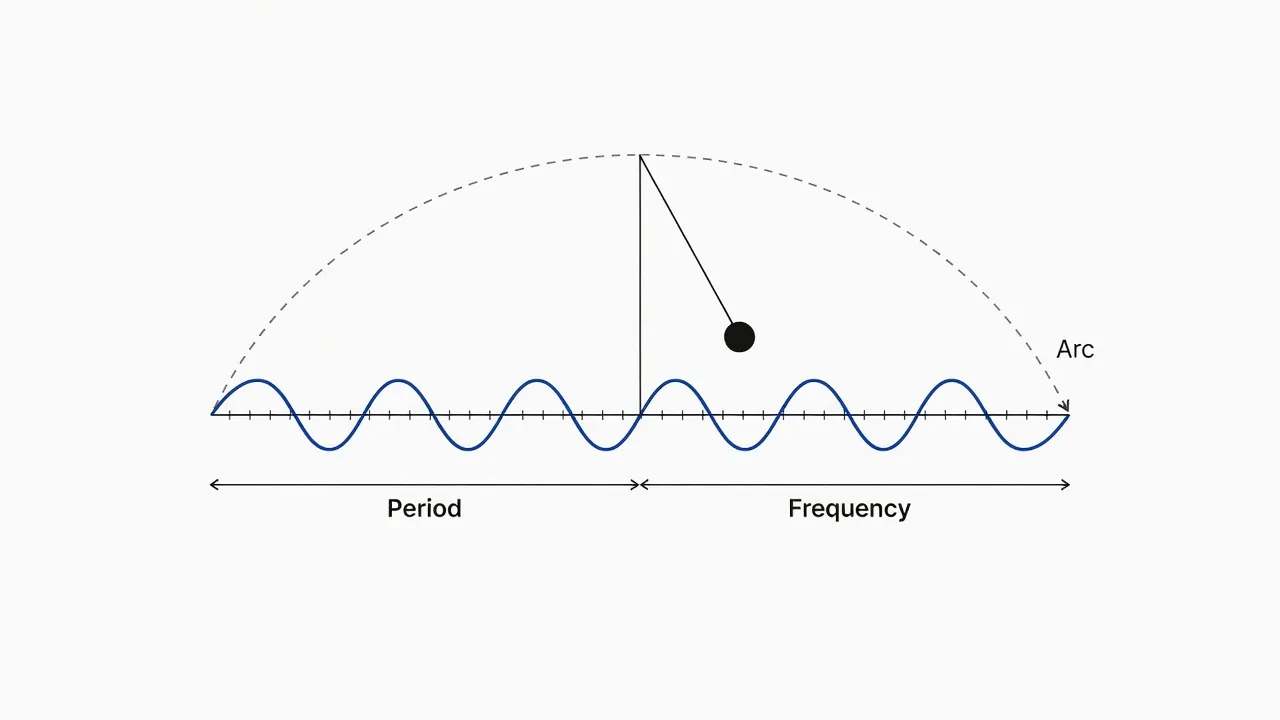
Period in physics is the duration of time required for a system to complete one full cycle of periodic motion, calculated as $T = 1/f$ or $T = 2\pi/\omega$. Unlike frequency, which measures how many cycles occur per second, period measures the seconds per cycle. In standard simple harmonic motion, the period depends entirely on the intrinsic properties of the system—such as mass and spring stiffness, or length and gravitational acceleration—rather than how far the system is displaced.
Understanding period calculations requires recognizing when simple approximations hold true and when physical reality forces you into complex corrections. Whether you are analyzing a simple spring oscillator, preparing for AP exams, or modeling large-angle pendulum swings, mastering period mechanics forms the core of classical physics.
To help you quickly reference how period functions across different physical setups, I compiled this comparison of standard harmonic systems, their restoring force mechanisms, and their governing period equations.
| System Type | Primary Restoring Force | Period Equation ($T$) | Key System Variables | Small-Angle / Small-Displacement Assumption |
|---|---|---|---|---|
| Mass-Spring Oscillator | Hooke's Law force ($F = -kx$) | $T = 2\pi\sqrt{\frac{m}{k}}$ | $m$ = mass (kg), $k$ = spring constant (N/m) | No angle limit; requires linear elastic Hooke's Law range |
| Simple Pendulum | Gravitational component ($F = -mg\sin\theta$) | $T \approx 2\pi\sqrt{\frac{L}{g}}$ | $L$ = string length (m), $g$ = acceleration of gravity ($\text{m/s}^2$) | Yes ($\sin\theta \approx \theta$, typically $\theta \le 15^\circ$) |
| Physical (Compound) Pendulum | Gravitational torque ($\tau = -mgd\sin\theta$) | $T \approx 2\pi\sqrt{\frac{I}{mgd}}$ | $I$ = moment of inertia ($\text{kg}\cdot\text{m}^2$), $d$ = distance to center of mass (m) | Yes ($\sin\theta \approx \theta$, small angular displacements) |
| Torsional Pendulum | Restoring torque ($\tau = -\kappa\theta$) | $T = 2\pi\sqrt{\frac{I}{\kappa}}$ | $I$ = moment of inertia, $\kappa$ = torsion constant ($\text{N}\cdot\text{m/rad}$) | Exact for linear elastic wire twisting |
When working through physics homework assignments, working out these mathematical relationships can quickly turn tedious. If you ever get stuck setting up coordinate axes or balancing restoring forces, I recommend using ThinkAssist. It is an AI-powered homework solver that lets you snap a photo of any physics problem to get clear, step-by-step explanations.
How is the period of a simple pendulum derived using the small-angle approximation, and why is it independent of mass?
The simple pendulum period formula $T = 2\pi\sqrt{L/g}$ is derived by applying Newton's second law for rotational motion and substituting $\sin\theta \approx \theta$ for small angular displacements. This linearizes the differential equation into standard simple harmonic motion.
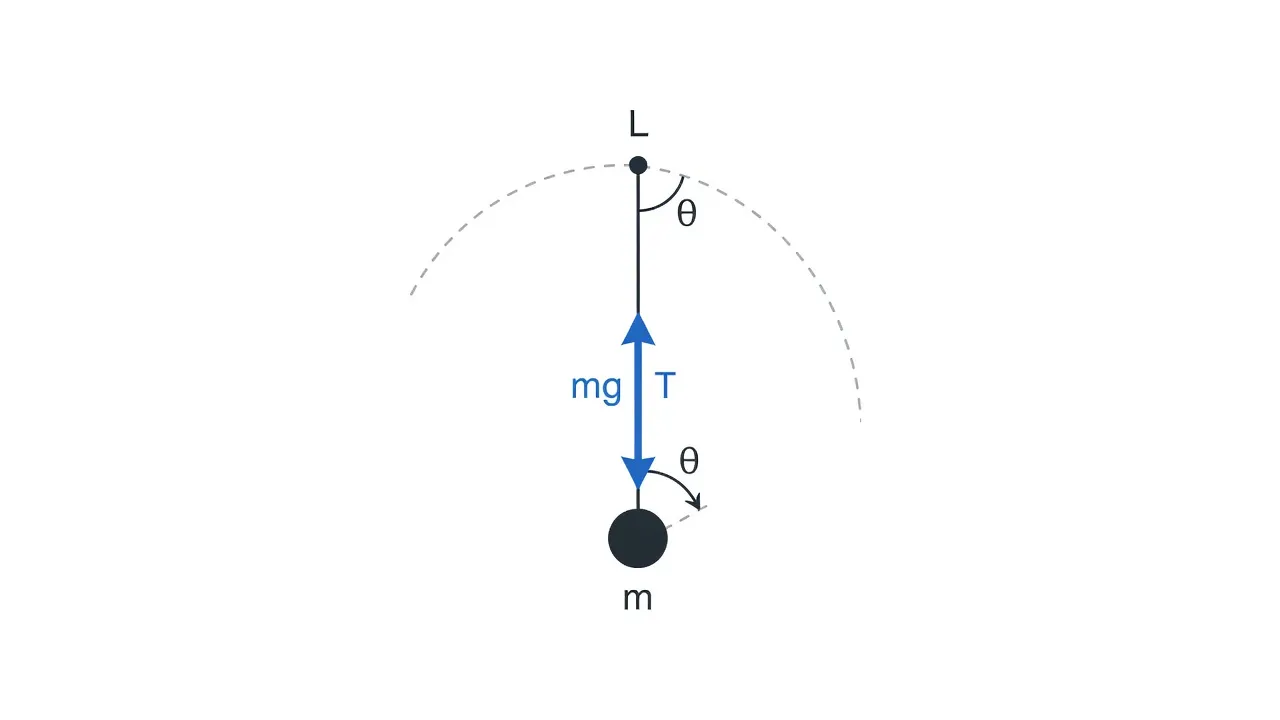
To see how this derivation unfolds step by step, consider a point mass $m$ suspended by a massless rod of length $L$. The gravitational force pulls downward with magnitude $mg$, creating a restoring torque about the pivot axis.
- Write the rotational equation of motion: The torque $\tau$ acting on the mass is $\tau = -mgL \sin\theta$, where the negative sign indicates the torque acts opposite to displacement.
- Apply Newton's second law for rotation: Set $\tau = I \alpha$, where $I = mL^2$ is the point mass moment of inertia and $\alpha = \frac{d^2\theta}{dt^2}$ is angular acceleration.
- Set up the nonlinear differential equation: Combining these terms gives $mL^2 \frac{d^2\theta}{dt^2} + mgL \sin\theta = 0$. Dividing through by $mL^2$ simplifies the expression to $\frac{d^2\theta}{dt^2} + \frac{g}{L} \sin\theta = 0$.
- Apply the small-angle approximation: For small angles measured in radians (typically under $15^\circ$), the Taylor series expansion yields $\sin\theta \approx \theta$. Substituting this approximation turns the relation into $\frac{d^2\theta}{dt^2} + \frac{g}{L} \theta = 0$.
- Extract natural angular frequency and period: This matches the standard harmonic equation $\frac{d^2\theta}{dt^2} + \omega^2 \theta = 0$, where angular frequency $\omega = \sqrt{\frac{g}{L}}$. Because period $T = \frac{2\pi}{\omega}$, substituting $\omega$ yields $T = 2\pi\sqrt{\frac{L}{g}}$.
The pendulum period is completely independent of mass because mass appears identically on both sides of Newton's force equation. The inertial resistance to acceleration ($mL^2$) increases at the exact same rate as the gravitational restoring torque ($mgL$).
If you are reviewing force balances for exam prep, drawing a clean free body diagram physics guide helps ensure you do not miss vector components. You can also consult an AP Physics 1 reference sheet to check standard unit conversions for gravitational acceleration. For detailed interactive derivations of mechanical oscillations, check the HyperPhysics pendulum documentation.
How does pendulum period depend on amplitude for large swings (nonlinear/elliptic integral correction)?
For large swing angles where $\sin\theta \approx \theta$ no longer holds, the period of a simple pendulum increases with initial amplitude and requires a complete elliptic integral of the first kind to compute accurately. As the release angle grows, restoring force increases more slowly than linearly, causing the pendulum to spend proportionately more time near its turning points.
The exact period for an arbitrary initial release angle $\theta_0$ is expressed by the exact integral formula:
$$T = 4\sqrt{\frac{L}{g}} K\left(\sin^2\left(\frac{\theta_0}{2}\right)\right)$$
Here, $K(k)$ represents the complete elliptic integral of the first kind. To evaluate this without numerical integration software, physicists use Borda's series expansion formula:
$$T \approx 2\pi\sqrt{\frac{L}{g}} \left( 1 + \frac{1}{16}\theta_0^2 + \frac{11}{3072}\theta_0^4 + \frac{173}{737280}\theta_0^6 + \dots \right)$$
In this equation, the angle $\theta_0$ must be expressed strictly in radians. The mathematical structure of these expansions and their higher-order coefficients are fully documented in the NIST Digital Library of Mathematical Functions.
The quantitative impact of swing amplitude on overall period timing breaks down across several common angles:
- Small swings ($5^\circ$ or 0.087 rad): The amplitude correction factor adds approximately 0.05% to the base period, making the simple SHM formula accurate enough for high school coursework.
- Moderate swings ($30^\circ$ or 0.524 rad): The period expands by roughly 1.7% over the small-angle baseline, creating measurable drift in timekeeping applications.
- Large swings ($60^\circ$ or 1.047 rad): The correction factor increases the period by 6.6%, invalidating linear approximations.
- Extreme swings ($90^\circ$ or 1.571 rad): The period stretches by 18.0% above the linear prediction because the bob slows down dramatically near horizontal peak height.
What do isochronism experiments and corrections (Huygens, Borda, circular error) show about pendulum period?
Isochronism experiments demonstrate that circular pendulum paths are only approximately isochronous, introducing a systematically longer period as amplitude increases known as circular error. Early precision horology depended on identifying and correcting this deviation to keep pendulum clocks accurate.
Italian scientist Galileo Galilei first asserted the principle of isochronism in 1602, observing that small chandelier swings appeared to take equal time regardless of arc width. However, 17th-century Dutch physicist Christiaan Huygens proved mathematically that Galileo's observation was only an approximation limited to minuscule arcs.
To correct this timing error in practical timekeeping, scientists introduced structural modifications:
- Circular Error Identification: Huygens demonstrated that because a circular arc curves upward less sharply than a true constant-period path, wide swings suffer from circular error, falling behind narrow swings.
- Borda's Experimental Corrections: In the late 18th century, French physicist Jean-Charles de Borda built precision pendulum setups to measure local gravity. He published correction tables that adjusted measured period lengths back to an idealized zero-amplitude baseline.
- Escapement Arc Reduction: Clockmakers realized that keeping escapement drive impulses low restricted the total pendulum swing to under $3^\circ$. At these micro-arcs, circular error drops below a fraction of a second per day.
For historical context on how pendulum measurements evolved into modern gravimetry, read the comprehensive history of the pendulum on Wikipedia.
What is Kater's pendulum and how does it measure period as a reversible pendulum?
Kater's pendulum is a rigid, asymmetric compound pendulum designed with two opposing pivot points that enables precise measurements of gravitational acceleration ($g$) without requiring knowledge of the object's center of mass or moment of inertia. Henry Kater invented this device in 1817 to overcome the physical impossibility of constructing a true point-mass simple pendulum.
The genius of Kater's design lies in the physics of conjugate centers of oscillation. A compound pendulum pivoted at point $O_1$ oscillates with a specific period $T_1$. If you invert the pendulum and swing it from a second pivot point $O_2$, it oscillates with period $T_2$.
By adjusting movable metal weights along the rod, an experimenter tunes the mass distribution until both periods match exactly ($T_1 = T_2 = T$). When this condition is met, the mathematical distance $L$ between the two knife-edge pivots equals the precise equivalent length of an ideal simple pendulum.
The local acceleration of gravity is then calculated using the basic period relation rewritten as:
$$g = \frac{4\pi^2 L}{T^2}$$
This eliminates systematic errors stemming from non-uniform rod density or complex geometry. You only need to measure the physical distance between two sharp metal edges and time the oscillation period. You can explore the exact mechanics and historical calibrations of Kater's pendulum on Wikipedia.
What is the Huygens tautochrone pendulum?
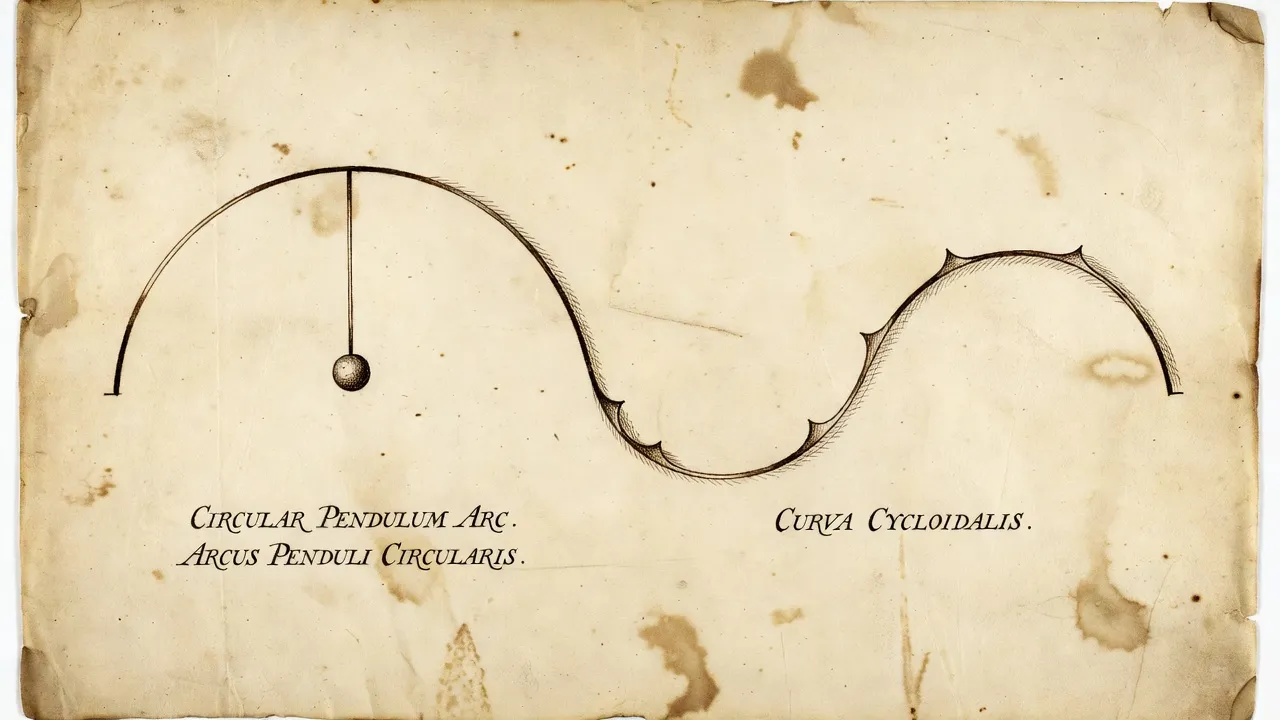
The Huygens tautochrone pendulum is a mechanical device that forces a swinging bob along a cycloidal path, producing an oscillation period that is strictly constant regardless of swing amplitude. Unlike standard circular pendulums, a tautochrone pendulum is perfectly isochronous across all angles.
In 1659, Christiaan Huygens mathematically proved that a curve called a cycloid—the path traced by a point on the rim of a rolling wheel—is the true tautochrone curve. A particle sliding down a frictionless cycloidal channel reaches the lowest point in exact matching time intervals, whether dropped from a height of one millimeter or one meter.
To force a flexible pendulum cord into a cycloidal trajectory, Huygens designed a clever physical suspension system:
- Cycloidal Cheeks: He mounted two curved metal jaws (cheeks) on either side of the top pivot point.
- Evolute Geometry: The geometric evolute—the locus of centers of curvature—of a cycloid is itself an identical cycloid.
- Restraining Arc: As the pendulum string swings outward, it wraps around the cycloidal cheek, shortening the effective free string length and pulling the bob upward into a cycloidal path.
The pivot point connects to two cycloid cheeks. A flexible string extends from both cycloid cheeks down to the bob. The bob follows the exact cycloid arc.
While Huygens' design solved circular error in theory, clockmakers in the 18th century largely abandoned cycloidal cheeks for major timekeeping. The mechanical friction and cable wear against the curved jaws introduced more timing variations than the small-angle circular approximation ever created. You can analyze the differential geometry behind the cycloid on Wolfram MathWorld's Tautochrone Problem guide.
How to solve complex period physics homework problems without getting stuck
Mastering period calculations requires managing unit conversions, rotational inertia formulas, and approximation limits. When working through complex multi-part problems, students frequently hit computational walls or struggle to identify which restoring force equation applies.
Here are the most common traps students encounter when solving period problems:
- Using degree measure in series expansions: Accidentally plugging degree angles into Borda's amplitude correction formula yields massive mathematical errors. Always convert angles to radians first.
- Confusing physical and simple pendulums: Applying $T = 2\pi\sqrt{L/g}$ to a solid uniform rod instead of using the physical pendulum formula $T = 2\pi\sqrt{I/mgd}$ leads to wrong numerical answers.
- Ignoring mass placement in compound systems: Assuming that adding mass to a pendulum bob does not alter period. While point mass pendulums ignore mass, adding physical weight to a real rod shifts the center of mass $d$ and alters moment of inertia $I$.
If you find yourself stuck on complex multi-step physics problems, ThinkAssist provides an immediate study companion. You can download it directly on the Apple App Store for a 3-day free trial, after which it costs $6.99/week.
ThinkAssist Homework Workflow
- Snap Photo: Take a picture of any equation
- Auto-Detect Subject: Detects physics concepts and target variables
- Step-by-Step: Detailed math and force breakdowns
Using the app's snap-a-photo capability, you simply take a picture of your textbook setup or handwritten work. ThinkAssist automatically detects the subject matter, identifies the governing equations, and generates step-by-step explanations.
Saving past answers inside the app also streamlines exam prep when reviewing for upcoming tests. If you are struggling with broad course concepts, reading our guide on why physics feels hard offers useful strategies for mastering technical problem solving. You can also review our breakdown of the AP Physics 1 FRQ study guide for structured practice.
Frequently Asked Questions
What is the simple definition of period in physics?
Period is the duration of time required for a physical system to complete one full cycle of repeating or oscillatory motion. It is measured in seconds per cycle and is the inverse of frequency.
What is the relationship between period and frequency?
Period and frequency are inverse quantities, defined by the relationship T = 1/f. A system with a high frequency completes many cycles per second and has a short period, whereas a low frequency system has a long period.
Why does mass not affect the period of a simple pendulum?
Mass does not affect a simple pendulum's period because inertia and gravitational force scale proportionally with mass. Increasing mass adds more inertial resistance to movement, but adds the exact same amount of gravitational pulling force, canceling out mass in the acceleration equation.
What happens to the period of a pendulum if you double its length?
If you double the length of a simple pendulum, its period increases by a factor of the square root of 2, which is approximately 1.414. Because period depends on the square root of length, quadrupling the length is required to double the period.
Does the amplitude of a pendulum change its period?
For small swing angles below 15 degrees, amplitude changes have a negligible effect on period. For larger angles, increasing amplitude systematically increases the period due to non-linear restoring force dynamics.
What is circular error in pendulum physics?
Circular error is the slight timing deviation caused by a pendulum swinging along a circular arc rather than a true cycloidal path. It causes wider swings to take slightly longer than narrower swings.
What is the difference between a simple pendulum and a physical pendulum?
A simple pendulum assumes a point mass hanging from a light, massless string. A physical or compound pendulum accounts for the real shape, mass distribution, and moment of inertia of a solid extended object swinging around a pivot.
How does altitude affect pendulum period?
Higher altitude reduces local gravitational acceleration g because you are farther from Earth's center. Because period T is inversely proportional to the square root of g, a pendulum swings slightly slower and has a longer period at high altitudes.