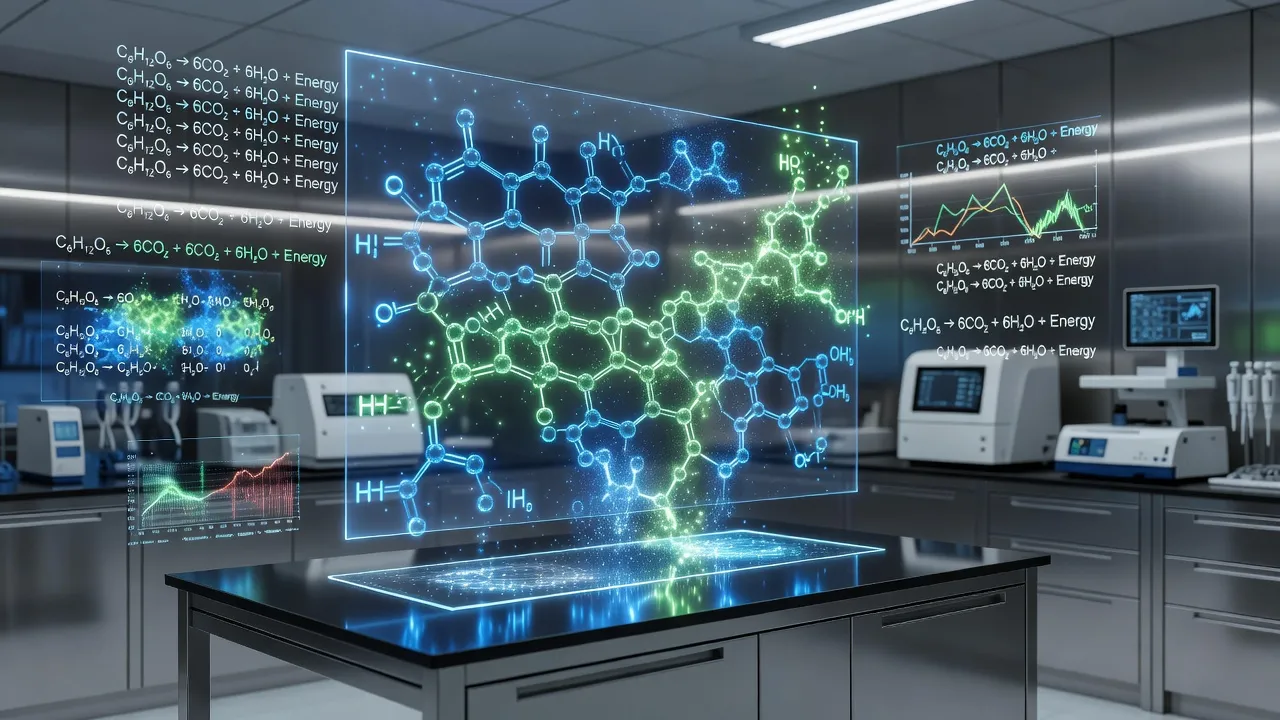
Problems in chemistry range from fundamental theoretical hurdles like predicting quantum states in complex molecules to practical engineering barriers like artificial photosynthesis and carbon dioxide reduction. While fundamental research tackles energy transition and materials science, students routinely encounter their own academic obstacles in courses like general chemistry 1. Bridging the gap between classroom calculations and real-world molecular engineering requires mastering key principles of chemical reactivity.
When working through tough coursework, tools like ThinkAssist offer an ai tutor experience by letting you snap a photo of a problem to get step-by-step explanations.
What are the unsolved problems in catalysis for CO2 reduction?
The primary unsolved problem in CO2 reduction catalysis is achieving high selectivity for multi-carbon products while maintaining low energy losses and long-term catalyst stability. Converting carbon dioxide (CO2) into high-value chemicals like ethylene or ethanol requires transferring multiple electrons and protons across complex intermediate states.
Current catalysts, particularly copper-based materials, often yield a mixture of unwanted byproducts such as methane, carbon monoxide, and hydrogen gas. Research highlighted by the National Renewable Energy Laboratory indicates that overcoming mass transport limits and structural degradation in alkaline environments remains a core objective.
As of October 2026, researchers are shifting focus toward custom single-atom catalysts and micro-environment tuning to suppress side reactions. Without precise control over the local micro-environment, industrial-scale electrochemical carbon capture remains economically unviable.
What are the challenges in quantum chemistry for large systems?
The main challenge in quantum chemistry for large systems is the exponential scaling of computational cost as electron counts increase. Solving the Schrödinger equation for a molecule requires calculating interactions between every pair of electrons, which quickly overwhelms modern supercomputers.
Standard methods like Density Functional Theory (DFT) provide acceptable accuracy for small organic molecules. However, DFT struggles with strongly correlated systems like transition metal complexes, metalloenzymes, and radical species.
As noted by the American Chemical Society, researchers modeling thousands of atoms must continuously trade numerical precision for computational speed. Recent developments in machine learning potentials offer faster approximations, but verifying their accuracy across novel chemical space remains a hurdle.
What are the challenges in nitrogen fixation beyond Haber-Bosch?
The central challenge in ambient nitrogen fixation is breaking the extremely strong nitrogen-nitrogen triple bond without requiring high heat and pressure. The century-old Haber-Bosch process supplies global fertilizer demand, but it consumes nearly 2% of world energy output and generates massive carbon emissions.
Biological nitrogenase enzymes perform this reaction at room temperature using iron-molybdenum clusters. However, synthetic mimics in the lab degrade quickly and display low turnover rates.
Data published in Nature Chemistry demonstrates that designing synthetic catalysts that favor nitrogen reduction over the competing hydrogen evolution reaction remains an active area of study. Achieving efficient, room-temperature ambient nitrogen reduction could transform agricultural supply chains.
What are the grand challenges in artificial photosynthesis?
The main grand challenge in artificial photosynthesis is integrating light absorption, charge separation, and multielectron catalysis into a single stable device. Natural photosynthesis splits water and fixes carbon dioxide using delicate protein assemblies, but synthetic systems face severe material degradation under constant sunlight.
Solar-driven oxidation reactions produce corrosive chemical environments that quickly destroy light-absorbing semiconductors. Engineers must balance solar absorption efficiency with chemical durability.
According to research documented in Science, achieving an overall solar-to-chemical conversion efficiency above 10% on an industrial scale requires far more durable semiconductor-catalyst interfaces. Current setups are either too expensive or fail within a few hundred hours of continuous operation.
What are AlphaFold's limitations for intrinsically disordered proteins?
AlphaFold struggles with intrinsically disordered proteins because these structures lack a single fixed minimum-energy 3D shape. Deep learning models predict structures by analyzing evolutionary patterns found in static, crystallized proteins.
Intrinsically disordered proteins (IDPs) constantly shift between hundreds of flexible conformations to carry out cell signaling. These dynamic regions do not fit the rigid structural assumptions used by automated prediction tools.
Data from the Protein Data Bank shows that structural prediction software returns low confidence scores for disordered regions. Researchers must still rely on physical techniques like nuclear magnetic resonance (NMR) spectroscopy and small-angle X-ray scattering to study these fluid systems.
What are the unsolved problems in origin of life chemistry (abiogenesis)?
The main unsolved problem in abiogenesis is explaining how self-replicating molecular systems emerged from simple non-biological organic precursors. Scientists continue to investigate how complex building blocks like nucleotides and amino acids assembled in prebiotic Earth conditions.
Under the "RNA World" hypothesis, early RNA molecules carried out both genetic inheritance and enzymatic activity. However, forming long RNA polymers in aqueous solutions runs into thermodynamic barriers, as water molecules tend to break polymer bonds apart.
An overview on Wikipedia's abiogenesis coverage notes that demonstrating a complete, self-sustaining metabolic network inside primitive cell membranes remains open. Connecting simple chemistry to functional biological systems remains one of science's deepest questions.

Key Frontiers and Bottlenecks in Modern Chemistry
Understanding where major chemistry research stands helps put academic topics into perspective. Below is a summary of active research bottlenecks across key branches of the field:
| Field | Key Research Goal | Primary Bottleneck | Current Method / Technology (2026) |
|---|---|---|---|
| CO2 Electroreduction | Convert emissions into usable fuels | Low selectivity for C2+ products | Copper gas-diffusion electrodes |
| Quantum Chemistry | Simulate large biological enzymes | Exponential computational scaling | Hybrid DFT & neural network potentials |
| Ambient Nitrogen Fixation | Replace the Haber-Bosch process | Competing hydrogen evolution | Single-atom electrocatalysts |
| Artificial Photosynthesis | Direct solar-driven water splitting | Rapid catalyst degradation | Tandem photoelectrochemical cells |
| Structural Biology | Map disordered protein ensembles | Static training data limits | Integrated NMR & AI ensemble modeling |
How to approach chemistry solving problems in academic courses
Mastering academic chemistry problems requires breaking down word descriptions into balanced chemical equations, stoichiometry ratios, and thermodynamic relations. Most students struggle when they attempt to memorize steps rather than identifying the fundamental laws at work.
Building confidence in chemistry involves practicing core calculations step by step:
- Identify given values and identify the unknown variable first.
- Convert all quantities to moles before applying reaction ratios.
- Verify unit cancellations using dimensional analysis.
- Practice multi-step conversions like stoichiometry practice problems until the process becomes automatic.
When working through difficult assignments, using an AI-powered solver can save hours of frustration. The ThinkAssist iOS app lets you snap a photo of any assignment or exam question to get clear, step-by-step explanations. It is free to download with a 3-day free trial, followed by $6.99 per week, making it a reliable companion for mastering complex coursework.
Whether you are working through introductory general chemistry or tackling complex multi-step synthesis, systematic practice with immediate feedback is the fastest path to clarity.
Frequently Asked Questions
What are the hardest chemistry problems to solve?
The hardest chemistry problems involve predicting quantum mechanical behavior in complex systems, understanding abiogenesis, and developing commercial-scale artificial photosynthesis.
Why is quantum chemistry computationally expensive?
Quantum chemistry is computationally expensive because electron interactions scale exponentially, requiring vast computing power to calculate precise quantum states.
Can AI solve all open chemistry problems?
No, AI cannot solve all open chemistry problems because machine learning models depend on high-quality experimental data and struggle with unprecedented molecular phenomena.
What is the difference between academic chemistry problems and research chemistry problems?
Academic chemistry problems have known solutions designed to test concepts, while research chemistry problems address unsolved real-world questions with unknown outcomes.
How does carbon dioxide electroreduction work?
CO2 electroreduction uses electricity and catalysts to convert captured carbon dioxide gas into useful fuels or industrial chemicals.
Why is nitrogen fixation hard at room temperature?
Nitrogen fixation is hard at room temperature because the triple bond in nitrogen gas requires significant energy input to break apart without industrial pressure.