
A question of the day for students is a daily discussion prompt used by educators to build community, warm up critical thinking, and check student well-being in under five minutes. As of August 2026, daily prompts have become a standard routine in public and private schools across the United States to reduce social anxiety and improve attendance. Teachers post these prompts on dry-erase boards, slide decks, or learning platforms as students enter the classroom.
The format shifts depending on grade level and lesson goals. Kindergarten teachers might ask simple "this or that" questions, while high school educators rely on deep ethical dilemmas or journaling prompts. When paired with digital tools like the ThinkAssist AI solver, daily questions also bridge the gap between whole-class warm-ups and independent practice at home.

What are question of the day prompts for morning meetings?
Question of the day prompts for morning meetings are low-stakes, conversational warm-ups designed to transition students into the school day while assessing emotional readiness. According to resources published by the National Education Association, starting the day with personal, non-academic inquiries helps establish psychological safety and boosts participation across all student demographics.
Here are concrete morning meeting prompts broken down by social-emotional learning focus:
- Emotional check-ins: "If your mood today were a weather pattern, what would it be?"
- Classroom community: "What is one rule our classroom should adopt to make group work fairer?"
- Self-reflection: "What is one small accomplishment you achieved outside of school this week?"
- Fun choices: "Would you rather have a permanent light switch in your head or solar-powered sneakers?"
- Gratitude practice: "Who is one classmate who helped you recently, and what did they do?"
Keeping answers under 30 seconds per student keeps the morning meeting within a 5 to 10 minute window. Teachers often use physical turn-and-talk arrangements or quick digital poll tools to gather responses efficiently.
What are question of the day prompts for elementary students?
Question of the day prompts for elementary students rely on simple binary choices, vivid imaginative scenarios, and personal preferences tailored for young readers. Early childhood researchers highlighted in Wikipedia's entry on social-emotional learning note that children aged 5 to 10 build oral language skills fastest when responding to open-ended, concrete choices.
These elementary-focused prompts encourage active speaking and listening skills:
- "If your pet could suddenly speak one human sentence, what would it say?"
- "Which superpower would help you most on the playground: flying or invisible shoes?"
- "Would you rather explore the bottom of the ocean or outer space?"
- "If you could invent a new ice cream flavor using vegetables, what would you name it?"
- "What is your favorite sound in nature, and why does it feel comforting?"
- "If you built a house entirely out of food, what food would you use for the roof?"
For early elementary grades (K-2), teachers often print these questions with visual icons alongside text. This structure helps pre-readers cast physical votes using magnetic name tags before morning circle time begins.
What are question of the day prompts for secondary students?
Question of the day prompts for secondary students focus on moral dilemmas, career aspirations, current events, and metacognitive learning habits. Middle and high school students respond best to prompts that treat their opinions as valid and force them to take a clear stance.
Consider these high-interest prompts for secondary classrooms:
- "Should public transit be completely free for everyone, or should users pay per ride?"
- "Is it ever acceptable to break a minor rule if the outcome helps a friend?"
- "What skill taught in school this year will be most useful to you in ten years?"
- "If you had a $1,000 budget to improve our school building, where would you spend it?"
- "Would you rather work in a high-paying job you dislike or a low-paying job you love?"
Secondary teachers frequently link these prompts directly to analytical writing units. If you are teaching persuasive structure, exploring curated persuasive writing essay topics gives middle and high schoolers realistic practice converting quick morning opinions into structured, multi-paragraph essays.

What question of the day prompts does Edutopia suggest?
Edutopia suggests question of the day prompts that emphasize active reflection, low-stakes metacognition, and immediate teacher feedback loops. Guidance from research articles on Edutopia highlights that framing prompts around reflection rather than rote factual recall yields higher student engagement and deeper retention.
Key categories of prompts recommended by educational research include:
- The Muddiest Point: "What single concept from yesterday's lesson still feels confusing?"
- Real-World Connection: "Where did you see an example of science or math in your daily life over the weekend?"
- Study Strategy Reflection: "What specific study method helped you prepare best for our last quiz?"
- Peer Advice: "What advice would you give to a student taking this class next year?"
Edutopia articles consistently advocate taking 2 minutes at the start of class to collect these responses digitally or on sticky notes. This gives teachers immediate diagnostic data before launching new content.
Matching Daily Questions to Classroom Scenarios
Different instructional goals require distinct prompt styles. Using an abstract riddle during a quiet morning check-in causes confusion, while asking a deep personal question right before a high-stakes math test distracts from academic focus, when students instead benefit most from calming testing encouragement strategies.
The table below outlines four primary classroom scenarios, the prompt style that fits best, and the target outcome for educators checked in August 2026.
| Scenario / Use Case | Primary Objective | Prompt Focus | Recommended Tool or Approach |
|---|---|---|---|
| Independent Study & Homework | Step-by-step problem support | Real-time explanation & verification | ThinkAssist iOS App (Snap photo, automatic subject detection) |
| Morning Advisory | Community building & SEL check-in | Low-stakes icebreakers & choices | Whiteboard poll or carpet turn-and-talk |
| Pre-Lesson Warm-Up | Diagnostic retrieval practice | Reviewing yesterday's core concept | Digital exit ticket or slide deck prompt |
| End-of-Class Reflection | Metacognitive synthesis | Identifying lingering confusion | Sticky note wall or short reflection journal |
When students transition from daily questions to independent homework
Daily questions work exceptionally well when a teacher guides the discussion. However, when students transition to working individually at home, they frequently hit obstacles on complex assignments where no instructor is available to offer instant feedback.
This gap is where personal technology steps in to maintain student momentum. Using an AI tool like ThinkAssist provides learners with a 24/7 tutor experience. When a student encounters a difficult prompt or complex equation, they can snap a photo of their homework sheet. The app's automatic subject detection processes the image and breaks down the solution into clear, step-by-step explanations.
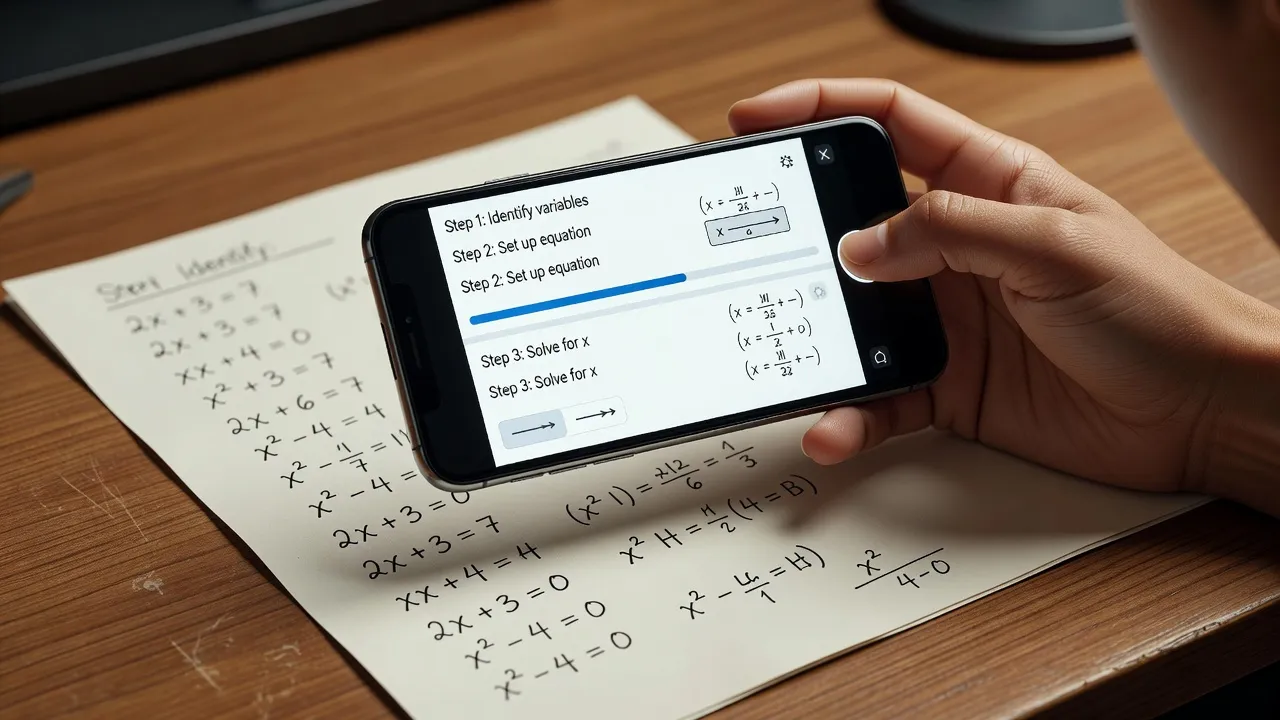
Rather than giving a simple answer, this step-by-step method mirrors the reflective nature of classroom warm-ups. If a student needs a reliable study helper during late-night assignment sessions, digital solvers keep them from getting stuck or procrastinating.
How to implement a question of the day routine without losing instructional time
Implementing a daily prompt routine often fails when discussions drag on past the intended time limit. To keep your schedule intact, establish strict timing rules and visual boundaries from day one.
Follow these three structured steps to run an efficient daily routine:
- Set up a fixed posting location: Always display the question of the day in the exact same spot, such as the upper left corner of the front whiteboard or the opening slide of your presentation deck.
- Limit response windows to 3 minutes: Use a visual countdown timer projected on the screen. Students should enter, read the prompt, and write their answer immediately without waiting for instructions.
- Use structured share-outs: Instead of calling on every hand, use rapid-fire strategies like "cold call three random cards" or "tell your shoulder partner in 15 seconds."
If you run a math classroom, incorporating targeted problem prompts alongside daily questions creates immediate academic focus. For instance, having students solve word problems in math as part of their entry routine builds both literacy and procedural confidence before formal instruction starts.
Frequently Asked Questions
How long should a question of the day exercise take in class?
A standard question of the day routine should take between 3 and 5 minutes total. This includes 2 minutes of silent reading and writing, followed by 1 to 2 minutes of quick student share-outs.
Can question of the day prompts be graded?
Most teachers do not grade daily questions for accuracy, choosing instead to mark them on a simple complete or incomplete scale for participation points. Keeping prompts ungraded encourages honest self-expression and prevents fear of failure.
What is the best way to collect responses from quiet or introverted students?
Using anonymous digital forms, mini whiteboards, or sticky notes allows quiet students to share their thoughts without the pressure of speaking aloud in front of the entire class.
How do daily questions help with classroom management?
Daily questions establish an immediate routine the moment students cross the threshold. By giving learners a clear task right away, teachers reduce transition noise and start class with focus.
Should daily questions always connect to the academic subject?
No, mixing academic warm-ups with fun or personal preference prompts keeps the routine fresh. A common pattern is using fun icebreakers on Mondays and Fridays, while reserving midweek prompts for subject concepts.
How far in advance should a teacher plan daily prompts?
Planning prompts two to four weeks in advance ensures questions align with curriculum units and upcoming school events, saving daily prep time.