
A narrative essay is an academic paper that tells a structured story from a specific point of view to convey a central message or thesis. Unlike fictional stories, narrative essays are almost always grounded in real personal experience and use storytelling elements like plot, dialogue, and character development to make a point.
| Stage | Content |
|---|---|
| 1. Exposition | Sets the scene, introduces thesis |
| 2. Climax & Conflict | Key turning point & sensory detail |
| 3. Reflection | What was learned; answers "so what?" |
The narrative arc shows how personal experience drives thesis. Exposition flows into Climax & Conflict, which flows into Reflection.
When professors or high school teachers assign narrative essays, they are not just asking for a summary of your weekend. They want to see how you synthesize a personal event, extract meaning from it, and present that growth logically. If you are exploring different types of writing for your English class, understanding the boundaries of narrative writing is the best place to start.
Core Elements That Define a Narrative Essay
Every personal narrative relies on specific storytelling tools to hold the reader's attention and deliver its core message. Without these structural elements, a essay quickly turns into an unstructured journal entry.
- Point of View: Narrative essays are usually written in the first person ("I" or "we"). This places the reader directly inside your perspective.
- Clear Plot Arc: The paper follows a logical sequence, typically chronological, moving through an introduction, rising action, a climax, and a resolution.
- Sensory Detail: Effective narratives use sight, sound, smell, touch, and taste to create an immersive scene rather than just stating facts.
- Reflective Thesis: The entire story serves a single overarching point or takeaway. The essay must answer the fundamental question: "So what?"
According to Purdue OWL's writing guide, a narrative essay is always driven by a purpose, which is usually stated clearly in the opening paragraph. If you strip away the purpose, you no longer have an essay; you just have an anecdote.

What is the difference between a narrative essay and other essay types (expository, descriptive, persuasive)?
The core difference is that a narrative essay uses a personal, chronological storyline to deliver its central message, whereas other essay types rely on objective explanations, pure sensory imagery, or logical arguments. While a narrative tells a real story about what happened, expository writing explains a topic, descriptive writing paints a visual picture, and persuasive writing argues a specific claim.
As of August 2026, most standardized English composition rubrics evaluate these four major genres based on purpose, structure, and tone. The table below breaks down how narrative essays compare to other standard academic writing formats:
| Essay Type | Primary Goal | Structural Focus | Typical Point of View | Primary Evidence |
|---|---|---|---|---|
| Narrative Essay | Tell a meaningful personal story | Chronological plot arc with a climax and reflection | First Person ("I", "We") | Personal experience and sensory detail |
| Expository Essay | Explain or inform about a topic objectively | Problem-and-solution, cause-and-effect, or process | Third Person ("He", "She", "They") | Statistics, expert facts, and research data |
| Descriptive Essay | Paint a detailed picture of a person, place, or object | Spatial organization or sensory breakdown | First or Third Person | Vivid sensory descriptions and figurative language |
| Persuasive Essay | Convince the reader to agree with a stance | Thesis claim followed by argument paragraphs | Third Person (rarely First Person) | Studies, logical reasoning, and counterarguments |
For instance, if your teacher assigns a topic on public transportation, your approach changes entirely depending on the genre. A narrative essay focuses on a specific, life-changing bus ride you took last summer and what it taught you about independence. Conversely, if you browse persuasive writing essay topics, you would write an argumentative essay arguing why city councils should double their public transit budgets using municipal budget data.
The Anatomy of a Narrative Essay Structure
Structuring a personal narrative requires balancing the flow of a story with the clear organization of an academic essay. In 2026, academic guidelines from major university writing centers continue to emphasize that a narrative essay must maintain a clear thesis despite its storytelling format.
-
Introduction
- Hook: Grabs reader attention
- Context: Sets time, place, and people
- Thesis Statement: Core takeaway/lesson
-
Body Paragraphs
- Rising Action: Building the tension or problem
- Climax: The central moment or turning point
- Falling Action: Immediate aftermath
-
Conclusion
- Resolution: How the situation wrapped up
- Reflection: Deep analysis of personal growth
1. The Introduction and Thesis
The introduction establishes the setting, introduces the main players, and hooks the reader with immediate action or intrigue. You should avoid slow preamble like "In this essay, I will tell you about the time I broke my leg." Instead, start in the middle of a scene or right before a major event occurs.
Your thesis statement usually sits at the end of this opening paragraph. Unlike a persuasive thesis, a narrative thesis outlines the lesson or emotional shift resulting from the event.
2. The Body Paragraphs and Rising Action
Body paragraphs move the storyline forward while inserting concrete details and dialogue. Each paragraph should cover a specific phase of the timeline.
- Establish tension: Show the obstacles, confusion, or conflict you faced.
- Incorporate sensory details: Name specific objects, sounds, and physical reactions to bring the reader into the room.
- Reach the climax: Dedicate a specific paragraph to the turning point of your experience where everything changes.
The Harvard Writing Center's essay resources highlight that reflection is what elevates a personal story into an academic essay. Do not just state what happened step-by-step; show how you felt and thought during those critical moments.
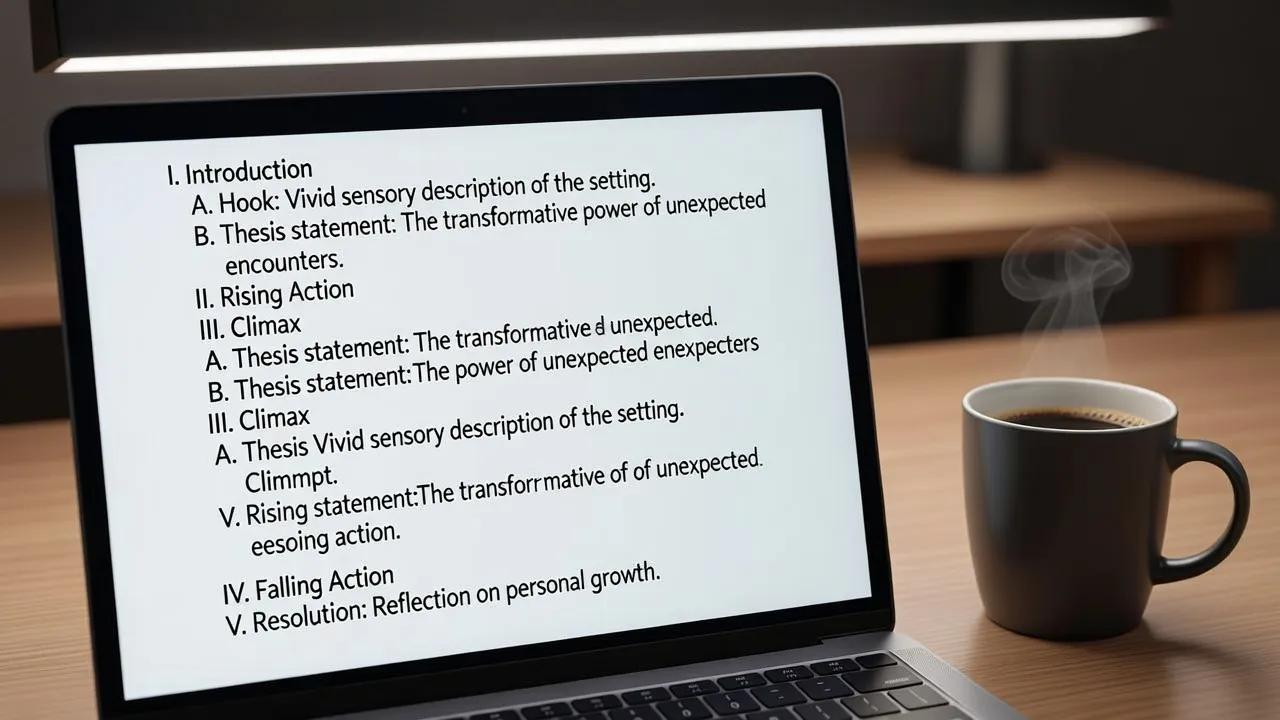
3. The Conclusion and Reflection
The conclusion provides the resolution and answers why this story was worth telling in the first place. It ties the final outcome directly back to your thesis statement.
In this section, step out of the past timeline and speak from your present perspective. Explain how that past moment shaped your current worldview, choices, or values.
When Personal Anecdotes Work (and When They Exceed Assignment Boundaries)
Not every prompt allows for a personal narrative, and using one when it is forbidden can sink your grade. Understanding the strict boundaries of narrative essays saves you from submitting the wrong assignment format.
| Is a narrative appropriate? | |
|---|---|
| Allowed | Ruled Out / No |
| • "Describe an obstacle..." | • "Analyze primary sources..." |
| • Personal statements / college | • Research papers / lab reports |
| • English Composition prompts | • Policy analysis / economics |
Personal narratives are ideal for college application essays, scholarship prompts, and creative composition courses. These prompts explicitly ask for personal experiences, such as "Describe a challenge you overcame" or "Discuss a moment your perspective shifted."
Personal narratives are strictly ruled out in empirical, technical, or research-based assignments. If a prompt asks you to analyze a historical document, critique a scientific experiment, or evaluate economic policy, using first-person anecdotes will violate academic formatting requirements. The University of North Carolina Writing Center notes that narrative writing relies on personal memory as evidence, whereas academic research requires verifiable third-party documentation.
Using ThinkAssist to Outline and Brainstorm Narrative Essays
When you are stuck staring at a blank page, organizing your thoughts into a clear storyline can feel overwhelming. This is where modern AI study tools can help you bridge the gap between your raw memories and a polished academic paper.
If you are unsure whether your outline fits narrative essay guidelines, using an AI-Powered Homework Solver like ThinkAssist can help you break down your prompt instantly. You can Snap a Photo of your teacher's assignment sheet or essay rubric, and the app's automatic subject detection will analyze the exact requirements for your submission.
- SNAP A PHOTO — Take a picture of your teacher's essay rubric
- AUTO-DETECT — App identifies story elements & thesis constraints
- STEP-BY-STEP — Get a breakdown of intro, climax, & reflection
- 24/7 TUTOR — Refine your thesis statement and structure
Instead of giving you canned text, ThinkAssist acts as a 24/7 tutor that helps you build step-by-step explanations and solutions for structuring your draft. It helps you check whether your outline has a clear plot arc, a solid thesis, and enough reflective detail to meet your rubric's criteria. You can download ThinkAssist for iOS or learn more on the official ThinkAssist website to get instant assistance with your writing assignments.
Common Pitfalls in Narrative Writing (and How to Fix Them)
Writing a successful narrative essay requires avoiding several common structural mistakes that trap student writers.
- Including Too Much Unnecessary Detail: Mentioning what you ate for breakfast or what shirt you wore drags down the pacing if it does not relate to your central theme. Focus strictly on details that advance the story or build atmosphere.
- Telling Instead of Showing: Writing "I was scared" is weak narrative prose. Instead, show the physical reaction: "My hands shook as I gripped the microphone, and my chest felt tight."
- Forgetting the Thesis/Reflection: Spending four pages telling a story without explaining what you learned leaves the reader wondering why you wrote the paper. Make sure your conclusion dedicates real space to self-reflection.
- Switching Verb Tenses: Jumping between past tense ("I walked into the room") and present tense ("I see my teacher standing there") confuses the reader. Pick one tense—usually past tense—and stay consistent throughout.
If you struggle with structuring your paragraphs correctly, studying real-world narrative essay examples can show you how experienced writers handle pacing and transitions.

Key Steps to Draft Your Essay
If you are ready to write, follow this simple roadmap to complete your essay from start to finish:
- Choose a Specific Moment: Pick a narrow time frame (a single hour, day, or event) rather than trying to summarize an entire year of your life.
- Draft Your Takeaway First: Decide on your reflection or thesis before you write the story so every paragraph moves toward that conclusion.
- Map Out the Timeline: Outline your opening hook, rising tension, climax, and resolution.
- Write the First Draft Fast: Focus on getting the narrative down without overthinking word choice on your first pass.
- Revise for Sensory Detail and Reflection: Read through your draft to add descriptive language and strengthen your conclusion.
Building these habits early will make all your writing assignments much easier to handle.
Frequently Asked Questions
Can a narrative essay be written in the third person?
Yes, a narrative essay can be written in the third person, but it is rare. Most narrative essays rely on first-person point of view ("I" or "we") because they are based on personal experience. Third-person narratives are typically used when you are telling a story about another person's real-life experience to make a broader academic point.
How long should a narrative essay be?
Standard high school and college narrative essays are typically between 500 and 1,500 words long, or about two to five double-spaced pages. Always follow the specific length limits specified in your assignment rubric.
Does a narrative essay need a thesis statement?
Yes, a narrative essay requires a thesis statement. While it may not look like an argumentative claim, a narrative thesis establishes the main lesson, theme, or personal realization that the rest of your story illustrates.
What is the best point of view for a narrative essay?
First-person point of view ("I") is the best choice for a narrative essay. Writing in the first person allows you to share your internal thoughts, emotions, and personal growth directly with the reader.
Can you use dialogue in a narrative essay?
Yes, using dialogue is an effective way to bring characters to life and advance the plot in a narrative essay. Keep dialogue brief and focused only on conversations that highlight the main conflict or theme of your story.
How do I choose a good narrative essay topic?
Choose a specific event or turning point in your life that led to genuine personal growth or a changed perspective. Narrow topics, such as failing your first driving test or learning a tough lesson during a group project, work much better than broad life summaries.