
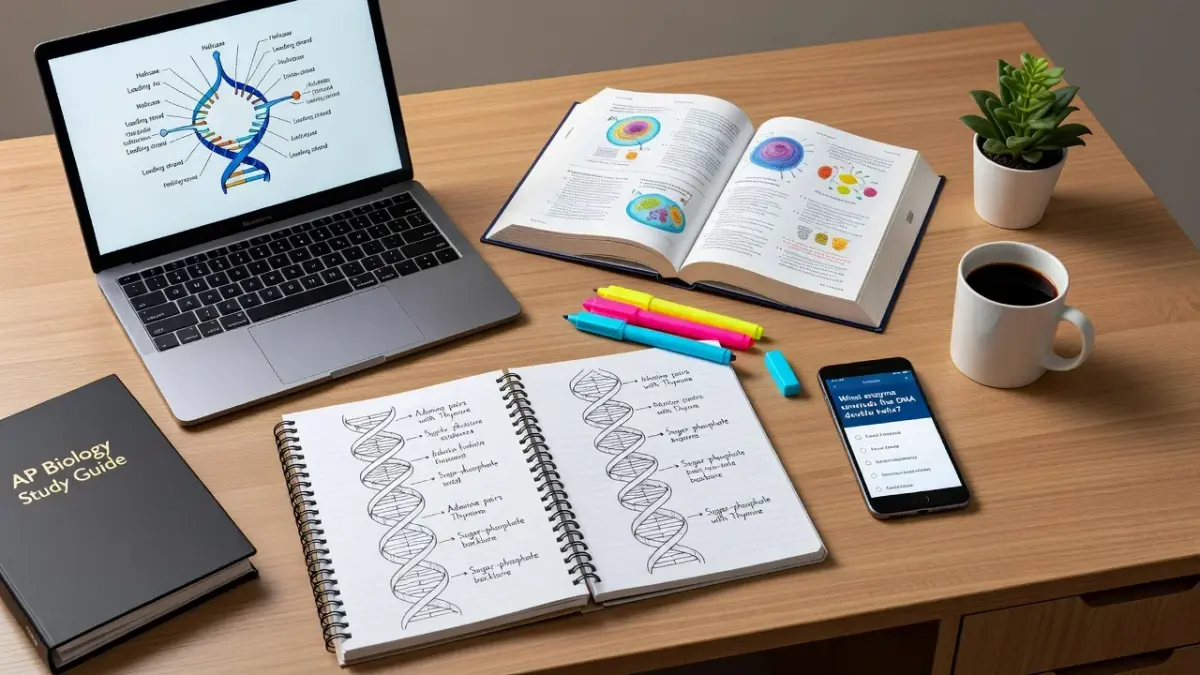
Effective AP Biology exam preparation requires combining College Board conceptual alignment, active data analysis practice, and targeted retrieval tools rather than passively reading textbooks. Studying for the AP Bio test in 2026 means mastering eight core units and six scientific practices across a 3-hour test split evenly between multiple-choice and free-response sections. Combining structured review books with interactive practice apps like ThinkAssist helps students break down hard pedigree charts, signal transduction pathways, and enzyme kinetics step-by-step.
What is the current AP Biology exam format?
The AP Biology exam lasts 3 hours and consists of 60 multiple-choice questions and 6 free-response questions, with each section accounting for 50% of your total score. According to the official College Board AP Biology course description, students receive 90 minutes for Section I (multiple-choice) and 90 minutes for Section II (free-response, which includes a mandatory 10-minute reading period).
Section I consists entirely of discrete individual questions and question sets accompanied by data tables, charts, or experimental diagrams. You are allowed a four-function, scientific, or graphing calculator throughout the entire exam.
Section II features two long free-response questions focused on experimental data interpretation and four short free-response questions covering conceptual analysis, scientific procedures, and visual representations.
| Exam Section | Question Count | Time Allowed | Score Weight |
|---|---|---|---|
| Section I (MCQ) | 60 Questions | 90 Minutes | 50% of Total |
| Section II (FRQ) | 6 Questions | 90 Minutes | 50% of Total |
The 5 best AP Biology prep tools compared for 2026
The most effective AP Biology preparation stack combines a comprehensive content book, an active problem-solving app, and official practice questions. Different tools serve distinct roles during your study plan, ranging from baseline content mastery to rapid error corrections.
| Resource | Best Suited For | Key Strength | Pricing Structure |
|---|---|---|---|
| Barron's AP Biology | Students targeting a 5 who want extra-challenging questions | Extremely thorough content coverage and hard practice exams | ~$20-$25 paperback |
| ThinkAssist | Students who need instant, step-by-step explanations for tricky homework and practice FRQs | Snap a photo to get automated step-by-step breakdown and saved practice logs | Free download; $6.99/week or $29.99/year |
| Khan Academy | Visual learners who want free, officially aligned video modules | Official College Board partner with unit-by-unit practice sets | 100% Free |
| The Princeton Review | Students looking for strategic test-taking techniques and clear summaries | Great test strategies and accessible concept recaps | ~$22-$26 paperback |
| Bozeman Science | Fast audio-visual refreshes before unit quizzes and midterms | High-yield video playlists structured around AP Big Ideas | 100% Free |
What are the best AP Biology review books?
The best AP Biology review books are Barron's AP Biology, The Princeton Review, and 5 Steps to a 5, each offering distinct levels of depth and question difficulty. Selecting the right book depends on whether you need deep conceptual explanations, strategic test-taking shortcuts, or structured study schedules.
Most top-scoring students rely on at least one published prep book alongside active study platforms like an AI homework helper to clarify complex diagrams and experimental scenarios.
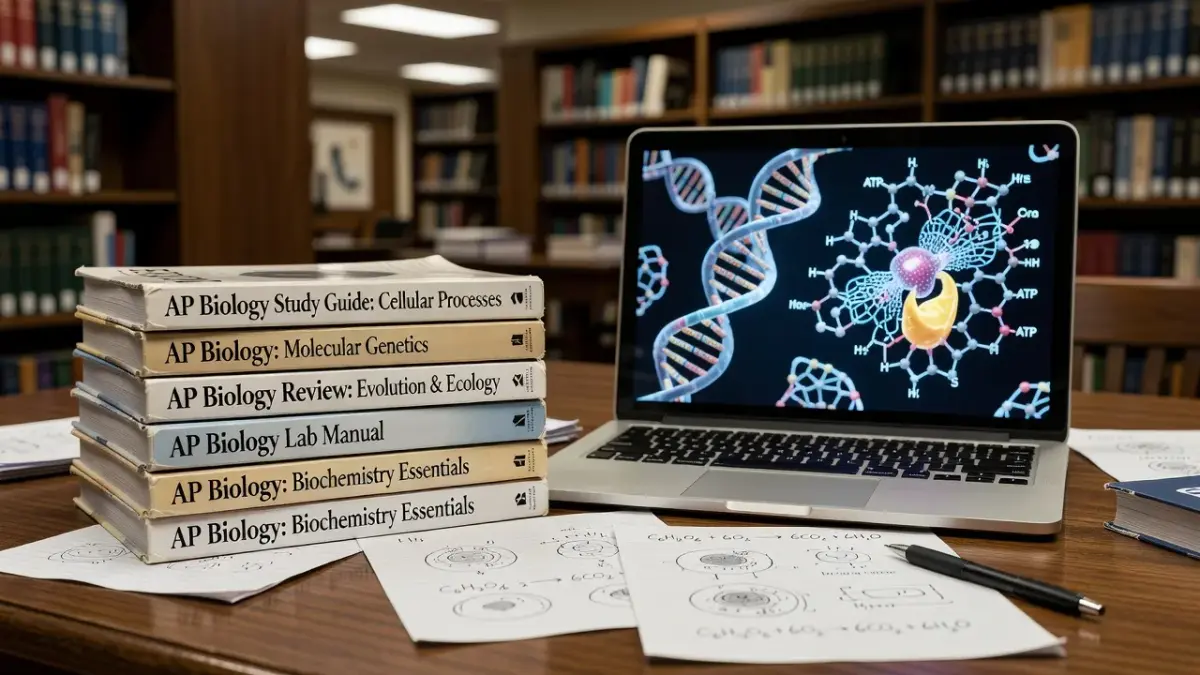
Is the Barron's AP Biology review book good?
Yes, Barron's AP Biology is widely considered the best prep book for students aiming for a score of 5 because its practice questions are notoriously rigorous. The content explanations go deeper into biochemical pathways and cellular genetics than most competing books.
However, its extreme detail can occasionally feel overwhelming if you are starting your review late in the spring semester. The practice tests in Barron's often feature slightly harder data interpretation sets than the actual exam, which builds high resilience for test day.
Is the Princeton Review AP Biology book good?
Yes, The Princeton Review AP Biology book is excellent for students who want clear, concise summaries and proven test-taking strategies. It excels at distilling massive units like Ecology and Cell Communication into digestible core takeaways.
While its practice questions mirror the standard difficulty of the exam reasonably well, some high-achieving students find its biology content recaps a bit too simplified for answering complex FRQs. It serves as a fantastic foundation if you struggle with pacing or exam anxiety.
Is 5 Steps to a 5 AP Biology a good review book?
Yes, 5 Steps to a 5 is a strong choice for students who need a structured daily study schedule and modular planning tools. It offers customized study plans (such as 180-day or 90-day tracks) that prevent cramming.
The main trade-off is that its practice questions are slightly easier than real College Board questions. If you use 5 Steps to a 5, combine it with official released FRQs to ensure you are ready for actual test-level prompts.
Are Bozeman Science, Khan Academy, and AP Classroom good AP Biology resources?
Yes, Bozeman Science, Khan Academy, and AP Classroom form the ultimate free digital triad for AP Biology preparation. Each platform fulfills a specific study need: visual instruction, interactive drilling, and official question exposure.
- Khan Academy: As an official partner of the College Board, Khan Academy's AP Biology course provides video lessons and practice drills matched exactly to the eight AP units.
- Bozeman Science: Hosted by veteran teacher Paul Andersen, Bozeman Science delivers short, high-yield video lectures covering all 56 AP Biology enduring understandings.
- AP Classroom: Provided directly by your AP teacher, this platform gives you access to real past AP questions and topic questions that reflect official grading rubrics.
Using these platforms together prevents blind spots in both theory and application.

How ThinkAssist streamlines AP Biology prep with AI
ThinkAssist acts as a 24/7 personal biology tutor that breaks down complex AP level problems into clear, step-by-step explanations. When working through multi-step genetics problems, enzyme graphs, or signal transduction scenarios, getting stuck on a single concept can halt your entire study session.
By using the ThinkAssist iOS app, you can instantly snap a photo of any practice question or FRQ prompt. The app automatically detects the subject and returns a detailed structural breakdown of the underlying biological principle.
Here is how it fits into your study workflow:
- Snap a photo: Capture any printed or handwritten problem from your prep book or homework worksheet.
- Review step-by-step solutions: Instead of just giving a final answer, the app explains why a specific biological mechanism applies.
- Save for test prep: Past questions and explanations are automatically archived in your account, making it simple to build personalized revision decks before midterms or the final May exam.
If you are building an organized approach to exams, combining automated problem solving with a practical exam prep plan keeps your review schedule stress-free.
THINKASSIST AP BIO STUDY FLOW
The study flow has four steps, run in this order:
- Snap Photo of Question
- AI Auto-Detects Topic. This step sits directly to the right of step 1, and an arrow points from step 1 into it.
- Explains Biological Concept. This step sits directly below step 2, and an arrow points down from step 2 into it.
- Step-by-Step Logic Saved. This step sits to the left of step 3 on the bottom row, and an arrow points left from step 3 into it.
Common AP Biology study mistakes that cost students a 5
The single biggest mistake AP Biology students make is prioritizing rote memorization over experimental data analysis and quantitative reasoning. In the past, AP Biology was largely a vocabulary test. As of 2026, the exam heavily tests your ability to interpret graphs, design experiments, evaluate hypotheses, and calculate error bars.
Here are four critical traps to avoid during your prep:
1. Passive reading instead of active recall
Reading through a 40-page chapter on Photosynthesis feels productive, but it yields low long-term retention. Instead, close your book and draw the light-dependent reactions and Calvin cycle from memory.
Leverage modern study techniques or active recall platforms. If you rely on digital tools, comparing flashcard applications can help you find tools designed specifically for space-repetition learning.
2. Ignoring chi-square and mathematical formulas
Many students panic when they see math on the AP Biology test. You do not need calculus, but you must know how to calculate chi-square statistics, Hardy-Weinberg equilibrium frequencies, water potential, and rate equations.
Practice applying these formulas to real data sets using your calculator until the steps feel automatic.
3. Neglecting the FRQ task verbs
The College Board uses precise "task verbs" in free-response questions: Describe, Explain, Calculate, Identify, and Justify.
- If a prompt asks you to Identify, state the fact briefly.
- If a prompt asks you to Justify, you must provide evidence or biological reasoning to support a claim.
- Failing to match your answer depth to the specific task verb costs easy points, even if your biology knowledge is correct.
4. Studying isolated facts instead of the 4 Big Ideas
AP Biology revolves around four overarching Big Ideas: Evolution, Energetics, Information Storage/Transfer, and System Interactions.
Always ask yourself how a specific topic connects to Evolution. For instance, when studying antibiotic resistance in bacteria, connect the cellular mechanism back to natural selection and allele frequency shifts.
Frequently Asked Questions
What is the hardest unit in AP Biology?
Unit 3 (Cellular Energetics) and Unit 6 (Gene Expression and Regulation) are widely considered the hardest units in AP Biology. They require a deep understanding of multi-step biochemical processes like cellular respiration, photosynthesis, transcription, translation, and operon regulation.
Can you use a calculator on the AP Bio exam?
Yes, you can use a four-function, scientific, or graphing calculator on both sections of the AP Biology exam. Make sure you are familiar with basic functions such as square roots and exponents for genetic and statistical calculations.
How many hours should I study for the AP Biology exam?
Most teachers recommend dedicating 40 to 60 total hours of targeted review spread across the two months leading up to the May exam. Breaking this down into 45-minute daily sessions yields much higher retention than weekend cram sessions.
Is self-studying for AP Biology realistic?
Yes, self-studying for AP Biology is entirely realistic if you possess strong self-discipline and use structured resources. Combining a comprehensive review book like Barron's with online video modules and step-by-step problem solvers like ThinkAssist gives self-studiers everything needed to earn a 5.
What score do you need on AP Biology to get college credit?
Most colleges offer credit or advanced placement for a score of 4 or 5 on the AP Biology exam. Some universities accept a score of 3 for introductory non-major science credit, but competitive STEM programs typically require a 4 or 5.
Is AP Biology harder than AP Chemistry?
AP Biology involves a higher volume of reading comprehension and conceptual analysis, whereas AP Chemistry involves more abstract mathematical problem solving. Students who excel at analytical reading and memorization often find AP Biology more manageable than AP Chemistry.