
Studying for finals successfully requires a structured 14-day study plan built around active recall, spaced repetition, and targeted practice exams rather than late-night re-reading. By breaking your syllabi into daily review blocks and testing yourself on weak concepts early, you can retain complex material across multiple subjects without running into cognitive overload. This step-by-step guide outlines the exact schedule, tools, and retrieval methods you need to maximize your exam scores without burning out.
Finals Prep Steps at a Glance
Organizing your final exam preparation prevents the last-minute panic that destroys memory retention. The table below outlines each phase of a complete 14-day finals strategy, including the time required and the main constraint that rules out ineffective habits.
| Step | Realistic Time Required | Primary Focus | Main Constraint / Limit to Watch |
|---|---|---|---|
| 1. Syllabus Audit | 1 to 2 hours | Grade weighting & weak-spot triage | Limited time prevents equal focus on every subject |
| 2. 14-Day Schedule | 30 minutes to set up | Spaced repetition schedule | Cognitive fatigue caps effective daily study at 4-5 hours |
| 3. Active Recall | 1.5 to 2 hours per session | Practice tests & self-quizzing | Passive highlighting provides zero long-term retention |
| 4. Problem Breakdown | 45 minutes per subject | Step-by-step error analysis | Memorizing steps without concept mastery leads to test failure |
| 5. Strategic Breaks | 5 to 15 minutes per hour | Mental recovery & memory consolidation | Studying past 90 minutes continuously drops focus by over 50% |
| 6. Exam Simulation | 1 to 2 hours per subject | Timed practice under quiet conditions | Open-book practice builds false confidence for closed-book exams |
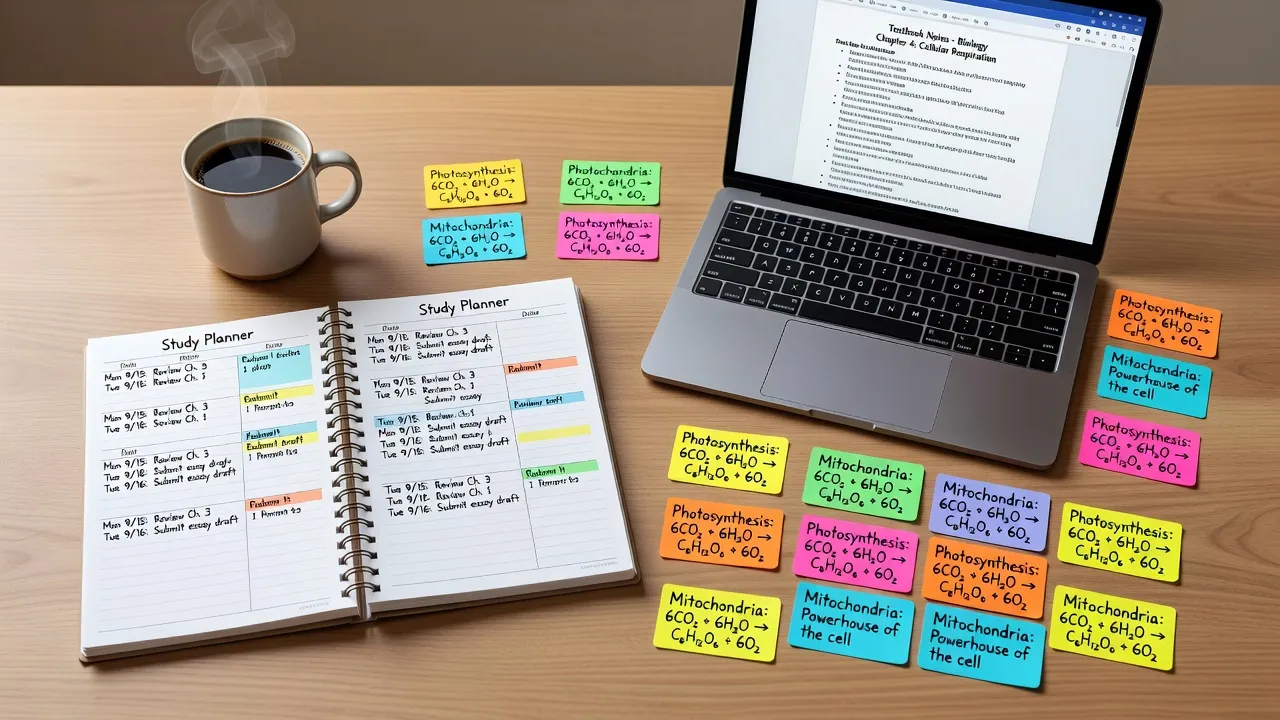
Step 1: Audit Your Syllabi and Calculate Your Target Grades
Auditing your syllabi allows you to prioritize subjects based on grade impact rather than personal comfort. Calculate your current grade in every class and determine the exact score you need on the final exam to maintain or raise your final letter grade.
Focusing equally on every class is the single biggest mistake students make during exam season. If you hold a secure 96% in introductory psychology but sit at a fragile 71% in organic chemistry, spending equal time on both guarantees a lower cumulative GPA.
List every exam date, total grade percentage weight, and test format (multiple choice, essay, or problem sets). If a final counts for 40% of your grade, it earns top priority in your schedule. If a final counts for only 10% and cannot change your final letter grade regardless of the score, cap your review time at two hours maximum.
Step 2: Build a 14-Day Spaced Repetition Schedule
Building a 14-day study schedule relies on spaced repetition to move information from short-term memory into long-term recall. Spacing your study sessions over two weeks allows your brain to consolidate neural connections during sleep cycles.
Instead of assigning whole days to single subjects, study two to three subjects per day in 45-minute blocks. The academic research behind spaced repetition confirms that reviewing a single topic four times for 30 minutes over a week creates far stronger neural pathways than studying that topic once for two continuous hours.
Organize your review blocks inside a digital planner or dedicated assignment tracker. If you need help organizing your deadlines across multiple classes, exploring dedicated tools like homework planner apps can keep your daily study blocks on schedule.
How many hours a day should you study for finals?
You should study between 3 to 5 hours total per day during finals week, divided into shorter 45-minute sessions. Pushing past five hours of intense cognitive focus yields diminishing returns and increases task fatigue.
Your brain requires rest intervals to process complex inputs. Splitting five hours into two morning sessions and two afternoon sessions yields significantly higher retention rates than doing five consecutive hours at night.

Step 3: Replace Passive Reading with Active Recall Methods
Active recall forces your brain to retrieve information without looking at the answer key, which forms the core of effective study tips for final exams. Passive methods like re-reading textbooks, highlighting paragraphs, and looking over completed notes create an illusion of competence without building real memory strength.
Close your notebook and write down everything you remember about a subtopic on a blank sheet of paper. Compare your written notes against the textbook to identify immediate knowledge gaps.
Convert your lecture slides into self-quizzing flashcards. Ask yourself conceptual "why" and "how" questions rather than simple definition matches to prepare for high-level exam prompts.
How do practice tests improve exam retention?
Practice tests improve exam retention by triggering the retrieval effect, which forces the brain to rebuild memory pathways under realistic conditions. The Cornell University Learning Strategies Center emphasizes that self-testing highlights exact weaknesses before you sit for the actual exam.
Complete practice problems without checking your notes mid-way through. If you get an answer wrong, analyze why your logic failed before trying a fresh problem set.
Repeat missed practice questions two days later. Overcoming initial retrieval difficulty is what locks the correct problem-solving process into your memory.
Step 4: Deconstruct Hard Problem Sets with Step-by-Step AI Solvers
Deconstructing complex stem and math problems requires breaking down every formula step rather than guessing at final answers. When practice exams contain dense calculations or multi-step derivations, hitting a wall on one problem can stall your entire study session.
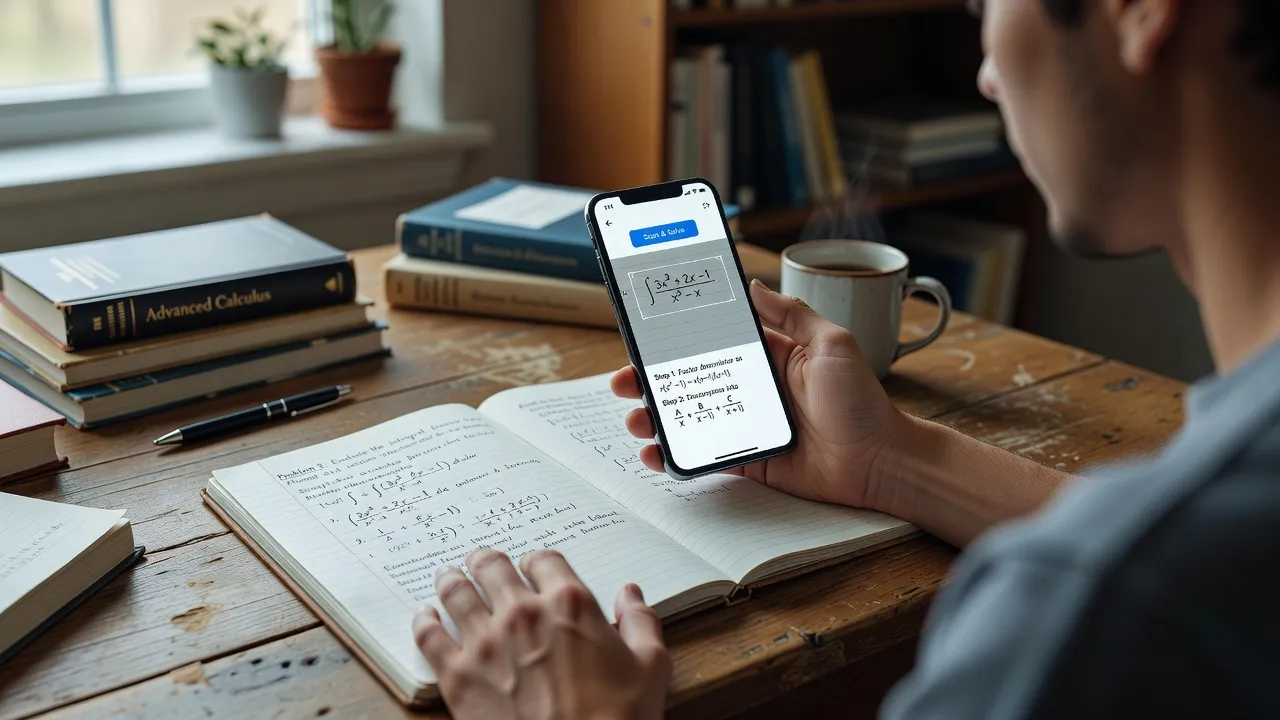
Using AI study technology like ThinkAssist helps clarify confusing problem logic in real-time. You can snap a photo of a handwritten physics equation or chemistry conversion problem to receive instant step-by-step explanations and automatic subject detection.
- Student captures a photo of a problem (Student Snap)
- AI automatically detects the subject matter (Automatic Subject Detection)
- AI breaks down the problem using step-by-step logic (Step-by-Step Logic Breakdown)
- The solution is saved to an exam prep folder (Saved to Exam Prep Folder)
As of October 2026, relying solely on static answer keys often leaves students guessing how an intermediate step was derived. Having a 24/7 tutor on your phone allows you to resolve confusion instantly, and saving past step-by-step answers directly in the app makes review seamless when test day arrives. You can start reviewing with a free download and a 3-day free trial on the ThinkAssist iOS App, after which full access is $6.99 per week.
Step 5: Implement Structured Study Breaks to Prevent Burnout
Structured study breaks prevent mental exhaustion and keep your brain operating at maximum focus throughout long review days. Working continuously without pause causes cognitive exhaustion, which degrades your capacity to solve multi-step analytical problems.
Adhere strictly to the Pomodoro Technique: work with complete focus for 25 to 50 minutes, then take a mandatory 5 to 10-minute break. Step away from your desk entirely during these intervals—do not scroll on social media or remain seated in the same room.
According to research from the UNC Learning Center, physical movement during study breaks restores executive brain function. If you struggle with attention fatigue or task paralysis while studying, implementing specialized ADHD study skills and choosing effective study break ideas will significantly improve your overall stamina.
Step 6: Simulate Test Day Conditions Under Strict Time Constraints
Simulating real test conditions trains your mind to manage time pressure and eliminates test anxiety. Run at least one full-length practice exam under identical constraints to your upcoming final exam.
Set an countdown timer equal to the official exam duration. Clear your workstation of all unauthorized materials, textbooks, search engines, and notes.
- No Distractions: Turn off your smartphone notifications and close all unrelated computer tabs.
- Strict Timing: Move past stuck questions immediately and return to them only if time permits.
- Realistic Scoring: Grade your test strictly using the official course rubric to identify remaining blind spots.
Reviewing your mistakes under timed pressure reveals whether your errors stem from content gaps or poor time management. Adjust your remaining study days to address whichever factor cost you the most points.
Step 7: Conduct a Final Pre-Exam Review and Fix Sleeping Schedules
Conducting a light review the night before an exam consolidates your memory without overloading your cognitive capacity. Pulling all-nighters right before finals severely impairs logical reasoning and working memory capacity during the actual test.
As of the Fall 2026 academic term, cognitive sleep studies consistently show that students who sleep 7 to 8 hours before a final score significantly higher than peers who trade sleep for extra late-night cramming. Sleep is the precise phase where your brain consolidates information studied throughout the day.
Review your summary formula sheets and key concept maps for 60 minutes before bed. Set two separate alarms, prepare your stationery and student ID the night before, and give your mind time to rest.
Frequently Asked Questions
How early should you start studying for final exams?
You should start studying for final exams at least two weeks (14 days) before your first exam date. Starting two weeks early allows you to use spaced repetition across multiple subjects without needing to cram.
Is cramming effective for final exams?
Cramming is not effective for final exams because short-term memorization fails rapidly under stress and fails to build long-term retention. Cramming often causes cognitive fatigue, leading to careless mistakes on complex or multi-step exam questions.
How do you study for finals when you have no motivation?
You can overcome low motivation by using the "5-minute rule" and breaking your study material into micro-tasks. Tell yourself you only have to study for five minutes; once you overcome initial task paralysis, momentum makes continuing much easier.
How many finals should you study for in one day?
You should study for a maximum of two to three different finals in a single day. Rotating between distinct subjects (like switching from biology to history) prevents mental fatigue and prevents concept confusion.
What is the best study method for final exams?
The best study method for final exams is combining active recall with spaced repetition and self-testing. Practice testing and teaching concepts out loud consistently outperform passive reading and highlighting in academic studies.
Should you pull an all-nighter before a final exam?
No, you should never pull an all-nighter before a final exam because sleep deprivation impairs cognitive function, memory retrieval, and focus. A well-rested brain retrieving 80% of reviewed content will score higher than an exhausted brain trying to recall 100% of crammed content.
How do you stop forgetting math formulas during finals?
You stop forgetting math formulas by practicing their step-by-step applications instead of trying to memorize raw equations. Deriving formulas through repeated problem sets builds conceptual understanding that is much harder to forget under test stress.