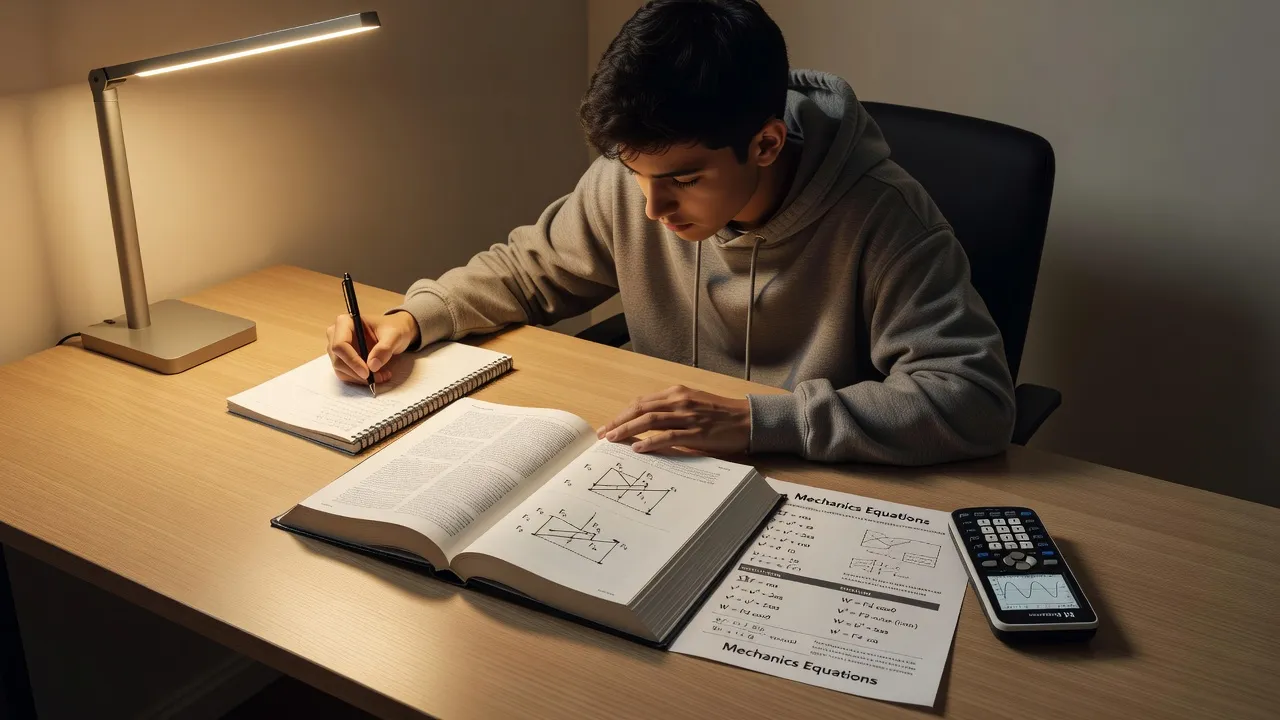
An AP Physics 1 review is a structured study plan focused on mastering algebra-based mechanics concepts, experimental design, and quantitative reasoning. Unlike traditional physics prep that relies heavily on formula memorization, reviewing for AP Physics 1 requires explaining why physical phenomena occur through written justifications and graphical analysis. Preparing effectively involves pairing official College Board practice materials with targeted problem-solving apps like ThinkAssist to break down complex free-response questions step-by-step.

What are the best AP Physics 1 review books (Princeton Review, Barron's, 5 Steps to a 5)?
The best AP Physics 1 review books are The Princeton Review for overall strategy, 5 Steps to a 5 for structured study schedules, and Barron's for rigorous extra practice. Each book caters to a different academic need, so your choice depends on whether you struggle with core concepts or need harder practice problems.
- The Princeton Review (Premium Edition): Excellent for conceptual explanations and test-taking strategies. The practice questions closely match the tone of actual exam questions, making it the best all-around choice for most students.
- 5 Steps to a 5: Ideal for students who struggle with pacing and time management. It provides clear study plans (5-minute daily drills, 1-semester plans) and breaks down complex paragraph-argument free-response questions (FRQs) cleanly.
- Barron's AP Physics 1: Best for students aiming for a top score who want challenging drills. However, its math difficulty often exceeds what the actual exam requires, which can overwhelm students who are already struggling with basic kinematics.
When selecting a book, check the publication year to ensure alignment with current AP standards. As of October 2026, recent updates to the AP Physics 1 curriculum place heavier weight on fluids and rotational motion, so older prep books may omit critical topic coverage.
Does College Board offer released AP Physics 1 practice exams (free response and multiple choice)?
Yes, the College Board provides past free-response questions (FRQs) publicly, but full released multiple-choice exams are strictly restricted to authorized AP teachers. You can download every official FRQ prompt, scoring rubric, and sample student response directly from the official College Board AP Central repository for free.
How to use official free-response questions
Official FRQs are the single most valuable resource for understanding how AP graders award points. Reviewing the rubric reveals exactly which keywords and scientific claims earn credit on multi-part problems.
- Practice under real conditions: Set a timer for 15 minutes per short FRQ and 25 minutes for experimental design questions.
- Grade your work against official rubrics: Check whether you included vector directions and explicit reasoning.
- Study high-scoring student samples: Read the actual student responses provided on AP Central to see how concise passing answers look.
How to access full multiple-choice practice tests
Because College Board keeps complete multiple-choice sections secure to re-use questions, students cannot download full secure exams online. Your AP Physics teacher can unlock secure practice exams inside the official student portal during the spring term.
Is Khan Academy's AP Physics 1 course a good review resource?
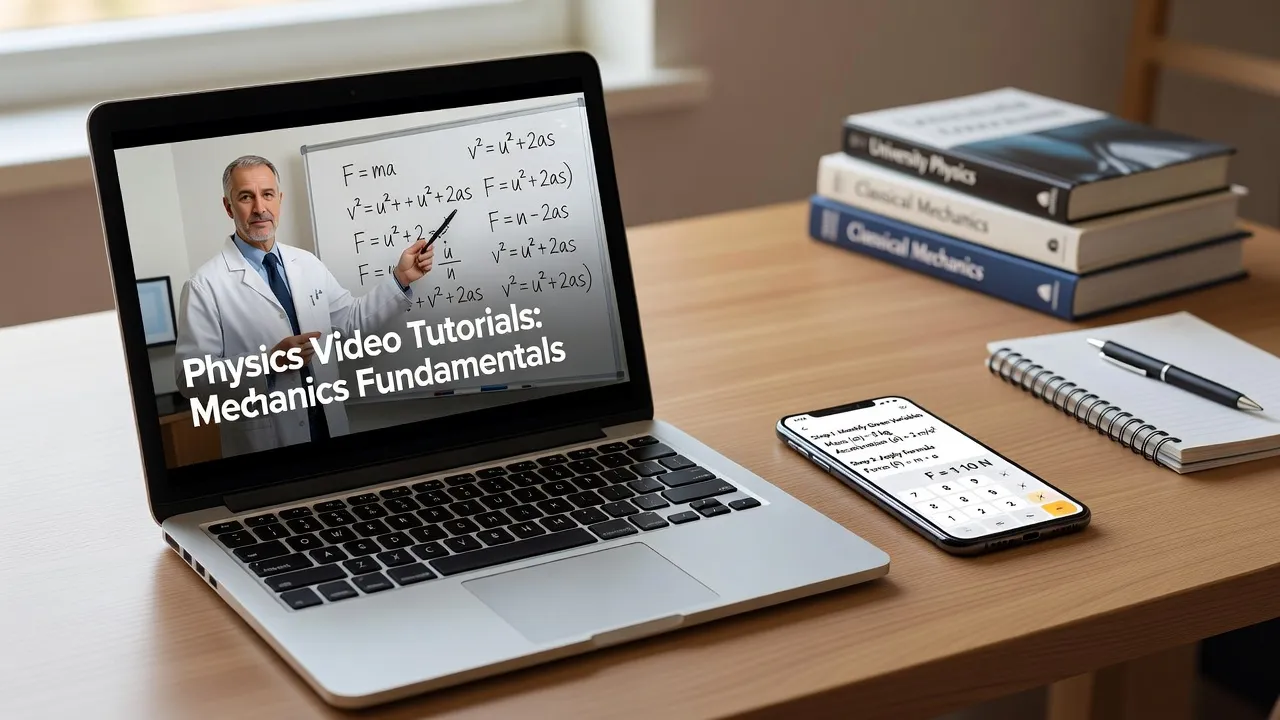
Yes, Khan Academy's AP Physics 1 course is an excellent free review resource that directly aligns with the College Board course framework. It offers unit-by-unit video tutorials, instant-feedback practice exercises, and full module quizzes created in partnership with AP educators.
According to the official Khan Academy AP Physics 1 course outline, the platform covers fundamental units ranging from kinematics and dynamics to simple harmonic motion and momentum.
- Instant feedback: Every practice problem includes step-by-step mathematical hints if you get stuck.
- Mastery tracking: The platform identifies specific conceptual gaps based on your incorrect practice answers.
- Limitations: Khan Academy focuses heavily on mathematical calculations and lacks sufficient practice for long-form paragraph-argument FRQs.
For daily assignment help alongside Khan Academy, using the ThinkAssist iOS app allows you to snap photos of tricky physics problems to get instant explanations and step-by-step logic breakdowns on your phone.
Are Albert.io's AP Physics 1 practice questions useful for review?
Yes, Albert.io is one of the most useful paid practice banks for AP Physics 1 because its questions emphasize conceptual reasoning over simple arithmetic. The platform organizes hundreds of original AP-style items into three distinct difficulty tiers: Easy, Moderate, and Hard.
As detailed on the Albert.io AP Physics 1 practice page, every question features detailed explanations for both correct and incorrect answer choices.
- Strengths: High volume of data-interpretation graphs, free-body diagram practice, and rigorous conceptual stems.
- Constraints: Albert.io requires an active school license or individual paid subscription, making it less accessible for students on a tight budget.
- Best Use Case: Use Albert.io after reviewing basic concepts in your textbook to test whether you can apply those concepts to unfamiliar scenarios.
Are Bozeman Science's Paul Andersen AP Physics 1 videos helpful?
Yes, Paul Andersen's Bozeman Science video series is exceptionally helpful for quickly reviewing core AP Physics 1 concepts. His videos break down complex physical relationships using visual demonstrations, real-world animations, and clear board work.
Why students prefer Bozeman Science for quick review
Paul Andersen structures each video around specific AP Learning Objectives defined by the College Board. His 10-to-15 minute video length makes them ideal for targeted topic reviews right before classroom unit tests.
- Visual demonstrations: He uses physical props to demonstrate rotational inertia, wave superposition, and torque.
- Graphic organizers: Many videos feature concept maps that connect force diagrams to energy conservation.
- Clear pacing: He speaks clearly and avoids overly dense mathematical jargon during conceptual overviews.
Where video review falls short
While watching videos builds intuitive understanding, it cannot replace active problem-solving. You must pair video review with hands-on practice, working through an ap physics 1 frq study guide and solving multi-step equations on paper.
What resources does AP Classroom provide for AP Physics 1 review?
AP Classroom provides official Personal Progress Checks (PPCs), topic questions, and teacher-assigned practice tests directly from the College Board. Because your AP teacher controls access, these materials represent the closest match to the actual national exam questions you will see in May.
- Personal Progress Checks (PPCs): Multiple-choice and free-response quizzes assigned at the end of each unit to evaluate topic mastery.
- Question Bank: A massive database of past AP questions that your teacher can assemble into custom review quizzes.
- AP Daily Videos: Concise, official 5-to-10 minute topic lectures taught by experienced AP Physics teachers nationwide.
Make sure to ask your teacher early in the spring semester to unlock all AP Classroom progress checks so you can practice on your own schedule.
Comparing top AP Physics 1 review tools and platforms
Choosing the right combination of review materials depends on your budget, your target score, and where you currently struggle most in the course.
| Review Tool | Primary Focus | Best For | Price / Accessibility |
|---|---|---|---|
| Princeton Review Book | Test strategy & full practice tests | Overall exam prep and timing strategy | ~$25 - $35 on Amazon |
| ThinkAssist App | AI photo solver & step-by-step tutoring | Daily homework help & instant step-by-step FRQ explanations | Free download; 3-day trial then $6.99/wk |
| Khan Academy | Structured unit lessons & basic practice | Building foundational physics concepts | 100% Free online |
| Albert.io | High-volume AP-style question bank | Rigorous multiple-choice practice | Paid subscription / School license |
| AP Classroom | Official College Board items & videos | Authentic exam alignment | Free (Requires teacher assignment) |
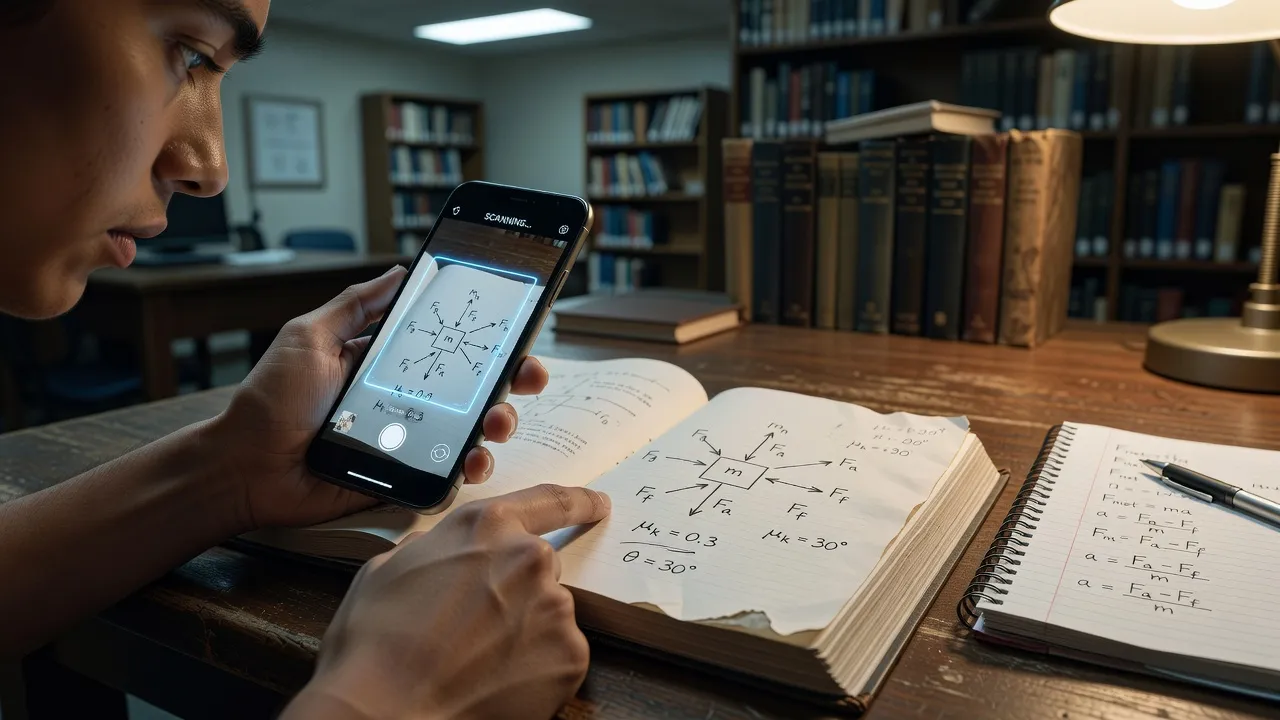
If you find yourself stuck on complex multi-step physics problems while studying late at night, I recommend downloading ThinkAssist on your phone. Its automatic subject detection lets you photograph any physics diagram or equation and get immediate step-by-step guidance 24/7.
How to build an effective AP Physics 1 review schedule
An effective AP Physics 1 review schedule spans six to eight weeks, focusing heavily on weak units and weekly FRQ writing practice. Trying to cram physics concepts in the final week rarely works because the exam tests analytical thinking rather than memorized facts.
Phase 1: Topic diagnostic and formula review (Weeks 1-2)
Start by identifying which units cause you the most trouble. Review the official ap physics 1 reference sheet to ensure you understand what each variable represents and when specific formulas apply.
- Kinematics & Dynamics: Ensure you can resolve forces into components on inclined planes.
- Work, Energy, & Momentum: Practice converting mechanical energy equations into conservation of momentum setups.
- Rotational Motion: Focus on torque balance equations and rotational inertia relationships.
Phase 2: Targeted practice and FRQ mastery (Weeks 3-5)
Spend this phase working through targeted topic sets on Khan Academy or Albert.io while practicing at least two official FRQs every week.
- Paragraph Argument FRQs: Practice writing coherent explanations using the "Claim, Evidence, Reasoning" structure.
- Experimental Design FRQs: Practice describing lab procedures, naming measured quantities, and identifying error sources.
- Quantitative/Qualitative Translation: Focus on explaining how changing a mathematical variable in an equation alters physical behavior.
Phase 3: Timed practice exams and final review (Weeks 6-8)
During the final month before the exam, take at least two full-length timed practice tests to build mental stamina.
- Simulate realistic test conditions: Sit in a quiet room, time both sections strictly, and use only an approved scientific or graphing calculator.
- Analyze every missed question: Keep an error log documenting whether you made an algebraic mistake, misread the prompt, or misunderstood a physics concept.
- Review saved solutions: Use modern study tools like best physics solver apps to double-check line-by-line calculations for problems you got wrong during practice drills.
Mastering basic physics equations and practicing regularly ensures you approach exam day with confidence.
Frequently Asked Questions
Is AP Physics 1 hard to pass?
Yes, AP Physics 1 is widely considered one of the hardest AP exams, historically having one of the lowest pass rates among all Advanced Placement subjects. The exam tests deep conceptual understanding, graphical analysis, and written scientific arguments rather than straightforward mathematical calculations.
What score do you need on AP Physics 1 to get college credit?
Most colleges and universities grant credit for a score of 4 or 5 on the AP Physics 1 exam. Some institutions accept a score of 3 for general elective credit, but science and engineering majors often require higher scores or specific course equivalencies.
What units are covered on the AP Physics 1 exam?
The AP Physics 1 exam covers Kinematics, Forces and Newton's Laws of Motion, Work, Energy, and Power, Linear Momentum, Rotational Motion, Simple Harmonic Motion, and Fluids. Checking current College Board guidelines is essential as course scope can adjust over time.
How is the AP Physics 1 exam structured?
The AP Physics 1 exam consists of two sections: a 90-minute multiple-choice section with 40 questions and a 90-minute free-response section with 4 questions. Both sections account for 50 percent of your overall composite exam score.
Can you use a calculator on the AP Physics 1 exam?
Yes, you are allowed to use a four-function, scientific, or graphing calculator on both the multiple-choice and free-response sections of the AP Physics 1 exam. You are also provided with an official equation sheet and constants list.
How much math do you need for AP Physics 1?
AP Physics 1 requires a strong foundation in Algebra I, Geometry, and basic Algebra II concepts like trigonometry and vector decomposition. You do not need calculus, as AP Physics 1 is entirely algebra-based.
How many hours should I study for the AP Physics 1 exam?
Most students need between 30 to 50 hours of dedicated review spread across 6 to 8 weeks leading up to the May exam. Consistent, daily practice with AP-style free-response questions yields much better results than last-minute cramming.
What is the difference between AP Physics 1 and AP Physics C?
AP Physics 1 is an algebra-based course covering mechanics and introductory fluids, designed for students taking high school physics for the first time. AP Physics C is a calculus-based sequence split into Mechanics and Electricity & Magnetism, intended for future engineering and physical science majors.