
Edgenuity chemistry answers are step-by-step problem solutions, answer keys, and conceptual guides that help students solve coursework inside Imagine Edgenuity's high school chemistry curriculum. While static answer keys often fail due to randomized question variables, step-by-step AI solvers break down the underlying chemical equations so students can pass unit tests independently.
Navigating online high school courses can feel isolating, especially when you encounter complex topics like stoichiometry or gas laws. As of September 2026, online learning platforms frequently update their question banks, which makes relying on static answer lists risky and often inaccurate. Using a real-time study tool like ThinkAssist lets you snap a photo of any question to receive instant, detailed explanations rather than guessing at unverified key dumps.

What is Edgenuity chemistry and how is the course structured?
Edgenuity chemistry is an online high school course covering core physical science principles through video lectures, interactive lab simulations, quizzes, and cumulative exams. The platform breaks high school chemistry into structured modules that evaluate both conceptual knowledge and quantitative calculations.
The curriculum is typically split into two semesters covering foundational and advanced concepts:
- Atomic structure and periodic trends: Students analyze subatomic particles, electron configurations, and periodic table patterns.
- Chemical bonding and reactions: Lessons cover ionic, covalent, and metallic bonds, alongside balancing synthesis and decomposition equations.
- Quantitative chemistry: Coursework dives heavily into mole conversions, reaction yields, and stoichiometry practice problems.
- States of matter and thermodynamics: Topics include gas law calculations ($PV=nRT$), enthalpy shifts, and phase equilibrium diagrams.
According to the official Edgenuity Wikipedia overview, the platform serves millions of middle and high school students across North America through public school district contracts and credit recovery programs. Because coursework is delivered asynchronously, students must master complex mathematical chemistry without a teacher actively sitting beside them.
Why are static online answer keys often wrong?
Static online answer keys are frequently inaccurate because Edgenuity utilizes randomized numerical variables and dynamic question pools across its assessments. Two students taking the exact same quiz will often receive identical word problems with completely different coefficients, masses, or volume measurements.
If you copy an answer directly from an unverified forum post, you risk selecting a value calculated for a completely different version of the question. Online answer repositories create four distinct trap zones for students:
- Randomized coefficients: Balancing equation questions swap molecular quantities automatically between quiz attempts.
- Outdated curriculum versions: Platform updates periodically alter test items, leaving older PDF keys obsolete.
- Paywalled solution steps: Study sites often lock the underlying math behind high recurring subscription fees, showing only an unverified final letter choice.
- Incorrect user submissions: Crowdsourced platforms allow any user to upload answers, leading to widespread formatting errors in mole conversions.
If you hit a wall on basic concepts, reviewing foundational topics like general chemistry 1 helps bridge the gap between lecture slides and graded assignments.
What tools help you solve Edgenuity chemistry problems?
The best tools for solving Edgenuity chemistry problems are AI powered solver apps, digital textbooks, and interactive flashcard databases. Rather than memorizing answer keys that change constantly, modern learners rely on step-by-step math engines to work through complex multi-step conversions.
The table below breaks down the primary tools students use to work through Edgenuity chemistry coursework, along with their pricing models checked in September 2026.
| Study Tool | Best Specific Use Case | Free Access Limits | Paid Pricing Model |
|---|---|---|---|
| ThinkAssist | Step-by-step photo math and chemistry problem breakdown | Free to download; full access via 3-day trial | $6.99/week |
| Brainly | Peer-to-peer textbook question forums | 1-2 free answers per day before hard paywall | $3.00 to $10.00/month (billed annually or monthly) |
| Quizlet | Quick term matching and flashcard memorization | Free flashcard viewing with banner ads | $7.99/month or $35.99/year for Quizlet Plus |
| ChatGPT Plus | Text-based chemistry concept explanations | Unlimited free access to base model (GPT-3.5/4o-mini) | $20.00/month for advanced reasoning models |
Each tool serves a specific purpose depending on your budget and learning needs:
- ThinkAssist: Ideal when you need to snap a photo of a complex chemical equation on your screen and get an instant, automatic subject detection solution.
- Brainly: Useful for static humanities questions, though pricing tier popups can interrupt rapid problem solving.
- Quizlet: Excellent for learning vocabulary terms on Quizlet, though mathematical steps remain hidden behind paywalls.
- ChatGPT: Handles conceptual essays well, but occasionally struggles with image formatting unless you pay for the $20/month tier.
How can you use AI solvers to master chemistry step-by-step?
You can use AI solvers by scanning printed or digital chemistry questions to generate instant, line-by-line calculations for your specific numerical values. Instead of searching online for a matching question string that might lead to a dead link, an AI solver evaluates your exact numbers in real time.
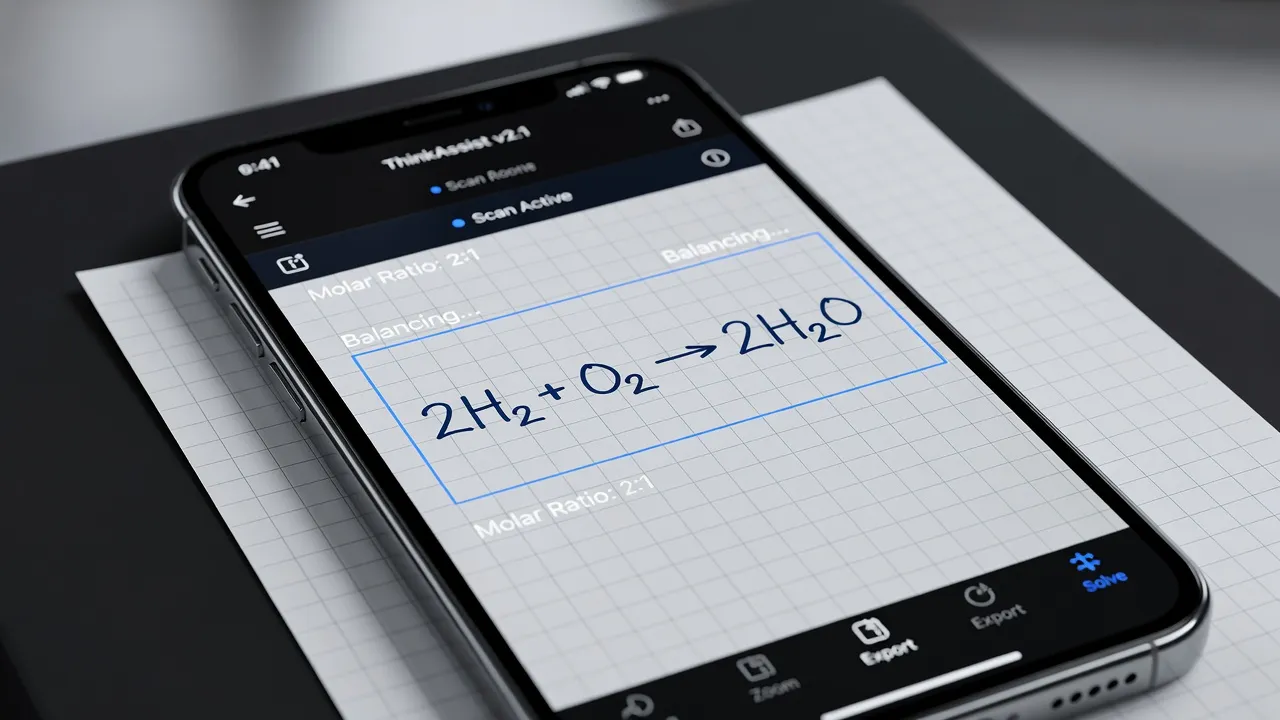
When working through quantitative units, following a clear method prevents simple calculation errors:
- Capture the entire problem: Ensure your phone camera captures all given units, compound formulas, and numerical values clearly.
- Review automatic subject detection: Modern engines identify whether the question involves thermochemistry, gas laws, or electron arrangements automatically.
- Follow the conversion pathway: Check how the solver converts grams to moles before applying stoichiometric ratios.
- Verify significant figures: Double-check your final rounding steps against Edgenuity's explicit input instructions.
For instance, when calculating orbital structures or subshell rules, asking an AI tool to break down quantum numbers chemistry ensures you understand why an electron sits in a specific energy state before you submit your quiz.
How do paywall traps affect online answer searchers?
Paywall traps affect answer searchers by luring students in with free previews before charging high recurring weekly or monthly subscription fees to view actual solutions. Many homework assistance websites utilize search engine optimization tricks to rank unverified user posts on search result pages.
- Search query: "Edgenuity Chemistry Unit 3 Test Answers"
- Landing page: Free preview of Question 1
- Question 2 & Solutions: Blurred out behind paywall
- Recurring subscription trap: $15–$30/month auto-renew
These platforms often rely on dark patterns during checkout:
- Hidden auto-renewals: Low upfront trial costs (such as $1 for 2 days) quietly convert into expensive monthly charges.
- Blurred answer blocks: Websites obscure the correct final answer until credit card details are entered.
- Outdated answer sheets: Students pay to unlock a document only to discover it contains answers from a 2018 course version.
I always advise checking pricing terms carefully before handing over billing details. A transparent app like ThinkAssist lets you test features during a 3-day free trial, giving you time to evaluate the solver before committing to a $6.99/week option.
What are the academic risks of copying answer keys?
The academic risks of copying answer keys include failing proctored unit exams, getting flagged by anti-cheat software, and losing essential foundations needed for advanced science courses. While copy-pasting answers might get you through a 10-question practice assignment, it leaves you unprepared for supervised tests.
The Academic Risk Cycle
- Copying Unverified Answers leads to Quick 100% on homework
- Skipping Problem Logic leads to Zero conceptual mastery
- Proctored Exam Arrives with Locked browser, no search tools
- Unprepared Execution leads to Failing score on major grade
High school online programs enforce strict academic integrity policies through several mechanism controls:
- Proctored exam environments: Cumulative tests often require secure browser locks or teacher authorization codes that block external web tabs.
- Keystroke and time tracking: Platforms flag accounts that answer complex, 5-step dimensional analysis problems in under 3 seconds.
- Plagiarism detection algorithms: Short-answer essay responses in lab reports are cross-checked against public databases automatically.
If you rely on quick shortcuts, you will inevitably hit a wall during proctored midterms. Taking a quick practice chemistry quiz helps you gauge your actual retention without risking your overall grade point average.
How can you study efficiently for Edgenuity chemistry tests?
You can study efficiently for Edgenuity chemistry tests by organizing your formulas, practicing dimensional analysis daily, and reviewing past solved problem steps. Building a structured study routine ensures you retain core concepts for cumulative finals.
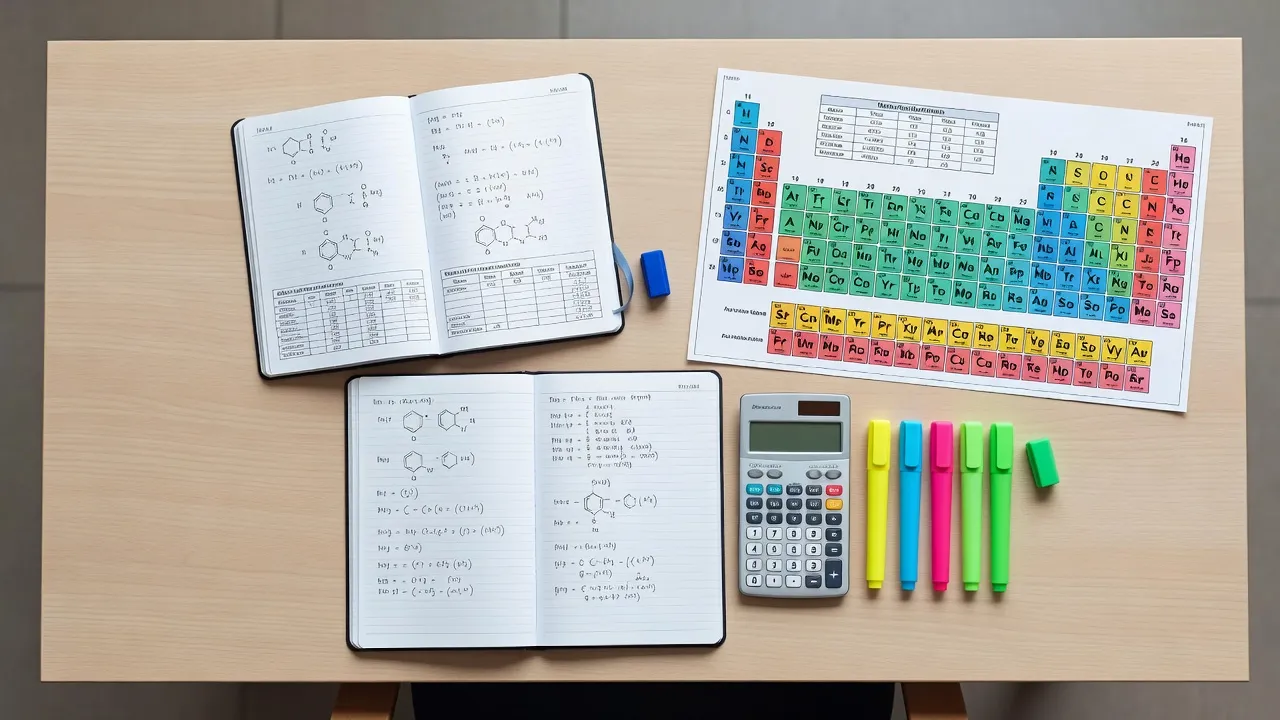
Here is a practical workflow to maximize your study time:
- Build a formula reference sheet: Keep constants like Avogadro's number ($6.022 \times 10^{23}$) and the ideal gas constant ($R = 0.0821 \text{ L}\cdot\text{atm}/\text{mol}\cdot\text{K}$) written clearly in your notebook.
- Master dimensional analysis: Always write out your units (grams, moles, liters) so they cancel out correctly in your work.
- Use open-source textbooks: Supplement confusing video lectures with free, peer-reviewed resources like the OpenStax Chemistry 2e textbook.
- Save step-by-step explanations: Use tools like ThinkAssist to archive tricky problem solutions so you can review the step-by-step logic right before test day.
Frequently Asked Questions
Are Edgenuity chemistry test questions the same for every student?
No, Edgenuity uses randomized question banks and alters numerical variables in calculation questions for different students.
Can Edgenuity detect if you search for answers in another tab?
Yes, the Edgenuity platform logs window focus events, completion times, and can require locked browsers during proctored assessments.
How do I solve Edgenuity stoichiometry problems when I am stuck?
Break the problem into three steps: convert given mass to moles, use the balanced equation mole ratio, and convert moles to desired output units.
Is there a free way to get help with Edgenuity chemistry homework?
Free open-source textbooks like OpenStax provide comprehensive topic overviews, while apps like ThinkAssist offer free downloads with initial trial periods.
Why do online answer keys have different numbers than my quiz?
Edgenuity updates its curriculum periodically and randomizes values to prevent static answer key sharing across online forums.
How does ThinkAssist help with Edgenuity chemistry assignments?
ThinkAssist uses AI subject detection to instantly solve chemistry problems from a photo, providing step-by-step math breakdowns 24/7.