
Writing a strong persuasive essay requires taking a clear position on a debatable topic, supporting it with empirical evidence, and systematically refuting counterarguments across a structured outline. By following the five-step drafting framework detailed below, you can brainstorm, research, and write a complete persuasive paper in approximately three to four hours.
Whether you are writing a quick classroom assignment or an advanced academic paper, mastering persuasive writing relies on one single variable: the strength of your central claim. If your thesis statement asserts a non-obvious, arguable point rather than an agreed-upon fact, the rest of your essay falls cleanly into place.
Here is a quick overview of the drafting process before breaking down each individual step.
Persuasive Writing Steps at a Glance
| Step | Core Action | Estimated Time | Key Deliverable |
|---|---|---|---|
| 1. Thesis Selection | Choose a debatable claim and state a clear verdict | 30 Mins | A 1-sentence thesis statement |
| 2. Rhetorical Sourcing | Gather empirical evidence and log counterarguments | 45 Mins | 3 strong statistics + 1 opposing claim |
| 3. Structural Outlining | Organize introduction, body paragraphs, and rebuttal | 30 Mins | A complete paragraph-by-paragraph map |
| 4. First Draft Execution | Write prose using logical transitions and proof | 60 Mins | A complete draft (~500–1,000 words) |
| 5. Revision & Rebuttal Polish | Refine rhetorical hooks, citations, and argument flow | 45 Mins | A polished, submission-ready essay |
What Are the Best and Most Recommended Persuasive Essay Topics?
The most effective persuasive essay topics focus on active policy debates, ethical dilemmas, or technology regulations where reasonable people hold opposing viewpoints. Choosing an overly settled topic like "smoking is bad for your health" gives you nothing to argue, whereas debating whether local municipalities should ban facial recognition technology forces you to weigh real evidence against opposing values.
When selecting a topic, aim for arguments that allow you to balance logic with credible facts. The best topics generally fall into three categories:
- Technology and Ethics: Regulating social media algorithm transparency, artificial intelligence copyright boundaries, or autonomous vehicle liability laws.
- Education Policy: Eliminating standardized testing for college admissions, mandating financial literacy courses in high school, or restructuring school start times.
- Society and Environment: Taxing single-use plastics, implementing universal basic income programs, or subsidizing municipal public transit expansion.
If you want a deeper directory of ideas, review our curated guide to persuasive writing essay topics to find a prompt that fits your assignment criteria.

What Are Persuasive Essay Topics for High School Students?
High school persuasive essay topics should tackle everyday issues within school culture, civic responsibilities, or adolescent life that students can analyze with accessible data. Assigning topics tied to a student's immediate environment helps them build arguments using personal observation backed by published statistics.
Top high school persuasive essay prompts include:
- Four-Day School Weeks: Should school districts shorten the academic week to improve student mental health and reduce facility costs?
- Cell Phone Restrictions: Should public schools enforce building-wide bans on smartphones during instructional hours?
- Paid Internships for Vocational Students: Should high school career programs require employers to pay minimum wage for student labor?
- Classroom Grading Models: Should high schools replace traditional A-F grading scales with mastery-based portfolio assessments?
What Are Persuasive Essay Topics for College Students and Instructors?
College-level persuasive essay topics demand complex, multi-layered arguments that evaluate systemic policies, economic impacts, or nuanced ethical frameworks. At the university level, instructors expect students to avoid simple binary choices ("good vs. bad") and instead propose actionable policy solutions or critique existing academic literature.
Recommended college persuasive topics include:
- Corporate Climate Disclosures: Should federal regulators require publicly traded corporations to publish audited scope-3 emissions data annually?
- Healthcare Algorithmic Bias: Should medical diagnostic software undergo mandatory peer-reviewed audits before clinical deployment?
- Intellectual Property Rights: Should patents for essential pharmaceutical formulations expire earlier in developing markets?
- Housing Density Mandates: Should state legislatures override local single-family zoning laws to alleviate urban housing shortages?
Does Purdue OWL Have a List of Persuasive Essay Topics?
Yes, the Purdue Online Writing Lab provides structural guides and rhetoric categories that serve as topic frameworks, though it emphasizes argument construction over static lists. Rather than giving students a simple inventory of prompts, Purdue OWL organizes persuasion through classic rhetorical structures like Rogerian and Toulmin models.
According to Purdue OWL's argumentative essay repository, a strong persuasive paper relies on clear evidentiary support and a well-defined thesis statement. Their materials encourage writers to pick topics by asking three questions: Is the issue genuinely contested? Is there factual evidence available on both sides? Can you offer a concrete resolution in your conclusion?
Does Edutopia Offer Current Persuasive Writing Topics for the Classroom?
Yes, Edutopia regularly publishes modern persuasive writing prompts focused on educational reform, student wellness, and digital citizenship. Their classroom resources highlight topics reflecting modern student experiences, making them popular choices for middle and high school English language arts teachers.
Teaching resources on Edutopia's language arts hub highlight how real-world prompts increase student engagement. Their featured prompts frequently explore media literacy, the ethics of consumer technology, and student agency in school governance.
Does the NYT Learning Network Provide Persuasive Writing Prompts?
Yes, The New York Times Learning Network publishes an updated list of over 1,000 persuasive prompts based on real-world news reporting. This repository is one of the most widely cited sources for contemporary argumentative prompts in secondary education.
The NYT Learning Network student prompt archive updates continuously with questions derived from recent reporting. Topics range from personal ethics—like whether sports culture places too much pressure on teenagers—to global policy debates surrounding climate change and labor laws.
Step 1: Choose a Debatable Claim and Define Your Thesis
To draft a successful persuasive essay, craft a single-sentence thesis statement that asserts an arguable position with a clear reason. A weak thesis makes an undeniable assertion, such as "Climate change causes weather shifts." A strong thesis presents a clear stance that requires evidence: "Municipal governments must reallocate 15% of annual infrastructure budgets toward stormwater resilience to mitigate regional flooding."
Follow this three-part formula to build your thesis statement:
- State the Specific Subject: Identify the exact policy, text, or issue under review.
- Take a Definitive Action Verb: Use strong verbs like must, should, requires, or demonstrates.
- Provide the Primary Supporting Reason: Give the core rationale that your body paragraphs will defend.
Avoid generic phrasing. If a reader cannot logically disagree with your thesis statement, scrap it and narrow your focus until an opposing viewpoint exists.
Step 2: Gather Evidence and Identify Opposing Views
Support your persuasive claim by gathering three distinct types of evidence: factual statistics, expert testimony, and an opposing viewpoint to dismantle. Relying solely on personal opinion weakens your credibility. A well-rounded persuasive argument applies classic ethos (credibility), logos (logic), and pathos (emotional resonance).
Organize your supporting material into a simple research grid before drafting:
- Logos (Data & Logic): Collect empirical statistics from academic journals, government agencies, or established research institutions.
- Ethos (Authority): Quote direct research findings or testimony from credentialed experts in the field.
- Counterargument Data: Locate the single strongest argument your opponents use. You must address this point directly to show thorough research.
When organizing your evidence, structure your argument around a formal 5-paragraph essay writing outline so each piece of data sits cleanly inside its designated body paragraph.
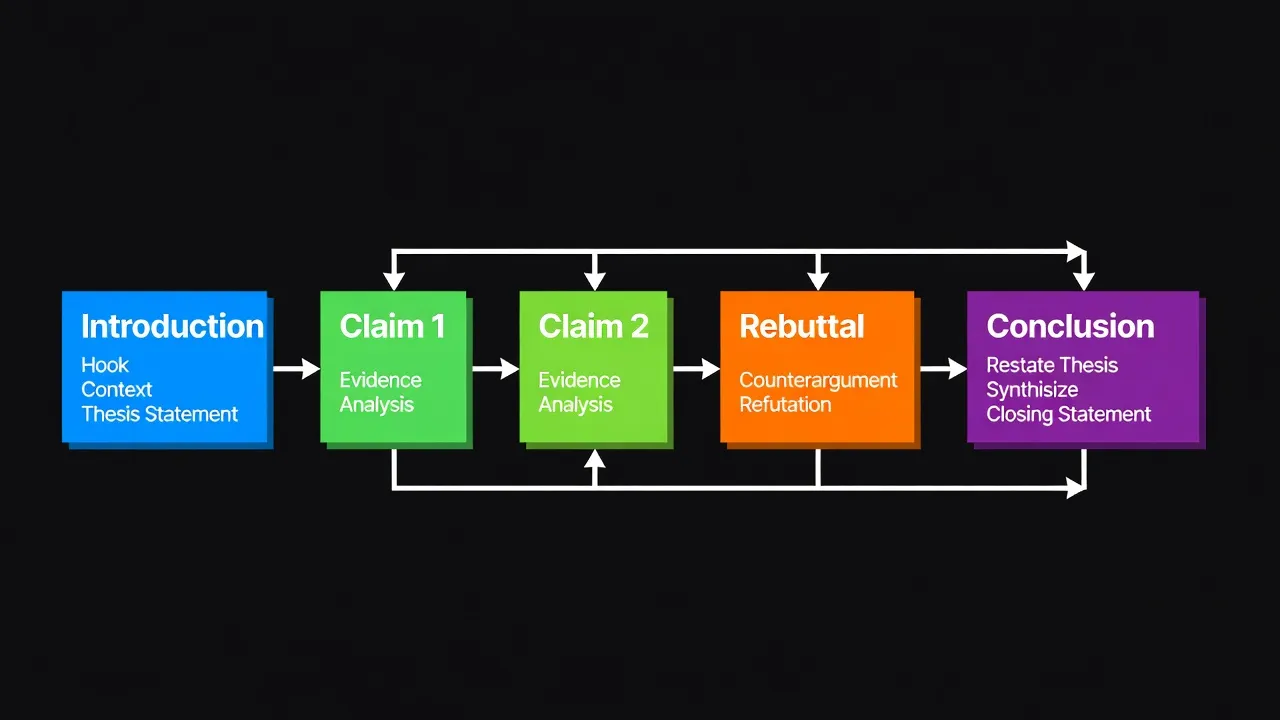
Step 3: Build a Structural Outline (The Counterargument Sandwich)
Structure your persuasive essay outline so that body paragraphs build your main claims before addressing and refuting the opposing view. A logical structure prevents your essay from feeling like a scattered list of points.
Use this proven outline sequence for a standard essay:
- Introduction Paragraph
- Hook: Introduce the issue with a compelling statistic or scenario.
- Context: Explain why this debate matters right now.
- Thesis Statement: State your stance clearly in the final sentence.
- Body Paragraph 1 (Strongest Argument)
- Topic Sentence: Introduce your primary claim.
- Evidence: Present statistical data or direct expert testimony.
- Analysis: Explain how this evidence proves your thesis.
- Body Paragraph 2 (Secondary Argument)
- Topic Sentence: Introduce your secondary supporting claim.
- Evidence: Provide concrete examples or case study outcomes.
- Analysis: Connect the evidence back to your core position.
- Body Paragraph 3 (Counterargument & Rebuttal)
- Opposing View: State what critics argue (e.g., "Opponents claim that...").
- Rebuttal: Explain why that criticism is flawed or secondary to your main evidence.
- Conclusion Paragraph
- Restated Thesis: Reframe your core position in fresh language.
- Summary of Evidence: Synthesize your major claims without repeating body text verbatim.
- Call to Action: End with a final statement on the broader implications of your topic.
Step 4: Draft Body Paragraphs with Signal Words and Direct Proof
Write your draft body paragraphs by opening with a claim, inserting concrete evidence, and spending two sentences analyzing the data. The most common drafting mistake is stating evidence without explaining why it matters.
Use precise transition phrases to guide your reader through your logic:
- To introduce evidence: According to data published by..., Research indicates that..., For instance...
- To introduce opposing views: Critics contend that..., Granted, some analysts argue..., While advocates for X maintain...
- To execute a rebuttal: However, this perspective overlooks..., Despite this claim, empirical evidence proves..., Conversely, recent trials show...
If you are writing an essay that analyzes how an author builds an argument rather than presenting your own, review a rhetorical analysis essay example to see how ethos and logos function in published texts.
Step 5: Edit for Tone, Rhetorical Flow, and Citation Precision
Polish your draft by cutting informal language, eliminating filler words, and checking that every supporting claim cites a verifiable source. Persuasive prose loses impact when it relies on emotional exaggeration or absolute statements like "everyone knows" or "obviously."
Run through this editing checklist before turning in your essay:
- Remove First-Person Filler: Cut phrases like "I think," "I believe," or "In my opinion." Stating "The data proves" is far more persuasive than "I think the data proves."
- Verify Rebuttal Placement: Ensure your counterargument paragraph gives a fair description of the opposing view before refuting it.
- Check Citation Formatting: Confirm every statistic, quote, and direct paraphrase follows your required style guide (MLA, APA, or Chicago).
- Read Aloud for Cadence: Read your prose out loud to catch awkward phrasing, run-on sentences, or repetitive transitions.
For more targeted mechanics advice during drafting, consult our master collection of writing tips to improve your sentence structure and paragraph rhythm.
How AI Feedback Tools Streamline the Persuasive Writing Process
Using an automated writing assistant helps you quickly check your persuasive draft for weak arguments, logical gaps, and structural flaws. While AI tools should never write your paper for you, relying on instant analysis helps you catch unverified claims before submitting your assignment for a final grade.
When working through complex homework assignments or outlining essays under tight deadlines, specialized study tools give you immediate structural feedback.
| Tool / Resource | Primary Function | Ideal Use Case |
|---|---|---|
| Purdue OWL | Style & Citation Rules | Manual formatting checks |
| Grammarly | Grammar & Tone Detection | Proofreading Mechanics |
| ThinkAssist | AI Homework Solver & Tutor | Outline and logic checks |
As shown in the table above, different platforms solve distinct parts of the writing process. ThinkAssist functions as an AI-powered homework solver and 24/7 tutor designed to help you get step-by-step explanations for tough assignments.
If you get stuck on how to structure a rebuttal paragraph or need to verify whether your research directly supports your thesis statement, you can snap a photo of your handwritten outline or draft text using the ThinkAssist iOS App. The app provides step-by-step breakdowns of argument logic, helping you spot weak assumptions in your outline before you write the final draft.
Frequently Asked Questions
What is the main purpose of persuasive writing?
The main purpose of persuasive writing is to convince a reader to accept a specific viewpoint, adopt a recommended policy, or take concrete action on a debatable issue through evidence and logical reasoning.
How does persuasive writing differ from argumentative writing?
Persuasive writing often uses emotional appeals (pathos) alongside factual arguments to sway the reader, whereas formal argumentative writing relies primarily on empirical logic, factual evidence, and formal academic analysis (logos).
What is the best structure for a persuasive essay?
The standard structure is the five-paragraph model: an introductory paragraph containing a thesis statement, two body paragraphs establishing supporting arguments, a third body paragraph addressing counterarguments with a rebuttal, and a concluding paragraph that synthesizes the evidence.
How long should a persuasive essay thesis statement be?
A persuasive essay thesis statement should be one sentence long, clearly stating your central claim and the primary reason supporting your position.
Where should the counterargument go in a persuasive essay?
The counterargument usually sits in the third body paragraph, right before the conclusion. Placing it here allows you to establish your supporting points first before acknowledging and refuting opposing perspectives.
What are common mistakes to avoid in persuasive essay writing?
Common mistakes include choosing a topic that isn't debatable, using absolute words like "always" or "never," writing in the first person ("I think"), failing to cite evidence, and ignoring opposing viewpoints.