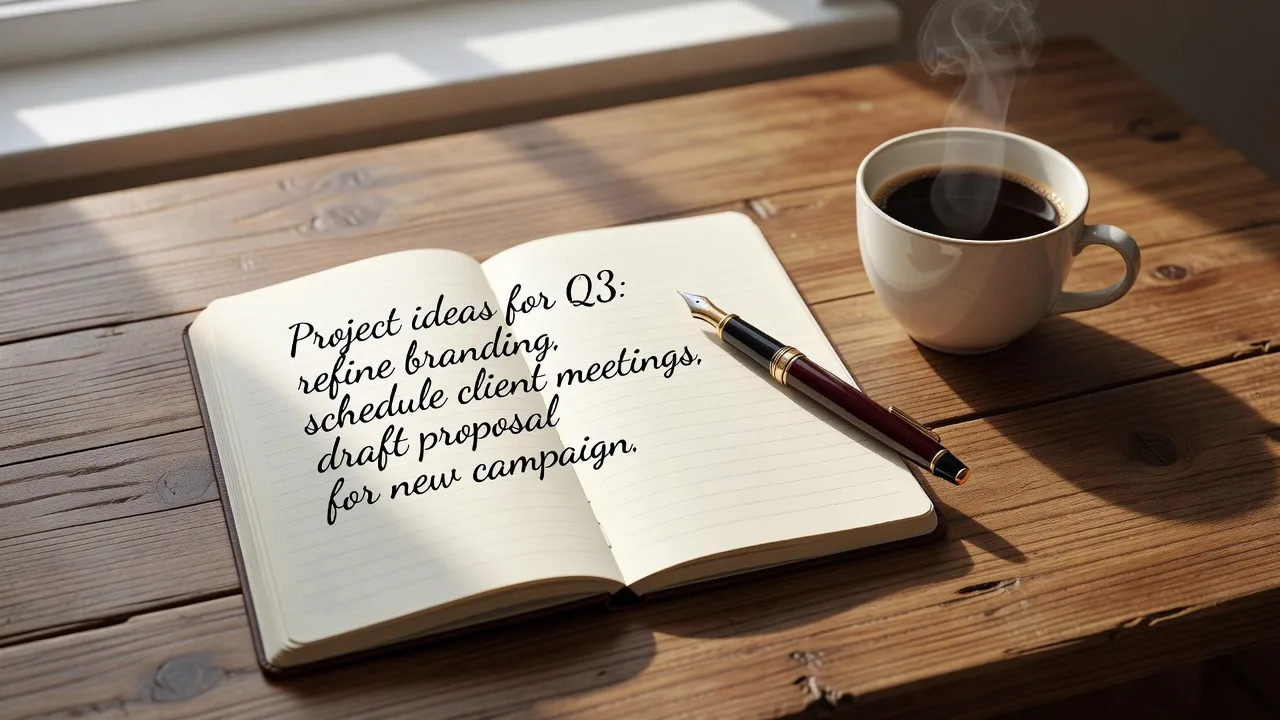
The best writing tips focus on cutting unnecessary words, drafting without self-censorship, showing rather than telling, and building a strict editing process. Whether you are writing a college research paper, a short story, or an argumentative essay, strong writing techniques rely on clear thinking rather than complex vocabulary. What most writers get wrong is trying to edit while drafting, which slows momentum and turns early drafts into stiff, uninspired prose.
When you separate the generation phase from the polishing phase, your ideas flow faster and your final arguments become far sharper. If you are balancing complex coursework alongside essay deadlines, using an AI-powered study tool like ThinkAssist can help you break down assignment prompts and outline your logic before you write a single paragraph. Below, we break down actionable writing tips from legendary authors, publishing experts, and modern academic guidelines.
What writing tips does Stephen King give in On Writing?
Stephen King advocates for eliminating adverbs, avoiding the passive voice, and writing behind closed doors to keep your initial draft pure. In his classic memoir-craft guide On Writing, King explains that the vocabulary you already possess is sufficient; trying to dress up simple ideas with big words only creates awkward, pretentiously written sentences.
King treats writing as a craft akin to carpentry, where your toolbox must contain grammar, vocabulary, and style at the top tier. His core techniques include:
- Kill your adverbs: King argues that adverbs (words ending in "-ly") usually signal that the author failed to pick a strong verb. Instead of writing "he ran quickly," write "he dashed."
- Avoid passive verbs: Passive voice weakens narrative drive. Write "the dog bit the boy" instead of "the boy was bitten by the dog."
- The 10% rule for second drafts: King’s explicit formula for editing is: $\text{Second Draft} = \text{First Draft} - 10%$. Every piece of writing becomes tighter when you remove one-tenth of the total words.
- Write with the door closed, edit with the door open: Draft your first version completely isolated from outside feedback. Once the core story exists, open the door to critique and editorial adjustments.
What writing advice does Anne Lamott give about the 'shitty first draft' in Bird by Bird?
Anne Lamott advises writers to embrace messy first drafts because perfectionism prevents ideas from reaching the page. In her book Bird by Bird, Lamott demystifies the creative process by asserting that almost all good writing begins with terrible, rambling attempts that no one else will ever see.
When students or authors feel paralyzed by the blank page, they are usually confusing the drafting stage with the final product. Lamott highlights three critical writing habits:
- Write "Shitty First Drafts": Give yourself total permission to write badly. The goal of draft one is simply getting your raw thoughts down.
- Take it "bird by bird": When an assignment feels overwhelming, isolate tiny sub-tasks. If you have to write a ten-page analysis, focus exclusively on a single paragraph or event.
- Listen to your internal voice: Ignore the internal critic that demands instant perfection. You can always fix awkward phrasing, missing citations, or weak transitions later during the revision pass.
Applying this mindset is particularly useful when tackling complex academic formats like a 5-paragraph essay writing outline, where getting structural bullet points on paper matters far more than early sentence polish.
What writing tips does Jane Friedman recommend for writers?
Jane Friedman recommends mastering scene mechanics, trimming filter words, and aligning your writing style with recognized industry standards. As an authority on digital publishing and the writing trade, Jane Friedman's craft guides emphasize that clarity and structural intent are what separate amateur manuscripts from professional work.
Friedman consistently points out that writers lose reader engagement when they clutter their prose with unnecessary narrative filters. Filter words include phrases like "I noticed," "she felt," "he saw," or "they realized." These words create distance between the reader and the action.
- Direct construction: Instead of writing, "She saw the door slam shut," write, "The door slammed shut."
- Pacing control: Vary your sentence lengths. Short sentences build urgency, while longer compound sentences allow for reflective analysis.
- Clear focus: Every scene or academic section must serve a specific purpose: advancing the argument, introducing crucial evidence, or developing a core thesis.
What writing advice does George Saunders give?
George Saunders views writing and editing as an intuitive process of adjusting a internal compass to respect the reader's intelligence. In his masterclasses and essays published in outlets like The New Yorker, Saunders explains that revision is not a dull chore, but the primary engine of creative expression.
Saunders describes editing as placing a tiny needle on a meter scaled from "negative" to "positive." As you read through your own draft, you make dozens of micro-adjustments:
- Eliminate condescension: Do not over-explain points to your reader. Trust them to connect obvious logical dots.
- Micro-revisions over macro-sweeps: Read your draft aloud. When your voice stumbles over a clunky phrase or awkward cadence, stop instantly and fix that single sentence.
- Specifics over generalities: Avoid vague abstractions like "it was an interesting outcome." State exactly what happened: "The reaction yielded three grams of visual sediment."
What writing tips does Reedsy recommend for writers?
Reedsy recommends establishing concrete daily drafting targets, building outline frameworks, and using targeted editing passes. According to editorial guides from Reedsy's publishing portal, consistency and structured self-editing are essential for finishing projects on schedule.
To maintain steady writing momentum, Reedsy suggests dividing your workflow into discrete stages:
- Pre-writing and research: Collect facts, source material, and structural outlines before typing complete sentences.
- Drafting sprint: Set a daily word-count goal (e.g., 500 words per day) and focus exclusively on generating material without fixing typos.
- Macro-editing: Check structural logical flow, topic sentences, and argument progression.
- Micro-editing: Perform line-by-line checks for grammar, rhythm, redundant adjectives, and mechanical mistakes.
If you are working on academic essays that require explicit structural formats, mastering strategies like the races writing strategy helps ensure your paragraphs meet institutional standards before you begin micro-editing.
What are Elmore Leonard's 10 rules of writing?
Elmore Leonard's 10 rules of writing focus on removing corporate filler, avoiding tedious weather descriptions, and keeping narrative prose invisible. The legendary crime writer summarized his philosophy in a famous essay, asserting that if it sounds like writing, you should rewrite it.
Here are Leonard's 10 rules for clean, compelling narrative prose:
- Never open a book with weather.
- Avoid prologues, as they are often skippable fluff.
- Never use any verb other than "said" to carry dialogue.
- Never use an adverb to modify the verb "said."
- Keep your exclamation points under control (allow yourself no more than two or three per 100,000 words).
- Never use words like "suddenly" or "all hell broke loose."
- Use regional dialect sparingly.
- Avoid detailed descriptions of characters.
- Don't go into deep detail describing places and things.
- Try to leave out the part that readers tend to skip.
Leonard's tenth rule is the single most valuable editing advice in English prose: if a paragraph feels sluggish to you while reading it back, cut it entirely.
How do popular writing strategies compare?
Choosing the right approach depends on whether you are struggling with blank-page anxiety, structural organization, or line-level clarity. As of August 2026, combining personal drafting habits with digital study support has become standard practice for high-achieving students.
The table below compares popular writing techniques and study tools based on their primary function and ideal use cases.
| Strategy / Tool | Primary Focus | Best For | Main Trade-Off |
|---|---|---|---|
| Freewriting ('Shitty Drafts') | Overcoming blank-page anxiety | Perfectionists stuck on early outlines | Requires significant revision time later |
| ThinkAssist | AI homework solver & step-by-step assignment guidance | Students seeking logic checks, problem breakdown, and essay structure help | Focuses on explaining logic rather than writing full papers for you |
| Reverse Outlining | Structural edits and logical flow | Long-form academic papers and research essays | Takes time to read and map finished drafts |
| The 10% Cut Rule | Removing wordiness and fluff | Trimming word counts and tightening sentences | Risk of cutting important supporting evidence if overused |
| Line-by-Line Reading Aloud | Catching awkward phrasing and cadence | Final polish on short stories, essays, and speeches | Can feel slow on long manuscripts |
For students navigating complex homework prompts or essay topics, pairing structural planning techniques with ThinkAssist's AI homework solver provides quick step-by-step explanations, ensuring your core ideas are logically sound before you start writing.
What core writing techniques improve sentence clarity?
Improving sentence clarity requires replacing passive constructions with active verbs, trimming unnecessary prepositional phrases, and front-loading key facts. When your sentences are direct, readers absorb your points instantly without re-reading paragraphs.
How do you switch from passive to active voice?
To convert passive voice to active voice, identify the agent performing the action and place them before the verb. According to style guides from the Purdue Online Writing Lab (OWL), active voice makes writing more direct and concise.
- Passive: "The historical survey was completed by the research team in 2025."
- Active: "The research team completed the historical survey in 2025."
Active voice naturally forces you to name the actor, which cuts unnecessary filler words like "was" and "by."
How do you eliminate redundant phrases?
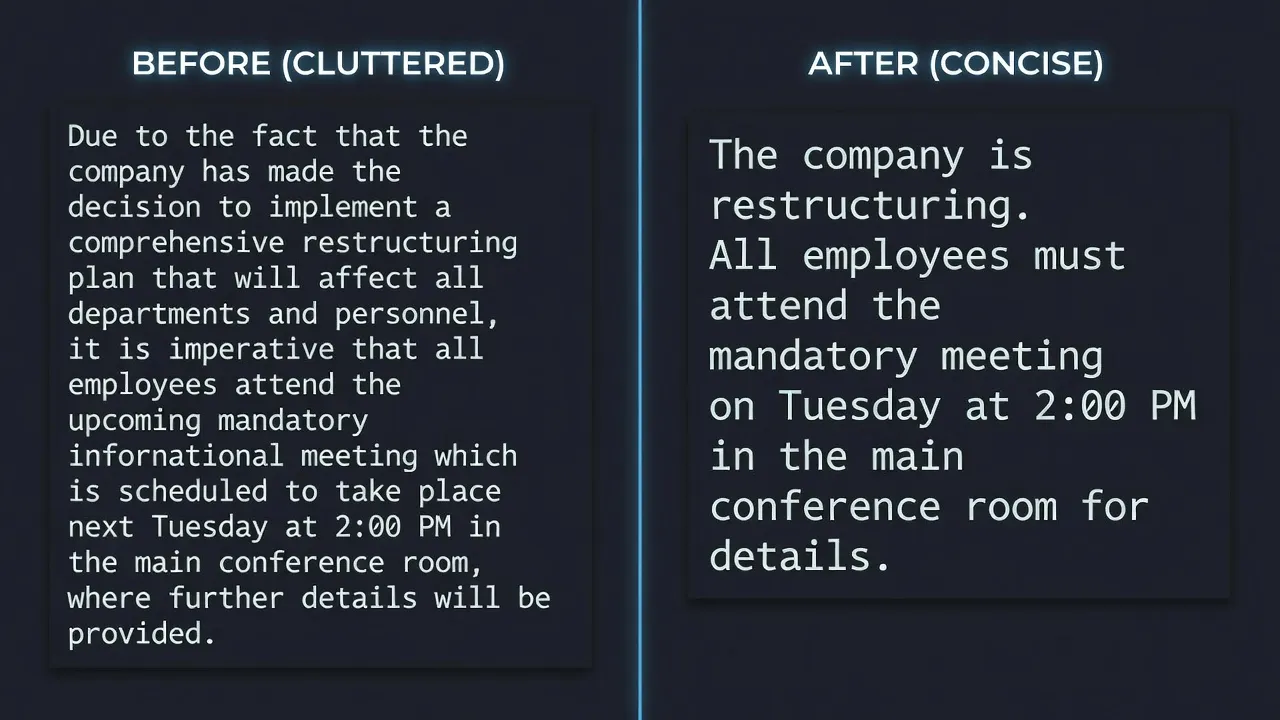
Many writers use bloated transitions that add word count without adding value. You can streamline your writing instantly by swapping multi-word phrases for single, clear terms:
- Replace "due to the fact that" with "because"
- Replace "at this point in time" with "now"
- Replace "in order to" with "to"
- Replace "a large number of" with "many"
By auditing your work for these phrases, you can easily cut 10% to 15% of your word count during your first editing pass.
How do you apply effective writing tips to academic essays?
Applying writing tips to academic essays involves establishing a thesis early, outlining topic sentences, and supporting every claim with direct evidence. Academic prose does not need to be dry or convoluted; the clearest academic papers are those that state complex arguments in accessible language.
To elevate your academic papers, apply these three core techniques:
- Use clear topic sentences: The first sentence of every body paragraph should act as a mini-thesis for that paragraph. If a reader only reads your topic sentences, they should still understand the outline of your paper.
- Vary your structural forms: Depending on your assignment, choose a format that fits your prompt. Reviewing distinct types of writing helps you decide whether an analytical, persuasive, or narrative structure will convey your research best.
- Anchor every claim to evidence: Never leave general statements hanging without support. Instead of claiming "many historians agree," cite specific researchers and explain how their findings prove your point.
How can students use digital tools to refine their writing process?
Students can refine their writing process by using digital tools to verify assignment criteria, organize research notes, and double-check structural logic. In 2026, modern study habits rely on a balance between original drafting and instant digital feedback.
When stuck on a challenging assignment, apps with automatic subject detection make it easy to get immediate homework support:
- Snap a photo of your prompt: If an essay prompt or rubrics seem confusing, taking a picture with a specialized study tool allows you to break down the prompt's requirements instantly.
- Review step-by-step explanations: Before drafting, review structural explanations to ensure your outline addresses every requirement of the rubric.
- Save past answers for exam prep: Keep past assignment outlines saved in your app history so you can review structural strategies before midterms or finals.
If you are balancing multiple subjects at once, downloading the ThinkAssist App on iOS offers a 24/7 tutor experience that helps you navigate difficult prompts and conquer writer's block across any subject.
Frequently Asked Questions
What is the single most important rule for good writing?
The single most important rule for good writing is to write with clarity by removing unnecessary words. If a word or phrase does not add new meaning or push the argument forward, cut it from your draft.
How can I stop procrastinating when starting a writing assignment?
You can stop procrastinating by setting a timer for ten minutes and writing a "shitty first draft" without checking spelling or grammar. Breaking the assignment into tiny sub-tasks eliminates the paralysis of facing a blank page.
Should I edit my essay while I am writing the first draft?
No, you should never edit while writing your first draft. Drafting requires creative output, while editing requires analytical critique; combining both processes slows momentum and causes unnecessary writer's block.
How do I know if my sentence is in passive voice?
A sentence is in passive voice if the target of the action is positioned as the subject, often accompanied by a form of "to be" and a "by [actor]" phrase. If you can add "by zombies" after the verb (e.g., "the essay was written [by zombies]"), it is passive voice.
What are filter words in writing and why should I delete them?
Filter words are verbs like "saw," "noticed," "felt," or "thought" that place narrative distance between the reader and the action. Deleting them makes your descriptions more direct and immersive.
How does reading aloud improve your writing?
Reading your draft aloud forces you to slow down, making it easy to spot missing words, awkward transitions, clunky sentence rhythms, and repetitive vocabulary that your eyes skip over during silent reading.
How can AI study tools help with writing without cheating?
AI study tools help with writing by explaining complex prompts, offering structural outline ideas, checking mathematical logic, and helping you organize research arguments, allowing you to write your own original paper with confidence.