
A 5-paragraph essay outline is a structural blueprint that divides a paper into one introductory paragraph, three supporting body paragraphs, and one concluding paragraph. Building this framework takes about 15 to 20 minutes before you start drafting full sentences. It keeps your arguments focused and ensures you never run out of things to say mid-draft.
As of August 2026, standardized exams and high school English rubrics continue to rely on the five-paragraph structure as the primary test of organized reasoning. Whether you are tackling argumentative prompts or simple reflections, mapping your main points beforehand saves hours of rewriting.
If you get stuck trying to break down a complex prompt, using an AI tool like ThinkAssist can jumpstart your outline. You can open the ThinkAssist iOS app to snap a picture of your assignment and receive step-by-step structural suggestions in seconds.
Here is the complete step-by-step process for building a 5-paragraph essay outline that gets results.
5-Paragraph Essay Outline Steps at a Glance
This table lays out the realistic time and core deliverable for each step of your outline. Spending 20 minutes here dramatically speeds up the writing phase.
| Step | Focus Area | Realistic Time | Core Deliverable |
|---|---|---|---|
| Step 1 | Thesis Statement & Pillars | 5–7 mins | 1 clear central argument supported by 3 main reasons |
| Step 2 | Introduction Outline | 3–5 mins | Hook ideas, context notes, and final thesis placement |
| Step 3 | Body Paragraphs (2, 3, & 4) | 8–10 mins | 3 topic sentences with bulleted evidence and analysis notes |
| Step 4 | Conclusion Outline | 3–5 mins | Restated thesis, key summary bullet points, and final takeaway |
| Step 5 | Structural Review | 2–3 mins | Logic check to confirm all evidence directly supports the thesis |

Step 1: Write a Thesis Statement and Define Your Three Pillars
Your thesis statement must state your central claim and list the three supporting reasons that form your body paragraphs. This single sentence acts as the anchor for your entire outline. Without a sharp thesis, your five paragraphs will drift in different directions.
To draft your thesis, combine your answer to the prompt with three distinct evidence pillars:
- State your position: Make a direct claim rather than repeating the question.
- List Reason A: This becomes the subject of Body Paragraph 1.
- List Reason B: This becomes the subject of Body Paragraph 2.
- List Reason C: This becomes the subject of Body Paragraph 3.
According to guidelines from the Purdue Online Writing Lab, a strong thesis must be narrow, debatable, and directly supported by the evidence that follows.
For example, if you are tackling broad persuasive writing essay topics, avoid vague claims like "Exercise is good." Instead, write: "Schools should mandate daily physical education because it increases classroom focus, improves mental health, and builds lifelong wellness habits."
Step 2: Outline Paragraph 1 (The Introduction)
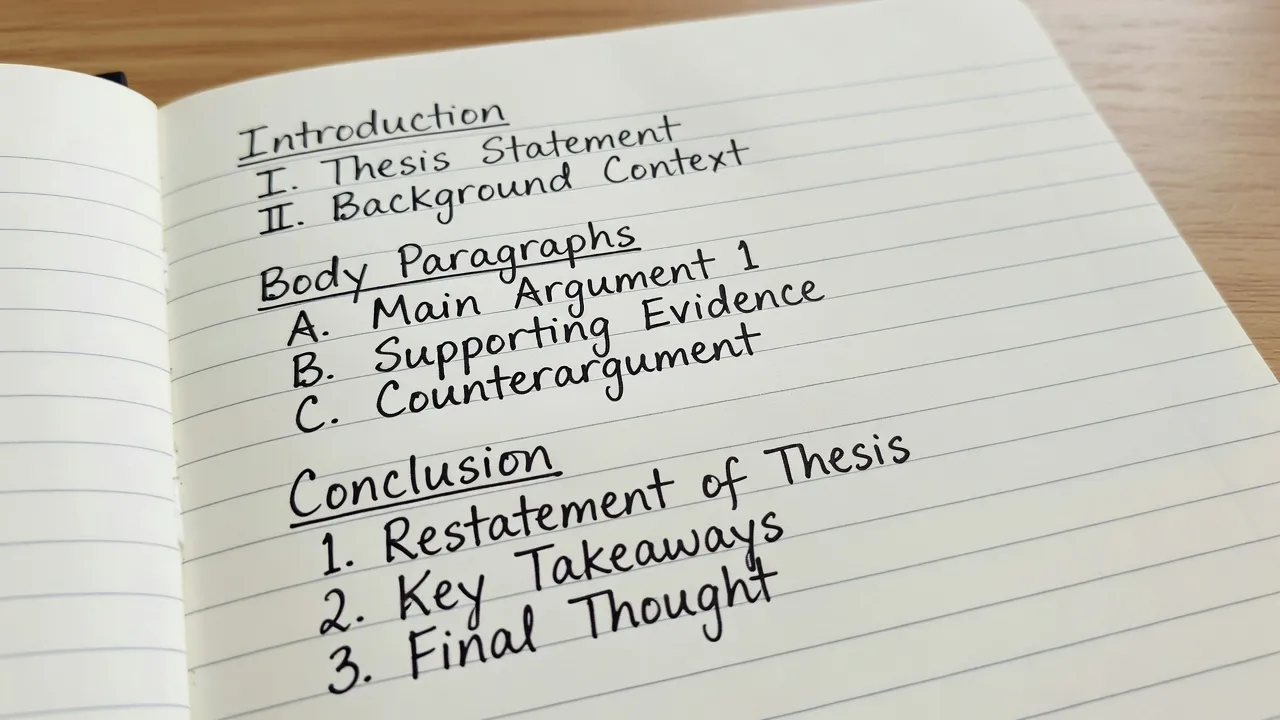
An effective introduction outline starts with a broad hook, provides background context, and narrows down to your thesis statement. You do not need polished prose in your outline. Bullet points with short phrases work best.
Organize your introduction outline into three distinct bullet groups:
- The Hook: Jot down an attention-grabbing stat, rhetorical question, or surprising fact.
- Context / Background: Write 1–2 notes defining key terms or introducing the main topic to the reader.
- Thesis Statement: Paste your complete, 3-pillar thesis statement from Step 1.
Depending on the specific types of writing you are doing—narrative, argumentative, or analytical—your hook will vary. For an analytical paper, a striking statistic or historical fact works far better than a generic quote.
Step 3: Outline Paragraphs 2, 3, and 4 (The Body Paragraphs)
Each body paragraph outline must begin with a clear topic sentence that matches one of the three pillars in your thesis. The body is where your essay earns its grade. If your thesis lists three reasons, Paragraph 2 handles Reason A, Paragraph 3 handles Reason B, and Paragraph 4 handles Reason C.
For each body paragraph, write out the following sub-points:
- Topic Sentence: State the specific reason this paragraph focuses on.
- Evidence Point 1: Note a quote, statistic, or concrete example.
- Analysis / Explanation: Write a short phrase explaining how this evidence proves your topic sentence.
- Evidence Point 2 (Optional): Add a supporting quote or fact if required by your rubric.
- Transition Sentence Note: Jot down a connecting word or phrase leading into the next point.
As noted in the University of North Carolina Writing Center's Outlining Guide, a strong outline acts as a stress test for your logic before you draft. If you cannot find two pieces of evidence for Body Paragraph 2, you know immediately that your thesis needs adjusting.
Step 4: Outline Paragraph 5 (The Conclusion)
Your conclusion outline must restate your thesis in new words, summarize your three main body points, and end with a broader takeaway. Never introduce brand-new evidence or arguments in the final paragraph.
Structure your conclusion outline with these three elements:
- Restated Thesis: Rephrase your main claim and three pillars using fresh vocabulary.
- Summary of Body Claims: Write a one-line synthesis combining your three paragraph highlights.
- Final Thought / So What?: Note a broader statement explaining why this topic matters in the real world.
Many students struggle with the final line. A simple way to close is to answer the "So what?" question: why should the reader care about your argument today?
Step 5: Review Your Outline Structure and Refine with AI
Reviewing your outline involves checking that every body paragraph directly connects back to your central thesis statement. Skipping this 2-minute review often leads to off-topic paragraphs and lost points on logic rubrics.
Run through this quick visual checklist before writing:
- Alignment: Does Topic Sentence 1 match Reason A in your thesis?
- Balance: Does each body paragraph have roughly the same amount of evidence notes?
- Flow: Are your ideas arranged in a logical order (e.g., chronological or weak-to-strong)?
Resources from the Harvard College Writing Center emphasize that flexible outlining allows you to reorganize paragraphs early without wasting written pages.
If you want to verify your paragraph logic, you can apply the races writing strategy to double-check that every body section Restates, Answers, Cites, and Explains cleanly.
When you need immediate feedback on whether your arguments hold up, ThinkAssist provides 24/7 step-by-step tutoring assistance. You can upload your bullet points or prompt to get instant structural suggestions, helping you finalize your draft with confidence.
Common Outline Pitfalls and How to Fix Them
The most common outlining mistake is writing vague topic sentences that fail to make a distinct claim. When your topic sentence merely announces a subject instead of taking a stance, the paragraph loses direction.
Here are three frequent mistakes and how to solve them:
- Mistake 1: Merging two main points into one paragraph.
- Fix: Keep each body paragraph strictly focused on one pillar from your thesis.
- Mistake 2: Writing full paragraphs instead of bullet points.
- Fix: Use fragments and keywords. Outlining is about structure, not final sentence style.
- Mistake 3: Forgetting transition notes between paragraphs.
- Fix: Add brief notes like "However," "Furthermore," or "As a result" at the end of each body section.
Frequently Asked Questions
What is the structure of a 5-paragraph essay outline?
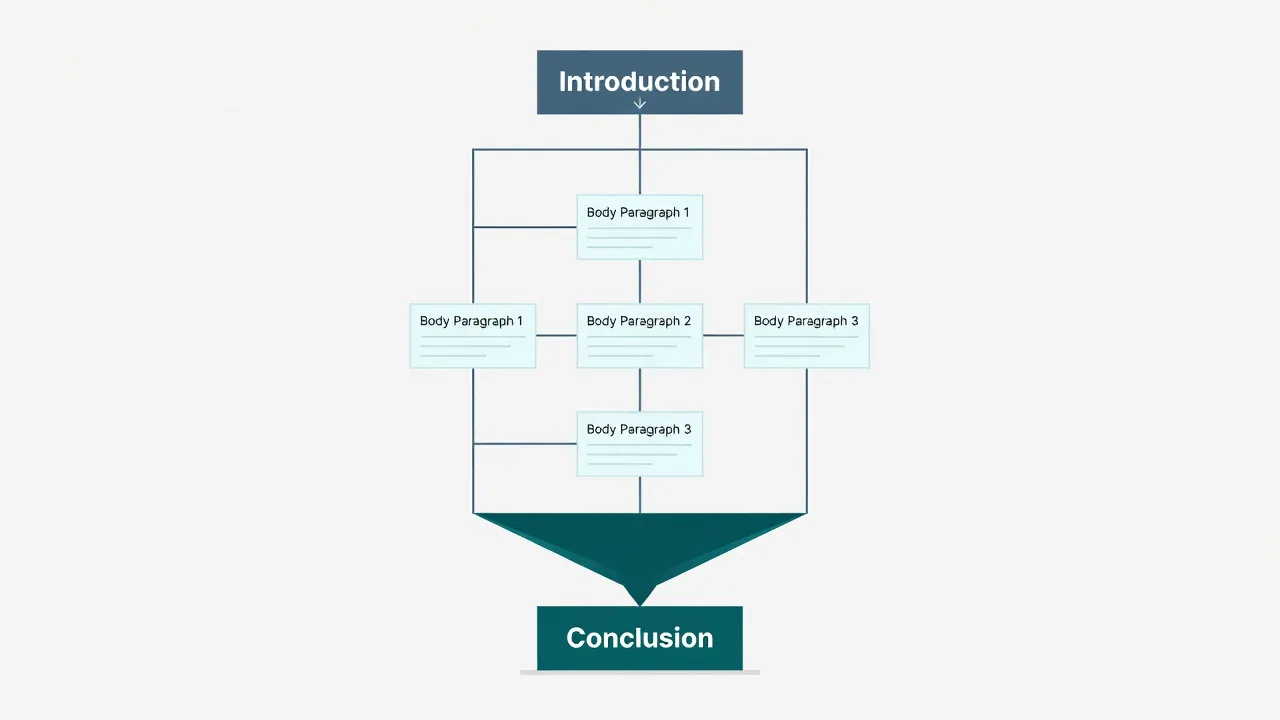
A 5-paragraph essay outline consists of an introduction paragraph (with a hook, background context, and a thesis statement), three distinct body paragraphs (each featuring a topic sentence, evidence, analysis, and a transition), and a conclusion paragraph (with a restated thesis, argument summary, and final takeaway).
How long should it take to write a 5-paragraph essay outline?
Creating an outline typically takes 15 to 20 minutes. Spending this time organizing your thesis, topic sentences, and evidence points speeds up your drafting phase and prevents writer's block.
Can I change my outline while writing the essay?
Yes, you can adjust your outline at any point during drafting. If you discover better evidence or realize your paragraphs flow better in a different order, update your thesis and topic sentences to match your new direction.
Where does the thesis statement go in a 5-paragraph outline?
The thesis statement almost always sits at the very end of your introductory paragraph outline. Placing it last allows your hook and background context to build up to your central argument.
How many items of evidence should be in each body paragraph outline?
Aim for one to two strong pieces of evidence per body paragraph outline. For each piece of evidence, include a short bullet point explaining how that fact or quote directly supports your topic sentence.
Is the 5-paragraph essay outline used in college writing?
While college papers often require longer and more flexible structures, the core principles of the 5-paragraph outline—clear thesis statements, topic-focused body paragraphs, and structured evidence—remain foundational for academic writing at every level.
How do I write topic sentences for my body paragraphs?
Write each topic sentence by taking one of the three supporting reasons listed in your thesis statement and turning it into a single, complete claim for that paragraph.