
A synthesis essay example combines arguments from multiple sources to support a single, original thesis rather than summarizing each text one by one. Instead of devoting individual paragraphs to individual articles, an effective synthesis essay groups sources by overlapping themes, comparing where authors agree, contrast, or build upon each other's research.
When writing academic papers, students frequently confuse a synthesis essay with a standard literature review or an argumentative summary. While a persuasive essay relies heavily on taking a single stance, synthesis requires weaving at least three distinct viewpoints into a cohesive conversation. Understanding how top university writing centers format these essays clarifies how to transition from basic summaries to high-level academic synthesis.
| Synthesis Source / Guide | Target Audience | Primary Focus | Citation Style Taught | Main Trade-Off |
|---|---|---|---|---|
| Purdue OWL | Undergraduate & Graduate | Structural mapping and source integration | APA, MLA, Chicago | Focuses heavily on mechanics rather than full essay drafts |
| AP Central (College Board) | High School & AP Lang | Timed 40-minute synthesis under exam rubrics | Parenthetical (Source A, B, C) | Rigid rubric focus can stifle creative academic argument |
| Harvard College Writing Center | Advanced Academic Writing | Counterargument synthesis and thesis defense | Chicago, MLA | Assumes prior mastery of advanced source evaluation |
| UNC Writing Center | College Students & Researchers | Matrix drafting and theme grouping | MLA, APA | Teaches process and outline methods over full text models |
| Bellevue College | Introductory Composition | Expository vs. argumentative synthesis | MLA | Simplified templates may feel basic for senior-level papers |
| Lewis University | Multi-Disciplinary Writing | Source attribution and thesis alignment | APA | Strong focus on avoiding dropped quotes, less focus on narrative flow |
What does a Purdue OWL synthesis essay example look like?
A Purdue OWL synthesis essay example models how to structure a paper around shared themes rather than individual source titles. The guide demonstrates how to construct a "synthesis matrix," placing sub-topics along one axis and individual sources along another to reveal where authors overlap or conflict.

According to the Purdue Online Writing Lab, an effective synthesis paper uses topic sentences that introduce ideas rather than authors. For example, instead of starting a paragraph with "Dr. Smith argues that remote work increases productivity," a synthesis topic sentence reads: "While remote work improves individual output, organizational communication often declines without structured check-ins (Smith 14; Jones 88)."
Key structural elements highlighted in Purdue OWL examples include:
- Thematic Grouping: Paragraphs organize around a central claim, integrating at least two distinct sources per paragraph.
- Expository vs. Argumentative Modes: Expository synthesis explains a broad topic without taking a firm stance, whereas argumentative synthesis uses sources to defend a specific position.
- Explicit Signal Phrases: Transitions like "Conversely," "Building on this framework," or "While X stresses economic impacts, Y highlights social outcomes" connect different authors smoothly.
If you struggle to break down dense journal articles when building your matrix, apps like ThinkAssist allow you to snap a photo of textbook pages or source documents to get instant, step-by-step breakdowns of key arguments.
What does an AP English Language synthesis essay sample from College Board look like?
An AP English Language synthesis essay sample from College Board shows how to incorporate at least three provided prompt sources into a 40-minute timed argument. On the exam, students receive six to seven brief documents—ranging from editorials to visual charts—and must take a clear position on a prompt topic.
The official guidelines published by AP Central College Board emphasize that the student's voice must drive the essay, not the sources. High-scoring student samples avoid quoting large blocks of text. Instead, top papers embed short, 3-to-5-word direct quotes directly into the student's own analytical sentences.
The Student Thesis / Original Claim branches into three paths:
- Theme A connects to Integrated Evidence (Source A + Source C)
- Theme B connects to Integrated Evidence (Source B + Source D)
- Counterargument connects to Rebuttal Evidence (Source E)
In high-scoring College Board samples, the synthesis structure follows three core rules:
- Source Attribution: Sources are cited parenthetically using the assigned letter designation, such as "(Source A)" or "(Source B)."
- Concession and Rebuttal: Successful essays dedicate at least one body paragraph to addressing a opposing source, explaining why that source's premise is flawed or limited.
- Avoidance of the "Tour Guide" Structure: Low-scoring essays walk through Source A in paragraph one, Source B in paragraph two, and Source C in paragraph three. High-scoring papers synthesize multiple sources within every single body paragraph.
Understanding this exam format is closely tied to mastering a broader rhetorical analysis essay example, as both require evaluating an author's line of reasoning under strict time limits.
What does a Harvard College Writing Center synthesis essay example look like?
A Harvard College Writing Center synthesis essay example illustrates how to enter an ongoing academic conversation by identifying gaps in current scholarly research. Harvard's model moves beyond simply agreeing or disagreeing with sources; it requires the writer to create a new perspective that emerges from comparing those sources.
The Harvard College Writing Center instructs students to treat their sources like guests at a dinner party. The writer acts as the host, introducing the guests to one another, pointing out shared interests, and highlighting areas of disagreement.
Poor Synthesis (Serial Summaries)
- Paragraph 1: Summary of Author A
- Paragraph 2: Summary of Author B
- Paragraph 3: Conclusion
Each paragraph follows sequentially from the previous one.
Effective Academic Synthesis (Conversation Model)
- Paragraph Topic Claim
- Author A's Argument
- Contrast with Author B
- Writer's Original Synthesis
Each element follows sequentially from the previous one.
Harvard's sample papers showcase several sophisticated writing techniques:
- Sophisticated Counter-Synthesis: Instead of dismissing an opposing view, the essay acknowledges the validity of Source A's data while using Source B's methodology to show why Source A's conclusion is incomplete.
- Nuanced Thesis Statements: A typical Harvard synthesis thesis uses complex sentence structures, such as: "Although scholars agree that urban development boosts tax revenues, evaluating municipal budgets alongside environmental reports reveals that infrastructure maintenance costs cancel out short-term economic gains."
- Secondary Source Integration: Samples integrate primary data alongside theoretical secondary sources, showing how empirical findings test theoretical frameworks.
What does a UNC Writing Center synthesis essay example look like?
A UNC Writing Center synthesis essay example focuses on the practical mechanics of drafting, emphasizing pre-writing outlines and concept maps. The University of North Carolina at Chapel Hill provides visual synthesis models designed to help students organize massive amounts of research into structured, manageable outlines.
The UNC Writing Center breaks down synthesis into two primary forms: local synthesis and global synthesis. Local synthesis happens at the paragraph level, where sentence structures directly connect two distinct pieces of evidence. Global synthesis occurs across the entire paper, ensuring that every body paragraph links back to the central thesis.
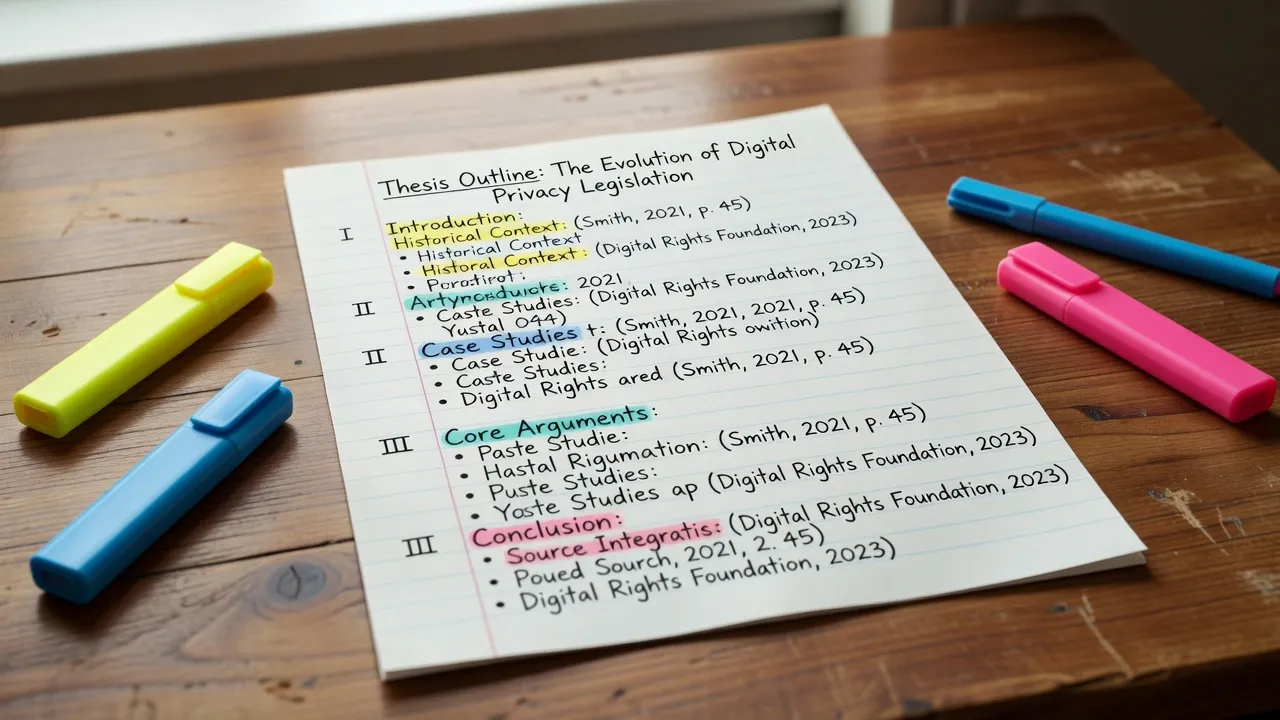
To achieve local synthesis, UNC guides recommend using specific transitional frameworks:
- Comparison Transitions: "Similarly," "In the same vein," "Consistent with X's findings."
- Contrasting Transitions: "However," "Conversely," "Where X sees opportunity, Y identifies risk."
- Causal Transitions: "As a direct result of the policies outlined by X, the economic shifts documented by Y occurred."
For students balancing high essay workloads across multiple subjects, utilizing ThinkAssist offers a quick way to check if your body paragraphs rely too heavily on a single source or if your arguments successfully incorporate multiple references.
What does a Bellevue College synthesis essay example look like?
A Bellevue College synthesis essay example provides a straightforward template for introductory composition students writing research papers. The Bellevue model emphasizes clarity, clean transitions, and strict adherence to standard academic essay formats, such as MLA or APA documentation.
The Bellevue guide contrasts simple summary with true synthesis through clear visual comparisons:
- Summary Paragraph: Focuses on one text. It answers the question, "What did this specific author say?"
- Synthesis Paragraph: Focuses on an overarching issue. It answers the question, "How do these different texts help us understand the broader problem?"
Bellevue College samples frequently use a standard 5-paragraph essay outline adapted for multi-source papers. The introduction provides background on the debate, defines key terms, and states a three-part thesis. Each body paragraph explores one sub-topic using evidence from at least two sources, while the conclusion addresses the broader real-world implications of the synthesis.
What does the Lewis University guide to creating effective synthesis essays cover?
The Lewis University guide covers strategies for avoiding dropped quotations, maintaining proper citation mechanics, and framing source material with analytical commentary. The resource focuses heavily on helping writers maintain control over their papers when managing numerous external quotes.
According to research resources from Lewis University, one of the most common mistakes in student synthesis essays is the "quote bomb"—dropping a direct quote into a paragraph without introduction or analysis. The guide teaches the "sandwich method" for source integration:
-
TOP BREAD: Writer's Topic Sentence / Analytical Claim
-
FILLING: Introduced Quote or Paraphrased Evidence
-
BOTTOM BREAD: Writer's Analysis / Synthesis Connection
-
Top Slice: The writer introduces an analytical claim in their own words.
-
The Filling: The writer introduces a quote using an active verb (e.g., demonstrates, contends, disputes).
-
Bottom Slice: The writer follows the quote with at least two sentences explaining why the quote matters and how it connects to the other sources mentioned in the paragraph.
The Lewis University guide emphasizes that paraphrasing is generally superior to direct quoting in synthesis essays. Paraphrasing allows the author to harmonize the tone and style of multiple sources, preventing the essay from feeling jarring or disjointed.
How to synthesize sources step-by-step
Synthesizing sources requires reading your materials critically, grouping key themes into an outline matrix, and writing paragraphs driven by your own central claims. Following a structured process prevents you from falling back into simple source summaries.
Step 1: Read and annotate with a matrix
Before writing your introduction, create a grid. List your source titles across the top row and your central research questions down the first column. As you read, fill in the corresponding boxes with key facts, quotes, and statistics.
Step 2: Draft a synthesis thesis statement
Your thesis statement must do more than state that sources exist on a topic. It needs to articulate a clear conclusion drawn from comparing those sources.
- Weak Thesis: "This essay will look at three sources that discuss social media's impact on teenagers."
- Strong Thesis: "While technological advocates highlight social media's role in peer connectivity, psychological data demonstrates that excessive platform use increases adolescent anxiety, necessitating stricter digital wellness policies."
Step 3: Construct paragraphs using topic-based headers
Group your matrix notes by shared concepts rather than author names. Each body paragraph should contain evidence from at least two distinct sources to ensure true synthesis.

Step 4: Streamline source analysis using AI study tools
When managing complex multi-source assignments under tight deadlines, digital tutors can help simplify source analysis. Using ThinkAssist, you can snap a photo of dense reading assignments or prompt guidelines to receive instant explanations, structural breakdowns, and study guidance 24/7. This helps ensure your paper stays organized and addresses all prompt requirements effectively.
Synthesis essay vs. literature review vs. argumentative essay
Understanding the distinct features of different academic types of writing prevents structural errors during the drafting process.
| Feature | Synthesis Essay | Literature Review | Argumentative Essay |
|---|---|---|---|
| Primary Goal | Combine multiple sources to form a new, unified argument | Summarize and evaluate the current state of research on a topic | Persuade the reader to accept a specific stance on an issue |
| Source Usage | Blends 3+ sources together within body paragraphs | Analyzes sources systematically, often study by study | Uses sources selectively to support the writer's own main points |
| Writer's Voice | Dominant; uses sources as dialogue partners | Neutral/Evaluative; maps existing scholarly landscape | Direct and persuasive; focuses on defending a specific claim |
| Common Length | 3–8 pages (AP Exam: 3–4 pages) | 5–20+ pages | 3–10 pages |
Frequently Asked Questions
What is the main purpose of a synthesis essay?
The main purpose of a synthesis essay is to combine information from multiple research sources to develop and support an original thesis statement. Rather than summarizing each text individually, the writer analyzes how different sources relate, agree, or conflict with one another on a shared topic.
How many sources should be used in a synthesis essay example?
Most standard synthesis essays require a minimum of three to four distinct sources. Academic assignments and AP English exams typically provide six to seven options and require students to incorporate at least three or four within their body paragraphs.
What is the difference between an expository and an argumentative synthesis essay?
An expository synthesis essay objective explains a topic by comparing how different sources view the issue without taking a personal stance. An argumentative synthesis essay uses evidence from multiple sources to defend a specific, debatable thesis statement.
Can I quote sources directly in a synthesis essay?
Yes, but direct quotes should be kept brief and embedded into your own sentences. Paraphrasing is generally preferred in synthesis writing because it helps maintain a consistent tone throughout the paper while effectively weaving multiple viewpoints together.
How do you write a thesis statement for a synthesis essay?
A synthesis thesis statement must present an original claim that emerges from comparing your sources. It should highlight a central trend, conflict, or conclusion drawn from analyzing the texts together, rather than merely stating that the sources discuss the topic.
What is a synthesis matrix?
A synthesis matrix is a pre-writing grid used to organize research. It places sub-topics along one axis and individual sources along another, allowing writers to easily spot overlapping arguments, shared evidence, and conflicting perspectives before drafting.
How do I avoid summarizing sources instead of synthesizing them?
To avoid simple summary, ensure that every body paragraph includes evidence from at least two different sources. Begin each paragraph with a topic sentence focused on a central idea or theme rather than an author's name or book title.