
The best free full-length MCAT practice test comes directly from the Association of American Medical Colleges (AAMC), which offers two official, full-length practice exams at zero cost. Combining these official AAMC exams with free full-length diagnostics from Blueprint, Kaplan, and The Princeton Review gives pre-med students up to five complete practice tests without paying for a commercial prep course as of August 2026.
Choosing the right free MCAT practice test comes down to one single variable: whether you need exact AAMC score calibration or granular diagnostic feedback on content gaps. Official tests show you how the test-makers write passages, while commercial tests highlight which science concepts require immediate remediation.
| Test Provider / Tool | Total Free Exams | Realism & Scoring Alignment | Standout Feature | Best Suited For |
|---|---|---|---|---|
| AAMC Official Prep | 2 Full-Length Exams | Exact scale and passage logic | Official retired test questions | Final score prediction and pacing |
| Blueprint MCAT | 1 Half-Length + 1 Full-Length | High realism, scaled slightly harsh | Advanced question-type analytics | Finding specific content weaknesses |
| ThinkAssist | Unlimited Question Review | Custom AI problem breakdown | Photo scanning app with step-by-step science breakdowns | Dissecting difficult practice questions |
| Kaplan Test Prep | 1 Full-Length Exam | Tougher CARS, representative science | Realistic interface simulation | High-yield content stamina testing |
| The Princeton Review | 1 Full-Length Exam | Deflated scoring scale | In-depth score report by sub-topic | Endurance training on dense passages |
| UWorld MCAT | 7-Day Free Trial (50+ questions) | Industry-leading explanation detail | Comprehensive visual diagrams | Target practice on weak subjects |

Does AAMC offer a free full-length MCAT practice test?
Yes, the AAMC offers two free full-length MCAT practice tests through its official Hub portal. These consist of the AAMC Practice Exam 1 (Unscored), formerly known as the Sample Test, and the AAMC Practice Exam 4 (Free), which provides a scaled score equivalent to a live exam.
You can access both resources directly on the AAMC official prep site. Because these exams use retired questions written by the actual test creators, they represent the gold standard for passage logic, difficulty level, and scoring accuracy.
What are the key trade-offs of the free AAMC exams?
- Unscored vs. Scored formats: The Unscored Sample Test provides raw percentages per section rather than a 472-528 scaled score, requiring you to use third-party conversion spreadsheets to estimate your score.
- Limited question volume: You only get two official free tests, meaning you must save them for strategic moments in your schedule, such as your baseline assessment and your final check two weeks before test day.
- Minimal explanations: Official AAMC answer explanations are notoriously brief, often stating why an answer choice is correct without clearly explaining why the distractors are wrong.
When you hit a confusing explanation on an official AAMC question, taking a screenshot and running it through a reliable study helper can clarify the underlying biochemistry or physics concepts behind the passage.
Does Blueprint (Next Step) offer a free full-length MCAT practice test?
Yes, Blueprint MCAT offers a free full-length practice test alongside a free half-length diagnostic exam when you sign up for their free account. Blueprint (formerly Next Step) is widely regarded by test-takers as having the most accurate third-party scoring algorithm and interface.
You can register for these free exams on Blueprint's free resources portal. Their system includes a free trial of their analytics engine, which categorizes every question you miss by subject, reasoning skill, and question type.
How realistic is Blueprint compared to the real MCAT?
- Science Sections: Blueprint's Chemical and Physical Foundations (C/P) and Biological and Biochemical Foundations (B/B) sections closely match the data-interpretation style of modern AAMC passages.
- CARS Section: Their Critical Analysis and Reasoning Skills (CARS) passages tend to feature slightly longer texts and more subjective answer logic than official AAMC materials.
- Score Scale: Scores above 505 on Blueprint align well with official AAMC results, though scores above 515 tend to be slightly deflated compared to the real exam.
Does Kaplan offer a free full-length MCAT practice test?
Yes, Kaplan offers one free full-length MCAT practice test that mimics the format, timing, and interface of the actual exam. Kaplan provides this free test as part of their introductory prep package to help students build testing stamina.
Pre-meds can access this practice test by visiting Kaplan's free MCAT practice page. The test includes a detailed score report that breaks down performance across all four test sections.
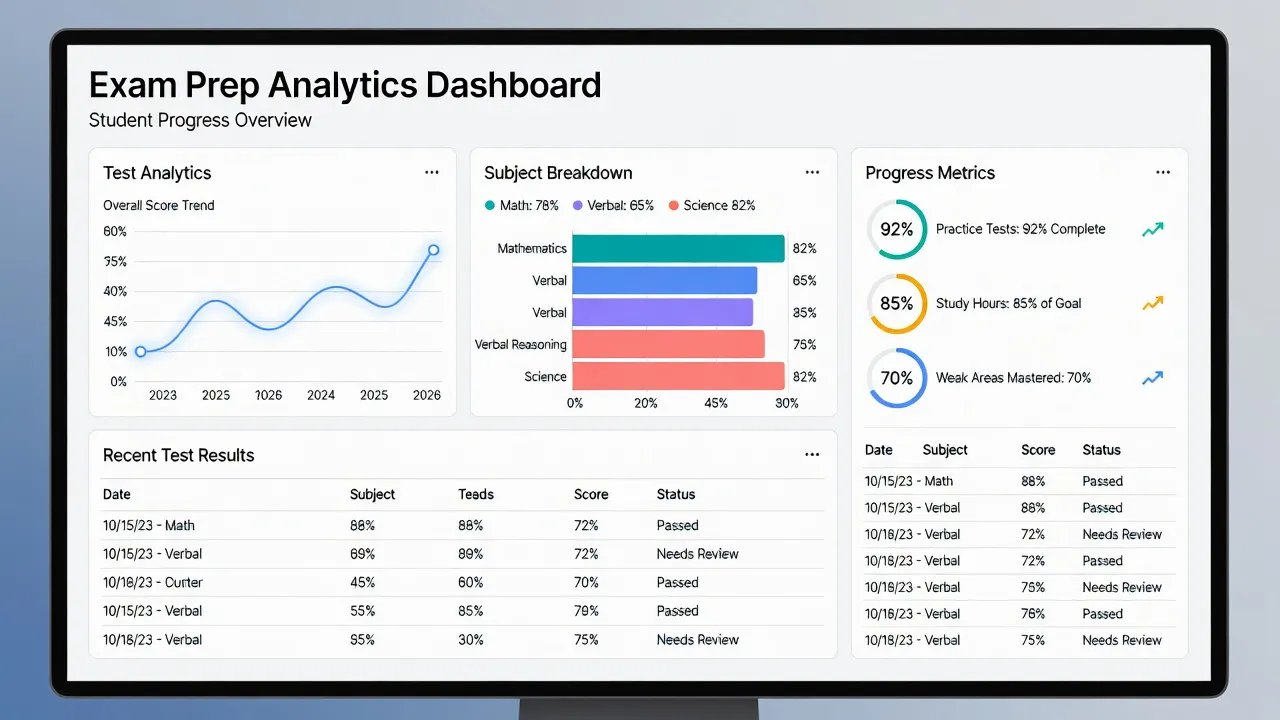
What should you expect from Kaplan's free exam?
- Higher emphasis on content recall: Kaplan's questions often test discrete textbook facts more heavily than the passage-based data analysis emphasized by the AAMC.
- Challenging CARS passages: Many students report that Kaplan CARS logic focuses on minor passage details rather than main-idea comprehension.
- Stamina building: Taking Kaplan's full 7.5-hour practice run is an excellent way to train your focus before diving into your precious AAMC materials.
Does Princeton Review offer a free full-length MCAT practice test?
Yes, The Princeton Review provides one free full-length MCAT practice test with an automated score report. This exam is structured to reflect the standard 230-question length and pacing of the official test.
You can create a free account on The Princeton Review's MCAT site to launch the test in your web browser. Their platform provides a comprehensive performance summary that flags content topics where you answered questions incorrectly.
Is The Princeton Review score accurate?
- Deflated scoring scale: Scores on The Princeton Review free test are notoriously deflated, frequently scoring students 3 to 7 points lower than their actual AAMC performance.
- Calculation-heavy science: Physical science passages often require more multi-step mental math than you will encounter on test day.
- Dense reading passages: Their Psychological, Social, and Biological Foundations of Behavior (P/S) section features dense text blocks that test your endurance under strict time constraints.
Does UWorld offer full-length MCAT practice exams?
No, UWorld does not offer complete, full-length 230-question MCAT practice exams, but they do provide a 7-day free trial containing sample question sets. Instead of full-length mock tests, UWorld functions as a high-yield practice question bank (QBank).
You can sign up for a trial account on UWorld's MCAT portal to test out their platform. Their 7-day trial gives you access to a limited set of passage-based questions across biochemistry, organic chemistry, physics, psychology, and CARS.
| Step | Stage | Action |
|---|---|---|
| 1 | Baseline Assessment | Take Blueprint Free Diagnostic (Half) |
| 2 | Content Diagnostics | Take Princeton Review or Kaplan Free |
| 3 | Targeted Skill Review | Practice with UWorld & ThinkAssist App |
| 4 | Official Calibration | Take AAMC Free Practice Exam 1 |
| 5 | Final Score Check | Take AAMC Free Practice Exam 4 (Scored) |
Why do pre-med students use UWorld alongside free exams?
- Unmatched visual explanations: UWorld is famous for its detailed illustrations, diagrams, and step-by-step logic breakdowns for every question choice.
- Customizable practice blocks: You can create custom 10-question or 59-question quizzes focused exclusively on your specific weak spots, such as renal physiology or optics.
- Active learning interface: Their interface duplicates the official Pearson VUE test center screen layout, familiarizing you with highlighting and strikethrough hotkeys.
What free MCAT practice tests do students recommend on Reddit?
On the r/Mcat community, students consistently recommend starting with the Blueprint free half-length diagnostic, followed by the two free official AAMC exams. Medical school applicants on Reddit's MCAT forum generally advise against using third-party tests for final score predictions, recommending them instead for stamina and strategy.
What is the consensus strategy on r/Mcat?
- Save AAMC for the final month: Reddit users strongly caution against taking AAMC Free Practice Exam 4 early in your review, as it is the single most predictive free exam available.
- Use third-party tests for stamina: Taking free full-length exams from Kaplan or Princeton Review early in your study schedule helps build the mental endurance required for a 7.5-hour exam.
- Track incorrect questions aggressively: Successful test-takers emphasize keeping an "error log" where you record the root cause of every missed question, whether it was a content gap, misreading the prompt, or a timing rush.
If you struggle to break down complex science word problems in your error log, using a scan question and get answer app lets you analyze step-by-step logic on your phone during study breaks.

How to review missed practice test questions with ThinkAssist
Reviewing your full-length practice tests thoroughly takes just as long as taking the exam itself. While commercial practice tests highlight which questions you missed, they rarely walk you through the precise step-by-step mathematical or chemical derivations needed to master the concept.
When you hit a roadblock during your review, ThinkAssist functions as an AI-powered homework solver and 24/7 tutor. You can snap a photo of any complex science problem, math calculation, or physics diagram from your practice test review notes to receive immediate, structured breakdowns.
- Snap a photo of tough questions: Simply capture a image of a printed passage question, organic chemistry mechanism, or physics formula to get step-by-step logic.
- Automatic subject detection: The app identifies whether your question involves biochemistry, general chemistry, physics, or algebra-based calculations without manual tagging.
- Step-by-step explanations: Instead of just giving a final answer key, the app breaks down the underlying principles so you understand the logic behind the solution.
- Save explanations for test prep: All your scanned questions and AI tutor responses are saved automatically in your account, building a personalized review deck as you approach test day.
Pairing your official free full-length exams with a mobile study app keeps your test prep organized and eliminates study downtime when working through tough science passages.
How to build a study schedule around free MCAT practice tests
A smart study schedule uses free practice tests at specific milestones rather than burning through them all at once. Spacing your full-length exams across a 12-to-16 week study window ensures you measure actual progress without running out of practice material.
Week 1:  Take Blueprint Free Half-Length Diagnostic (Establish Baseline)
Week 4:  Take Kaplan Free Full-Length Exam (Content Gap Check)
Week 8:  Take The Princeton Review Free Full-Length Exam (Stamina Building)
Week 11: Take AAMC Free Practice Exam 1 (Unscored Official Baseline)
Week 13: Take AAMC Free Practice Exam 4 (Scored Final Predictor)
Step 1: Establish your baseline with a diagnostic
Start your prep in Week 1 with the Blueprint free half-length test. This 3.5-hour exam gives you an initial score estimate without the exhaustion of a full day in front of the screen.
Step 2: Bridge content gaps with commercial tests
Use the free full-length tests from Kaplan and The Princeton Review during Weeks 4 through 8. Treat these scores purely as diagnostic feedback to highlight weak topics in biochemistry, physics, or psychology.
Step 3: Calibrate with official AAMC practice exams
In the final month before your exam date, shift exclusively to official AAMC materials. Take AAMC Free Practice Exam 1 three weeks before test day and AAMC Free Practice Exam 4 two weeks before test day to lock in your pacing and confirm your target score range.
Frequently Asked Questions
Are free MCAT practice tests accurate?
Official free practice tests from the AAMC are highly accurate and match the actual exam's difficulty and scoring scale. Third-party free tests from Kaplan or Princeton Review tend to be deflated, often scoring students several points lower than their actual ability.
How many free full-length MCAT practice tests exist?
There are currently five high-quality free full-length practice tests available online: two from the AAMC, one from Blueprint, one from Kaplan, and one from The Princeton Review.
Should I take a free full-length MCAT test before studying?
Yes, taking a free diagnostic test before studying helps you establish a realistic baseline score and identifies which subject areas need the most attention during your content review phase.
What is the difference between the AAMC Unscored Sample Test and Practice Exam 4?
The AAMC Unscored Sample Test provides raw percentages per section without an official scaled score, whereas Practice Exam 4 uses the official 472-528 scoring scale based on real student performance data.
Can you pause a free MCAT practice test?
Most third-party free practice tests allow you to pause the timer or complete sections individually. However, taking the exam under strict, un-paused timed conditions is recommended to build real testing stamina.
How long does a full-length MCAT practice test take?
A full-length MCAT practice test takes approximately 7 hours and 30 minutes to complete, including total content time of 6 hours and 15 minutes plus standardized test breaks.
Do I need to buy paid MCAT prep courses if I use all free tests?
No, many students achieve high scores using free practice tests combined with affordable practice question banks, free outline documents, and self-study tools.