
The IB Physics data booklet is an official reference document provided by the International Baccalaureate Organization during Paper 1 and Paper 2 exams containing fundamental constants, unit conversions, and essential mathematical formulas. Unlike traditional open-book cheat sheets, it provides bare equations without variable definitions or application steps, meaning students must know what each symbol represents and when to apply it.
Understanding this booklet is often the single biggest factor determining whether a student scores a 5 or a 7. Many students assume that having a booklet full of equations means they do not need to memorize anything. That misconception causes severe time management issues on exam day.
What is the IB Physics data booklet and what does it contain?
The IB Physics data booklet—often called the IB physics formula booklet—is a multi-page reference document split into mathematical symbols, physical constants, metric prefixes, and topic-specific equations. It covers both Standard Level (SL) and Higher Level (HL) material across the entire curriculum.
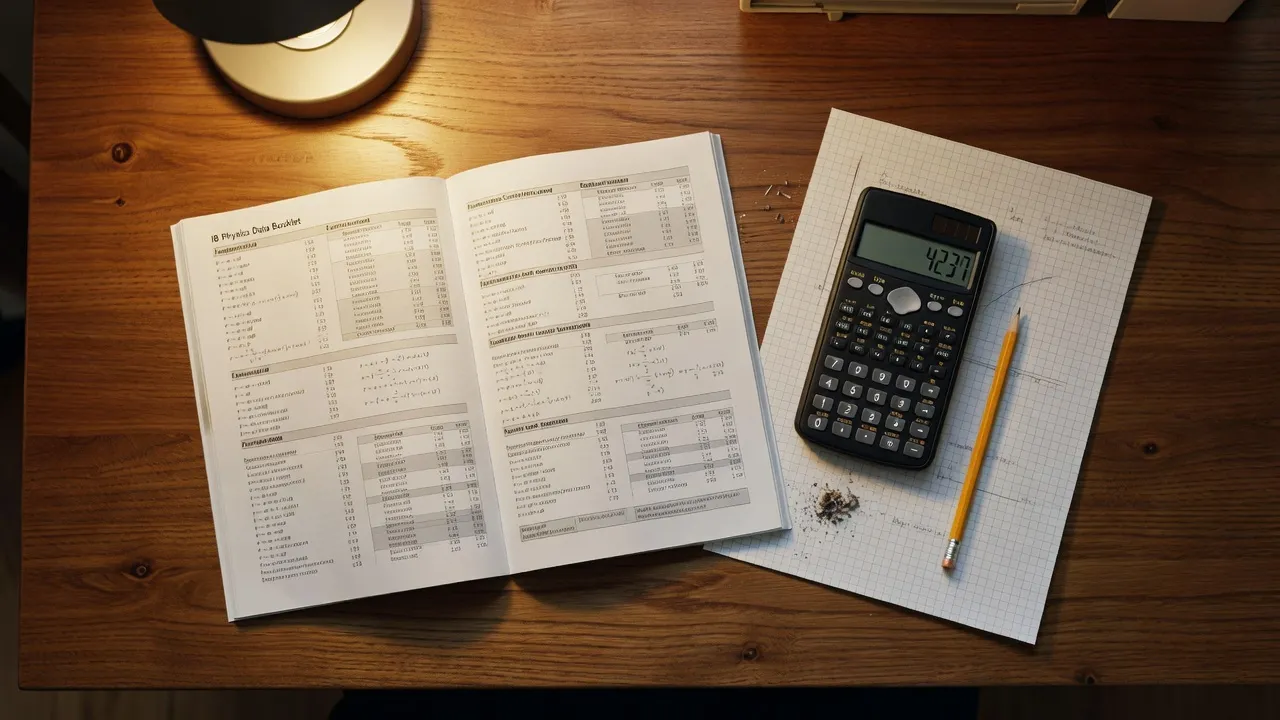
According to the official International Baccalaureate Organization subject brief, the physics curriculum organizes topics around core concepts like space, time, motion, energy, and fields. The data booklet mirrors this structure by grouping formulas under matching thematic headings.
Here is a breakdown of what you will find inside the document:
- Fundamental Constants: Precise physical values including the speed of light ($c = 3.00 \times 10^8 \text{ m/s}$), Planck's constant ($h = 6.63 \times 10^{-34} \text{ J}\cdot\text{s}$), and the gravitational constant ($G$).
- Unit Conversions & Prefixes: Scientific notation multipliers from pico- ($10^{-12}$) to tera- ($10^{12}$), along with electron-volt ($eV$) and astronomical unit ($AU$) conversions.
- Mathematical Formulas: Geometry equations for sphere volumes, arc lengths, trigonometry identities, and vector resolution formulas.
- Core Subject Formulas: Sub-sectioned equations for kinematics, thermal physics, wave behavior, electricity, magnetism, atomic structure, and energy production.
- Higher Level (HL) Extensions: Dedicated equation blocks reserved for topics like quantum mechanics, wave phenomena extensions, and gravitational fields.
How is the IB physics formula booklet structured across topics?
The IB physics formula booklet arranges equations sequentially by syllabus topic, starting with measurement uncertainty and progressing through classical mechanics to modern quantum physics. Each section presents equations in stripped-down form, without explaining what the individual symbols mean.
As noted in Wikipedia's IB Diploma Program overview, the curriculum assesses candidates through standardized written exams where reference materials must be used efficiently under tight time limits.
Core topics versus Higher Level (HL) sections
Standard Level students only need to focus on core sections (typically sections 1 through 8 in traditional layouts or Themes A through E under newer syllabus structures). Higher Level students must navigate additional sub-sections clearly designated with "HL" labels.
If you are trying to understand why physics is hard, much of the difficulty comes down to connecting abstract variables in these tables to actual exam problems.
Constant values and standardized notation
The constants given in the booklet match international scientific consensus. For example, fundamental physical values align with CODATA standards published by the National Institute of Standards and Technology.
Using the exact constant values provided in the data booklet—rather than rounded values stored in your personal calculator—is essential for securing full marks on numerical calculation questions.
What are the biggest mistakes students make with the IB Physics data booklet?
The most common mistake students make is treating the data booklet as a substitute for conceptual understanding rather than an index of mathematical shorthand. Relying on the booklet without understanding variable definitions leads to five specific traps on test day:
- Misidentifying variables: The letter $k$ can represent Boltzmann's constant, Coulomb's constant, or spring stiffness depending on the section you are reading.
- Ignoring missing equations: The booklet intentionally excludes foundational relationships (like $v = d/t$ or basic power definitions) that students are expected to know automatically.
- Assuming vector direction is given: The formulas provide magnitude in physics calculations, but they rarely indicate directional signs or vector components.
- Failing to check unit compatibility: Constants in the booklet use SI units, but exam questions frequently mix megajoules, electron-volts, or kilometers per hour.
- Wasting time searching for basic forms: Spending 45 seconds hunting for a simple wave equation during Paper 1 cuts directly into your buffer for complex multi-step problems.

How do you use the data booklet for Paper 1 and Paper 2?
You should use the data booklet in Paper 1 for rapid constant lookups and vector component verification, while using it in Paper 2 to structure multi-step derivations. Paper 1 tests quick recall and conceptual logic, whereas Paper 2 requires you to synthesize equations from different sub-sections into a single coherent solution.
Here is how your approach should differ between exam components:
Paper 1 (Multiple Choice & Data Analysis)
- Speed is everything: Limit your booklet lookups to constants and obscure equations.
- Sanity check units: Use the metric prefix table to double-check power-of-ten conversions quickly.
- Identify proportionalities: Look at equation structures to see how changing one variable doubles or quadruples another.
Paper 2 (Written Response)
- Map out multi-step derivations: State the primary equation directly from the booklet before making substitutions.
- Draw structural diagrams: Combine equation lookups with free body diagrams to verify force directions before plugging in numbers.
- Show explicit unit work: Show how booklet constants simplify into the final units required by the question prompt.
When working through homework problems or past papers, relying purely on static PDF booklets can leave you stuck when you do not recognize a variable. If you get stumped on an equation derivation late at night, using an interactive app like ThinkAssist lets you snap a photo of any physics problem to get instant, step-by-step explanations of how specific data booklet formulas apply.
How does the IB Physics data booklet compare to other physics reference sheets?
The IB Physics data booklet provides significantly less explanatory context than AP Physics formula sheets, forcing students to rely heavily on prior problem-solving practice. While other exam boards include explicit variable labels or simple contextual diagrams, the IB booklet lists raw formulas side-by-side.
The table below contrasts popular physics exam reference tools with modern digital study aids like ThinkAssist.
| Reference Tool | Primary Target Audience | Strengths | Major Limitations |
|---|---|---|---|
| IB Physics Data Booklet | IB SL and HL Physics students | Comprehensive, standardized across all official exams | Contains zero variable descriptions or step-by-step guidance |
| ThinkAssist AI Tutor | High school & IB students seeking 24/7 homework help | Snaps photos of problems, detects subjects automatically, explains steps | Requires smartphone or web access during homework (not allowed in exam room) |
| AP Physics 1 Formula Sheet | High-school AP Physics 1 candidates | Clear variable key definitions next to major topic sections | Specific only to algebra-based content; lacks advanced topics |
| SAT Math Reference Sheet | SAT exam takers | Simple geometric layout with basic shape diagrams | Very limited scope; covers basic geometry and spatial formulas only |
Comparing these tools shows why exam reference sheets alone are rarely enough for comprehensive prep. If you are also preparing for standardized testing alongside IB coursework, reviewing our guide on the SAT math formula sheet provides additional clarity on geometry formulas.
How can you practice decoding data booklet equations efficiently?
You can practice decoding the data booklet by annotating a personal copy during daily revision and solving unguided past paper questions. The goal is to build muscle memory so your eyes jump directly to the exact page and quadrant where a target equation sits.

Here is a four-step method for mastering the booklet before exam day:
- Create an annotated "master booklet": Print a fresh copy of the data booklet. Write out variable names, SI units, and common rearrangement forms in the margins.
- Categorize by exam topic: Color-code core topics (mechanics, thermal, electricity) so you learn the spatial geography of the booklet.
- Practice backward decoding: Take a past paper solution and locate every formula used in the scoring scheme back inside the booklet.
- Leverage modern AI tools for self-testing: When practicing at home, download the ThinkAssist iOS App to quickly check whether you selected the correct equation for complex multi-topic questions.
ThinkAssist works as a personal 24/7 tutor. You can try it with a 3-day free trial (and $6.99/week after that) to scan tricky problem sets, receive automatic subject detection, and review step-by-step solutions that break down exactly how variables from the IB physics formula booklet are transformed into numerical answers.
What key constants and mathematical relations are included in the booklet?
The data booklet includes foundational physical constants, standard unit prefixes, and basic geometric identities that eliminate the need for rote memorization of universal quantities. Knowing where these values sit on the front pages saves valuable minutes during calculation-heavy exam questions.
Here are the most frequently referenced constant values provided in the booklet:
- Speed of light in vacuum ($c$): $3.00 \times 10^8 \text{ m s}^{-1}$
- Permittivity of free space ($\varepsilon_0$): $8.85 \times 10^{-12} \text{ F m}^{-1}$
- Permeability of free space ($\mu_0$): $4\pi \times 10^{-7} \text{ T m A}^{-1}$
- Elementary charge ($e$): $1.60 \times 10^{-19} \text{ C}$
- Avogadro's constant ($N_A$): $6.02 \times 10^{23} \text{ mol}^{-1}$
- Gravitational constant ($G$): $6.67 \times 10^{-11} \text{ N m}^2 \text{ kg}^{-2}$
- Acceleration of free fall at Earth's surface ($g$): $9.81 \text{ m s}^{-2}$
If you are also studying advanced placement physics alongside or instead of IB physics, you can read our detailed breakdown of AP Physics 1 FRQ strategies to see how formula application differs between test formats.
Frequently Asked Questions
Do you get the data booklet for IB Physics Paper 1?
Yes, you receive a clean, unannotated copy of the official IB Physics data booklet for both Paper 1 and Paper 2 during official examinations.
Is the IB physics formula booklet the same for SL and HL?
Yes, SL and HL students use the same master data booklet, but HL students utilize additional equations clearly marked for Higher Level content.
Are variable names explained inside the IB physics data booklet?
No, the data booklet lists equations and constants without defining variable symbols or providing instructions on how to apply them.
Has the IB Physics data booklet changed for the updated syllabus?
As of October 2026, the data booklet reflects the updated IB Physics syllabus structure, organizing formulas under modern thematic headings rather than numbered sub-topics.
Can you write notes on the data booklet during the exam?
You can write, highlight, and annotate the copy of the data booklet provided to you during the exam session, but you cannot bring your own pre-annotated booklet into the room.
How do I memorize where formulas are in the IB physics formula booklet?
The best strategy is to use a clean copy of the booklet on every homework assignment and practice exam so that finding equations becomes automatic.