
A reinforcer in psychology is any stimulus or event following a behavior that increases or maintains the future probability of that behavior. Unlike standard rewards, which depend on human intent or pleasant feelings, a reinforcer is defined strictly by its functional impact on observable action. If a consequence causes an action to happen more frequently in the future, that consequence is a reinforcer.
Understanding reinforcement is fundamental to behavioral psychology, learning theory, and everyday habit formation. Whether you are studying operant conditioning for an exam or trying to build better personal study habits, grasping how consequences shape action provides a clear blueprint for behavior change.
What is the APA dictionary definition of a reinforcer?
The American Psychological Association (APA) defines a reinforcer as any stimulus or event that increases the likelihood of a specific response when presented immediately following that response.
According to the official APA Dictionary of Psychology, the term applies across both operant and classical conditioning contexts. In operant conditioning, a reinforcer strengthens the voluntary response it follows. In classical conditioning, the unconditioned stimulus sometimes acts as a reinforcer for the conditioned response.
Psychologists emphasize that a reinforcer must be measured by performance changes rather than subjective appeal. What acts as a strong reinforcer for one individual might have zero effect on another.
What is the Cooper, Heron, and Heward (ABA) definition of a reinforcer?
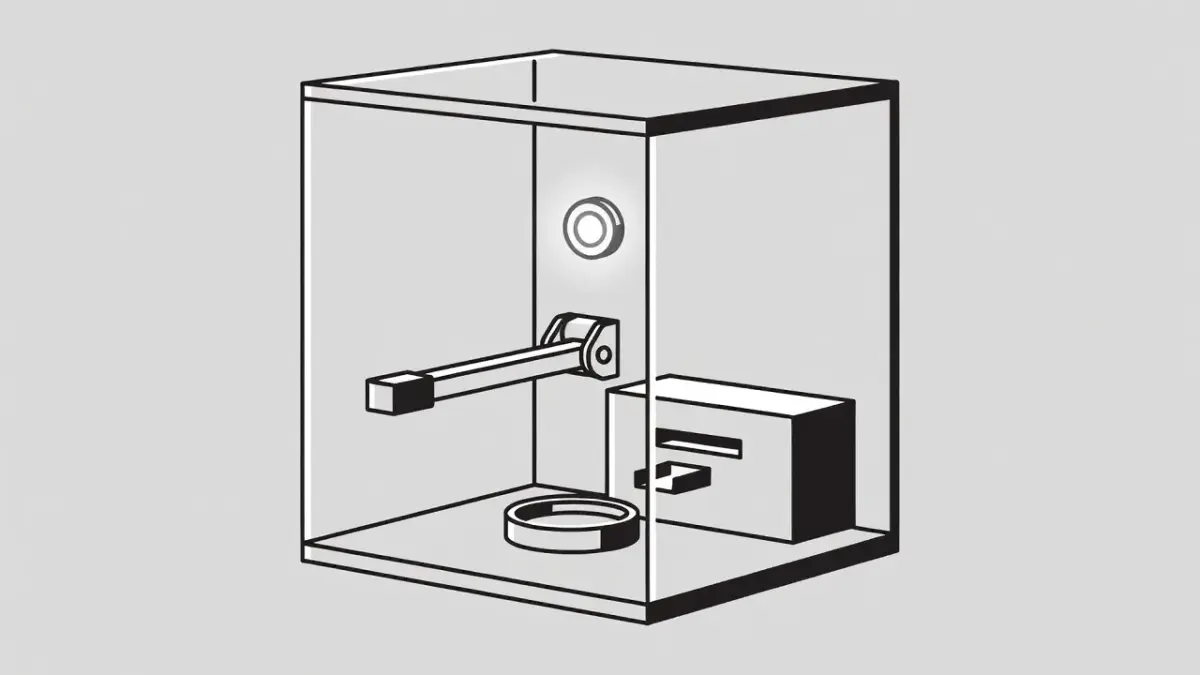
In Applied Behavior Analysis (ABA), Cooper, Heron, and Heward define a reinforcer as a stimulus change that increases the future frequency of any behavior that immediately precedes it.
As outlined in their foundational text Applied Behavior Analysis, the definition requires a concrete functional relationship verified through objective measurement. The stimulus change must occur within a very short temporal window (typically seconds) after the target behavior.
Cooper, Heron, and Heward emphasize three specific criteria for identifying a reinforcer in practice:
- Temporal Contiguity: The stimulus follows the target behavior almost immediately.
- Functional Increase: The target behavior increases in frequency, duration, intensity, or rate over time.
- State Dependability: The reinforcing effect depends on current motivating operations, such as deprivation or satiation.
The B.F. Skinner Foundation notes that operant principles rely entirely on these strict, observable criteria rather than hypothetical mental states.
Is a reinforcer defined by its effect on behavior rather than by intent?
Yes, a reinforcer is defined entirely by its functional effect on behavior, regardless of what the person delivering it intended.
This functional distinction separates psychological reinforcement from colloquial concepts like rewards or bribes. A teacher might give a student verbal feedback intending to encourage quiet work. However, if that feedback results in the student talking more often to get attention, the teacher's response functioned as a positive reinforcer for disruption.
| Intended Consequence | Behavior | Functional Classification |
|---|---|---|
| Scolding | Increases | Functional Reinforcer |
| Gold Star | Decreases | Functional Punisher |
In clinical and educational settings, assuming that a well-meaning reward will automatically reinforce behavior is a common mistake. If the data does not show an increase in the future frequency of the target action, reinforcement did not occur.
Primary vs. secondary reinforcers in psychology
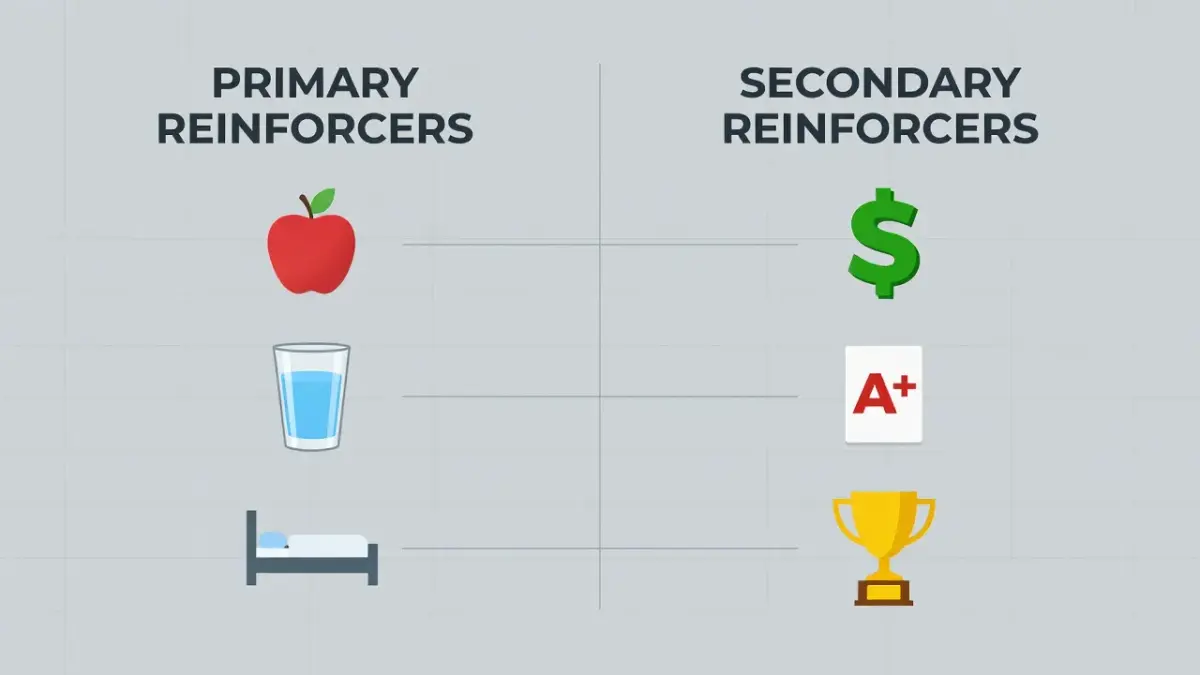
Primary reinforcers satisfy basic biological survival needs, whereas secondary reinforcers acquire their reinforcing value through systematic pairing with other reinforcers.
Understanding the divide between primary reinforcers psychology and secondary reinforcement psychology is a core topic in behavioral science.
What is a primary reinforcer?
For students preparing for exams, the primary reinforcer AP Psychology definition specifies an unlearned, innately reinforcing stimulus that satisfies a biological need. Examples include food, water, sleep, oxygen, and physical warmth.
The mechanism of primary reinforcement psychology relies on homeostasis and drive reduction. An organism does not need prior training to find food reinforcing when hungry.
What is a secondary reinforcer?
In contrast, secondary reinforcer psychology focuses on conditioned stimuli. A secondary reinforcer (also called a conditioned reinforcer) starts as a neutral stimulus. Through repeated conditioning alongside primary or established secondary reinforcers, it takes on reinforcing properties.
A classic secondary reinforcer psychology example is money. Paper bills have no intrinsic biological value to a human infant. However, through secondary reinforcement psychology, cash becomes a powerful generalized conditioned reinforcer because it can be exchanged for food, shelter, entertainment, and safety.
| Feature | Primary Reinforcers | Secondary Reinforcers |
|---|---|---|
| Origin | Innate, biological, unlearned | Learned through classical conditioning |
| Dependence on Need | Tied to immediate biological drives | Less dependent on immediate physical deprivation |
| Common Examples | Food, water, sleep, temperature control | Money, grades, praise, tokens, praise |
| Satiation Speed | High (organism gets full or rested quickly) | Low (generalized reinforcers rarely lose appeal) |
What are reinforcer and preference assessment methods?
Reinforcer and preference assessment methods are structured, empirical procedures used to identify which specific stimuli an individual prefers and which will actually function as reinforcers.
Assuming a child likes stickers or a student cares about gold stars often leads to failed intervention plans. Behavior analysts use three major assessment methods documented in peer-reviewed clinical literature on the National Center for Biotechnology Information:
- Single-Stimulus Assessment: Practitioners present one item at a time to the individual and record engagement duration and emotional reaction.
- Paired-Stimulus Assessment (Forced-Choice): Practitioners present two items simultaneously, asking the individual to choose one. Every item is paired with every other item across trials to create a ranked hierarchy.
- Progressive-Ratio Assessment: Practitioners measure how much physical or cognitive effort an individual will exert (such as pressing a lever or solving math problems) to earn a specific stimulus as the requirement increases.
While preference assessments show what a person likes, only a functional reinforcement assessment confirms whether an item increases target performance.
How effective are token economies as a reinforcement method?
Token economies are exceptionally effective reinforcement systems that reliably increase academic engagement and reduce disruptive behavior across schools, psychiatric settings, and rehabilitation centers.
A token economy relies on generalized conditioned reinforcers—such as plastic chips, points, or digital stars—that individuals earn for performing specified target behaviors. Participants later exchange these tokens for backup reinforcers like free time, snacks, or privileges.
Research demonstrates that token economies succeed because they bridge the time delay between the behavior and the final reward. Immediate delivery of a token preserves temporal contiguity, keeping motivation high.
When fading out a token economy, practitioners slowly increase the number of tokens required or transition to naturally occurring social reinforcers. If you stop a token program too abruptly, target actions may decline—a phenomenon closely tied to behavioral extinction. To understand how extinguished behaviors can unexpectedly reappear later, read our guide on Spontaneous Recovery Psychology Definition and Examples (2026).
What evidence supports attention as a social reinforcer?
Decades of empirical research in classroom management and developmental psychology confirm that social attention is one of the most powerful reinforcers for human behavior.
In landmark studies published during the expansion of applied behavior analysis, researchers demonstrated that teacher attention directly controlled student study behavior. When teachers systematically provided verbal praise and eye contact contingent on students staying in their seats, productive work increased dramatically.
Conversely, reprimands can accidentally reinforce off-task actions. If a student is seeking attention, a teacher shouting "sit down" provides immediate social interaction, reinforcing the very behavior the teacher wants to stop.
Key findings on social reinforcement include:
- Praise-to-Reprimand Ratio: Academic performance peaks when educators maintain at least a 4:1 ratio of positive praise to corrective statements.
- Specific vs. General Praise: Behavior-specific praise ("Great job finishing problem four!") is significantly more reinforcing than generic comments ("Good job").
- Peer Attention: As children reach adolescence, peer attention frequently overtakes adult praise as the dominant social reinforcer.
How to apply reinforcement schedules to master complex subjects
Applying scheduled reinforcement to your study routine involves setting immediate feedback loops and variable reward intervals to build persistent study habits.
In my view, most students struggle with academic motivation because study rewards are far too delayed. Waiting four weeks for an exam grade provides zero immediate reinforcement for reading a textbook chapter tonight.
To build reliable study routines, you need tools that deliver immediate corrective feedback and positive reinforcement while you solve problems. If you want to structure your study routines effectively, check out our guide on Academic Skills: Core Categories and Proven Study Strategies.
When working through difficult homework in subjects like calculus, chemistry, or physics, hitting a roadblock breaks your momentum. Immediate step-by-step guidance functions as a secondary reinforcer, keeping your problem-solving behavior active rather than letting task paralysis set in.
| Study Option | Feedback Speed | Reinforcement Mechanism | Ideal Use Case |
|---|---|---|---|
| Textbook Answer Keys | Delayed (End of chapter) | Fixed ratio (only after completing full problem sets) | Final review and self-testing |
| Generic Search Engines | Moderate (Manual searching required) | Unpredictable (answers often lack steps) | Looking up quick factual definitions |
| ThinkAssist AI Homework Solver | Instant (Immediate camera upload response) | Continuous immediate feedback with step-by-step logic | Daily homework, step-by-step problem solving, and test prep |
| Private In-Person Tutors | Delayed (Scheduled 1-2 times per week) | High social reinforcement during paid sessions | Weekly deep-dive conceptual tutoring |
For automated academic feedback, ThinkAssist provides an immediate feedback loop. Available on the iOS App Store, the app lets you snap a photo of any complex math, physics, or chemistry assignment. It features automatic subject detection to break down questions into step-by-step solutions immediately.
ThinkAssist is free to download and includes a 3-day free trial, followed by a subscription of $6.99 per week. Using a tool that instantly verifies your working steps transforms frustrating study sessions into reinforcing wins. If you want to explore more strategies for staying engaged during study hours, read our practical overview on How to Be Motivated to Do Homework: 2026 Study Strategies.

Frequently Asked Questions
What is the simple definition of a reinforcer in psychology?
A reinforcer is any consequence or event that increases the future frequency of the behavior it immediately follows.
What is the difference between positive and negative reinforcement?
Positive reinforcement adds a desirable stimulus after a behavior, while negative reinforcement removes an unpleasant stimulus. Both mechanisms increase the likelihood that the behavior will happen again.
What is an example of a secondary reinforcer?
Money is a classic secondary reinforcer because cash has no intrinsic biological value, but it buys primary reinforcers like food and shelter.
Why is food considered a primary reinforcer?
Food is a primary reinforcer because it satisfies an innate biological survival need without requiring prior conditioning or learning.
How does negative reinforcement differ from punishment?
Negative reinforcement strengthens a behavior by removing an unwanted condition, whereas punishment weakens or decreases a behavior by introducing an unpleasant consequence or removing a reward.
What are the four main schedules of reinforcement?
The four basic schedules of operant reinforcement are fixed-ratio, variable-ratio, fixed-interval, and variable-interval schedules.
Can a consequence be a reinforcer if it was intended as a punishment?
Yes, if an intended punishment causes the target behavior to increase in the future, it functioned functionally as a reinforcer.