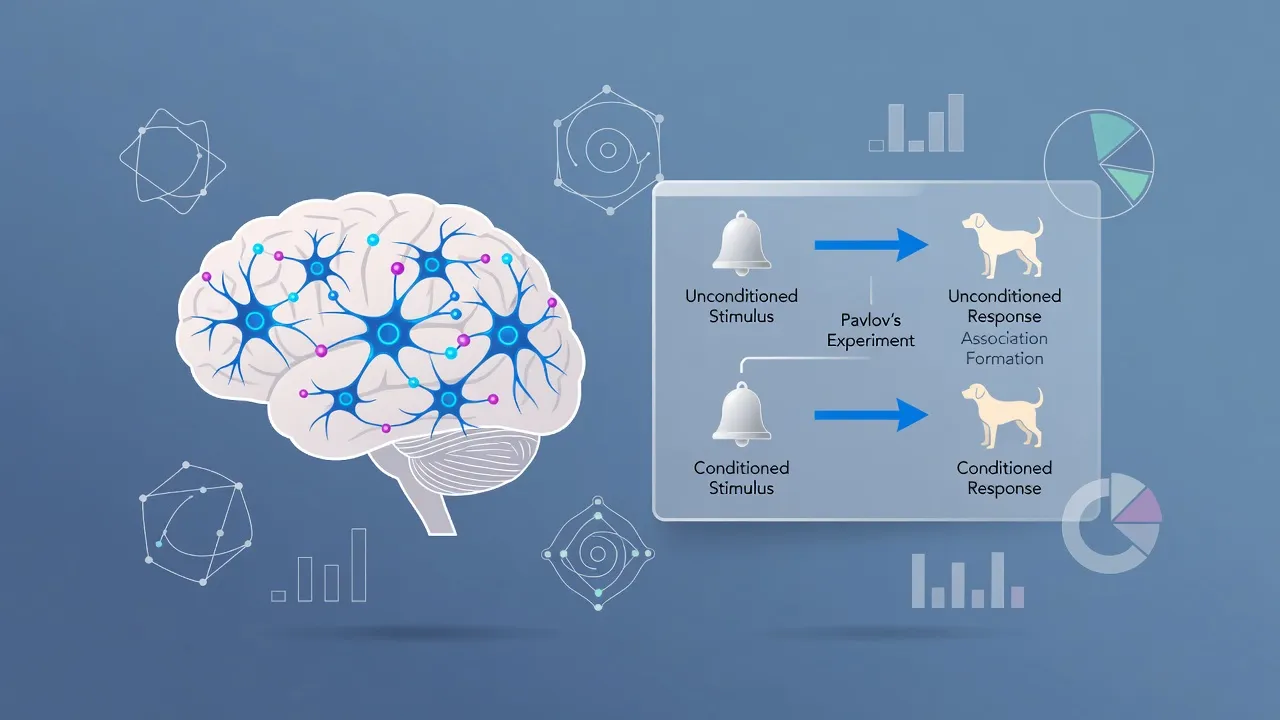
Spontaneous recovery in psychology is the sudden reappearance of a previously extinguished conditioned response after a delay period without any additional learning trials. First identified by Ivan Pavlov during his classical conditioning experiments on dogs, this phenomenon demonstrates that extinction suppresses a learned association rather than erasing it from memory.
In behavioral psychology, understanding spontaneous recovery helps explain why breaking habits, treating phobias, and overcoming addiction require long-term management rather than one-time interventions.
What is spontaneous recovery in psychology?
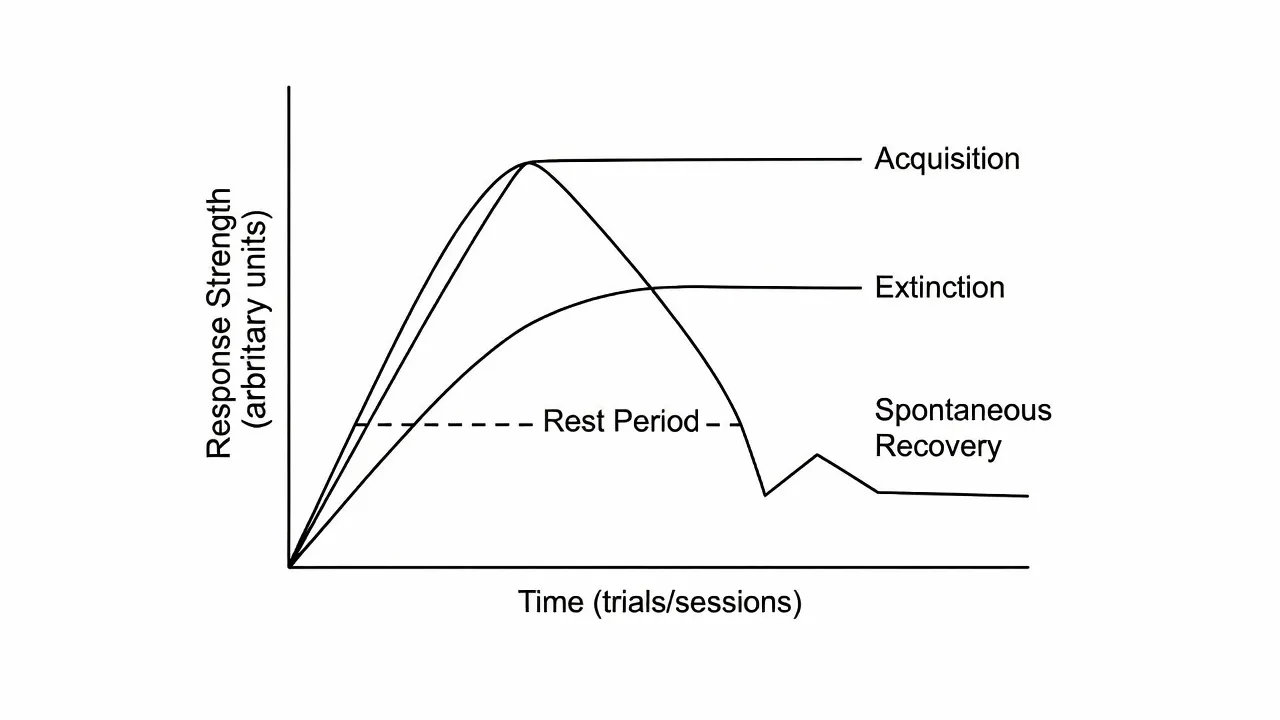
Spontaneous recovery is the re-emergence of an extinguished response following a rest interval where no conditioned stimulus is presented. The phenomenon shows that memory traces created during initial learning remain structurally intact inside the brain long after outward behavior appears to change.
When studying classical conditioning, Ivan Pavlov conditioned dogs to salivate (conditioned response) at the sound of a metronome (conditioned stimulus) by pairing the sound with food (unconditioned stimulus). When Pavlov repeatedly sounded the metronome without presenting food, the dogs gradually stopped salivating. This process is called extinction.
However, after putting the dogs back in their kennels for a 20-minute rest period and sounding the metronome again, Pavlov observed that the salivation instantly returned. The response was weaker than during peak acquisition, but it appeared without any secondary food pairings.
A classic spontaneous recovery psychology example occurs in fear conditioning. If a person gets into a car accident, they might develop an immediate fear of driving. Exposure therapy can help extinguish this fear by placing the driver in safe driving environments until their heart rate remains steady.
If that individual avoids driving for several months and then feels a sudden surge of anxiety upon getting behind the wheel again, they are experiencing spontaneous recovery. The old fear association was not erased; it was merely inhibited during therapy sessions.
For students reviewing the spontaneous recovery ap psychology definition, remember that spontaneous recovery cannot occur without an intervening rest period following extinction. On standardized AP Psychology exams, test items frequently ask candidates to differentiate between extinction (where the response drops to zero) and spontaneous recovery (where the response returns after a delay).
- Acquisition Phase: Paired CS + US leads to Strong CR
- Extinction Phase: CS alone (no US) leads to CR disappears
- Rest Period: No CS presented while Time passes
- Spontaneous Recovery: CS presented leads to Moderate CR returns
Why does spontaneous recovery occur after extinction?
Spontaneous recovery occurs because extinction creates a second, inhibitory memory trace that competes with the original memory rather than destroying it. When time passes, this newer inhibitory memory weakens faster than the original association, allowing the original conditioned response to temporarily regain control of behavior.
Researchers analyze five core phenomena to explain why extinction fails to permanently eliminate learned habits:
- Inhibitory Learning: During extinction, the subject learns a brand-new rule: "This stimulus no longer predicts the reward." According to the American Psychological Association, extinction represents new learning that inhibits original performance rather than an unlearning of the initial association.
- Retrieval Failure: Over time, the internal and external cues that signaled "inhibition is active" fade away. When the subject encounters the conditioned stimulus again, the brain retrieves the original, stronger association first.
- Context Change: The context surrounding extinction differs from the context of initial acquisition. A shift in environment or internal state makes the inhibitory rule harder to recall.
- Renewal: If an association is learned in Context A and extinguished in Context B, returning the subject to Context A automatically brings back the conditioned response.
- Reinstatement: Exposure to a single unconditioned stimulus (like an unexpected loud noise or shock) after extinction can instantly revive the full conditioned response across all contexts.
As of September 2026, clinical researchers use these principles to design relapse prevention protocols for addiction treatment. Because cue-exposure therapy relies on extinction, clinicians warn patients that spontaneous recovery is a biological expectation rather than a personal failure.
Do textbooks explain spontaneous recovery as recovery of inhibition or context-dependent retrieval?
Introductory psychology textbooks typically attribute spontaneous recovery to a decay in inhibition, whereas advanced neuroscience texts explain it using context-dependent retrieval models. High school and undergraduate curricula simplify the concept to help students grasp basic behavioral mechanics, while contemporary neurobiology focuses on how temporal context alters memory selection.
Standard AP Psychology prep guides describe inhibition as a temporary "brake" applied over an underlying habit. In this simplified view, the brake naturally wears off during rest periods, letting the underlying habit leak out.
Advanced literature published by the National Center for Biotechnology Information demonstrates that memory processing relies on context matching. The brain constantly asks which memory trace best fits the present environment.
Because initial acquisition usually lasts longer or carries higher emotional weight, it remains the default memory. Inhibitory memories are fragile and highly dependent on active contextual reminders.
If you are balancing complex behavioral concepts across multiple science modules this semester, staying organized is essential. Taking a structured study break every 45 minutes gives your brain the necessary downtime to consolidate memory traces without cognitive burnout.
What is Bouton's context retrieval theory of spontaneous recovery?
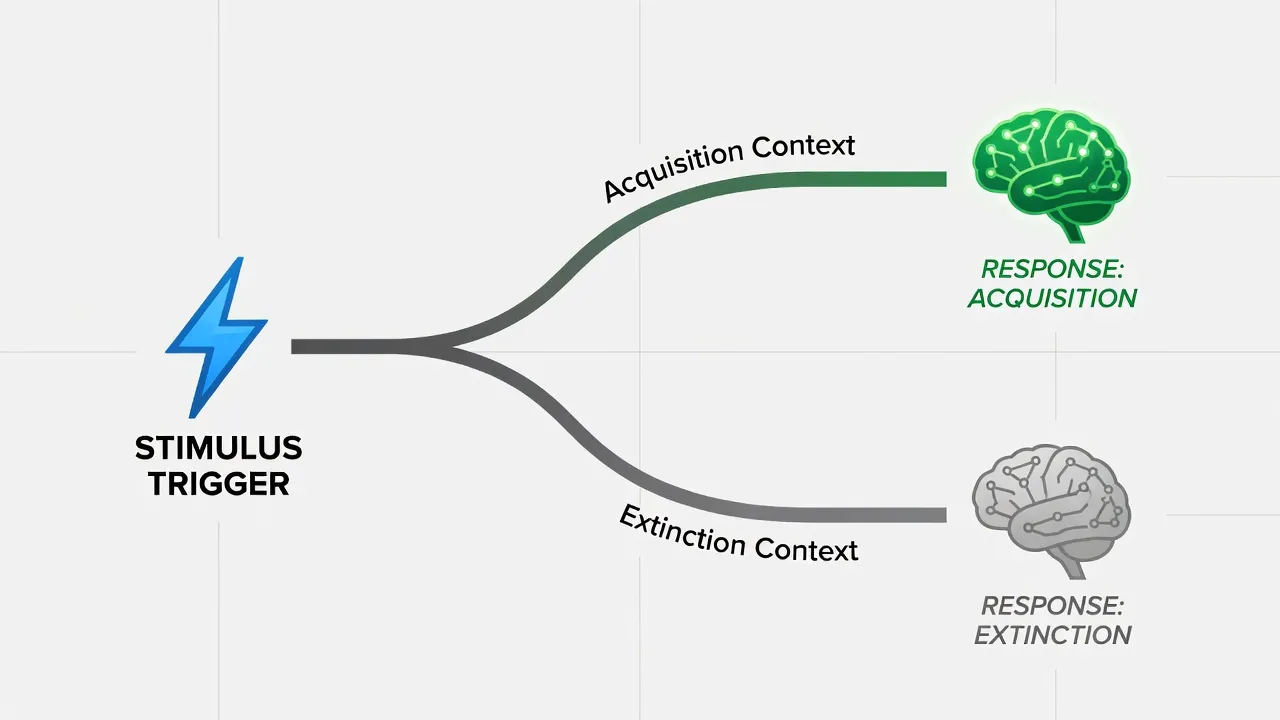
Bouton's context retrieval theory asserts that extinction creates an ambiguous stimulus with two distinct meanings, and the brain uses surrounding environmental and temporal contexts to decide which meaning to express. Developed by psychologist Mark E. Bouton, this model frames extinction as a problem of memory retrieval rather than memory storage.
According to Bouton's theory, the conditioned stimulus (CS) becomes informationally ambiguous after extinction:
- Meaning 1 (Acquisition): CS predicts the Unconditioned Stimulus (US).
- Meaning 2 (Extinction): CS predicts the absence of the US.
To resolve this ambiguity, the nervous system relies on context as a signal. Context includes physical environment, internal hormonal states, and the passage of time itself (temporal context).
During extinction trials, the recent passage of time serves as a strong temporal context that activates Meaning 2. However, after a long rest period, the temporal context shifts.
Because Meaning 2 is bound tightly to the specific time period during which extinction occurred, the shift in time causes the brain to drop Meaning 2 and revert to its default setting: Meaning 1.
What are the neural mechanisms of spontaneous recovery in the hippocampus and amygdala?
Spontaneous recovery depends on dynamic interaction between the basolateral amygdala, the ventromedial prefrontal cortex, and the hippocampus. The amygdala stores the emotional weight of original Pavlovian conditioning, while the prefrontal cortex enforces extinction inhibition, and the hippocampus tracks the contextual cues that determine which circuit controls behavior.
Neuroscientists mapping fear conditioning circuits have pinpointed specific functions for each brain structure:
- Basolateral Amygdala (BLA): Houses the primary threat memory formed during initial conditioning. Synaptic plasticity in the BLA remains altered long after behavior is extinguished.
- Ventromedial Prefrontal Cortex (vmPFC): Sends inhibitory signals via GABAergic interneurons to the amygdala during extinction. When the vmPFC is active, it suppresses the expression of fear.
- Hippocampus: Encodes background cues and temporal intervals. If the hippocampus detects a shift in time or location, it reduces vmPFC activity, allowing the BLA to express the original conditioned response again.
When researchers disable the vmPFC in animal models, spontaneous recovery occurs immediately without requiring a rest period. This proves that spontaneous recovery is governed by a failure of top-down prefrontal inhibition rather than a loss of original memory storage.
How classical conditioning phenomena compare
The table below outlines how spontaneous recovery relates to other fundamental classical conditioning processes documented across behavioral psychology.
| Phenomenon | Trigger Condition | Behavioral Outcome | Underlying Neural Mechanism |
|---|---|---|---|
| Acquisition | Repeated pairing of CS and US | Conditioned response strengthens over trials | Synaptic potentiation in the basolateral amygdala |
| Extinction | CS presented repeatedly without US | Conditioned response gradually drops toward zero | Active vmPFC inhibition over amygdala output |
| Spontaneous Recovery | CS presented after a rest period following extinction | Conditioned response briefly reappears | Shift in temporal context weakens prefrontal inhibition |
| Stimulus Generalization | Presentation of a stimulus similar to the CS | Conditioned response fires to new, related triggers | Broad sensory cortex tuning across neural populations |
| Stimulus Discrimination | Differential pairing of target CS vs similar stimuli | Conditioned response fires only to the exact original CS | Refined hippocampal filtering and inhibitory control |
Understanding these distinctions is essential for performing well on behavioral neuroscience exams. Detailed breakdowns of classical conditioning terms are regularly updated on educational reference sites like Simply Psychology for psychology students preparing for midterms.
How to master learning concepts for psychology exams with ThinkAssist
Working through complex behavioral models, brain structures, and conditioning equations can feel overwhelming during exam season. When self-testing on classical conditioning mechanics or analyzing tricky exam scenarios, having immediate academic support makes a massive difference in your study workflow.
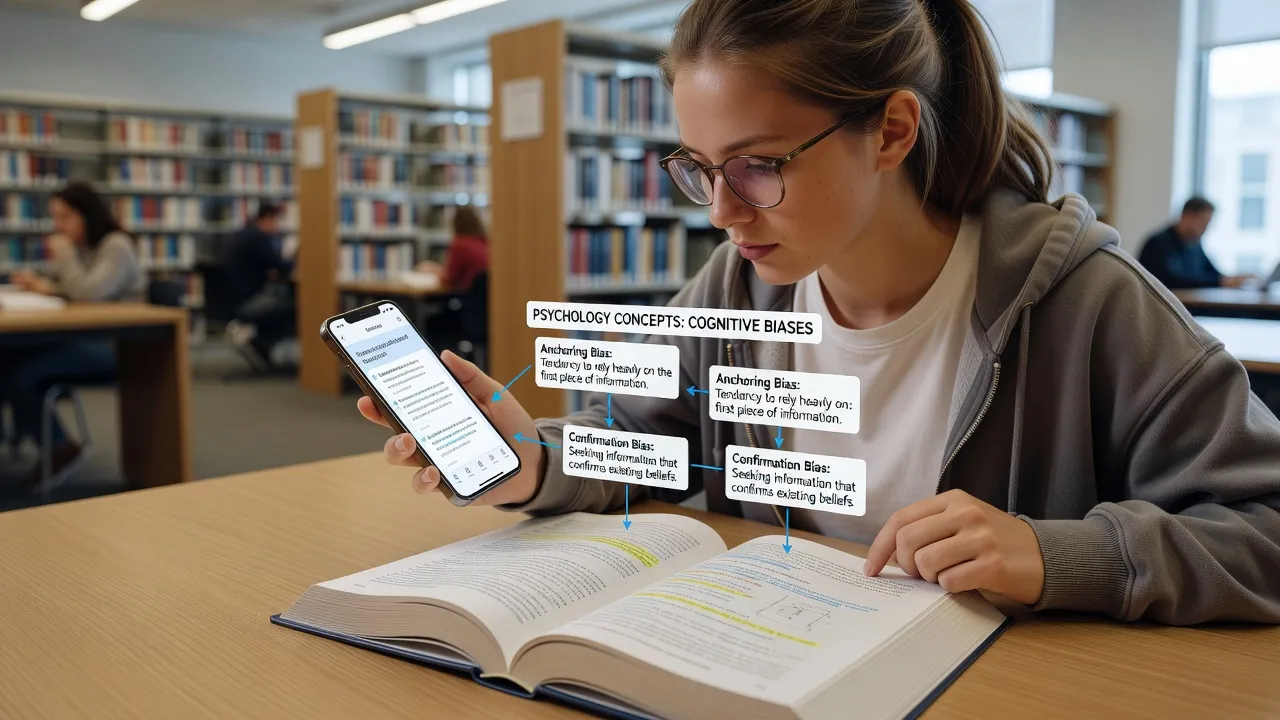
If you get stuck on a homework question about Pavlovian conditioning, ThinkAssist provides an immediate study solution. You can simply snap a photo of any textbook problem or exam study guide, and the app uses automatic subject detection to break down the underlying psychological concepts step by step.
Whether you need 24/7 tutoring support while reviewing late at night or want past answers saved for quick test preparation before midterms, downloading ThinkAssist on the App Store gives you an instant academic advantage. You can start with a 3-day free trial, with full unlimited access available for $6.99/week.
ThinkAssist Study Workflow
- Snap Photo
- Subject Detected
- Step-by-Step Answer
Features:
- Instant solution for conditioning diagrams & AP Psych FRQs
- Explanations saved automatically for fast test prep
Frequently Asked Questions
What is the simple definition of spontaneous recovery in psychology?
Spontaneous recovery is the unexpected reappearance of a previously extinguished learned behavior after a rest period without any new training sessions.
How does spontaneous recovery prove that extinction is not unlearning?
Because the extinguished response reappears without any new pairings of the conditioned stimulus and unconditioned stimulus, the original memory trace must have remained intact inside the brain during extinction.
What is a real life example of spontaneous recovery?
A real life example is a recovered dog that stopped barking at the doorbell after training, but suddenly barks at the doorbell again months later after hearing it for the first time in a long time.
How long does spontaneous recovery last?
Spontaneous recovery is typically short-lived. If the conditioned stimulus continues to appear without the unconditioned stimulus, the response undergoes extinction a second time much faster than it did originally.
What is the difference between renewal and spontaneous recovery?
Spontaneous recovery occurs due to the passage of time (a shift in temporal context), whereas renewal occurs due to a change in physical location or environment (a shift in spatial context).
Does spontaneous recovery occur in operant conditioning?
Yes, spontaneous recovery occurs in both classical conditioning and operant conditioning. In operant conditioning, an extinguished lever-press response by a rat will briefly return after a rest period away from the testing chamber.
Why is spontaneous recovery important in clinical therapy?
It warns therapists and patients that extinguished phobias, anxiety responses, or unhealthy habit loops can briefly return after treatment, requiring ongoing relapse-prevention strategies.