
Word problems in math multiplication translate written stories into mathematical equations where equal groups, scaled quantities, or arrays are combined. Solving them requires identifying the total number of groups, the quantity inside each group, and the unknown total value. When students learn to recognize these structural patterns rather than rely on misleading keywords, their accuracy increases dramatically.
To master these tasks, learners need targeted practice platforms, visual representation methods, and step-by-step decoding strategies. Below, we break down top educator recommendations, common learning scenarios, and practical tools to master word problems.
What are the best websites for multiplication word problems that teachers recommend?
Teachers widely recommend Khan Academy, Education.com, IXL, and K5 Learning for multiplication word problem practice. These platforms provide structured, standards-aligned problems that range from basic array modeling to complex multi-step scenarios.
When choosing a platform, the single variable that decides the right choice for a student is whether they need free foundational videos or adaptive, real-time feedback.
- Khan Academy offers completely free videos and practice sets organized by Common Core standards.
- IXL provides adaptive questions that adjust in difficulty as students submit answers.
- Education.com offers downloadable, printable worksheets tailored for elementary grades.
- K5 Learning provides free printable math worksheets with step-by-step answer keys for parents and teachers.

Is Khan Academy recommended for multiplication word problems?
Yes, Khan Academy is strongly recommended by educators for multiplication word problems because it provides free, video-supported practice tied to state standards. The platform breaks problems into clear visual models before transitioning to abstract standard equations.
Students can work through targeted modules such as "Multiply by tens word problems" or "Multi-step word problems involving multiplication." As of August 2026, Khan Academy remains entirely free with no subscription paywalls, making it an accessible choice for home and classroom use.
The platform also provides immediate hint sequences if a child gets stuck. This prevents students from guessing wildly when attempting tricky multi-step word scenarios.
Are Teachers Pay Teachers resources recommended for multiplication word problems?
Yes, Teachers Pay Teachers resources are recommended for teachers and parents who need customized, grade-specific printables and thematic word problem sets. Because the materials are created by active educators, they often include differentiated instruction tools and word bank keys.
You can find targeted resources on Teachers Pay Teachers for specific concepts like:
- Task cards for multi-digit multiplication word problems.
- Graphic organizers that force students to draw equal groups.
- Differentiated problem sets sorted by reading reading level.
- Seasonal story sets (such as back-to-school or holiday budgeting problems).
While individual downloads cost between $2.00 and $10.00, many educators publish free sample sheets. These are helpful when a student needs a specific format that standard textbooks omit.
Is IXL recommended for multiplication word problems?
Yes, IXL is recommended for multiplication word problems, especially for students who need adaptive skill practice and instant feedback. Its platform automatically adjusts question difficulty based on student performance.
If a student answers two questions incorrectly, IXL lowers the difficulty and breaks down the exact step where the mistake occurred. The platform covers micro-skills such as:
- Writing multiplication sentences for equal groups.
- Solving word problems with arrays and area models.
- Comparing quantities using multiplicative comparison ("3 times as many as").
- Multi-step word problems involving multiplication and addition.
IXL requires a paid subscription for full access, though users can answer a limited number of free practice questions daily.
Does Edutopia recommend resources for multiplication word problems?
Yes, Edutopia recommends research-backed pedagogical strategies and curated resource lists for teaching multiplication word problems. Rather than host direct drill worksheets, the site focuses on schema-based instruction and conceptual modeling.
Articles on Edutopia emphasize moving away from "keyword hunting" (like assuming the word "total" always means addition). Instead, Edutopia articles urge teachers to guide students through visual schema building.
In Edutopia's framework, students learn to recognize whether a problem represents:
- Equal groups (number of items per group * number of groups).
- Area or array models (rows * columns).
- Multiplicative comparison (base amount * multiplier factor).
Does Education.com offer recommended multiplication word problems worksheets?
Yes, Education.com offers hundreds of recommended multiplication word problem worksheets searchable by grade level and specific learning objective. Their library covers single-digit visual grouping up to multi-digit word scenarios.
Education.com allows parents and teachers to filter worksheets specifically for 3rd grade, 4th grade, and 5th grade math standards. As of August 2026, visitors can download a limited number of free worksheets per month before requiring a paid membership.
Many worksheets include visual themes, such as calculating items in a bakery or timing laps in a race. These real-world contexts help bridge abstract math with practical situations.
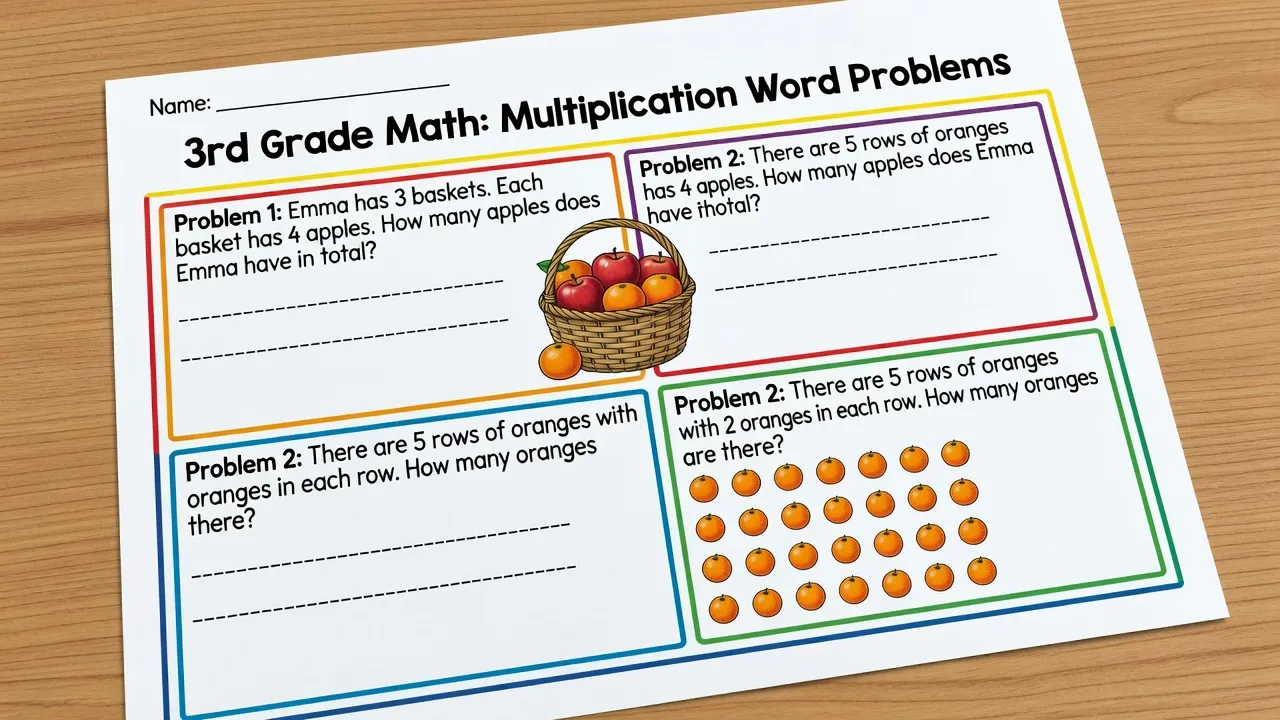
Scenario 1: When students struggle with multi-step word problems
Multi-step multiplication word problems require students to hold intermediate values in memory before performing a final calculation. These problems test logical sequencing just as much as arithmetic ability.
Consider this example: "A bakery packs 6 muffins in a box. They sell 8 boxes in the morning and 5 boxes in the afternoon. How many total muffins were sold?"
Step 1: Find total boxes sold (8 + 5 = 13 boxes)
Step 2: Multiply total boxes by muffins per box (13 * 6 = 78 muffins)
Alternatively, a student might calculate the morning and afternoon totals separately before adding them together:
Step 1: Morning muffins (8 * 6 = 48)
Step 2: Afternoon muffins (5 * 6 = 30)
Step 3: Total muffins (48 + 30 = 78)
The core blocker in multi-step questions is not the multiplication fact itself. It is figuring out what the intermediate number actually represents. If a student loses track of units, they will combine the wrong numbers.
When working through a complex multi-step scenario, students can also read more about how to solve word problems in math systematically using structured decoding frameworks.
Scenario 2: When visual learners need array and equal-groups models
Visual learners process multiplication word problems best when written text is translated into physical or drawn structures like arrays and tape diagrams. Text-only explanations often cause cognitive overload for these students.
An array model arranges items into rows and columns. This helps students visualize that 4 rows of 7 chairs equals 28 total chairs.
Row 1:  X  X  X  X  X  X  X  (7)
Row 2:  X  X  X  X  X  X  X  (7)
Row 3:  X  X  X  X  X  X  X  (7)
Row 4:  X  X  X  X  X  X  X  (7)
Total:  4 rows * 7 columns = 28
Tape diagrams (also called bar models) work equally well for multiplicative comparison problems. For example: "Leo has 5 trading cards. Maya has 4 times as many cards as Leo. How many cards does Maya have?"
Leo:  [ 5 ]
Maya: [ 5 ][ 5 ][ 5 ][ 5 ]
Equation: 5 * 4 = 20
Drawing these models prevents students from blindly guessing operations. It makes the relationship between the quantities explicit before writing any digits down.
Scenario 3: When distractor numbers create reading comprehension traps
Distractor numbers are extra numerical values included in a word problem that are irrelevant to the final calculation. Test writers deliberately include them to verify that a student actually understands the story.
Look at this common distractor scenario: "In a 4th-grade classroom with 24 students and 2 teachers, each student gets 3 notebooks. How many notebooks are handed out in total?"
- Relevant numbers: 24 students, 3 notebooks per student.
- Distractor number: 2 teachers.
A student who rushes will simply multiply all numbers together: 24 * 2 * 3 = 144 (incorrect).
The correct approach requires identifying the targeted unit:
- What are we looking for? Total notebooks for students.
- How many students? 24.
- How many notebooks per student? 3.
- Correct calculation: 24 * 3 = 72 notebooks.
To defeat distractor traps, students should cross out irrelevant facts during their first reading of the problem.
Scenario 4: When prepping for standardized tests under timed conditions
Standardized math assessments present multiplication word problems with dense text, varied sentence structures, and strict time limits. Students must quickly translate sentences into algebra without second-guessing their setup.
Under timed conditions, the main variable separating high scoring students from others is word recognition speed. Standardized tests frequently use phrasing like:
- "The product of..."
- "Each equal portion contains..."
- "Yielded a total rate of..."
- "Increased by a factor of..."
When reviewing under time pressure, practicing with a dedicated study helper or automated worksheet system builds confidence.
Students should practice identifying the core equation within 30 seconds of reading a item. If the setup takes longer than one minute, the student needs more practice with schema identification.

Scenario 5: When doing daily homework with non-standard phrasing
Daily homework assignments often mix different word problem structures, making it easy for students to confuse multiplication with inequality constraints or division. Students who rely on memory shortcuts often freeze when phrasing changes.
For example, compare these two non-standard problems:
- "Marcus has 3 times as many marbles as Liam. If Liam has 8 marbles, how many does Marcus have?" (Multiplication: 8 * 3 = 24)
- "Marcus has 24 marbles, which is 3 times as many as Liam. How many does Liam have?" (Division: 24 / 3 = 8)
Notice that both problems contain the exact phrase "3 times as many as." If a student relies solely on "times as many" as a trigger word to multiply, they will get the second problem wrong every time.
For more advanced algebra preparation, students often transition from basic story problems to solving a math inequality word problems worksheet, where understanding relationships between quantities becomes even more critical.
Comparing practice approaches for multiplication word problems
Choosing the right tool depends on whether a student needs printable offline drills, video guidance, or instant step-by-step resolution on demand.
| Learning Needs | What it Needs | Primary Challenge | Recommended Solution |
|---|---|---|---|
| Foundational Video Instruction | Visual explanation of equal groups and arrays | Student lacks conceptual understanding of multiplication | Khan Academy (Free video sequences) |
| Targeted Offline Drills | Printable sheets for physical paper practice | Student needs practice away from computer screens | Education.com / Teachers Pay Teachers |
| Instant Real-Time AI Support | Photo-based scanning with step-by-step logic breakdown | Student gets stuck at home without a tutor nearby | ThinkAssist (AI Homework Solver) |
| Adaptive Skill Practice | Automated difficulty scaling with immediate grading | Student gets bored by easy problems or frustrated by hard ones | IXL Math (Subscription platform) |
When students run into roadblocks outside of class hours, manual worksheets and video search can take too long. This is where modern mobile apps change how students review at home.
For instance, ThinkAssist functions as an AI-powered homework solver app designed as a 24/7 personal tutor. If a student is faced with a dense multi-step multiplication word problem late at night, they can simply snap a photo of their assignment.
By taking a picture of the textbook page or worksheet, ThinkAssist uses automatic subject detection to analyze the question setup. Rather than simply giving a blank final answer, it provides step-by-step explanations and solutions.
The app is available directly on the Apple App Store. It also saves past answers and explanations for easy exam prep, making it simple to review tricky multiplication structures right before a test.
Students who rely on a scan question and get answer app like ThinkAssist can work through stuck points immediately without having to wait for the next school day.
How to decode a multiplication word problem in 4 simple steps
To consistently solve multiplication word problems, students should follow a 4-step framework: Read, Schema, Equation, and Check. This protocol eliminates guess-work and builds repeatable math habits.
-
Read the problem carefully. Identify the question being asked.
-
Determine the Schema: Equal Groups, Array, or Comparison.
-
Write and Solve the Equation. Number of Groups × Size of Group = Total.
-
Check for Reasonableness. Does the total make sense in context?
-
Read and Annotate: Read the story twice. Circle the target question and underline the numbers connected to that question.
-
Identify the Schema: Ask, "Is this combining equal groups, measuring an array, or comparing quantities?"
-
Write the Equation: Set up
[Groups] * [Group Size] = [Total]. Make sure intermediate steps in multi-step problems are written separately. -
Check Reasonableness: Ask, "Does this answer make sense?" If you multiply 12 packages of 5 pencils and get 17 total pencils, the number is too small (you added instead of multiplied).
By practicing this step-by-step methodology, students build the reasoning skills needed to tackle word problems across all grade levels.
Frequently Asked Questions
What is the difference between additive and multiplicative word problems?
Additive word problems involve combining or separating distinct sets (such as adding 5 apples to 3 apples). Multiplicative word problems involve equal groups, scaling, or repeated quantities (such as buying 5 boxes that each contain 3 apples).
How do I help a child who knows multiplication facts but fails word problems?
Focus entirely on reading comprehension and visual modeling rather than math facts. Have the child draw arrays or equal group circles for the story before allowing them to write any numbers down.
Why shouldn't students rely solely on math key words?
Key words like "total" or "altogether" are often misleading because they appear in addition, multiplication, and multi-step problems alike. Relying on key words causes students to skip reading the actual context, leading to frequent errors on standardized tests.
What are equal groups in multiplication word problems?
Equal groups refer to sets that each contain the exact same number of items. For example, in "4 baskets with 6 eggs each," the baskets are the groups and the 6 eggs represent the group size.
How do multi-step multiplication word problems work?
Multi-step multiplication problems require solving one calculation first to find a missing value, then using that result in a second equation. They often combine multiplication with addition, subtraction, or division.
What age do kids start learning multiplication word problems?
Students typically begin simple equal-groups word problems in late 2nd grade, with formal multiplication word problem instruction accelerating throughout 3rd and 4th grade.
Can AI homework tools explain math word problems?
Yes, modern AI tools can read scanned text from a photo, break down the narrative structure of a word problem, and output a step-by-step logical explanation to show how the solution was derived.