
A literacy test is an administrative examination used to evaluate reading, writing, and comprehension skills, historically weaponized in the United States to disenfranchise Black voters before being banned by federal law. While modern literacy tests refer to standardized reading diagnostic tools in K-12 and adult education, the historical term specifically describes state-level voting qualifications designed to deny minority citizens access to the ballot box.
Understanding the legal definition and historical mechanics of literacy tests requires examining state voter suppression statutes, federal constitutional amendments, and modern educational reading assessments. As of September 2026, educational standards across AP US History and American Government curricula heavily emphasize how administrative barriers were structured to undermine democratic participation.
If you are working on history assignments or analyzing primary source documents for civics class, parsing dense legal texts can feel overwhelming. Tools like ThinkAssist serve as an AI-powered homework solver where students can snap a photo of historical legal excerpts or test questions to get step-by-step explanations and clear context.
What is the definition of a literacy test?
A literacy test is an assessment administered by a governing body or educational institution to determine an individual's ability to read, write, and comprehend written text. Depending on the context, the test can function either as a diagnostic tool for reading proficiency or as an administrative prerequisite for exercising legal rights.
In legal history, the definition carries a specific civil rights context. Southern state governments between 1890 and 1965 established voter literacy tests as mandatory prerequisites for voter registration.
Historical Literacy Test Framework
A state voting prerequisite branched into two parallel tests:
- State Constitution Test: Read complex statutory text verbatim to registrar
- Understanding Clause: Oral interpretation given to local election official
Both tests fed into registrar discretion, which determined pass/fail with no checks.
These examinations rarely measured functional reading capability. Instead, local registrars used complex constitutional passages and subjective scoring to ensure targeted failure rates among specific demographics.
In modern educational settings, literacy tests serve a completely different purpose. Schools use standardized literacy evaluations to benchmark student reading grade levels, identify learning differences like dyslexia, and tailor reading intervention programs.
What were literacy tests used for in voter suppression during Jim Crow?
During the Jim Crow era, literacy tests were used as a discriminatory voter suppression mechanism designed to systematically disenfranchise Black Americans while bypassing the Fifteenth Amendment. Because the Fifteenth Amendment prohibited states from denying voting rights explicitly based on race, Southern legislatures enacted facially neutral literacy requirements that local officials applied almost exclusively against Black citizens.
The legal architecture of Jim Crow voting restrictions relied on giving local voting registrars absolute discretion over how tests were conducted and evaluated.
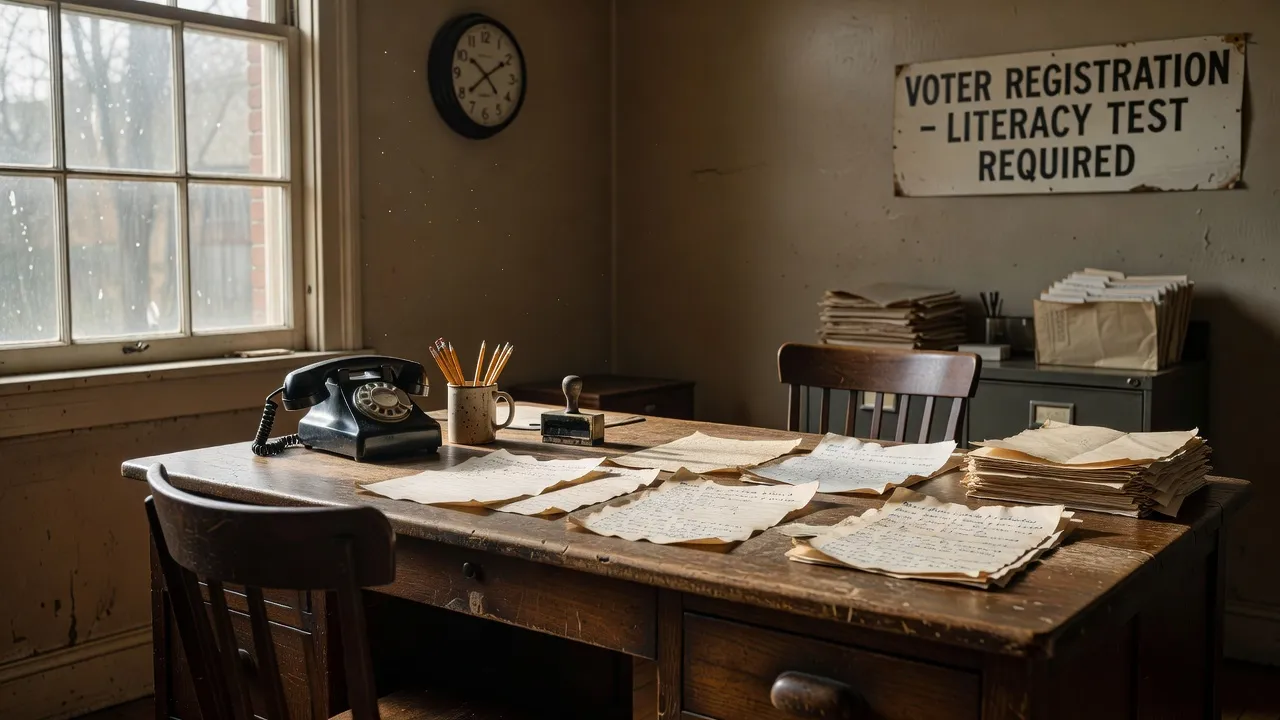
How did Southern registrars administer voter literacy tests?
Southern election registrars administered voter literacy tests by assigning impossibly difficult legal texts to Black applicants while giving simple sentences or complete exemptions to white applicants. Registrars maintained sole authority over passing grades, with no objective answer key or administrative appeal process.
Black applicants were routinely required to read and interpret long, technical excerpts from state constitutions or local tax codes. Common features of these suppressed tests included:
- Impossible questions: Test takers were asked to answer absurd prompts, such as "How many bubbles are in a bar of soap?" or "Name every county officer in the state of Florida."
- Strict time limits: Applicants were often given less than 10 minutes to complete multi-page statutory analysis sheets.
- Subjective grading: A single misplaced punctuation mark or minor verbal hesitation during oral reading was logged as an automatic failure.
According to historical archives preserved by the Library of Congress, these tests effectively reduced Black voter registration in states like Mississippi and Alabama to single-digit percentages by the mid-20th century.
What was the grandfather clause and how did it work?
The grandfather clause was a legal exemption created by Southern states that allowed illiterate white citizens to bypass literacy tests if their ancestors had the right to vote prior to 1867. This clause protected poor white voters who could not pass reading exams while ensuring Black citizens remained subject to testing barriers.
Because Black Americans were legally enslaved and denied voting rights before 1867, none could qualify for the grandfather clause exemption. The United States Supreme Court eventually declared grandfather clauses unconstitutional in Guinn v. United States (1915), but states quickly replaced them with alternative loopholes like "understanding clauses" and good character requirements.
How do literacy tests relate to the Voting Rights Act history?
Literacy tests are centrally linked to the Voting Rights Act of 1965 because the landmark law targeted and banned test-based voter qualification devices to enforce federal constitutional guarantees. Congress determined that incremental court battles against individual voting registrars were ineffective at overcoming deep-seated state discrimination.
When President Lyndon B. Johnson signed the Voting Rights Act (VRA) into law, it fundamentally altered state electoral authority by placing federal monitors in regions with a history of voting suppression.
| Year | Milestone |
|---|---|
| 1870 | Fifteenth Amendment Ratified |
| 1890 | Mississippi Adopts State Literacy Test System |
| 1915 | Guinn v. US Strikes Down Grandfather Clauses |
| 1965 | Voting Rights Act Passed; Literacy Tests Suspended |
Under Section 4(b) of the VRA, any jurisdiction that used a literacy test as of November 1964 and had less than 50% voter registration or turnout was automatically covered by federal oversight. Section 4(a) suspended the use of all literacy tests in those covered jurisdictions.
The statutory ban was challenged immediately by Southern states, but the Supreme Court upheld the federal government's authority to outlaw voter literacy tests in South Carolina v. Katzenbach (1966). The official documentation from the National Archives confirms that within two years of the VRA's passage, over 50% of eligible Black citizens in Southern states were registered to vote.
In 1970 and 1975, Congress extended the Voting Rights Act amendments to impose a permanent, nationwide ban on all literacy tests and similar qualification devices for public elections.
Comparison: Historical Voter Literacy Tests vs. Modern Educational Diagnostics
Understanding the difference between weaponized political testing and legitimate educational assessment is essential when researching educational policy or civil rights law.
| Evaluation Metric | Historical Voter Suppression Literacy Test | Modern Educational Literacy Diagnostic | ThinkAssist Study & Exam Analysis |
|---|---|---|---|
| Primary Goal | Deny voter registration and restrict democratic participation | Identify reading grade levels and support learning development | Help students break down complex reading passages and test logic |
| Target Audience | Targeted minority adult citizens seeking to vote | K-12 students, ESL learners, and adult literacy students | High school and college students prepping for exams |
| Scoring Standard | Arbitrary, unwritten standards controlled by local officials | Standardized, validated psychometric rubrics | Automated step-by-step logic breakdown |
| Legal Basis | Discriminatory state statutes passed during Jim Crow | Federal and state education standards (e.g., ESEA, IDEA) | Educational support utility for self-directed study |
| Outcome | Total disenfranchisement and denial of constitutional rights | Individualized instruction plans and reading support | Improved academic comprehension and exam readiness |
How are reading proficiency exams used in modern education?
Modern literacy tests are standardized diagnostic assessments designed to measure reading comprehension, vocabulary acquisition, and writing mechanics for academic placement rather than legal restriction. Unlike their historical namesakes, educational reading tests use empirically validated scoring systems to help teachers identify where a student needs support.
Educational institutions evaluate literacy across three core domains:
- Phonemic Awareness & Decoding: Testing a reader's ability to hear, identify, and manipulate vocal sounds and correlate them with written letters.
- Fluency & Vocabulary: Measuring the speed, accuracy, and word-recognition capacity of a student reading age-appropriate texts.
- Reading Comprehension: Evaluating how well a student synthesizes main ideas, infers context, and analyzes text structure.

When working through complex primary documents or preparing for exams that test these skills, students often encounter different types of writing that require specialized analysis techniques.
For students preparing for standardized AP tests or civics exams, using ThinkAssist makes review seamless. By taking a picture of any primary source excerpt or practice question, students receive instant, step-by-step explanations saved automatically in their exam prep folder for quick study breaks.
Why did state literacy tests fail the Equal Protection Clause?
State voter literacy tests violated the Equal Protection Clause of the Fourteenth Amendment because local authorities applied them with clear racial animus to deny equal voting rights to Black citizens. Although the text of state statutes often omitted explicit racial language, federal courts established that selective enforcement constituted intentional discrimination.
The constitutional breakdown of literacy tests centered on three legal flaws:
- Unbridled Discretion: Local election officers had unrestricted power to decide which citizens received difficult tests, violating procedural due process.
- Discriminatory Intent: Historical records demonstrated that state constitutional conventions openly adopted literacy tests to maintain white political supremacy.
- Unequal Enforcement: White applicants who failed or skipped tests were regularly passed by registrars under informal exemptions, while qualified Black applicants were rejected for minor errors.
In legal case law tracked by legal repositories like Oyez, the Supreme Court noted that when a state grants administrative officials standardless discretion over a fundamental right, that law is unconstitutional on its face.
If you are drafting an essay analyzing these legal arguments, reviewing a clear rhetorical analysis essay example can help you structure your breakdown of court opinions and constitutional claims effectively.
How to study and analyze primary sources on literacy tests
Studying primary sources on historical literacy tests requires analyzing original state registration applications, court testimony, and actual test sheets to evaluate the structural hurdles faced by voters. Historians and students use specific primary source protocols to extract historical facts without relying on second-hand summaries.
- Identify Context: Source, date, state jurisdiction, author
- Examine Mechanics: Language complexity, grading standards
- Synthesize Impact: Registration numbers and legal challenges
Each step feeds into the next step in sequence.
When evaluating a historical literacy test document for an essay or AP research project, follow these step-by-step steps:
- Verify the Source Origin: Determine which state or county drafted the test and what year it was administered (e.g., the infamous 1968 Louisiana Citizenship Test).
- Evaluate Question Feasibility: Read the questions literally to identify trick phrasing, ambiguous definitions, or missing correct choices.
- Compare Registration Data: Match the period when the test was active against voter participation figures published by local election offices.
- Organize Your Findings: Structure your analytical paper using a clear essay writing outline 5 paragraph layout to build a compelling argument.
If you hit a roadblock while writing your report late at night, having access to a 24/7 tutor powered by AI ensures you can get immediate clarity on historical terminology, legal definitions, and essay outlines whenever you need it.
Frequently Asked Questions
When were literacy tests first used for voting in the US?
Connecticut and Massachusetts adopted the first voter literacy tests in the 1850s to restrict voting rights for incoming European immigrants. Southern states later modified and expanded these testing frameworks during the 1890s specifically to disenfranchise Black voters following Reconstruction.
Are voter literacy tests legal in the United States today?
No, voter literacy tests are completely illegal in every U.S. state and territory. The federal Voting Rights Act of 1965 suspended them, and subsequent statutory amendments permanently banned all literacy tests and character exams as voter prerequisites.
Did white citizens have to take literacy tests during Jim Crow?
While the law officially applied to all citizens, white applicants were rarely subjected to rigorous testing. Registrars used grandfather clauses, informal oral waivers, and simple reading prompts to bypass testing rules for white registration candidates.
What is the difference between a literacy test and a citizenship test?
A historical voter literacy test evaluated reading comprehension and legal interpretation as a voting requirement within a state. A modern naturalization citizenship test is a federal exam evaluating English language basics and U.S. civics for immigrants seeking legal citizenship.
What court case banned voter literacy tests?
While Guinn v. United States (1915) struck down grandfather clauses, the Supreme Court case South Carolina v. Katzenbach (1966) officially upheld the Voting Rights Act of 1965, which suspended literacy tests nationwide. Later federal statutory amendments placed a permanent ban on all such exams.
How do educational literacy tests differ from historical voting tests?
Educational literacy tests measure reading grade levels to help teachers provide academic support and targeted instruction. Historical voting literacy tests were designed with ambiguous questions and subjective grading to prevent targeted populations from voting.